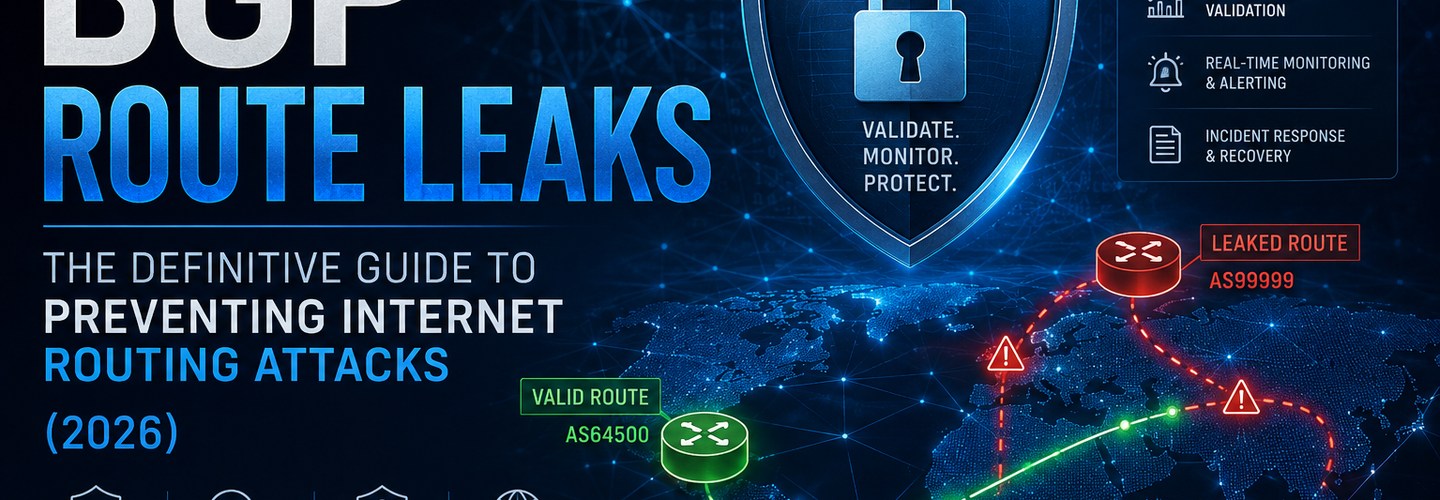
Securing BGP Route Leaks: The Definitive Guide to Preventing Internet Routing Attacks (2026)
Summarize this blog post with: ChatGPT | Perplexity | Claude | Grok
If you've been working in network engineering or enterprise security, you already know that BGP is the routing protocol holding the global internet together. What many teams overlook is that a single misconfigured router can leak routing announcements across the entire internet, redirecting traffic, silently exposing communications, or taking cloud services offline in minutes. In this guide, you'll learn exactly how BGP route leaks happen, why they are so dangerous to your infrastructure, and the practical security controls used by ISPs and enterprise network teams to prevent them.
## Key Takeaways
- ▸BGP route leaks occur when incorrect routing information is accidentally or intentionally propagated between autonomous systems beyond its intended network boundary.
- ▸Improper BGP route advertisements can cause global outages, traffic interception, latency spikes, and large-scale internet instability affecting millions of users simultaneously.
- ▸Route filtering, AS path validation, and max-prefix controls are foundational defenses against BGP route leaks and must be applied at every peering boundary.
- ▸RPKI is a cryptographic framework that validates whether an autonomous system is authorized to announce a specific IP prefix, significantly reducing unauthorized route propagation.
- ▸Continuous BGP monitoring enables organizations to detect abnormal route propagation before it causes widespread disruption across upstream providers and internet exchanges.
- ▸ISP operators and enterprise network teams should implement layered routing security policies rather than relying on a single mitigation method for long-term resilience.
- ▸Automated validation and threat intelligence integration improve long-term resilience against routing attacks and configuration mistakes across complex multi-AS environments.
## What Is a BGP Route Leak and How Does It Work?
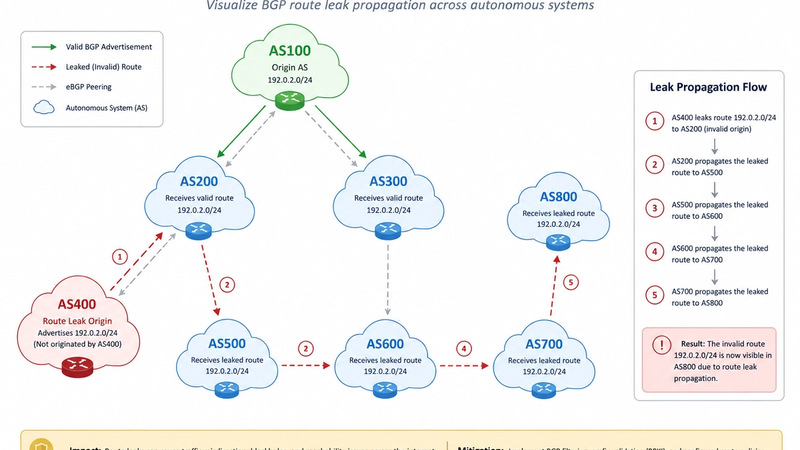
A BGP route leak is the unintended propagation of routing announcements beyond their intended network boundaries, causing routers around the world to forward traffic through an unauthorized or incorrect path. BGP — the Border Gateway Protocol — is the inter-domain routing protocol that autonomous systems (ASes) use to exchange reachability information across the internet. Every major ISP, cloud provider, and enterprise network is assigned an ASN (Autonomous System Number) and uses BGP to advertise the IP prefixes it is responsible for routing.
BGP relies on a trust-based routing model, which makes misconfigurations and malicious route advertisements difficult to prevent without dedicated validation mechanisms. When an AS receives a route from one peer and incorrectly re-advertises it to another peer — especially one in a different routing relationship — it creates a route leak. Think of it like a postal sorting facility accidentally re-routing parcels meant for a local delivery zone to an international shipping lane. The parcels are still moving, but they're going through the wrong channels, creating delays, exposure, and confusion.
For a concrete example: if an enterprise customer receives routes from its upstream ISP and then re-advertises those same full-table routes to another provider, that customer effectively becomes a transit point for global internet traffic — a role it is not equipped to handle and was never supposed to play. This exact scenario has caused some of the most disruptive internet outages in history.
Understanding the difference between a route leak and its more malicious cousin is essential. BGP hijacking involves a network deliberately claiming ownership of IP prefixes it does not control — often to intercept traffic. A BGP route leak, by contrast, is usually unintentional and involves legitimate prefixes being propagated through incorrect routing paths. For a deeper analysis of deliberate routing attacks, see our guide on BGP hijacking explained on the ReconShield Intel Feed.
## Why Are BGP Route Leaks Dangerous for Internet Infrastructure?
BGP route leaks are dangerous because they can instantly re-route massive volumes of internet traffic through unintended network paths, causing outages, interception, and latency spikes that affect millions of users globally. The impact is not limited to the leaking network — a single leak can cascade across dozens of upstream providers in seconds, affecting services that have no direct relationship with the responsible AS.
The financial and operational consequences are severe. According to Dyn Research, significant BGP events have caused measurable disruption to global connectivity for periods lasting from minutes to hours. The 2010 China Telecom incident re-routed approximately 15% of global internet traffic through Chinese networks for 18 minutes — Source: US-China Economic and Security Review Commission, 2010. In 2019, a routing leak by a small Pennsylvania ISP caused major traffic disruption for Cloudflare, Amazon, and Facebook for over two hours — Source: Cloudflare Blog, 2019.
Traffic interception risks are equally serious. When traffic routes through an unexpected AS, it passes through routers and network infrastructure that were never authorized to see it. For enterprise organizations, this means sensitive communications — API calls, authentication tokens, encrypted payloads — traverse networks outside their security perimeter. While encryption limits data exposure, the routing metadata itself reveals behavioral patterns that attackers can exploit.
National infrastructure and ISP impact cannot be overstated. The 2008 Pakistan Telecom incident demonstrated how a single misconfigured route advertisement took YouTube offline globally for approximately two hours. A Pakistani ISP issued a more-specific prefix for YouTube's IP space, and because BGP prefers more-specific routes, networks worldwide began routing YouTube-bound traffic into Pakistan Telecom's network — which had no connectivity to YouTube's actual servers. For a broader understanding of how internet-facing infrastructure exposure leads to incidents like this, the ReconShield Exposure Assessment Tool can help audit your own edge infrastructure against known misconfigurations.
Beyond outages, route leaks increase service latency by stretching the physical path traffic must travel. A connection that normally routes through two or three hops might suddenly traverse twenty, adding hundreds of milliseconds of delay. For real-time applications — VoIP, financial trading platforms, interactive video — this latency is operationally catastrophic.
## How Do BGP Route Leaks Happen?
BGP route leaks happen primarily because BGP was designed for trust and efficiency, not security — meaning routers accept and propagate route announcements from peers without any built-in cryptographic verification. The original BGP specification, formalized in RFC 1771, assumed that all participating autonomous systems were cooperative and correctly administered. This assumption has aged poorly as the internet scaled to accommodate millions of routes and thousands of independent operators with varying levels of routing expertise.
Misconfigured Routing Policies
Misconfigured routing policies are the most common root cause of BGP route leaks. When a network engineer sets up a peering session, they must explicitly define which routes are accepted from each peer and which routes are re-advertised. A missing or incorrectly applied route policy — even one line of BGP configuration — can result in full routing tables being propagated in the wrong direction. For example, failing to apply an outbound route filter on a customer-facing interface means every route learned from an upstream provider could be re-advertised back to all other customers. This is a transit leak, and it happens regularly.
Transit and Provider Relationship Errors
BGP routing relationships are defined by commercial agreements — customer, provider, and peer — and each relationship has strict rules about which routes should flow in which direction. A customer advertises its own prefixes to its provider. A provider advertises full or partial routing tables to its customers. Peers exchange only their own prefixes, not those learned from others. When an AS violates these valley-free routing principles — either by accident or misconfiguration — it creates the conditions for a route leak to propagate across the internet.
Human Operational Mistakes
Human error remains a leading cause. Changes to routing configurations during maintenance windows, automated scripts that apply incorrect policy templates, or operators working with unfamiliar equipment are all common triggers. BGP configuration changes take effect immediately — there is no staging environment or rollback preview. A mistake propagates in real time, and the impact is visible globally within seconds through BGP looking glass servers and route monitoring platforms.
You can verify your own DNS infrastructure configuration — a common companion attack surface — using the ReconShield DNS Lookup and Security Analysis tool, which audits SPF, DMARC, MX, and NS records that are often involved in multi-vector infrastructure attacks.
## What Are the Types of BGP Route Leaks?
BGP route leaks are classified into several distinct types based on their direction, scope, and cause — each requiring slightly different detection and mitigation approaches. Understanding the specific leak type affecting your network is essential before applying the correct remediation.
Accidental route leaks are the most common type. They result from misconfigured policies, incomplete filter lists, or operational mistakes. The 2019 Verizon/Allegheny Technologies leak — where a misconfigured router policy propagated a small ISP's routes to Verizon's global network — is a textbook example of an accidental leak causing cascading internet disruption.
Malicious route leaks are intentional. A threat actor who gains control of a BGP-speaking router, or who operates a rogue AS, can deliberately advertise prefixes to redirect traffic. These are frequently used in traffic interception campaigns targeting financial institutions and government networks.
Prefix hijacking occurs when an AS announces IP prefixes it does not legitimately own. Unlike a standard route leak (which involves legitimate prefixes traveling through unauthorized paths), a hijack claims false ownership. Prefix hijacking can be detected by comparing the originating AS against the legitimate owner registered in routing registries.
Route propagation leaks happen when a correctly originated route is re-advertised beyond its intended scope — for example, a peer route being re-advertised to a transit provider in violation of the routing relationship.
Lateral ISP leaks involve two ISPs at the same peering tier inadvertently forwarding each other's customer routes in violation of their peering agreements, often due to missing AS path filters at internet exchange points.
## How Can RPKI Help Prevent BGP Route Leaks?
RPKI — Resource Public Key Infrastructure — is a cryptographic framework that validates whether an autonomous system is authorized to announce a specific IP prefix, providing the first layer of mathematically verifiable trust in internet routing. Before RPKI, the only defense against unauthorized route announcements was manually maintained filter lists and routing registry lookups, which are slow to update and easy to misconfigure.
RPKI works through Route Origin Authorizations (ROAs) — digitally signed records that specify which ASN is permitted to originate a given IP prefix and at what maximum prefix length. These ROAs are issued by regional internet registries (ARIN, RIPE NCC, APNIC, LACNIC, AFRINIC) and validated by routers using a local RPKI cache validator. When a router receives a BGP announcement, it checks the announced prefix and originating AS against the ROA database. If the announcement is invalid — meaning the prefix doesn't match a valid ROA — the router can drop or de-prefer the route depending on its configured RPKI validation policy.
The RPKI validation workflow follows a clear sequence. First, a network operator creates ROAs for every IP prefix they originate, signed by the certificate authority at their regional registry. RPKI validators (software like Routinator, OctoRPKI, or FORT) fetch and validate the complete ROA database. BGP routers query the validator via RTR protocol and apply route origin validation to all received announcements. Routes with a "Valid" state are preferred. Routes with an "Invalid" state are either dropped (a strict policy) or assigned lower local preference (a softer policy).
The benefits of RPKI are significant. As of 2024, over 50% of internet routes are covered by ROAs, and RPKI adoption among tier-1 ISPs has reached a point where invalid routes are regularly dropped — Source: RIPE NCC RPKI Dashboard, 2024. Networks that drop RPKI-invalid routes act as a collective enforcement layer, progressively reducing the propagation distance of invalid announcements.
RPKI has real limitations. It validates route origin but does not validate the full AS path a route traverses. A leak involving a valid origin AS and a valid prefix — but routing through an incorrect intermediate AS — will still pass RPKI validation. This is why RPKI must be combined with additional controls like AS path filtering and IRR-based prefix filtering. For an actionable deployment checklist, see our RPKI deployment checklist in the ReconShield Intel Feed.
## What Are the Most Effective BGP Route Filtering Techniques?
BGP route filtering is the practice of restricting which prefixes and AS paths a router accepts or advertises to its peers — forming the primary operational defense against route leaks at each peering boundary. While RPKI addresses cryptographic origin validation, route filtering addresses the operational routing policy layer and catches leaks that RPKI cannot.
Prefix Filtering
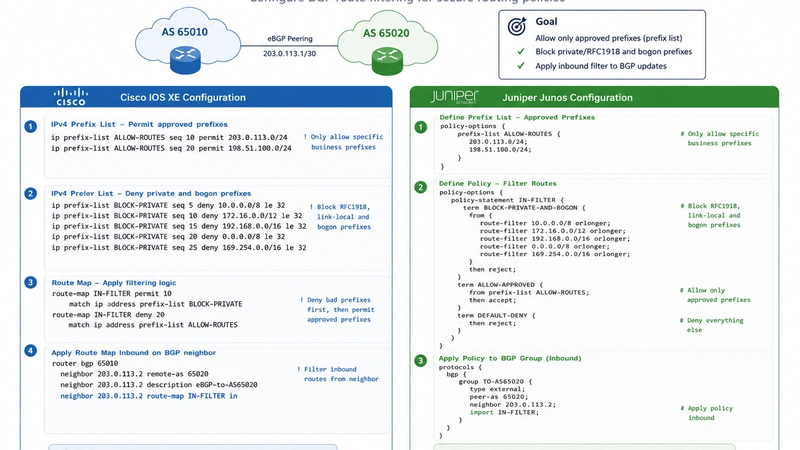
Prefix filtering involves creating explicit lists of IP prefixes that a router is permitted to accept from or advertise to a given peer. For a customer connection, the provider configures a strict inbound prefix filter that accepts only the customer's own registered prefixes — nothing more. Any announcement outside that list is discarded. This is the most direct way to prevent a customer from propagating routes it should not be originating or re-advertising.
Prefix filters should be generated from Internet Routing Registry (IRR) data. The IRR is a globally distributed database of routing policy objects — route objects, AS-SET objects, and aut-num objects — maintained by regional registries and network operators. Tools like bgpq4 can automatically generate prefix filter lists from IRR data, reducing the manual effort required to maintain accurate, up-to-date filters. You can audit your own domain's publicly exposed configuration objects using the ReconShield WHOIS Domain Intelligence tool, which queries modern RDAP endpoints to expose infrastructure attribution data.
AS Path Filtering
AS path filtering validates the sequence of autonomous systems a route has traversed before it reaches your router, allowing you to reject routes that passed through unexpected or unauthorized networks. A simple AS path filter for a customer session would reject any route whose AS path contains more than one ASN — because a direct customer should never be advertising routes it learned from a third party. More granular AS path filters can block routes that traverse known problematic ASNs or that exhibit unexpectedly long AS path lengths.
Max-Prefix Limits
Max-prefix limits help prevent routers from accepting excessive route advertisements that may indicate a route leak or configuration error. A max-prefix limit defines the maximum number of prefixes a router will accept from a given peer. If a peer suddenly advertises 50,000 prefixes when it normally advertises 200, the max-prefix limit triggers an alert or terminates the BGP session, preventing the leaked routes from propagating further. Most BGP implementations — Cisco IOS, Juniper Junos, FRRouting — support max-prefix limits natively and should have them configured on every peering session.
Route Policy Enforcement
Comprehensive route policy enforcement combines prefix filters, AS path filters, community-based routing, and max-prefix controls into a unified policy framework applied at every BGP session boundary. The goal is defense in depth: no single filter catches every type of leak, but layered controls ensure that most leaks are stopped at the source or within one or two AS hops. For a broader view of layered network security controls applicable to enterprise environments, our guide on internet infrastructure security best practices covers defense-in-depth frameworks for internet-facing assets.
## How Do ISPs Detect and Monitor BGP Route Leaks?
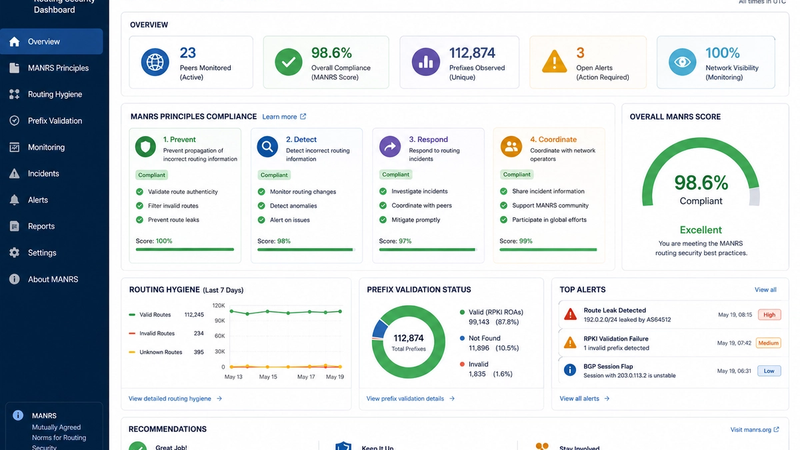
BGP monitoring tools analyze route propagation changes in real time to detect abnormal routing behavior and potential hijacking or leak events before they cascade globally. Passive monitoring is the most scalable approach — rather than probing the routing system, these tools observe BGP update feeds from route collectors positioned at internet exchange points worldwide.
Real-Time Route Monitoring Platforms
BGPStream is an open-source framework developed by CAIDA that provides access to live and historical BGP data from RouteViews and RIPE RIS route collectors. Security teams use BGPStream to build custom anomaly detectors that flag unexpected changes in prefix origins, AS path lengths, or route withdrawal patterns.
RIPE RIS (Routing Information Service) operates a network of route collectors across more than 20 internet exchange points globally, collecting full BGP table dumps and real-time update feeds. RIS data is freely accessible via API and is used by academic researchers and operational security teams alike to investigate routing events.
RouteViews is a University of Oregon project that has been collecting BGP routing table data from hundreds of peers since 1997. RouteViews archives provide invaluable historical routing data for post-incident analysis and trend investigation.
Cloudflare Radar provides a public-facing dashboard of BGP routing health, including real-time visibility into route leak events, RPKI invalid announcements, and AS-level internet outages. It is one of the most accessible monitoring interfaces for security teams without direct access to BGP infrastructure.
OpenBMP (Open BGP Monitoring Protocol) is an open-source implementation of RFC 7854 that enables operators to collect and store BMP telemetry from their own BGP routers directly. This provides inside-out monitoring visibility that external route collectors cannot offer.
For threat intelligence correlation — enriching BGP anomaly data with IOC feeds and known malicious ASNs — see our Beginner's Guide to Threat Intelligence and IOC Analysis for a full breakdown of how to integrate external threat data into security monitoring workflows.
IP Reputation and ASN Intelligence
Cross-referencing suspicious ASNs against threat intelligence feeds is an effective supplementary monitoring strategy. The ReconShield IP Reputation Intelligence tool cross-references IP addresses and ASNs against global threat feeds, providing risk scores and identifying ASNs associated with known malicious activity — a practical first step when investigating a suspicious BGP announcement from an unfamiliar AS.
Alerting and SIEM Integration
Effective BGP monitoring requires automated alerting. Raw BGP data streams must be parsed, filtered, and correlated to produce actionable alerts. Most teams ingest BGP monitoring data into their SIEM platforms via syslog or API connectors, where routing anomaly events are correlated with firewall logs, DNS query data, and endpoint telemetry. For organizations building SIEM correlation rules for network-layer threats, SIEM integration for network monitoring is covered in depth in our ReconShield Intel Feed.
## Which Real-World BGP Route Leak Incidents Changed Internet Security?
Real-world BGP route leak incidents have repeatedly demonstrated that even brief routing disruptions can cause global-scale service outages, traffic redirection, and lasting erosion of trust in internet routing infrastructure. Each major incident has driven adoption of new security standards and monitoring practices.
The Pakistan Telecom YouTube Incident (2008)
In February 2008, Pakistan Telecom announced a more-specific prefix for YouTube's IP space (208.65.153.0/24) as part of a government-ordered blocking directive. Because BGP prefers more-specific routes, routers around the world began sending YouTube-bound traffic to Pakistan Telecom — which had no path to YouTube's actual servers. YouTube was unreachable globally for approximately two hours. This incident directly accelerated discussions about route origin validation and the eventual development of the RPKI standard.
The Google BGP Leak (2017)
In August 2017, a Nigerian ISP (MainOne) incorrectly re-advertised Google's prefixes to China Telecom, which then propagated them to its global routing table. As a result, traffic destined for Google services was briefly routed through China Telecom's network. The incident lasted approximately 74 minutes and affected Google search, G Suite, and other services for users across multiple continents — Source: BGPMon / ThousandEyes, 2017.
The Verizon Route Leak (2019)
In June 2019, a small Pennsylvania ISP (Allegheny Technologies) advertised a misconfigured routing policy to Cloudflare, which then propagated approximately 20,000 routes to Verizon. Verizon, lacking adequate max-prefix controls, accepted and propagated the leaked routes, causing major disruptions to Cloudflare, Amazon, and Facebook services for over two hours — Source: Cloudflare Blog, 2019. This incident highlighted the critical importance of max-prefix limits at every BGP peering boundary.
For historical context on how threat actors learn from infrastructure incidents to build more targeted attacks, our analysis of real-world cybersecurity incident case studies demonstrates the operational lessons derived from major internet infrastructure events.
## What Tools Are Best for BGP Security Monitoring and Validation?
The best BGP security monitoring platforms combine real-time route observation, historical data access, and automated alerting to give network operators complete visibility into routing anomalies across the global internet. No single tool provides complete coverage — effective BGP security requires a layered toolset spanning route collection, RPKI validation, and threat intelligence enrichment.
MANRS (Mutually Agreed Norms for Routing Security) is not a tool but a global initiative coordinated by the Internet Society that defines four concrete routing security actions: filtering, anti-spoofing, coordination, and global validation. Network operators who join MANRS commit to implementing these actions and undergo public validation. MANRS participation is increasingly becoming a requirement for peering relationships at major internet exchanges.
Routinator is a free, open-source RPKI validator developed by NLnet Labs that runs locally on your network, fetches ROA data from all five regional registries, and serves validated RPKI data to your BGP routers via the RTR protocol. It is the most widely deployed RPKI validator among ISPs and enterprise network operators.
bgpq4 is a command-line tool that queries IRR databases and automatically generates prefix filter lists and AS path access lists in the native syntax of Cisco, Juniper, and other router platforms. Using bgpq4 to automate filter generation ensures that prefix filters are always up to date with current IRR registrations without manual intervention.
Cisco and Juniper both provide native routing security features including RPKI RTR client support, prefix list filtering, AS path access lists, and BGP maximum-prefix limits. Cisco's BGP prefix-list and route-map framework and Juniper's routing policy framework are the two most widely deployed BGP policy engines in enterprise and ISP networks.
To audit whether your web-facing infrastructure is exposing security configuration gaps alongside your routing infrastructure, the ReconShield Security Headers Auditor checks your Content-Security-Policy and HSTS headers — a common companion vulnerability in organizations that focus on network layer security but neglect application layer controls.
Additionally, validating your SSL/TLS cipher suites and certificate chain alongside BGP security hardening is good operational hygiene. The ReconShield SSL/TLS Crypto Checker audits cryptographic trust chains and identifies weak cipher suites across your internet-facing infrastructure.
## What Are the Best Practices for Securing BGP Routing Infrastructure?
Securing BGP routing infrastructure requires a layered, policy-driven approach that combines cryptographic validation, operational filtering, continuous monitoring, and structured incident response procedures applied consistently across every peering relationship. No single control is sufficient on its own.
Implement RPKI With a Drop-Invalid Policy
Deploy RPKI validation on all BGP-speaking routers and configure a drop-invalid policy for routes with RPKI-invalid status. A drop-invalid policy means your routers will not install or propagate routes that are cryptographically invalid according to current ROA data. This requires running a local RPKI validator (Routinator, FORT, or OctoRPKI) connected to your routers via RTR. Additionally, create ROAs for every IP prefix your organization originates to protect your prefixes from being hijacked by others.
Apply IRR-Based Prefix Filters on Every Session
Generate prefix filter lists from IRR data for every BGP customer and peer session. Use bgpq4 to automate filter generation and configure a process to refresh filters regularly — at minimum monthly, and ideally triggered automatically when IRR objects for a peer are updated. Apply strict inbound filters on customer sessions that accept only the customer's registered prefixes and outbound filters on provider sessions that advertise only your organization's legitimate prefixes.
Configure Max-Prefix Limits on All Peering Sessions
Set max-prefix limits on every BGP session based on the expected route count for that peer. For customer sessions, set limits slightly above the customer's registered prefix count. For provider sessions, set limits at a percentage of the full routing table appropriate to the expected session type. Configure routers to log and alert when limits are approached (at 80% of the threshold) and to terminate the session when exceeded, preventing a route leak from propagating into your network.
Establish a BGP Incident Response Plan
A BGP incident response plan defines the specific steps your team takes when a route leak is detected — whether your network is the source or is receiving leaked routes from a peer. The plan should include contact information for upstream providers and peering partners, escalation paths to your NOC and security teams, a procedure for withdrawing leaked prefixes or dropping sessions, and post-incident analysis requirements. Many organizations practicing strong network threat intelligence strategies integrate BGP anomaly detection directly into their SOC workflows, enabling faster escalation during routing incidents.
Conduct Regular Routing Audits
Audit your BGP configuration, IRR registrations, and ROA coverage at least quarterly. Verify that every prefix your organization announces has a valid ROA. Check that all IRR route objects are up to date and match your current routing policy. Review max-prefix limits and prefix filter lists for accuracy. For organizations managing large numbers of internet-facing assets, the ReconShield Port Scanner can help map exposed network services that may be directly affected by routing disruptions caused by BGP leaks.
## What Is the Future of BGP Security and Route Validation?
The future of BGP security lies in the progressive automation of route validation, broader adoption of cryptographic controls, and integration of AI-driven anomaly detection into routing infrastructure — moving the internet toward a state where invalid routing announcements are automatically rejected rather than manually investigated. The foundational standards are in place; what remains is global adoption and enforcement.
Global RPKI Adoption Acceleration
RPKI adoption has accelerated significantly since 2020. As of 2024, over 50% of global BGP routes are covered by ROAs, and the percentage of networks dropping RPKI-invalid routes has increased from under 10% in 2018 to over 40% in 2024 — Source: RIPE NCC, 2024. Major hyperscalers — Google, Amazon, Meta, Cloudflare — have all implemented drop-invalid policies, creating a powerful incentive for ISPs to follow. As more tier-1 networks adopt strict validation, the propagation distance of invalid announcements shrinks, limiting their real-world impact.
BGPsec and AS Path Validation
BGPsec is a proposed extension to BGP that cryptographically signs the AS path — not just the route origin — preventing route leaks that involve valid prefixes traversing unauthorized intermediate networks. Unlike RPKI, which validates only the originating AS, BGPsec validates every AS hop in the path. Deployment remains limited due to the performance overhead of cryptographic path signing at internet scale, but ongoing research and hardware improvements are making BGPsec progressively more feasible for wide deployment.
AI-Driven Anomaly Detection
Machine learning is being applied to BGP monitoring data to improve the speed and accuracy of route leak detection. Traditional threshold-based alerts — triggered by sudden changes in prefix counts or AS path lengths — generate significant false positives. AI models trained on historical BGP data can distinguish between expected routing changes (network maintenance, traffic engineering) and genuine anomalies (route leaks, hijacks) with higher precision. For a broader perspective on how AI is reshaping defensive security operations beyond BGP, see our research on AI cybersecurity intelligence and its implications for SOC automation.
Zero-Trust Principles Applied to Routing
Zero-trust networking principles — verifying every connection request regardless of source — are being adapted for routing security through the concept of zero-trust BGP. Under this model, no routing announcement is trusted by default. Every prefix and AS path must be validated against authoritative cryptographic sources before being installed in the routing table. This extends beyond RPKI to include BGPsec, IRR validation, and behavioral anomaly detection working in concert. The principles align closely with zero trust networking principles that are already widely adopted at the application and identity layers of enterprise security architecture.
## Conclusion
BGP route leaks remain one of the most underestimated threats to internet infrastructure — not because they are technically complex to understand, but because the tools to prevent them require disciplined, organization-wide commitment to implement and maintain. Securing BGP routing infrastructure is not a one-time project; it is an ongoing operational discipline.
The practical path forward is clear. Deploy RPKI with a drop-invalid policy and create ROAs for every prefix you originate. Apply IRR-based prefix filters on every BGP session. Configure max-prefix limits without exception. Monitor BGP routing data continuously with real-time alerting. Join MANRS and hold your peers to the same standards. And when an incident occurs — because at some point it will — have a tested incident response plan ready to execute in minutes, not hours.
The organizations that invest in layered routing security today are the ones that avoid being the next incident case study. Audit your routing infrastructure now, close the gaps, and contribute to a more secure global internet — one correctly configured BGP session at a time. Begin your infrastructure exposure assessment at ReconShield's passive diagnostics suite to identify surface-level gaps alongside your routing hardening initiative.
Written by Surendra Reddy Cybersecurity Researcher & Founder, ReconShield. Surendra is a cybersecurity engineer specializing in Open Source Intelligence (OSINT), exposure intelligence, and AI-driven threat analysis. He built ReconShield to democratize access to enterprise-grade infrastructure visibility tools and secure the digital internet-facing assets.
Reviewed by ReconShield Editorial Team — Peer-reviewed for technical accuracy, routing policy correctness, and operational applicability against current BGP security standards.
## Analyst Commentary & Implementation Blueprint
Security advisory
BGP route security remains the Achilles' heel of core internet routing. Rogue route advertisements can redirect enterprise traffic through adversarial infrastructure, enabling man-in-the-middle attacks. Security analysts must verify BGP path logs, configure explicit neighbor maps, and deploy RPKI certificates.
BGP Route Map Validation Configuration
! Cisco IOS Route Map to Filter Unauthorized Prefixes
ip prefix-list BLOCK-LEAKS seq 5 deny 0.0.0.0/0 le 32
route-map RECONSHIELD-INBOUND permit 10
 match ip address prefix-list BLOCK-LEAKS
 set local-preference 200
Actionable Mitigation Checklist
- ✔Deploy RPKI origin validation across all core routers.
- ✔Configure explicit route filters for peer BGP sessions.
- ✔Enable automated routing anomaly alerts via third-party monitor networks.
Common Inquiries & FAQs
What is the difference between BGP route leaks and hijacking?
A route leak is generally an accidental propagation of routing information beyond its intended scope, while hijacking is the deliberate falsification of IP ownership advertisements.
How does RPKI solve BGP vulnerabilities?
Resource Public Key Infrastructure (RPKI) links an IP address block to an authorized Autonomous System Number (ASN) using cryptographic certs, allowing routers to reject invalid routes.
Surendra Reddy
Surendra Reddy is a cybersecurity researcher and founder of ReconShield, specializing in OSINT and defensive infrastructure analysis.
Connect on LinkedIn ↗// AUDIT BRIEFING DISCUSSION (2 COMMENTS)
Great breakdown of the passive infrastructure vectors. We recently audited our external DNS zones and found multiple dangling staging environments. Implementing wildcard certificates reduced our CT log leaks significantly.
Is there any automated tooling you recommend for daily crt.sh scraping? Manually checking CT logs is becoming unsustainable for our domain portfolio.
// MORE ARTICLES
SplitVPN Hacked: Data Breach Exposes 865,000 User Records and 58 Million Hidden Connection Logs (July 2026)
SplitVPN hacked: 865,336 user records and 58 million connection logs exposed, directly contradicting the VPN's "no-logs" promise. What was leaked and what to do now.

Critical WordPress wp2shell RCE Vulnerability Puts Millions of Sites at Risk—Patch Now
wp2shell is a pre-auth RCE in WordPress Core affecting 500M+ sites. Public exploits exist—patch to 7.0.2 or 6.9.5 immediately.
New Windows RDP Flaws Could Lead to Data Theft — Everything You Need to Know
Microsoft patched a dozen Windows RDP flaws in July 2026 that could leak memory data. See affected versions, KB numbers, and how to patch.