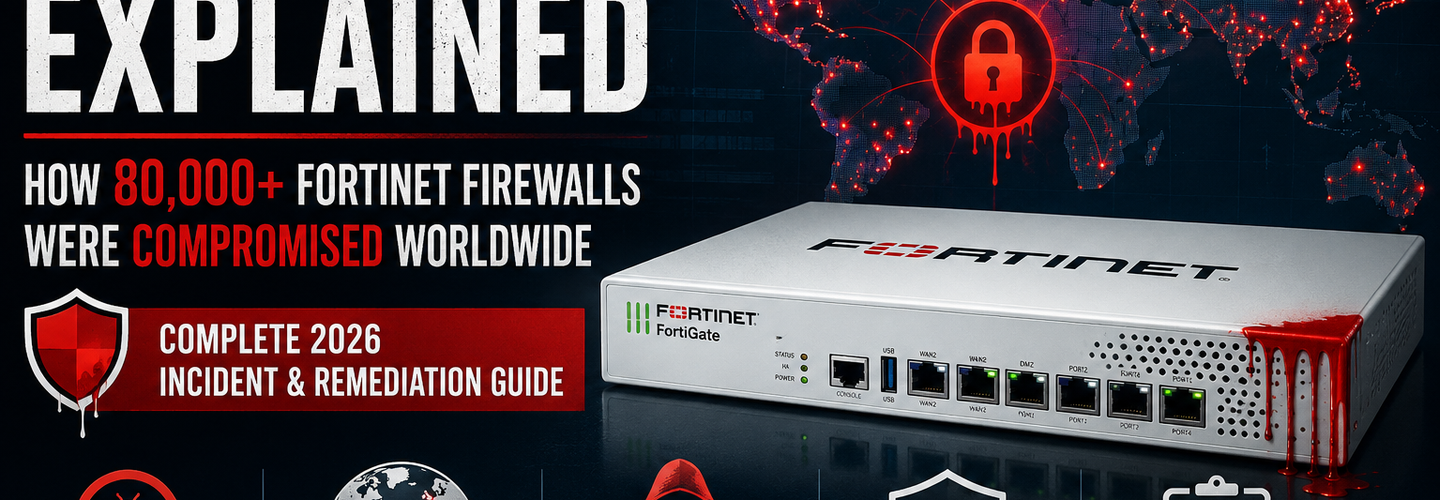
FortiBleed Explained: How 80,000+ Fortinet Firewalls Were Compromised Worldwide (Complete 2026 Incident & Remediation Guide)
Summarize this blog post with: ChatGPT | Perplexity | Claude | Grok
Most organizations trust their firewalls to serve as the first line of defense against cyber threats. However, the FortiBleed incident revealed how a single exposed credential set can transform that protective barrier into an attacker's entry point. In this guide, you'll learn how tens of thousands of Fortinet firewalls were compromised, how the attack unfolded, and exactly what your team can do to prevent a similar breach.
## Key Takeaways
▸ FortiBleed is a large-scale credential-exposure campaign that surfaced in mid-June 2026, exposing login data for internet-facing Fortinet firewalls across 194 countries.
▸ Firewall vulnerabilities can hand attackers direct access to sensitive credentials, VPN tunnels, and internal network infrastructure.
▸ Effective vulnerability management significantly reduces an organization's exposure to large-scale exploitation campaigns like this one.
▸ Indicators of compromise help teams identify whether their devices were targeted, accessed, or fully breached.
▸ Timely patching, credential rotation, and configuration audits are the essential remediation measures after exposure.
▸ Perimeter devices should be monitored continuously, because a compromised firewall is more dangerous than no firewall at all.
▸ Defense-in-depth is the clearest lesson of FortiBleed, since multiple security layers limit the damage from any single point of failure.
## What Is FortiBleed and Why Is It Important?
FortiBleed is a large-scale cybersecurity incident involving the compromise of tens of thousands of Fortinet firewall devices through the exposure of stolen administrator and VPN credentials. The dataset began circulating in cybercriminal communities in mid-June 2026 and was first detailed by security researcher Volodymyr "Bob" Diachenko after the attackers accidentally exposed their own server.
To be precise, FortiBleed is not a single Heartbleed-style memory bug or one fresh zero-day. Instead, it is an aggregated trove of validated SSL VPN logins, plaintext passwords, and configuration exports harvested from internet-facing FortiGate appliances. For example, security researcher Kevin Beaumont confirmed that sampled logins were real and that the data clearly came from device configuration exports.
The numbers explain the global alarm. CISA reported that the activity exposed leaked credentials for approximately 74,000 Fortinet devices — Source: CISA, 2026. Separately, Hudson Rock researchers documented 73,932 unique firewall URLs across 194 countries, while other outlets reported figures as high as 75,000 from a pool of more than 320,000 probed appliances — Source: Hudson Rock / TechRadar, 2026. A firewall compromise occurs when attackers gain unauthorized access to security infrastructure that is designed to protect network boundaries.
A Quick Timeline of the FortiBleed Incident
The FortiBleed dataset entered public awareness over a single weekend in mid-June 2026, then spread across major security outlets within 48 hours. Diachenko raised the alarm first, multiple vendors corroborated portions of the data, and CISA issued a hardening advisory on June 18, 2026.
Importantly, the campaign behind it is far older than the leak date. Investigators describe a long-running credential-cracking operation powered by a 45-GPU cluster, which points to months of brute-force and hash-harvesting work before the trove ever became public.
## Why Does the FortiBleed Breach Matter for Every Organization?
The FortiBleed breach matters because a firewall compromise grants attackers a foothold at the exact point your network trusts most. Perimeter devices terminate VPNs, enforce access rules, and store privileged credentials, so their exposure undermines the entire security model in one move.
First, consider the enterprise impact. A valid FortiGate admin or VPN credential lets an attacker bypass perimeter defenses entirely, then move laterally toward domain controllers, file shares, and backups. For example, at least four organizations across Japan, Taiwan/Vietnam, Iraq, and Turkey were reportedly fully compromised — including a Turkish NATO defense contractor whose classified documents were exfiltrated — Source: SecurityDiscovery.com, 2026.
Second, there is the firewall trust problem. When the device meant to inspect traffic is itself controlled by an adversary, logging, alerting, and segmentation can all be quietly weakened. To map your own exposure inside a structured model, review our cybersecurity risk assessment framework before assuming your perimeter is safe.
## How Did Attackers Compromise More Than 70,000 Fortinet Firewalls?
Attackers compromised the firewalls through a sustained credential-harvesting campaign that combined brute-force attacks, SSL VPN hash cracking, and credentials recycled from earlier FortiOS vulnerabilities. No single magic exploit explains the full dataset, which is what makes it so dangerous to defenders.
The FortiBleed Attack Chain
The attack chain followed four repeatable stages that scaled across hundreds of thousands of devices. Each stage fed the next, producing a verified list of working logins.
- ▸Discovery: Attackers used internet-wide scanning to fingerprint exposed FortiGate management and SSL VPN portals. To understand this reconnaissance step in depth, see how port scanning works.
- ▸Credential acquisition: They intercepted SSL VPN authentication hashes and cracked them on a 45-GPU cluster managed through Hashtopolis, while folding in passwords leaked during prior incidents.
- ▸Validation: Automated tooling tested each credential to confirm which logins still worked, producing a verified subset.
- ▸Aggregation: The validated credentials and configuration data were compiled into one searchable dataset.
For scale, researchers observed roughly 1.1 billion credential attempts against more than 320,000 FortiGate instances during the campaign — Source: TechRadar, 2026. Rapid patch deployment significantly reduces the window of opportunity available to threat actors exploiting known vulnerabilities, yet credential reuse meant even patched devices stayed exposed.
How Credentials Were Exposed and Weaponized
The core weakness was how some FortiGate devices stored passwords, not just how they were exposed to the internet. Fortinet strengthened its hashing in early 2025 by switching to PBKDF2 with randomized salt, but many appliances still used the older, crack-resistant-but-weaker SHA-256-with-salt method.
As such, an attacker who pulled a configuration export could crack those older hashes offline and reuse them against Active Directory. This is why credential theft attack patterns now drive the largest perimeter breaches. Credential rotation involves replacing potentially exposed authentication credentials to prevent unauthorized access after a security incident.
## Which Fortinet Products Were Affected by FortiBleed?
FortiBleed primarily affects internet-facing FortiGate firewalls and SSL VPN gateways running older or unpatched FortiOS builds, especially devices that never rotated credentials after earlier flaws. Because the dataset is credential-driven, exposure correlates with weak password hygiene more than with one specific firmware number.
That said, the highest-risk profile is clear. Any FortiGate device with a publicly reachable admin interface or VPN portal and stale credentials should be treated as potentially exposed — particularly appliances tied to known issues such as CVE-2022-40684, CVE-2023-27997 (XORtigate), and CVE-2024-55591. For a related Fortinet flaw, review our analysis of the FortiSandbox critical vulnerability (CVE-2026-39808).
Geographic Spread and Industries Impacted
The exposure is global, spanning 194 countries and many of the world's largest enterprises and government agencies. Affected organizations reportedly include Samsung, Siemens, Foxconn, Oracle, Accenture, DHL, Infosys, and Fortinet itself, alongside critical-infrastructure operators.
To check whether your own public IP ranges or hostnames appear in suspicious infrastructure, start with our IP lookup tool and a DNS lookup to map what you expose. Indicators of compromise are forensic artifacts, log entries, or behavioral anomalies that suggest a system may have been breached.
## What Indicators of Compromise Should Security Teams Look For?
The most useful FortiBleed indicators of compromise center on authentication anomalies and configuration drift on the firewall itself. Credential theft rarely looks dramatic; it usually looks like a normal login from the wrong place.
Watch for these patterns across your FortiGate logs:
- ▸Admin or VPN logins from unfamiliar countries, hosting-provider ranges, or anonymizing infrastructure.
- ▸New or modified local accounts, especially admin-level users you did not create.
- ▸Unexpected configuration changes, such as altered firewall policies, new port forwards, or disabled logging.
- ▸VPN sessions outside business hours or from impossible-travel locations.
- ▸Cleared or disabled logs, which often signal an attacker covering their tracks.
For example, a single SSL VPN login from a residential proxy IP immediately followed by an internal RDP connection is a strong compromise signal. To build a repeatable detection process, follow our guide on how to identify indicators of compromise. By baselining normal behavior first, you can spot the gap between what should happen and what actually did.
## How Can Organizations Detect and Mitigate FortiBleed?
Organizations mitigate FortiBleed by rotating all credentials, applying the latest FortiOS patches, restricting management access, and hunting for compromise indicators — in that order of urgency. Speed matters because exposed credentials are actively traded.
Step 1: Rotate Credentials and Enforce MFA
Reset every administrator, local user, and SSL VPN credential on affected devices immediately. Because FortiBleed is credential-driven, a patched firewall with an unchanged password is still wide open. In addition, enforce multi-factor authentication on all VPN and admin access, and log in once to force the device to re-hash passwords using the stronger PBKDF2 standard.
Step 2: Patch and Verify
Timely patching remains one of the most effective defenses against known exploitation campaigns. Update to the latest FortiOS release, then verify the build number rather than assuming the update applied. For context on disciplined update cycles, see our breakdown of the security patch management process.
Step 3: Harden the Attack Surface
Firewall hardening reduces the attack surface through secure configuration, access controls, and continuous monitoring. Practically, remove public exposure of the management interface, restrict admin access to allowlisted IPs, and disable unused services. You can confirm what you expose with our port scanner and reduce blind spots using our enterprise firewall hardening checklist.
Step 4: Segment, Monitor, and Audit
Network segmentation limits how far an attacker can travel after breaching the perimeter. For example, isolating VPN users into a restricted zone prevents one stolen credential from reaching domain controllers. Pair segmentation with Fortinet vulnerability management best practices so new exposures surface in days, not quarters.
## What Security Lessons Can Be Learned from FortiBleed?
The clearest lesson from FortiBleed is that perimeter devices are now primary targets and must be defended with the same rigor as a domain controller. A firewall is no longer a "set and forget" appliance.
First, patching alone is never enough when credentials are involved — rotation and MFA must accompany every update. Second, defense-in-depth is a cybersecurity strategy that uses multiple layers of security controls to reduce the impact of a single point of failure, which is exactly what limits lateral movement here. Third, a Zero Trust posture that verifies every session shrinks the value of any single stolen credential. For a structured recovery and resilience model, explore our incident response and zero trust architecture implementation playbook.
## How Does FortiBleed Compare to Other Major Firewall Breaches?
FortiBleed differs from classic firewall vulnerabilities because it is an aggregated credential leak rather than a single exploitable flaw — yet its impact rivals the largest perimeter-device incidents. Comparing it to recent cases clarifies the threat.
- ▸The Belsen Group leak (January 2025): exposed configurations for 15,000+ FortiGate devices via OS flaws. FortiBleed is roughly five times larger in device count.
- ▸CVE-2024-55591 (FortiOS auth bypass): a discrete bug with a clean patch. FortiBleed is a dataset, so patching alone does not resolve it.
- ▸The Palo Alto PAN-OS bypass: another edge-device flaw under active exploitation, detailed in our PAN-OS authentication bypass analysis.
- ▸The F5 BIG-IP SSH intrusion: a parallel case of edge-device access leading to internal compromise, covered in our F5 BIG-IP intrusion writeup.
The shared theme is unmistakable: attackers increasingly target the trust anchors at the network edge. Effective vulnerability management involves identifying, prioritizing, patching, and continuously monitoring security weaknesses across an organization's infrastructure.
## Which Tools and Resources Help Investigate FortiBleed Exposure?
The most effective FortiBleed investigation combines official Fortinet advisories, external exposure scanners, SIEM log analysis, and threat intelligence feeds. Using both vendor and independent sources prevents blind spots.
To begin, enumerate what attackers already see. You can flag exposed FortiGate portals using the ReconShield vulnerability scanner, confirm device fingerprints with the technology detector, and discover forgotten assets with the subdomain finder.
[Insert image: ReconShield vulnerability scanner results highlighting an exposed Fortinet SSL VPN portal | Alt text: "Scan Fortinet firewall exposure with ReconShield vulnerability scanner"]
For fairness and breadth, also lean on free and third-party resources. Official Fortinet PSIRT advisories confirm affected versions, Shodan and Censys reveal internet-facing devices, and CISA's Known Exploited Vulnerabilities catalog tracks actively abused CVEs. You can validate certificate hygiene on your gateways with our SSL checker, and assemble a no-cost starter kit from our roundup of free cybersecurity tools.
## What's Next for Defenders After FortiBleed?
The next priority for defenders is to move from one-time cleanup to continuous verification — assume credentials can leak again and build detection accordingly. A single remediation pass is not a durable defense.
First, schedule recurring external scans so new exposures surface within days. Second, verify patches and credential rotations through evidence rather than assumption. Third, run periodic perimeter assessments using a repeatable attack surface management method. By treating your firewall as a high-value asset, you can turn FortiBleed into the catalyst for a security-first, continuously monitored network.
## Conclusion
FortiBleed is a stark reminder that the device guarding your network can become its weakest link the moment its credentials leak. The exposure of roughly 74,000 Fortinet firewalls across 194 countries shows how quickly perimeter trust can be weaponized at global scale.
The path forward is well understood: rotate credentials, patch and verify, harden management access, segment the network, and hunt continuously for indicators of compromise. Start by mapping your real external exposure today, and keep learning from the latest cybersecurity breach analysis so the next campaign finds your perimeter ready, not exposed.
Written by Surendra Reddy, Cybersecurity Researcher & Founder, ReconShield — an information security engineer specializing in OSINT, exposure intelligence, AI-driven threat analysis, and attack surface management.
Reviewed by a Senior Security Researcher on the ReconShield Editorial Board, with expertise in vulnerability management and perimeter-device threat analysis.
## Analyst Commentary & Implementation Blueprint
Security advisory
Continuous security exposure assessment is critical to identifying public vulnerabilities before they are exploited. Organizations should maintain a passive inventory of all web servers, TLS configs, and open ports, ensuring that default configurations are eliminated and security advisories are actively implemented.
Hardened Security Configuration Blueprint
# General Security Hardening Directive
ServerTokens ProductOnly
ServerSignature Off
FileETag None
Actionable Mitigation Checklist
- ✔Perform passive asset inventories weekly.
- ✔Restrict administrative ports using local firewall controls.
- ✔Monitor active CVE alerts for exposed software.
Common Inquiries & FAQs
Why is passive scanning preferred for continuous auditing?
Passive audits do not cause operational impact or trigger firewall blocks, making them ideal for constant surveillance of internet-facing assets.
What should I do if a vulnerability is flagged?
Apply the latest vendor patches, restrict access to the resource via firewalls, or verify configuration flags to mitigate risks.
Surendra Reddy
Surendra Reddy is a cybersecurity researcher and founder of ReconShield, specializing in OSINT and defensive infrastructure analysis.
Connect on LinkedIn ↗// AUDIT BRIEFING DISCUSSION (2 COMMENTS)
Great breakdown of the passive infrastructure vectors. We recently audited our external DNS zones and found multiple dangling staging environments. Implementing wildcard certificates reduced our CT log leaks significantly.
Is there any automated tooling you recommend for daily crt.sh scraping? Manually checking CT logs is becoming unsustainable for our domain portfolio.
// MORE ARTICLES
SplitVPN Hacked: Data Breach Exposes 865,000 User Records and 58 Million Hidden Connection Logs (July 2026)
SplitVPN hacked: 865,336 user records and 58 million connection logs exposed, directly contradicting the VPN's "no-logs" promise. What was leaked and what to do now.

Critical WordPress wp2shell RCE Vulnerability Puts Millions of Sites at Risk—Patch Now
wp2shell is a pre-auth RCE in WordPress Core affecting 500M+ sites. Public exploits exist—patch to 7.0.2 or 6.9.5 immediately.
New Windows RDP Flaws Could Lead to Data Theft — Everything You Need to Know
Microsoft patched a dozen Windows RDP flaws in July 2026 that could leak memory data. See affected versions, KB numbers, and how to patch.