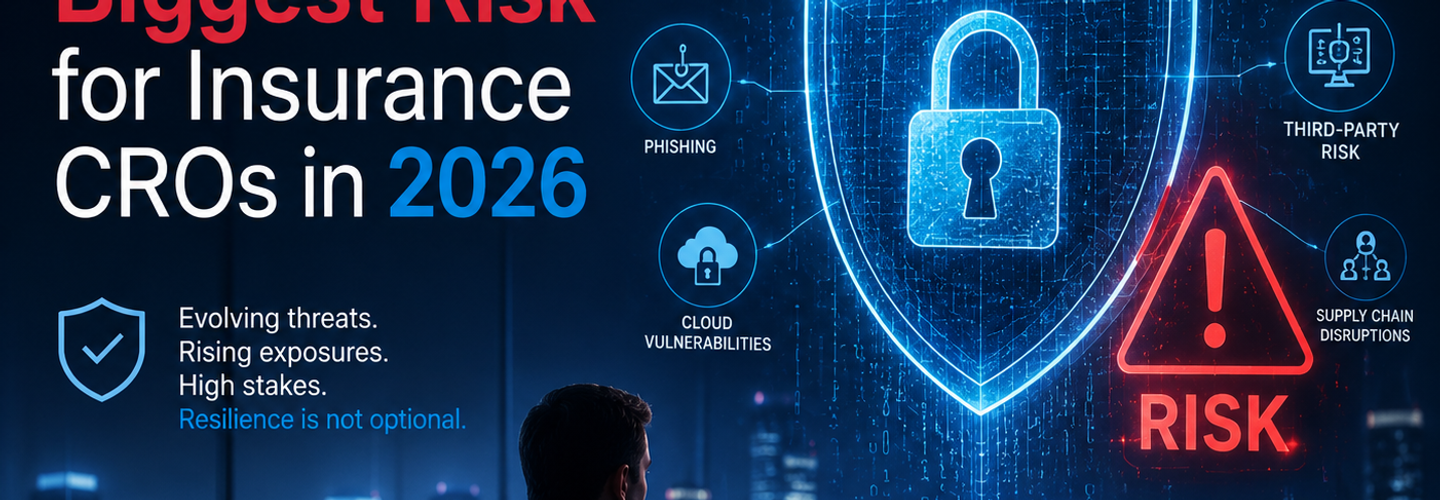
Cyber Operational Resilience: The Comprehensive 2026 Guide for CISOs, CROs, and Enterprise Risk Leaders
You've already invested heavily in firewalls, endpoint detection, and compliance programs. Yet when ransomware strikes, an AI-automated attack bypasses your controls, or a critical vendor goes offline, many organizations still struggle to keep essential business operations running. The missing piece isn't more prevention — it's resilience. In this guide, you'll learn exactly what cyber operational resilience means in 2026, how to build a framework that withstands modern threats, and why it has become the single biggest concern on the desks of insurance Chief Risk Officers worldwide.
## Key Takeaways
- ▸Cyber operational resilience is an organization's ability to anticipate, withstand, respond to, recover from, and adapt to cyber disruptions while maintaining critical business services — not just to prevent attacks.
- ▸Effective cyber resilience combines cybersecurity, business continuity, disaster recovery, and operational risk management into a single, unified strategy rather than four siloed programs.
- ▸AI-powered cyber threats are accelerating attack velocity and reducing defender response windows, making resilience-focused security programs more urgent than prevention-only approaches.
- ▸Third-party and supply-chain dependencies have become the primary operational resilience risk for modern enterprises, as interconnected vendors and cloud providers create cascading failure scenarios.
- ▸Continuous monitoring, immutable backups, and regular resilience testing are the three most impactful practices that demonstrably improve recovery readiness and reduce mean time to restore (MTTR).
- ▸Regulatory frameworks — including DORA, NIS2, and NIST CSF 2.0 — increasingly mandate measurable, tested resilience capabilities, not just documented policies.
- ▸Organizations that prioritize cyber operational resilience reduce operational downtime by up to 70%, strengthen stakeholder trust, and demonstrate superior long-term business performance compared to prevention-only peers.
## What Is Cyber Operational Resilience and Why Is It Important?
Cyber operational resilience is an organization's ability to maintain critical business services before, during, and after a cyber incident through a continuous cycle of prevention, detection, response, recovery, and adaptation. It is not simply the absence of breaches — it is the capacity to absorb disruption and keep essential operations running even when defenses are partially compromised.
The definition matters because it fundamentally reframes the security objective. Traditional cybersecurity asks: "How do we stop attackers from getting in?" Cyber operational resilience asks: "How do we keep operating even when something gets through?" These are different problems requiring different investments, metrics, and leadership conversations.
How Does Cyber Operational Resilience Differ From Traditional Cybersecurity?
Cyber operational resilience extends far beyond cybersecurity by placing operational continuity at the center of the security strategy, whereas traditional cybersecurity focuses primarily on preventing unauthorized access and protecting data. The practical difference becomes visible during a crisis: a cybersecurity-first organization scrambles to contain an incident and assess damage; a resilience-first organization activates pre-tested recovery procedures and maintains service delivery throughout.
The distinctions across related disciplines are important to understand clearly. Cybersecurity protects systems and data from threats. Cyber resilience maintains operations despite successful threats. Operational resilience sustains critical business services through any disruption — cyber, physical, or operational. Business continuity ensures pre-planned alternative processes exist when primary processes fail. A mature enterprise cyber resilience program integrates all four disciplines into one operating model rather than managing them separately.
For more foundational context on how threat actors target your infrastructure, the ReconShield Beginner's Guide to Threat Intelligence and IOC Analysis provides an essential primer on how cyber threat data is collected and operationalized.
What Are the Core Objectives of a Resilience Program?
A cyber operational resilience framework pursues five measurable objectives: minimize impact, maintain continuity, accelerate recovery, learn from incidents, and adapt continuously. Each objective maps directly to a measurable outcome — not to a control category or a compliance checkbox.
First, minimizing impact means deploying preventive and detective controls that reduce the blast radius of successful attacks. Second, maintaining continuity means identifying which services are truly critical and designing failover procedures for each. Third, accelerating recovery means having tested playbooks, clean backups, and practiced teams ready before an incident occurs. Fourth, learning from incidents means conducting structured post-incident reviews and feeding findings back into the program. Fifth, adapting continuously means treating resilience as a dynamic capability — not a static policy document reviewed once per year.
## Why Is Cyber Operational Resilience the Top Priority for Insurance CROs in 2026?
Cyber operational resilience has become the dominant concern for insurance Chief Risk Officers because cyber incidents now represent the single largest source of unmodeled, cascading operational loss across the insurance sector. The convergence of AI-powered attacks, ransomware professionalization, third-party concentration risk, and intensifying regulation has created a risk environment that legacy cybersecurity frameworks were not designed to address.
The numbers reinforce the urgency. Global cybercrime costs are projected to reach $10.5 trillion annually by 2025 — Source: Cybersecurity Ventures, 2023. The average cost of a data breach reached $4.88 million in 2024, the highest ever recorded — Source: IBM Cost of a Data Breach Report, 2024. And 74% of all breaches now involve a human element, confirming that technical controls alone cannot eliminate operational risk — Source: Verizon DBIR, 2024.
How Do AI-Powered Threats Impact Operational Resilience?
AI-powered cyber threats are directly compressing the defender response window by automating reconnaissance, payload generation, and lateral movement at speeds that human-only security operations cannot match. Attackers are using large language models to generate convincing phishing emails at scale, to write polymorphic malware that evades signature-based detection, and to automate vulnerability scanning across enterprise attack surfaces within minutes of a new CVE publication.
For example, AI-assisted spear-phishing campaigns that previously required hours of manual research per target can now be executed against thousands of targets simultaneously. This acceleration means organizations can no longer rely on the assumption that they will detect a threat before it reaches critical systems — they must instead assume partial compromise and maintain operational continuity regardless. Understanding how threat actors are actively exploiting your exposed infrastructure is a prerequisite for resilience planning; the ReconShield Shadow IT Exposed Ports guide documents exactly which services attackers target first when scanning enterprise perimeters.
Why Has Ransomware Become the Primary Resilience Test?
Ransomware has evolved from opportunistic malware into a professionalized, service-based industry that specifically targets operational continuity rather than data theft. Modern ransomware operators — operating under Ransomware-as-a-Service (RaaS) models — spend weeks inside a target network mapping critical systems, disabling backup solutions, and exfiltrating sensitive data before encrypting anything. Their explicit goal is to make recovery impossible without paying.
The operational impact is severe. The average ransomware recovery time in 2024 extended to 24 days — Source: Sophos State of Ransomware Report, 2024. More critically, organizations without tested recovery procedures experienced downtime two to three times longer than those with mature resilience programs. This gap is the direct business case for cyber operational resilience investment.
What Role Do Supply Chain and Third-Party Risks Play?
Third-party cyber risk has become a primary operational resilience challenge because modern business services depend on dense networks of interconnected vendors, cloud providers, and software suppliers that expand the attack surface far beyond organizational boundaries. A single compromised vendor can simultaneously disrupt hundreds or thousands of downstream organizations — as demonstrated by the MOVEit Transfer exploitation in 2023, which affected over 2,700 organizations globally — Source: Emsisoft Ransomware Report, 2023.
Insurance CROs face a compounded version of this problem: their own third-party dependencies plus the third-party exposures embedded in every policy they underwrite. Organizations with mature third-party risk management programs identify vendor incidents an average of 13 days faster than those without structured vendor oversight — Source: Ponemon Institute, 2023. Use the ReconShield IP Reputation Intelligence tool to passively assess the threat exposure of vendor IP ranges before they become your operational risk.
## What Are the Five Pillars of Cyber Operational Resilience?
A cyber operational resilience framework rests on five interdependent pillars: Prevention, Detection, Response, Recovery, and Adaptation. These pillars are not sequential phases — they operate simultaneously as a continuous loop, with each pillar strengthening the others.
Pillar 1 — Prevention: Reducing the Probability of Successful Attack
Prevention encompasses all controls designed to reduce the likelihood that an attack achieves its objective, including network segmentation, patch management, access control, and attack surface reduction. Prevention is necessary but cannot be sufficient on its own — no organization has achieved zero successful intrusions at enterprise scale.
Effective prevention in 2026 centers on three non-negotiables. First, Zero Trust Architecture — the principle that no user, device, or service is trusted by default, regardless of network location. Every access request is continuously verified. Second, attack surface management — the continuous discovery and classification of all internet-facing assets, which forms the empirical foundation for prevention prioritization. Use ReconShield's Exposure Assessment Tool to passively map your web application's misconfigurations and prioritize remediation before attackers exploit them. Third, multi-factor authentication (MFA) — which blocks over 99.9% of account compromise attacks according to Microsoft Security research, 2023.
Pillar 2 — Detection: Identifying Threats Before They Achieve Impact
Detection is the pillar that determines how quickly an organization discovers that an attack is in progress, directly determining how much damage occurs before response begins. The average dwell time — the period between initial compromise and detection — remains approximately 194 days for insider threats and 16 days for external attackers — Source: IBM Threat Intelligence Index, 2024.
Effective detection requires layered telemetry: network traffic analysis, endpoint detection and response (EDR), log aggregation via Security Information and Event Management (SIEM) platforms, and behavioral analytics. AI-assisted detection tools have demonstrated the ability to reduce mean time to detect (MTTD) by 50–70% in enterprise environments by correlating signals across data sources that human analysts cannot process at speed — Source: Gartner Security Operations Report, 2024. Monitoring your external-facing infrastructure for anomalous exposure changes is an often-overlooked detection layer; the ReconShield DNS Security Analysis tool provides real-time auditing of your DNS records, SPF, and DMARC configurations to detect unauthorized modifications.
Pillar 3 — Response: Containing and Neutralizing Active Incidents
Incident response is the structured, pre-planned set of actions an organization executes to contain an active threat, minimize damage, and preserve evidence for investigation. The word "pre-planned" is critical — organizations that improvise incident response under attack pressure consistently perform worse than those with documented, rehearsed playbooks.
Effective response programs define clear roles and decision trees for the most probable attack scenarios: ransomware encryption, credential compromise, DDoS, insider data exfiltration, and cloud account takeover. Security Orchestration, Automation, and Response (SOAR) platforms automate the first 15–30 minutes of response — the period when damage is most acute — by executing containment actions at machine speed. Reviewing the ReconShield guide on Passive OSINT reconnaissance helps response teams understand exactly what information attackers gather during the pre-attack phase, enabling more targeted containment of lateral movement paths.
Pillar 4 — Recovery: Restoring Operations to Normal State
Recovery is the pillar most directly responsible for business outcome after a cyber incident, determining whether downtime is measured in hours, days, or weeks. Recovery readiness depends on three factors: the quality and currency of backups, the completeness of recovery runbooks, and the frequency of recovery testing.
Immutable backups — stored in a write-once format that ransomware cannot encrypt or delete — are the single most impactful resilience investment for most organizations. Organizations with immutable, air-gapped, tested backups recovered from ransomware attacks in an average of 5.3 days, compared to 24 days for organizations without them — Source: Sophos State of Ransomware Report, 2024. Recovery planning must also address Recovery Time Objectives (RTOs) and Recovery Point Objectives (RPOs) for each critical system, ensuring business continuity thresholds are met. Ensuring your SSL/TLS infrastructure remains intact during recovery is equally critical; the ReconShield SSL/TLS Checker provides rapid cryptographic configuration audits to verify certificate integrity post-incident.
Pillar 5 — Adaptation: Learning, Improving, and Evolving Continuously
Adaptation transforms each incident, near-miss, and resilience test into an improvement opportunity, making the organization progressively harder to disrupt over time. This is the pillar that differentiates genuinely mature resilience programs from organizations that merely respond to incidents and return to the same vulnerable state.
Adaptation requires structured post-incident reviews (PIRs), threat intelligence integration, red team exercises, and regular updates to the threat model. Organizations that conduct post-incident reviews and implement findings reduce the likelihood of repeat incidents by 54% — Source: Ponemon Institute Cost of Cybercrime Study, 2023. The ReconShield Threat Intelligence blog category provides continuously updated intelligence briefings that feed directly into adaptation cycles.
## How Do Organizations Build a Cyber Operational Resilience Framework?
A cyber operational resilience framework is a structured operating model that integrates risk assessment, governance, incident management, continuity planning, and continuous testing into a single, organizationally embedded capability. Building one requires sequenced effort across six workstreams, typically spanning 12–18 months for a mature initial state.
Step 1 — Critical Asset Identification and Risk Assessment
The foundation of any resilience framework is a current, accurate inventory of critical business services and the technology assets that support them. Without knowing which systems are truly essential to operations, resilience investment is allocated by assumption rather than evidence.
Start by mapping business services to their enabling technology: which databases, APIs, cloud services, third-party integrations, and network paths must function for each critical service to operate. Then apply a risk assessment to each dependency — evaluating likelihood of disruption, impact of disruption, and current control effectiveness. Use the ReconShield Port Scanner to discover which services your infrastructure is exposing to the internet — an essential first step in identifying unmanaged dependencies that belong in your asset inventory.
Step 2 — Governance and Accountability Structures
Cyber operational resilience requires executive ownership, cross-functional accountability, and board-level reporting — it cannot succeed as a purely technical program owned by IT or security teams alone. The CISO, CRO, COO, and General Counsel each have distinct roles in a mature resilience governance model.
Governance frameworks should define: who approves resilience investment decisions, who owns recovery of each critical service, who communicates with regulators and customers during incidents, and how resilience performance is reported to the board. Insurance CROs specifically need to align cyber resilience governance with underwriting risk committees, since cyber incidents increasingly trigger both operational disruption and policy claims simultaneously.
Step 3 — Incident Response and Business Continuity Integration
Incident response planning and business continuity planning must be integrated into a single operational playbook rather than maintained as separate documents owned by different teams. In practice, this means that when the IR team declares an incident, business continuity procedures activate automatically — without requiring a separate decision or escalation.
Integration points include: shared communication trees, pre-authorized failover decisions, joint tabletop exercises, and aligned recovery objectives (RTOs and RPOs). The ReconShield guide on BGP Route Leak prevention is directly relevant here — routing disruptions caused by BGP attacks can silently degrade business continuity without triggering traditional security alerts, making them a critical integration point between network operations and incident response.
Step 4 — Resilience Testing and Validation
Resilience testing validates that documented plans actually work under realistic conditions — because plans that have never been tested under pressure almost always contain critical gaps. There are three essential testing modalities for a mature program.
First, tabletop exercises — scenario-based discussions where teams walk through their responses to simulated incidents. These identify process gaps, clarify decision rights, and build muscle memory. Second, technical recovery tests — actual restoration of systems from backups in isolated environments, validating that RTOs and RPOs are achievable. Third, red team exercises — adversarial simulations that test the full kill chain from initial access through lateral movement to impact, validating that detection and response controls work against realistic attack techniques. Organizations that conduct annual resilience tests identify 2.6x more critical process gaps than those relying on documentation reviews alone — Source: ISACA State of Cybersecurity Report, 2024.
## What Are the Most Effective Cyber Operational Resilience Best Practices?
The most effective cyber operational resilience practices share one characteristic: they address the full attack lifecycle rather than focusing exclusively on prevention. The following eight practices have the strongest evidence base for improving resilience outcomes in enterprise environments.
Zero Trust Architecture Reduces Lateral Movement
Zero Trust Architecture is the security model that eliminates implicit trust from network design, requiring continuous verification of every user, device, and service before granting access to any resource. For resilience specifically, Zero Trust's most important property is its ability to limit lateral movement — preventing an attacker who has compromised one account or system from moving freely across the network to reach critical assets.
Implementing Zero Trust typically begins with identity — enforcing MFA and privileged access management across all accounts — then progresses to network microsegmentation and application-level access controls. Organizations at advanced Zero Trust maturity levels experience 50% lower breach costs than those at early maturity — Source: IBM Zero Trust Impact Report, 2023.
Immutable Backup Architecture Is the Ransomware Insurance Policy
Immutable backup architecture protects recovery capability by storing backup copies in a write-once format that ransomware cannot modify, encrypt, or delete, regardless of what credentials an attacker has compromised. This single control has the highest direct impact on ransomware recovery outcomes of any technical measure.
Best practice immutable backup architecture follows the 3-2-1-1 rule: three copies of data, on two different media types, with one offsite copy, and one offline or air-gapped copy. Backups must be tested regularly — at minimum quarterly for critical systems — because untested backups fail at a rate that makes them unreliable without validation. Monitor for unauthorized changes to your backup infrastructure's certificates and network exposure using the ReconShield SSL/TLS Checker and Security Headers Auditor.
Continuous Monitoring Creates the Telemetry Foundation for Resilience
Continuous monitoring of the attack surface, network traffic, endpoint behavior, and cloud configurations provides the telemetry foundation that all other resilience capabilities depend on. Organizations cannot respond to what they cannot see, and they cannot recover accurately from what they have not logged.
Effective continuous monitoring in 2026 combines SIEM for log aggregation and correlation, EDR for endpoint visibility, cloud security posture management (CSPM) for cloud configuration drift, and external attack surface monitoring for internet-facing asset changes. The ReconShield passive diagnostics scanner provides non-intrusive, continuous visibility into your internet-facing assets — auditing email authentication records, SSL/TLS cipher suites, and HTTP security headers without generating alert noise in your target environment. For a deep understanding of how attackers use publicly available data to reconnoiter your environment, the ReconShield Passive OSINT anatomy guide is required reading for any SOC team building a continuous monitoring program.
Third-Party Risk Management Closes the Supply Chain Gap
Third-party risk management for cyber resilience requires extending your resilience requirements contractually and technically to every vendor with access to your critical systems or data. This means vendor security assessments, contractual SLA requirements for incident notification and recovery, and continuous monitoring of vendor cyber posture.
Prioritize vendors by concentration risk — those whose failure would cascade into your operations — and apply the most rigorous resilience requirements to the highest-concentration dependencies. Require vendors to demonstrate resilience capabilities (not just policies) through evidence: test results, insurance documentation, and third-party audit reports. Use the ReconShield WHOIS Intelligence tool to investigate vendor domain registration patterns, infrastructure ownership, and registration history as part of third-party due diligence workflows.
Security Awareness Training Addresses the Human Resilience Layer
Security awareness training builds the human resilience layer by ensuring every employee understands their role in maintaining operational continuity during a cyber incident, not just in avoiding phishing emails. This distinction matters: most training programs focus on threat avoidance; resilience-focused training also covers incident reporting, business continuity procedure activation, and communication protocols during crises.
Phishing simulation programs combined with role-specific training reduce susceptibility rates by an average of 72% within 12 months — Source: Proofpoint State of the Phish Report, 2024. Organizations that include incident response role-playing in security awareness programs respond to actual incidents 40% faster than those with awareness programs focused solely on threat avoidance — Source: SANS Security Awareness Report, 2023.
## Which Frameworks and Standards Support Cyber Operational Resilience?
The cyber operational resilience regulatory and standards landscape in 2026 is defined by four primary frameworks: NIST Cybersecurity Framework 2.0, ISO 27001:2022, DORA, and NIS2, each addressing different aspects of resilience with varying levels of prescriptiveness and jurisdictional applicability.
NIST Cybersecurity Framework 2.0 — The Resilience Operating Model
The NIST Cybersecurity Framework 2.0, released in 2024, is the most widely adopted voluntary resilience framework globally, providing a comprehensive taxonomy of cybersecurity and resilience outcomes organized across six functions: Govern, Identify, Protect, Detect, Respond, and Recover. The addition of the Govern function in version 2.0 explicitly elevated organizational leadership and supply chain risk management to first-class framework components.
NIST CSF 2.0 is particularly valuable as an internal operating model — mapping your program's current and target maturity states across all six functions, then using the gap analysis to prioritize investment. It integrates cleanly with ISO 27001 for organizations pursuing formal certification. For a deep audit of your web infrastructure's compliance with security configuration standards referenced by NIST, the ReconShield OWASP HTTP Headers guide provides direct implementation guidance on the browser-level controls that NIST CSF's Protect function requires.
DORA — The Financial Sector Resilience Mandate
The Digital Operational Resilience Act (DORA), which became fully applicable across EU financial services in January 2025, is the most prescriptive operational resilience regulation currently in force globally, requiring financial entities to demonstrate — not just document — their ability to withstand, respond to, and recover from ICT-related disruptions. DORA explicitly includes insurance companies, requiring CROs at EU-regulated insurers to treat digital operational resilience as a core governance obligation.
DORA's most operationally demanding requirements include: mandatory ICT risk management frameworks with board accountability, threat-led penetration testing (TLPT) for significant entities, contractual requirements for ICT third-party providers, and incident classification and reporting timelines measured in hours. Non-compliance carries penalties of up to 2% of total annual worldwide turnover for financial entities and 1% of average daily worldwide turnover for critical ICT third-party providers — Source: European Parliament, DORA Regulation, 2022.
NIS2 — Expanding Resilience Requirements Across Critical Sectors
The NIS2 Directive, which EU member states were required to transpose into national law by October 2024, extends mandatory cyber resilience requirements to a significantly broader range of sectors than its predecessor, including digital infrastructure, managed service providers, postal services, waste management, food production, and manufacturing — in addition to the energy, transport, finance, and health sectors covered by the original NIS Directive.
NIS2 requires covered entities to implement risk management measures across ten specific areas, including incident handling, business continuity and crisis management, supply chain security, and encryption. For insurance sector organizations, NIS2 interacts with DORA — entities subject to both must satisfy the more stringent requirements of each framework. Understanding your SSL/TLS configuration is directly relevant to NIS2's encryption requirements; the ReconShield SSL/TLS Regulatory Compliance guide maps encryption standards to PCI DSS, HIPAA, GDPR, and ISO 27001 requirements simultaneously.
ISO 27001:2022 — The International Resilience Certification Standard
ISO 27001:2022 is the internationally recognized information security management standard that provides a certifiable framework for implementing and maintaining a comprehensive resilience program, with Annex A now explicitly including controls for threat intelligence, cloud security, ICT readiness for business continuity, and information security for DevSecOps.
ISO 27001 certification provides verifiable third-party assurance of resilience program maturity — increasingly required by enterprise customers, insurers, and regulators as a condition of doing business. The 2022 revision added 11 new controls specifically relevant to operational resilience, including controls for physical security monitoring, configuration management, data masking, and web filtering.
## Real-World Examples of Cyber Operational Resilience in Practice
Real-world cyber operational resilience programs succeed when they combine tested technical controls with organizationally embedded response procedures that activate without executive decision-making delays.
Insurance Sector Resilience Programs
Major insurance groups — including Allianz, Munich Re, and AXA — have published operational resilience frameworks that explicitly treat cyber risk as a top-tier operational risk category alongside market and credit risk. These programs share common characteristics: board-level cyber risk committees with quarterly resilience reporting, mandatory third-party cyber resilience assessments for all significant ICT providers, and tested recovery procedures for core policy administration, claims, and reinsurance systems. The insurance sector's unique challenge is that a major cyber incident can simultaneously trigger operational disruption and a wave of cyber insurance claims — a dual-impact scenario that DORA's financial resilience requirements directly address.
Financial Services Resilience Initiatives
The Bank of England's Operational Resilience Policy, which became fully effective in March 2022 as a precursor to DORA, required UK financial services firms to identify important business services, set impact tolerances, and demonstrate by 2025 that they could remain within those tolerances during a severe but plausible disruption scenario. Firms that invested early in immutable backup infrastructure, tested recovery runbooks, and cross-functional incident response training consistently demonstrated materially better resilience outcomes during supervisory assessments than those that treated resilience as a documentation exercise.
Healthcare Ransomware Preparedness
The healthcare sector has been the most targeted industry for ransomware for five consecutive years — Source: Sophos, 2024. Organizations that survived ransomware attacks with minimal operational disruption shared three characteristics: network segmentation that contained the blast radius to non-clinical systems, offline backups of patient record systems with tested 4-hour RTOs, and pre-established relationships with cyber incident response retainer firms who could mobilize within hours. The lesson for other sectors is straightforward: resilience outcomes are determined almost entirely by decisions made before an incident occurs.
## How Can Organizations Measure Cyber Operational Resilience?
Cyber operational resilience is measured through a combination of leading indicators — which predict future resilience capability — and lagging indicators — which measure actual resilience performance during incidents and tests. A mature measurement program tracks both categories and reports them to executive leadership on a quarterly cadence.
Key leading indicators include: percentage of critical systems covered by tested recovery runbooks, time since last resilience test, vendor risk assessment completion rate, backup test success rate, and mean time to patch critical vulnerabilities. Key lagging indicators include: mean time to detect (MTTD), mean time to respond (MTTR), mean time to recover (MTTR), percentage of incidents contained within pre-defined impact tolerance thresholds, and post-incident review completion rate.
Organizations that establish resilience metrics before incidents occur are 3x more likely to meet their recovery time objectives during actual incidents than those that define metrics reactively — Source: ISACA Cyber Resilience Survey, 2024. The ReconShield Security Headers Auditor provides a rapid, measurable audit of your web application's browser-level security posture — one specific, auditable leading indicator that maps directly to NIST CSF and OWASP compliance requirements.
## What Are Common Challenges in Implementing Cyber Operational Resilience?
The most common implementation challenges for cyber operational resilience programs are organizational rather than technical — including fragmented ownership, resource competition between prevention and resilience investment, and the difficulty of sustaining board attention during periods without active incidents.
Fragmented ownership occurs when cybersecurity, IT operations, business continuity, and legal teams each own separate components of the resilience capability without a unified governance structure. The result is programs that look comprehensive on paper but fail to activate coherently during actual incidents because teams have never practiced together. The solution is a resilience steering committee with cross-functional representation and a single executive accountable for the integrated program.
Prevention bias — the tendency to invest security budgets primarily in controls that prevent incidents rather than those that enable recovery — remains pervasive because prevention investments are easier to justify before an incident occurs. Resilience investments, by contrast, only prove their value during the crisis they were designed for. Reframing resilience investment in financial terms — comparing the cost of tested backup infrastructure against the average $4.88 million breach cost — consistently generates more compelling business cases for resilience programs.
Vendor dependency mapping gaps persist because most organizations' asset inventories do not accurately reflect the web of third-party services their critical systems depend on. Quarterly vendor dependency reviews, combined with passive infrastructure reconnaissance using the ReconShield WHOIS Intelligence and DNS Security Analysis tools, close this gap by providing current, evidence-based visibility into the infrastructure underlying your third-party dependencies.
## What Is the Future of Cyber Operational Resilience in the Age of AI?
The future of cyber operational resilience will be defined by the convergence of autonomous resilience operations, expanded regulatory scope, board-level resilience accountability, and quantum-era cryptographic preparedness — all accelerated by the same AI capabilities that are simultaneously intensifying the threat landscape.
Autonomous Resilience Operations (ResOps)
Autonomous resilience operations — the emerging practice of using AI to automate detection, containment, and initial recovery actions without human decision-making delays — will become a standard capability for large enterprises within the next three to five years. Early implementations are already demonstrating 60–80% reductions in mean time to contain incidents by automating the first 15 minutes of response across the most common attack scenarios. For AI-specific cybersecurity threat research relevant to building autonomous resilience programs, the ReconShield AI Cybersecurity research category documents emerging attack techniques and defensive countermeasures.
Regulatory Expansion Beyond Financial Services
Regulatory requirements for demonstrable operational resilience are expanding from financial services to critical infrastructure sectors globally. The U.S. SEC's cybersecurity disclosure rules (effective 2024) now require public companies to disclose material cyber incidents within four business days and to describe their cybersecurity risk management programs annually. The EU's Critical Entities Resilience Directive (CER), complementing NIS2, extends resilience obligations to physical and digital critical infrastructure across eleven sectors. Insurance CROs need to anticipate that cyber resilience will become a Board-level disclosure obligation within their own organizations within the next 24 months.
Quantum-Era Cryptographic Preparedness
Post-quantum cryptography preparedness is an emerging operational resilience requirement because quantum computing advances threaten to render current encryption standards obsolete, creating a class of future-dated cryptographic risk that organizations must begin addressing now. NIST finalized its first post-quantum cryptographic standards in August 2024 — Source: NIST, 2024 — providing the technical foundation for migration planning. Organizations should begin cryptographic inventory assessments, identify which systems use quantum-vulnerable algorithms, and prioritize migration timelines aligned with asset lifecycle planning. The ReconShield SSL/TLS Checker provides current cipher suite analysis — the starting point for any cryptographic migration assessment.
Board-Level Resilience Reporting Becomes Standard
Board-level cyber resilience reporting will shift from periodic briefings on incidents to continuous, metric-driven reporting on resilience capability and gap closure progress. Leading organizations are already implementing resilience dashboards that track recovery capability against regulatory impact tolerance thresholds in real time — providing boards with the same quality of resilience visibility they currently have for financial risk. This evolution requires security leaders to translate technical resilience metrics into business-language outcome statements: not "MTTD is 4 hours" but "we detected the last simulated intrusion before it reached any customer-facing system."
## Conclusion
Cyber operational resilience is not a compliance exercise, a technology project, or the sole responsibility of the security team. It is a core business capability — the organizational equivalent of structural engineering for a building operating in an earthquake zone. Most organizations are already investing in the components of resilience. What remains is integrating those components into a coherent, tested, board-accountable program that activates reliably when disruption occurs.
The urgency is real. AI-powered attacks are compressing response windows. Ransomware operators are specifically targeting backup infrastructure. Third-party concentration risk is creating systemic exposure that no individual organization can fully control. Regulators across financial services, critical infrastructure, and now public markets are demanding demonstrated, not just documented, resilience capabilities.
Start with the fundamentals: map your critical assets, test your backups, integrate your incident response and business continuity procedures, and run a tabletop exercise before you need to run a real incident. Then use the ReconShield passive diagnostics scanner to audit your internet-facing attack surface — the external view of your infrastructure that attackers see before you know they're looking.
Resilience is built before the storm, not during it. The organizations that invest in cyber operational resilience today will be the ones that maintain customer trust, regulatory standing, and competitive position when the next major cyber disruption inevitably arrives.
Written by Surendra Reddy Cybersecurity Researcher & Founder, ReconShield. Surendra is a cybersecurity engineer specializing in Open Source Intelligence (OSINT), exposure intelligence, and AI-driven threat analysis. He built ReconShield to democratize access to enterprise-grade infrastructure visibility tools and secure digital internet-facing assets. Author Profile →
Reviewed by ReconShield Editorial Team — Peer-reviewed for technical accuracy against current threat intelligence, regulatory requirements (DORA, NIS2, NIST CSF 2.0), and enterprise resilience frameworks.
## Analyst Commentary & Implementation Blueprint
Security advisory
Continuous security exposure assessment is critical to identifying public vulnerabilities before they are exploited. Organizations should maintain a passive inventory of all web servers, TLS configs, and open ports, ensuring that default configurations are eliminated and security advisories are actively implemented.
Hardened Security Configuration Blueprint
# General Security Hardening Directive
ServerTokens ProductOnly
ServerSignature Off
FileETag None
Actionable Mitigation Checklist
- ✔Perform passive asset inventories weekly.
- ✔Restrict administrative ports using local firewall controls.
- ✔Monitor active CVE alerts for exposed software.
Common Inquiries & FAQs
Why is passive scanning preferred for continuous auditing?
Passive audits do not cause operational impact or trigger firewall blocks, making them ideal for constant surveillance of internet-facing assets.
What should I do if a vulnerability is flagged?
Apply the latest vendor patches, restrict access to the resource via firewalls, or verify configuration flags to mitigate risks.
Surendra Reddy
Surendra Reddy is a cybersecurity researcher and founder of ReconShield, specializing in OSINT and defensive infrastructure analysis.
Connect on LinkedIn ↗// AUDIT BRIEFING DISCUSSION (2 COMMENTS)
Great breakdown of the passive infrastructure vectors. We recently audited our external DNS zones and found multiple dangling staging environments. Implementing wildcard certificates reduced our CT log leaks significantly.
Is there any automated tooling you recommend for daily crt.sh scraping? Manually checking CT logs is becoming unsustainable for our domain portfolio.
// MORE ARTICLES
Security Researchers Warn Critical n8n Flaws May Expose Automation Platforms to RCE
Researchers have disclosed critical vulnerabilities in n8n that could expose automation workflows and connected enterprise systems to remote code execution risks, prompting urgent patch recommendations for users and administrators.
How Agentic AI Is Changing Software Engineering and Expanding Mobile Attack Surfaces
Agentic AI is rapidly transforming software engineering workflows through automation and intelligent coding assistance, while cybersecurity experts warn of expanding mobile attack surfaces and emerging application security risks.
SplitVPN Hacked: Data Breach Exposes 865,000 User Records and 58 Million Hidden Connection Logs (July 2026)
SplitVPN hacked: 865,336 user records and 58 million connection logs exposed, directly contradicting the VPN's "no-logs" promise. What was leaked and what to do now.