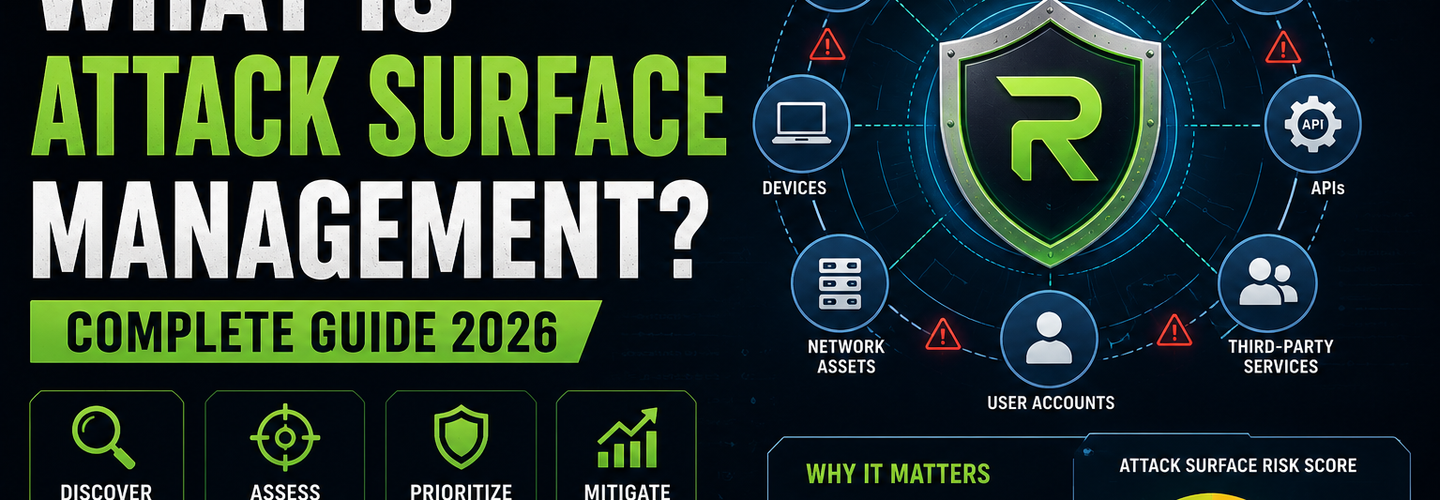
What Is Attack Surface Management? Complete Guide 2026 | ReconShield
You probably already know that attackers don't wait for an invitation — they scan continuously for every exposed service, forgotten subdomain, misconfigured DNS record, and unpatched endpoint your organization leaves reachable from the internet. What most security guides skip over, however, is the systematic process for finding those exposures before attackers do. In this guide, you'll learn exactly what attack surface management is, why 64% of internet-connected assets go undetected by the organizations that own them, and how to run a complete attack surface assessment step by step.
## Key Takeaways
- ▸Attack surface management is the continuous practice of discovering, inventorying, classifying, and reducing every digital asset and exposure point that an attacker could use to gain unauthorized access.
- ▸Organizations are unaware of an average of 64% of their internet-connected assets — meaning most security programs are defending less than half their actual exposure — Source: Reposify Research.
- ▸Exploits against internet-facing assets have been the top initial infection vector for the sixth consecutive year, according to Mandiant M-Trends 2026.
- ▸The median time to exploit a newly disclosed vulnerability is now under 5 days, while the average remediation time exceeds 60 days — creating a 55-day exposure window where most breaches occur — Source: Security Boulevard, 2026.
- ▸The attack surface management market is projected to grow from $1.25 billion in 2026 to $5 billion by 2034, reflecting how foundational ASM has become to enterprise security strategy — Source: Fortune Business Insights, 2026.
- ▸A complete external attack surface assessment covers DNS, WHOIS, SSL/TLS certificates, open ports, subdomains, security headers, email authentication, and web technology fingerprinting.
- ▸Attack surface management is not a one-time audit — it is a continuous, always-on discipline requiring regular re-assessment as infrastructure changes.
## What Is Attack Surface Management?
Attack surface management (ASM) is the continuous process of discovering, inventorying, classifying, risk-scoring, and reducing every digital asset and exposure point that a threat actor could exploit to gain unauthorized access to an organization's systems, data, or infrastructure.
The core idea is deceptively simple: you cannot defend what you cannot see. Every domain, subdomain, IP address, open port, web application, API endpoint, SSL certificate, DNS record, cloud service, and third-party integration represents a potential entry point. ASM is the discipline of maintaining continuous visibility across all of them — not just the assets your IT team knows about, but also the shadow IT, forgotten test environments, deprecated services, and acquired infrastructure that quietly accumulate over time.
Attack surface management is distinct from traditional vulnerability management, which typically starts with a known asset list and scans it for weaknesses. ASM starts one step earlier: discovering what exists in the first place. Only after you have a complete, continuously updated inventory of your internet-facing assets can you meaningfully assess and prioritize the vulnerabilities within them.
## Why Attack Surface Management Matters More Than Ever in 2026
Attack surface management matters more than ever in 2026 because the internet-facing attack surface of the average organization has expanded by more than 67% since 2022, while the time attackers need to exploit newly discovered vulnerabilities has dropped to under five days — Source: INE 2026 Cybersecurity Forecast, Security Boulevard 2026.
The math is stark. Organizations are unaware of approximately 64% of their internet-connected assets on average, according to Reposify's research. Businesses that implement automated attack surface scanning routinely discover up to 40% additional assets they had no record of. That hidden 64% doesn't just represent theoretical risk — it represents the specific assets attackers actively scan for, because defenders aren't watching them.
Mandiant's M-Trends 2026 report, grounded in over 500,000 hours of frontline incident investigations, found that exploits against internet-facing systems have remained the top initial infection vector for six consecutive years — Source: Mandiant M-Trends 2026. That's not a trend; it's a structural characteristic of how breaches happen. Attackers will always probe the external perimeter first, because it's the easiest path in.
The scale of the ASM market reflects how seriously organizations are taking this: the global attack surface management market is projected to grow from $1.25 billion in 2026 to $5 billion by 2034 — Source: Fortune Business Insights, 2026. A prediction from a US agency forecasts that 60% of organizations will have formal ASM programs in place by the end of 2026, up from less than 10% in 2021. The security industry has converged on a simple realization: visibility comes before defense.
Starting your own ASM program begins with passive reconnaissance — the same techniques attackers use, run by defenders before attackers get there. ReconShield's definitive passive OSINT guide covers the reconnaissance methodology in depth, explaining exactly how both attackers and security teams build comprehensive asset inventories from publicly available data sources.
## What Are the Types of Attack Surface?
The three primary attack surface types are the external attack surface — everything reachable from the public internet — the internal attack surface — assets accessible from within the network perimeter — and the digital supply chain attack surface — third-party vendors, SaaS integrations, and partner connections.
External Attack Surface
The external attack surface is the most critical starting point for any ASM program because it is directly reachable by any attacker in the world without requiring prior network access. It includes all publicly resolvable domain names, subdomains, IP addresses, web applications, open ports and services, APIs, SSL/TLS certificates, DNS records, email infrastructure, and cloud storage buckets associated with your organization.
External attack surface management — commonly abbreviated as EASM — has become its own discipline precisely because the external perimeter is so dynamic. A developer spins up a test environment, a SaaS tool gets integrated via API, a certificate expires, a subdomain gets forgotten — and suddenly the external attack surface has changed without any security review. Continuous external discovery is not optional in a threat environment where attackers exploit new exposures within days of their appearance.
Internal Attack Surface
The internal attack surface encompasses assets that require network access to reach — internal services, database servers, Active Directory infrastructure, lateral movement paths, and management interfaces that should never be reachable from the internet but sometimes become exposed through misconfiguration. Shadow IT is the primary driver of unexpected internal exposure: departments deploying services without IT involvement, opening ports without firewall review, or running applications on endpoints that briefly expose management interfaces.
ReconShield's analysis of shadow IT exposed ports documents exactly how these unexpected internal exposure paths emerge and why they are consistently exploited in real-world breaches.
Digital Supply Chain Attack Surface
The digital supply chain attack surface comprises every third-party vendor, SaaS integration, open-source dependency, and partner connection that can reach or be reached from your environment. Over the past five years, major supply chain and third-party breaches have quadrupled — Source: IBM X-Force Threat Intelligence Index 2026. A supplier's misconfigured API, a compromised npm package in your CI/CD pipeline, or a partner's exposed database can all become the initial access point for your breach, even if your own directly managed infrastructure is locked down.
## How Does the Attack Surface Management Process Work?
The attack surface management process follows five stages: continuous asset discovery, asset classification and inventory, risk scoring and prioritization, remediation and hardening, and ongoing monitoring — running as a continuous cycle rather than a periodic project.
Stage 1 — Asset Discovery
Asset discovery is the process of finding every internet-facing asset associated with your organization, including assets you don't know you have. Discovery uses passive and active techniques including DNS enumeration, certificate transparency log analysis, WHOIS data analysis, ASN mapping, port scanning, and web crawling to build the most complete possible picture of what's exposed.
Passive DNS analysis is one of the most powerful discovery techniques available. Running a DNS lookup against your primary domains reveals every DNS record type in use — A, AAAA, MX, TXT, SPF, DKIM, CNAME, NS — and frequently surfaces subdomains, mail server configurations, and infrastructure details that weren't in any internal inventory. DNS is the single most information-rich starting point for external asset discovery because it maps an organization's entire visible internet presence.
Stage 2 — Asset Classification and Inventory
Asset classification assigns ownership, business function, data sensitivity, and risk context to every discovered asset. This transforms a raw list of domains and IP addresses into an actionable inventory that security teams can prioritize. Without classification, discovery produces a list of thousands of assets with no clear guidance on which ones matter most.
WHOIS data provides the registration intelligence needed to verify asset ownership during classification — confirming which domains genuinely belong to your organization, identifying domains that may have been registered to impersonate you, and revealing third-party registrations in your DNS delegation chain. The WHOIS lookup tool surfaces domain registration dates, registrar details, contact information, and nameserver configurations that feed directly into asset ownership validation. Understanding how WHOIS privacy features affect this analysis is covered in ReconShield's WHOIS privacy protection guide.
Stage 3 — Risk Scoring and Prioritization
Risk scoring evaluates each discovered asset and exposure against a consistent framework combining exploitability, business impact, data sensitivity, and proximity to critical systems. Without prioritization, a discovery scan produces a noise-filled list of findings that overwhelms security teams and ensures the most dangerous issues are buried in the volume.
The median time to exploit a vulnerability is now under five days, while average remediation time exceeds sixty days — Source: Security Boulevard, 2026. That 55-day gap is where the majority of breaches occur. Effective risk scoring compresses the remediation window by ensuring the highest-risk, most-likely-to-be-exploited exposures are addressed immediately.
A vulnerability scanner applied to discovered assets validates which exposures are genuinely exploitable rather than theoretical, dramatically reducing false positives. Over a quarter of cybersecurity teams — 26% — have exposed MySQL databases in their external attack surface according to Intruder's 2026 ASM Index, an exposure type that validates immediately in a risk scoring workflow.
Stage 4 — Remediation and Hardening
Remediation converts prioritized risk findings into concrete security improvements: patching vulnerable software, closing unnecessary open ports, renewing expired certificates, removing deprecated services, hardening web application configurations, and enforcing email authentication protocols. Each remediation action directly reduces the exploitable attack surface.
Hardening web-facing assets means ensuring they present the minimum necessary information to the public internet. Checking security response headers on web-facing applications reveals whether critical protective headers — Content-Security-Policy, Strict-Transport-Security, X-Frame-Options, X-Content-Type-Options, and Referrer-Policy — are correctly configured. Missing headers are both common and directly exploitable. ReconShield's OWASP HTTP headers hardening guide covers the complete defensive header configuration required to pass security assessments and reduce web application attack surface.
Stage 5 — Continuous Monitoring
Continuous monitoring is what distinguishes mature ASM programs from periodic security audits. The attack surface changes constantly: new subdomains appear, certificates expire, ports get opened during deployments, DNS records get misconfigured during migrations. A point-in-time scan performed six months ago describes a completely different attack surface than the one that exists today.
Continuous monitoring detects these changes as they happen, triggering new risk assessments whenever the attack surface expands or new exposures appear. This is the "always-on" characteristic that security leaders increasingly demand from ASM programs — not monthly reports, but real-time visibility into every change in what's exposed to the internet.
## What Does a Complete External Attack Surface Assessment Cover?
A complete external attack surface assessment is a structured review of every internet-facing asset category — covering DNS records, WHOIS registration data, SSL/TLS certificates, open ports and services, subdomains, web application security headers, email authentication posture, and web technology fingerprinting.
Here is what each assessment dimension reveals and why it matters:
DNS and Domain Intelligence — DNS records reveal your entire internet-visible infrastructure: mail servers (MX), web servers (A/AAAA), name delegation (NS), and SPF/DKIM authentication records. DNS misconfiguration is one of the most common sources of exposure because DNS changes are made frequently and don't always receive security review. A DNS security analysis should be the first step of any external assessment.
WHOIS Registration Intelligence — WHOIS data confirms which domains you own, surfaces domains registered to impersonate you, and reveals unauthorized nameserver delegations. Running a WHOIS lookup against every domain in your inventory validates ownership and surfaces suspicious registrations in your namespace.
SSL/TLS Certificate Analysis — Every HTTPS service in your infrastructure needs a valid, properly configured SSL/TLS certificate with strong cipher suites and no expired or self-signed certificates visible from the public internet. An SSL/TLS checker validates certificate chains, expiry dates, key strength, cipher suite configuration, and HSTS status across all domains. For compliance context, ReconShield's SSL/TLS regulatory compliance guide maps certificate requirements to specific frameworks including PCI-DSS, HIPAA, and ISO 27001.
Subdomain Enumeration — Subdomains are the most consistent source of forgotten and unsecured internet-facing assets. A development server spun up on dev.yourcompany.com, a deprecated marketing site on campaign.yourcompany.com, or an exposed staging environment on staging.yourcompany.com — each represents an asset that may be running unpatched software with no security monitoring. Running a subdomain finder enumerates the complete subdomain inventory across your registered domains, surfacing assets that weren't in any internal record.
Open Port and Service Discovery — Every open port is a potential entry point. A port scanner identifies every TCP service reachable from the internet on your IP ranges, revealing management interfaces, database services, and remote access tools that should never be directly internet-facing. Remote desktop services alone accounted for 30% of all exposures in recent threat intelligence research.
Web Application Security Headers — As covered above, missing security headers create direct web application attack surface. The security headers checker evaluates all protective headers in a single scan and produces a prioritized remediation list.
Email Authentication Posture — Your email domain is part of your attack surface. Missing or misconfigured SPF, DKIM, and DMARC records allow attackers to send phishing emails that appear to come from your domain — one of the most effective and frequently used social engineering vectors. An email security checker validates all three email authentication protocols simultaneously, confirming your domain cannot be spoofed. ReconShield's email spoofing prevention guide explains the precise configuration required to eliminate domain impersonation risk.
Technology Fingerprinting — Identifying the web frameworks, server software, CMS platforms, JavaScript libraries, and analytics tools running on your internet-facing assets is critical for vulnerability prioritization. When a critical CVE is disclosed for a framework, you need to know immediately which of your assets are running it. An IP lookup and technology detector surfaces the hosting infrastructure behind your assets, supporting attribution and exposure mapping.
## What Are the Biggest Attack Surface Risks in 2026?
The biggest attack surface risks in 2026 are unmanaged subdomains and shadow IT assets, expired or misconfigured SSL/TLS certificates, missing email authentication allowing domain spoofing, exposed management ports reachable from the internet, and unpatched vulnerabilities in internet-facing web applications.
API attack surface expansion is an emerging category that deserves specific attention: API vulnerability exploitation grew 181% in 2025, and more than 40% of organizations lack full visibility into their API attack surface — Source: Security Boulevard, 2026. Shadow APIs, undocumented endpoints, and APIs developed without security testing create exposures that traditional scanning tools frequently miss.
Artificial intelligence is accelerating the threat on both sides. IBM's X-Force Threat Intelligence Index 2026 found that AI tools are enabling attackers to scale reconnaissance and exploitation operations faster than human security teams can respond — identifying vulnerable assets within seconds of new CVE disclosures. Organizations that don't maintain continuous visibility into their attack surface are increasingly at a structural disadvantage against this automated threat model.
## What Is the Difference Between ASM, EASM, and Vulnerability Management?
Attack surface management (ASM) is the broad discipline covering all asset discovery and exposure management. External attack surface management (EASM) is the specific focus on internet-facing assets discoverable without internal access. Vulnerability management is the process of scanning known assets for weaknesses — it begins where ASM ends.
The key distinction is starting point. Vulnerability management assumes a known asset inventory and scans it for CVEs. ASM and EASM don't assume you already know what you have — they build the inventory first through discovery, then apply vulnerability analysis to a complete rather than assumed picture of your exposure.
In practice, the most mature security programs combine all three: ASM for continuous discovery and inventory, EASM for external perimeter visibility, and vulnerability management for deep technical analysis of confirmed exposures. Mandiant's M-Trends 2026 makes the recommendation explicit: "Aggressively manage internet-facing attack surfaces — prioritize rapid patching, vulnerability scanning, and strict isolation of external-facing web application servers."
## How to Reduce Your Attack Surface: Seven Actionable Practices
Attack surface reduction is the active process of minimizing the number and severity of exploitable exposure points across your digital infrastructure — achieved by eliminating unnecessary assets, hardening remaining assets, and enforcing security controls consistently.
First, decommission unused assets. Every subdomain, server, or service that serves no current business purpose is pure attack surface with zero benefit. Remove it from DNS, shut down the server, and revoke any associated certificates or credentials.
Second, enforce minimum necessary exposure. Every open port, enabled service, and accessible endpoint should have a documented business justification. Close everything else. ReconShield's shadow IT port exposure guide shows how to systematically identify services that should never have been internet-facing.
Third, implement and validate email authentication. SPF, DKIM, and DMARC records eliminate one of the most commonly exploited attack vectors. Validate current email security posture with the email security checker and remediate any gaps immediately.
Fourth, maintain SSL/TLS hygiene. Expired certificates, weak cipher suites, and missing HSTS configurations are consistently exploited. Audit every certificate in your inventory with an SSL/TLS checker on a regular schedule.
Fifth, continuously enumerate subdomains. New subdomains appear constantly through developer activity and third-party integrations. Run the subdomain finder on a regular cadence and review every new result against your authorized asset inventory.
Sixth, harden web application headers. Missing security headers reduce the effort required to exploit web applications. The security headers checker identifies every missing protective header in one scan.
Seventh, run regular external vulnerability scans. Known vulnerabilities in internet-facing applications are the most reliably exploited attack vector. The vulnerability scanner surfaces OWASP-class misconfigurations and CVE exposures across your web-facing assets.
## What's Next — Continuous Threat Exposure Management (CTEM)
Continuous Threat Exposure Management (CTEM) is the evolution of attack surface management beyond asset discovery into a fully integrated, continuously running cycle that encompasses discovery, scoping, prioritization, validation, and mobilization of remediation efforts across the entire organization.
Gartner introduced CTEM as a strategic framework in 2022 and has repeatedly identified it as a top security technology priority. The key distinction from traditional ASM is the emphasis on validation — confirming through adversarial simulation that discovered exposures are genuinely exploitable, not just theoretically vulnerable — and mobilization, ensuring that findings are translated into remediation actions with documented ownership and timelines.
Organizations moving toward CTEM are building the governance structures that make attack surface management a business-aligned function rather than a purely technical one. Security teams that can demonstrate which assets are exposed, what risks they carry, which have been validated as exploitable, and what remediation timelines are in place are the teams that earn organizational trust and budget — because they speak in the language of measurable, managed risk.
## Conclusion
Attack surface management is not a tool you buy or a scan you run once a quarter. Attack surface management is the continuous organizational practice of knowing what you have, knowing what's exposed, knowing what risk each exposure carries, and systematically reducing that exposure before attackers find what you missed.
The statistics paint a clear picture of what happens when ASM is absent: 64% of internet-connected assets go undetected, exploits against external infrastructure remain the top breach vector year after year, and the gap between disclosure and exploitation has collapsed to under five days. Organizations that have no continuous visibility into their external attack surface are not secure — they're just not yet aware of how they've been compromised.
The good news is that external attack surface assessment doesn't require a six-figure enterprise platform to get started. A disciplined, tool-assisted process covering DNS, WHOIS, SSL/TLS, subdomains, ports, security headers, email authentication, and vulnerability scanning gives any security team real, actionable visibility into their external exposure. Run a DNS lookup on your primary domains. Enumerate your subdomains with a subdomain finder. Validate your SSL posture with an SSL/TLS checker. Scan for open ports with a port scanner. Check your email authentication with an email security tool. Audit your web application headers with a security headers checker. Assess your exposure with a vulnerability scanner. That's a complete external attack surface assessment — available to any team, starting right now.
## Frequently Asked Questions
What is attack surface management in simple terms? Attack surface management is the practice of finding every part of your organization that an attacker could access from the internet — domains, subdomains, servers, open ports, web apps, email systems, APIs — and continuously monitoring, assessing, and reducing that exposure before attackers exploit it.
What is included in an attack surface? An attack surface includes all internet-facing domains and subdomains, DNS records, IP addresses, open network ports and services, web applications and APIs, SSL/TLS certificates, email authentication infrastructure, cloud storage buckets, third-party integrations, and any shadow IT assets associated with your organization that are reachable from the public internet.
What is the difference between attack surface management and vulnerability management? Vulnerability management scans a known list of assets for security weaknesses. Attack surface management first discovers what assets exist — including unknown and forgotten ones — before assessing vulnerabilities within them. ASM is the discovery layer that makes vulnerability management complete rather than partial.
Why do organizations miss so many of their own assets? Organizations miss assets because infrastructure grows faster than documentation. Developers spin up subdomains, teams adopt SaaS tools, cloud resources get provisioned, acquisitions add unknown infrastructure, and deprecated services are abandoned without being decommissioned. The result is a gap between the assets IT knows about and the assets actually reachable from the internet.
How often should you run an attack surface assessment? Ideally, critical attack surface assessment components — especially subdomain enumeration, DNS monitoring, and port scanning — should run continuously or at least weekly. SSL certificate monitoring and vulnerability scanning should run at minimum monthly. Major infrastructure changes (acquisitions, migrations, new product launches) should trigger immediate reassessment.
What is external attack surface management (EASM)? External attack surface management (EASM) is the specific discipline of discovering and managing assets reachable from the public internet — without requiring internal network access. EASM uses the same techniques attackers use: DNS enumeration, certificate transparency log analysis, WHOIS intelligence, port scanning, and passive web reconnaissance.
What is Continuous Threat Exposure Management (CTEM)? Continuous Threat Exposure Management (CTEM) is a security framework introduced by Gartner that extends attack surface management into a fully continuous cycle of discovery, scoping, prioritization, validation, and remediation mobilization. It emphasizes confirming that exposures are genuinely exploitable through adversarial testing, not just theoretically vulnerable based on CVE presence.
Can small organizations benefit from attack surface management? Yes — small organizations often benefit more per unit of effort than large enterprises because their attack surface is more manageable. A startup with ten domains and a few dozen subdomains can achieve complete external visibility in a few hours using free passive security tools. The risk doesn't scale down with organization size: attackers target small organizations specifically because their ASM programs are weaker.
Written by Surendra Reddy — Founder & Principal Architect, ReconShield Surendra is an information security engineer specializing in OSINT methodology, internet telemetry mapping, and cryptographic domain security. He designed ReconShield to help security teams manage their external attack surface exposure through passive, authorized diagnostic tooling.
Reviewed by ReconShield Editorial Team — Peer-reviewed for technical accuracy, factual integrity, and sourcing against primary industry research.
## Analyst Commentary & Implementation Blueprint
Security advisory
Continuous security exposure assessment is critical to identifying public vulnerabilities before they are exploited. Organizations should maintain a passive inventory of all web servers, TLS configs, and open ports, ensuring that default configurations are eliminated and security advisories are actively implemented.
Hardened Security Configuration Blueprint
# General Security Hardening Directive
ServerTokens ProductOnly
ServerSignature Off
FileETag None
Actionable Mitigation Checklist
- ✔Perform passive asset inventories weekly.
- ✔Restrict administrative ports using local firewall controls.
- ✔Monitor active CVE alerts for exposed software.
Common Inquiries & FAQs
Why is passive scanning preferred for continuous auditing?
Passive audits do not cause operational impact or trigger firewall blocks, making them ideal for constant surveillance of internet-facing assets.
What should I do if a vulnerability is flagged?
Apply the latest vendor patches, restrict access to the resource via firewalls, or verify configuration flags to mitigate risks.
Surendra Reddy
Surendra Reddy is a cybersecurity researcher and founder of ReconShield, specializing in OSINT and defensive infrastructure analysis.
Connect on LinkedIn ↗// AUDIT BRIEFING DISCUSSION (2 COMMENTS)
Great breakdown of the passive infrastructure vectors. We recently audited our external DNS zones and found multiple dangling staging environments. Implementing wildcard certificates reduced our CT log leaks significantly.
Is there any automated tooling you recommend for daily crt.sh scraping? Manually checking CT logs is becoming unsustainable for our domain portfolio.
// MORE ARTICLES

₹250 Crore Cyber Scam Busted: Gujarat Police Arrest 19, Including MBA Student
Gujarat Police bust a ₹250 crore cyber fraud network, arresting 19 including an MBA student. Here's how the mule account scam worked.

Critical Tenda Router Backdoor (CVE-2026-11405): Check If Your Device Is Vulnerable Now
CVE-2026-11405 is an unpatched Tenda router backdoor granting full admin access without a password. Check if your model is affected now.
Microsoft Defender Zero-Day Patched: What IT Teams Need to Know
Microsoft patches RoguePlanet, a Defender zero-day (CVE-2026-50656) letting attackers gain SYSTEM access. Here's what IT teams need to know.