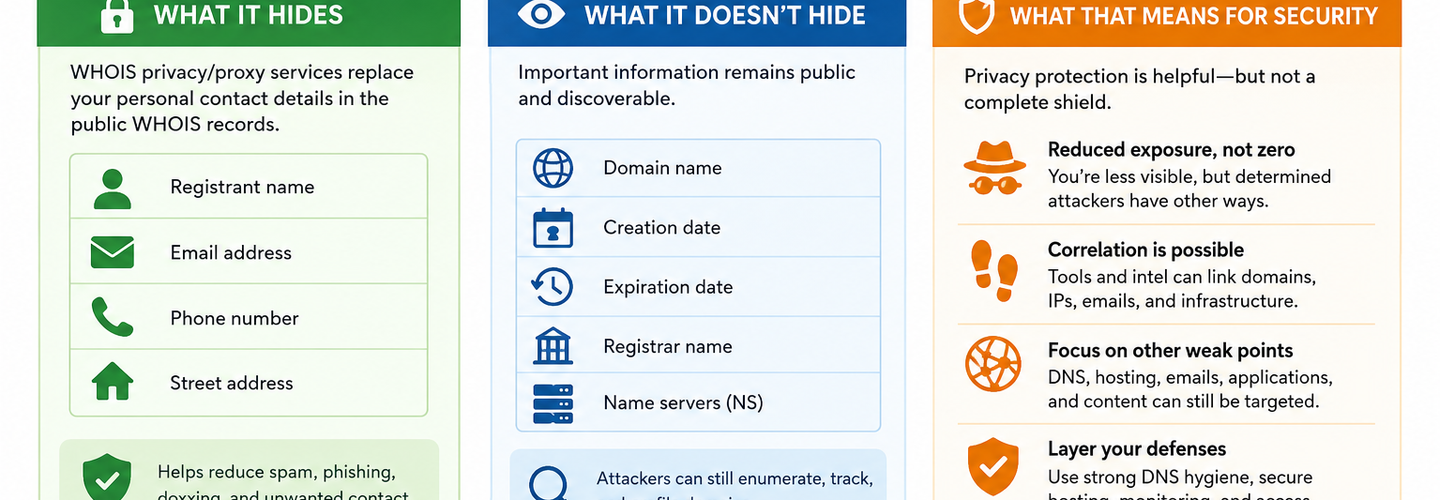
WHOIS Privacy Protection: What It Hides, What It Doesn't, and What That Means for Security
Summarize this blog post with: ChatGPT | Perplexity | Claude | Grok
You've probably seen a WHOIS record where the registrant contact shows a privacy proxy address instead of actual owner details and assumed the domain is either suspicious or simply privacy-conscious — but if you don't understand what WHOIS privacy protection actually hides versus what it leaves fully visible, you're either missing investigative data that's right in front of you or drawing the wrong conclusions from redacted records. WHOIS privacy protection is one of the most misunderstood controls in domain security. In this guide, you'll learn exactly how domain privacy works, what GDPR changed about public WHOIS data, what remains visible even behind full privacy protection, and how this affects both attackers and defenders.
## Key Takeaways
- ▸WHOIS privacy protection (also called domain privacy or proxy registration) replaces a registrant's personal contact data — name, address, email, phone — with generic proxy contact details provided by the registrar's privacy service.
- ▸Privacy protection does not hide the registration metadata that matters most for security investigations — creation date, registrar identity, name servers, EPP status codes, and expiry date all remain fully visible in public WHOIS records.
- ▸GDPR enforcement since 2018 has made privacy-like redaction the default for most domain registrations globally, making privacy proxy enrollment largely redundant for EEA registrants while creating new investigation challenges for security researchers.
- ▸Historical WHOIS archives captured registrant contact data before GDPR and privacy services became widespread — these archives remain accessible and expose pre-privacy-era registration data for a significant fraction of existing domains.
- ▸Privacy protection does not prevent law enforcement, regulators, or vetted security researchers from obtaining underlying registrant data through formal channels — ICANN's SSAD (System for Standardized Access/Disclosure) provides the mechanism.
- ▸Attackers exploit privacy protection not to hide their identity from investigators but to slow the investigation timeline — buying hours or days that allow phishing campaigns to complete before the infrastructure is attributed and blocked.
- ▸Organizations must monitor their own WHOIS records continuously regardless of privacy protection status — because privacy services protect registrant identity, not registration integrity, and do not prevent domain hijacking.
## What Is WHOIS Privacy Protection and How Does It Work?
WHOIS privacy protection is a registrar-offered service that substitutes a domain registrant's actual contact information — name, organization, physical address, email address, and phone number — with the contact details of the registrar's proxy service in the public WHOIS record, while maintaining the actual registrant data in a private database accessible only to the registrar and authorized parties.
The mechanism is straightforward. When a registrant enrolls in privacy protection, the registrar inserts its own proxy contact data into the WHOIS record fields that would otherwise contain the registrant's personal details. Someone querying the WHOIS record sees the registrar's proxy address (typically a generic mailbox like privacy@registrar-privacy-service.com) and the registrar's contact information rather than the actual domain owner's details. The registrar maintains the actual registrant data internally and forwards legitimate contact attempts — abuse reports, legal notices — to the actual owner through its proxy system.
Privacy protection has existed since the early 2000s, initially marketed as protection against spam (real email addresses in WHOIS records were harvested by spammers at scale) and identity exposure (home addresses published for every personal domain owner). Most major registrars offered it as an add-on service for $1–10 per year. Since GDPR, most registrars include privacy-equivalent redaction by default at no additional cost — making explicit privacy service enrollment largely redundant for the contact redaction benefit, though some registrars still offer enhanced proxy services with additional features like abuse report screening. Run a WHOIS lookup on any domain to immediately see whether privacy protection is active and what data remains visible using the ReconShield WHOIS Intelligence tool.
## What Does WHOIS Privacy Protection Actually Hide?
WHOIS privacy protection hides exactly five data fields from public WHOIS records: registrant name, registrant organization, registrant physical address, registrant email address, and registrant phone number. Everything else in the WHOIS record remains unchanged and fully publicly accessible — including the data most operationally useful for security investigations.
The five hidden fields are the ones that identify the legal individual or organization behind a domain registration. Before privacy protection became widespread, these fields could be queried by anyone in the world — enabling both legitimate security research and extensive personal data harvesting by spammers, stalkers, and identity thieves. Privacy protection closed this exposure by replacing personal data with proxy details.
What it does not hide is significant. The creation date — when the domain was first registered — remains visible. The registrar identity — which company sold the registration — remains visible. The name servers — the authoritative DNS servers hosting the domain — remain visible. The EPP status codes — the lock protections on the domain — remain visible. The expiry date — when the registration lapses — remains visible. The updated date — when the record was last modified — remains visible. And for IP address WHOIS lookups, all network block registration data — organization, ASN, network description, abuse contact — remains fully visible regardless of any domain privacy service. For the complete breakdown of what every WHOIS field contains and means for security analysis, the ReconShield WHOIS domain intelligence guide covers every field in operational detail.
## How Did GDPR Change WHOIS Privacy?
GDPR (General Data Protection Regulation) enforcement beginning in May 2018 fundamentally changed the WHOIS privacy landscape by making contact data redaction a legal requirement for EEA-located registrants — effectively mandating WHOIS privacy for European domain owners regardless of whether they enrolled in a privacy service, and causing most major global registrars to extend default redaction to all registrants worldwide for consistency and legal risk management.
Before GDPR, publishing personal registrant data in publicly queryable WHOIS records was the ICANN-required default. Domain owners who wanted privacy had to explicitly purchase and enroll in a privacy protection service. The result was that the majority of domain registrations — particularly those registered before 2015 — contained actual registrant names, addresses, emails, and phone numbers in public WHOIS records.
GDPR reclassified this data as personally identifiable information (PII) subject to data minimization and purpose limitation principles. Publishing personal contact data to a publicly queryable global database with no access controls, no purpose restriction, and no consent mechanism violated multiple GDPR provisions. ICANN adopted a Temporary Specification in May 2018 — later formalized as the Registration Data Policy — requiring registrars to redact personal data from public WHOIS for EEA registrants. Most global registrars immediately applied this redaction universally rather than maintaining separate policies for EEA and non-EEA registrants.
What the ICANN SSAD Replaced Public Access With
The System for Standardized Access/Disclosure (SSAD) is the formal mechanism ICANN established to provide vetted, purpose-limited access to non-public registrant data — replacing the open-access model of pre-GDPR WHOIS with a structured disclosure framework for legitimate use cases including security research, law enforcement, intellectual property enforcement, and abuse investigation.
Through SSAD, accredited requesters — security researchers, law enforcement agencies, intellectual property attorneys, and domain abuse investigators — can submit formal disclosure requests to registrars specifying the domain, the requested data fields, the purpose of the request, and the legal basis for disclosure. Registrars evaluate each request and disclose non-public data where the purpose meets their disclosure criteria. The process is slower than the instantaneous public WHOIS lookup it replaced — typically taking hours to days rather than seconds — but provides a documented, legally defensible pathway to registrant identification when investigation requires it.
## What Remains Visible Behind Privacy Protection?
The registration metadata that remains visible in a privacy-protected or GDPR-redacted WHOIS record is sufficient for the majority of security investigation triage decisions — because the fields that carry the strongest analytical signal for distinguishing malicious from legitimate infrastructure are the ones that privacy protection does not touch.
Creation date and registration age is the single most predictive field for phishing and malware infrastructure identification. Freshly registered domains — particularly those created within 7–30 days of a campaign launch — exhibit a consistent pattern across all categories of malicious infrastructure regardless of whether registrant details are redacted. A domain impersonating a financial institution, created three days ago, with a 1-year registration term, is classifiable as suspicious from these three visible fields alone — no registrant contact data required.
Registrar identity enables clustering analysis even with fully redacted contact fields. Certain registrars are disproportionately represented in malicious domain portfolios due to permissive abuse policies, bulk registration APIs, and cryptocurrency payment acceptance. Identifying that 40 suspicious domains all share the same registrar, the same name server provider, and the same registration window — all visible fields despite privacy protection — is sufficient to attribute them to a common campaign without identifying the individual registrant. The Interisle Consulting Phishing Landscape Report consistently documents that the top 10 registrars by phishing domain volume account for the majority of all phishing registrations globally — a clustering signal that privacy protection does not obscure — Source: Interisle Consulting, 2024.
Name server records expose hosting infrastructure regardless of registrant privacy. Domains sharing the same name server provider — especially name servers associated with bulletproof hosting providers — are clusterable into campaigns and attributable to infrastructure categories even when every registrant contact field is redacted. Audit name server configuration and validate it against live DNS records using the ReconShield DNS Security Analysis tool, which also surfaces email authentication misconfigurations that privacy protection does not address.
## How Do Attackers Exploit Privacy Protection?
Attackers use WHOIS privacy protection not primarily to hide their identity from determined investigators — sophisticated investigators can work around it — but to slow the initial triage and attribution timeline enough for their campaign to complete its objective before being blocked. A phishing campaign that runs for 72 hours before infrastructure is attributed and blocked has often already harvested thousands of credentials. Adding 6–12 hours to the attribution timeline through privacy protection meaningfully extends campaign effectiveness even if it does not ultimately prevent attribution.
The more operationally significant attacker use of domain privacy is obscuring the relationship between domains in a campaign portfolio. Pre-GDPR, a security researcher could identify that 50 malicious domains were registered with the same email address in a single afternoon — immediately revealing the full campaign scope and allowing mass blocking. Post-GDPR, with contact data redacted, the same 50 domains require infrastructure clustering analysis across name servers, IP addresses, registration timing, and certificate data to attribute to a common campaign. This is achievable with the right tools, but it requires more analyst time and more data source correlation than simple registrant email matching.
Registrant email domain reuse was the most common pre-GDPR attribution technique and remains useful for domains registered before 2018. Historical WHOIS archives — which captured registrant data before privacy redaction became widespread — are accessible through commercial platforms and preserve the email address and organizational data that was publicly available at registration time. Attackers who registered their infrastructure before 2018 using real or reused email addresses are still attributable through historical archives despite current privacy protection. For the full passive OSINT methodology that integrates historical WHOIS data with current infrastructure intelligence, the ReconShield passive reconnaissance guide covers the complete multi-source correlation approach.
## Does Privacy Protection Make Your Domain More Secure?
WHOIS privacy protection makes your domain's registrant identity less discoverable to the public but does not improve the security of the domain registration itself — it does not add EPP lock protections, does not secure your registrar account, does not protect name server configurations, and does not prevent domain hijacking. Organizations that conflate registrant privacy with domain security may inadvertently neglect the controls that actually matter.
The domain security controls that matter most are entirely independent of privacy protection status. EPP lock codes — clientTransferProhibited, clientUpdateProhibited, clientDeleteProhibited — protect against unauthorized modification regardless of whether the registrant's name is public or private. Registrar account MFA prevents account compromise regardless of whether the account email is published in WHOIS. Registry-level locks (serverTransferProhibited, serverUpdateProhibited) require out-of-band verification before removal and are immune to registrar account compromise regardless of privacy settings.
A domain with full privacy protection but no EPP locks and no registrar account MFA is significantly less secure than a domain with publicly visible registrant data but registry-level locks, MFA-protected registrar credentials, and automated WHOIS change monitoring. Security is determined by the operational controls on the registration, not by the visibility of the registrant's contact information. Audit your current EPP lock status immediately using the ReconShield WHOIS Intelligence tool — then cross-reference name server integrity with the DNS Security Analysis tool to verify that WHOIS-listed and live name servers match.
## Historical WHOIS Data: What Archives Still Expose
Historical WHOIS archives represent one of the most underestimated intelligence sources in security investigation — because they captured domain registration data before GDPR redaction and privacy services became widespread, preserving the actual registrant names, email addresses, phone numbers, and organizational details that were publicly available for the majority of domain registrations made before 2018.
Commercial historical WHOIS platforms including DomainTools, SecurityTrails, and WhoisXML API maintain archives covering billions of historical domain registration snapshots. These archives allow investigators to query a domain's registration history across time — seeing every registrar transfer, every name server change, every registrant update, and every contact detail that was publicly visible at any point in the domain's history. For domains registered and operated before GDPR, this often means full registrant contact data is archived and searchable regardless of current privacy settings.
The investigative implication is significant. An attacker who registered malicious infrastructure in 2015 using a real email address — when public WHOIS was the default and privacy protection was an explicit opt-in — may have full contact attribution available in historical archives even if their current WHOIS record shows complete privacy redaction. Security researchers investigating long-running threat actor groups or attribution of legacy malware campaigns regularly use historical WHOIS as a primary attribution source precisely because it captures data that current public records no longer expose.
Historical WHOIS data also exposes legitimate organizations' legacy registration details — email addresses of former employees, home addresses used before corporate address standardization, and personal email accounts used for domain management before IT governance matured. Organizations should audit their historical WHOIS footprint and implement additional monitoring and MFA enforcement for any email addresses that appear in pre-GDPR registration records. For the complete investigation workflow that integrates historical WHOIS data with current passive intelligence, the ReconShield Anatomy of Passive OSINT guide covers multi-source data correlation in operational detail.
## Privacy Protection for Organizations: Best Practices
Organizations managing domain portfolios should treat WHOIS privacy protection as one component of a broader domain security program — enabling privacy protection for consistent policy application while simultaneously implementing the operational security controls that determine actual registration security.
Enable privacy protection on all non-corporate domains where publishing personal registrant data serves no legitimate business purpose. For corporate root domains where public organizational contact data is appropriate and legally required in some jurisdictions, configure privacy protection carefully — some regulatory frameworks require publicly visible registrant data for commercial domain operators.
Implement EPP locks regardless of privacy status. Every domain in your portfolio should have clientTransferProhibited, clientUpdateProhibited, and clientDeleteProhibited active as a baseline. Critical corporate domains — root domain, payment portals, authentication endpoints — should additionally have registry-level locks (serverTransferProhibited, serverUpdateProhibited). These locks protect registration integrity whether or not registrant data is public.
Audit your historical WHOIS footprint quarterly. Search commercial historical WHOIS databases for all domains associated with your organization. Identify any personal employee contact data, internal email addresses, or corporate address details in pre-GDPR registration records. Implement additional authentication monitoring for all email addresses appearing in historical records. The ReconShield WHOIS domain intelligence guide covers the complete domain security audit methodology in step-by-step detail.
Monitor your own WHOIS records continuously for unauthorized changes. Privacy protection does not alert you when your name servers are changed, your EPP locks are removed, or your registrar account is accessed. Automated monitoring that compares live WHOIS output against a baseline and alerts on any field change is the only reliable domain hijacking early warning system. Verify your current registration state using the ReconShield WHOIS Checker as your monitoring baseline.
## How Investigators Work Around WHOIS Privacy Protection
Security investigators and threat intelligence analysts work around WHOIS privacy protection through five primary techniques — each leveraging data sources and correlation methods that extract meaningful attribution from records where contact fields are fully redacted.
Infrastructure clustering groups domains by shared technical signals — name servers, IP addresses, certificate issuers, registration timing windows — rather than by registrant contact data. Domains sharing all four signals while impersonating the same brand are attributable to a common campaign with high confidence regardless of privacy protection.
Certificate Transparency correlation links domains through their SSL/TLS certificates. A certificate's Subject Alternative Names frequently reveal multiple domains on the same infrastructure. Certificate issuance patterns — same CA, same issuance date range, same key type — correlate campaign infrastructure without requiring registrant data. Use the ReconShield SSL/TLS Checker to examine certificate SANs for any suspicious domain, revealing related infrastructure that shares the same certificate.
Passive DNS correlation links domains through historical IP resolution data. Multiple domains that have historically resolved to the same IP address are attributable to common hosting infrastructure — allowing campaign mapping even when each domain's registrant is independently privacy-protected.
Registrar abuse channel reporting uses the visible registrar abuse contact in the WHOIS record — which remains publicly listed even when registrant data is redacted — to report malicious domains for suspension. Registrars are contractually obligated under ICANN agreements to investigate and act on credible abuse reports regardless of registrant privacy status.
SSAD formal disclosure requests provide the official pathway for obtaining non-public registrant data when the investigation meets the disclosure criteria — typically reserved for law enforcement, vetted security researchers, and intellectual property enforcement cases where domain suspension requires ownership attribution.
## Tools for WHOIS Privacy Investigation
Investigating domains behind WHOIS privacy protection requires a multi-source passive intelligence approach that extracts maximum value from the visible metadata while correlating across DNS, certificate, IP, and web application data sources:
WHOIS Intelligence Tool — Retrieves the full WHOIS and RDAP record for any domain, clearly displaying what is visible versus redacted. Returns creation date, registrar identity, name servers, EPP status codes, and expiry date — the fields that remain visible regardless of privacy protection and carry the primary investigative signal value.
DNS Security Analysis Tool — Maps the complete DNS record set including name servers, MX records, and TXT records. Validates SPF, DKIM, and DMARC configuration. Cross-references name server data against WHOIS-registered servers to detect unauthorized changes. The ReconShield DNS record types guide covers how to interpret every DNS record type in a security investigation context.
IP Reputation Intelligence Tool — Returns ASN ownership, hosting provider classification, and threat reputation for any IP address associated with a privacy-protected domain — providing hosting infrastructure attribution even when registrant data is fully redacted.
SSL/TLS Checker — Audits TLS certificates and Subject Alternative Names for any domain, revealing related domains on shared certificates and certificate issuance patterns useful for campaign correlation.
Port Scanner — Maps open TCP ports on IP addresses associated with investigated domains, providing service profile data that complements registration and DNS intelligence for infrastructure characterization.
Passive Scanner Suite — Runs the complete non-intrusive infrastructure audit — email authentication, SSL/TLS configuration, HTTP security headers — across any domain, including domains behind full privacy protection.
## What's Next: Registration Data Access in a Post-GDPR World
The WHOIS privacy landscape will continue to evolve as ICANN's Registration Data Policy matures, SSAD operational processes improve, and regional privacy regulations outside the EU extend GDPR-style data protection requirements to additional jurisdictions. The current equilibrium — full public redaction with SSAD-gated disclosure — is likely to persist for the medium term, making multi-source intelligence correlation an increasingly essential competency for security teams.
The investigative techniques that have emerged in response to WHOIS redaction — infrastructure clustering, CT log correlation, passive DNS analysis, ASN attribution — are collectively more powerful than simple registrant email matching was, because they attribute campaign infrastructure rather than individual registrants. A campaign mapped through shared name servers, IP hosting blocks, and certificate issuance patterns is more comprehensively attributed than a campaign linked only by a shared registration email that the attacker may have fabricated.
For organizations managing domain security programs, continuous WHOIS monitoring remains essential regardless of how privacy policies evolve — because the fields that matter for detecting domain hijacking (name servers, EPP status codes, registrar changes) have never been subject to privacy redaction and are always publicly visible. The ReconShield WHOIS Intelligence tool provides the foundational lookup capability for both manual investigation and continuous monitoring baseline establishment.
## Conclusion
WHOIS privacy protection is a legitimate, valuable tool for protecting personal data published in domain registration records — and its widespread adoption through GDPR-mandated redaction has meaningfully reduced personal data exposure in a system that was never designed with privacy in mind. But it is not a security control, and it does not hide the registration metadata that carries the majority of investigative signal value.
Creation dates, registrar identities, name servers, and EPP status codes are visible in every WHOIS record regardless of privacy protection. Multi-source correlation across DNS, certificate, and IP intelligence produces campaign attribution from these visible signals alone. And privacy protection does absolutely nothing to protect a domain against hijacking — that requires EPP locks, registrar account MFA, and continuous monitoring.
Audit your own domain portfolio now using the ReconShield WHOIS Checker. Enable EPP locks on every domain. Cross-reference name servers with the DNS Security Analysis tool. Then run the passive scanner suite for the complete external security posture picture.
Written by Surendra Reddy Cybersecurity Researcher & Founder, ReconShield. Surendra specializes in OSINT, exposure intelligence, and AI-driven threat analysis. Author Profile →
Reviewed by ReconShield Editorial Team — Peer-reviewed for accuracy against ICANN Registration Data Policy, GDPR enforcement guidance, and current WHOIS/RDAP specifications.
## Analyst Commentary & Implementation Blueprint
Security advisory
Continuous security exposure assessment is critical to identifying public vulnerabilities before they are exploited. Organizations should maintain a passive inventory of all web servers, TLS configs, and open ports, ensuring that default configurations are eliminated and security advisories are actively implemented.
Hardened Security Configuration Blueprint
# General Security Hardening Directive
ServerTokens ProductOnly
ServerSignature Off
FileETag None
Actionable Mitigation Checklist
- ✔Perform passive asset inventories weekly.
- ✔Restrict administrative ports using local firewall controls.
- ✔Monitor active CVE alerts for exposed software.
Common Inquiries & FAQs
Why is passive scanning preferred for continuous auditing?
Passive audits do not cause operational impact or trigger firewall blocks, making them ideal for constant surveillance of internet-facing assets.
What should I do if a vulnerability is flagged?
Apply the latest vendor patches, restrict access to the resource via firewalls, or verify configuration flags to mitigate risks.
Surendra Reddy
Surendra Reddy is a cybersecurity researcher and founder of ReconShield, specializing in OSINT and defensive infrastructure analysis.
Connect on LinkedIn ↗// AUDIT BRIEFING DISCUSSION (2 COMMENTS)
Great breakdown of the passive infrastructure vectors. We recently audited our external DNS zones and found multiple dangling staging environments. Implementing wildcard certificates reduced our CT log leaks significantly.
Is there any automated tooling you recommend for daily crt.sh scraping? Manually checking CT logs is becoming unsustainable for our domain portfolio.
// MORE ARTICLES
Security Researchers Warn Critical n8n Flaws May Expose Automation Platforms to RCE
Researchers have disclosed critical vulnerabilities in n8n that could expose automation workflows and connected enterprise systems to remote code execution risks, prompting urgent patch recommendations for users and administrators.

How Agentic AI Is Changing Software Engineering and Expanding Mobile Attack Surfaces
Agentic AI is rapidly transforming software engineering workflows through automation and intelligent coding assistance, while cybersecurity experts warn of expanding mobile attack surfaces and emerging application security risks.
SplitVPN Hacked: Data Breach Exposes 865,000 User Records and 58 Million Hidden Connection Logs (July 2026)
SplitVPN hacked: 865,336 user records and 58 million connection logs exposed, directly contradicting the VPN's "no-logs" promise. What was leaked and what to do now.