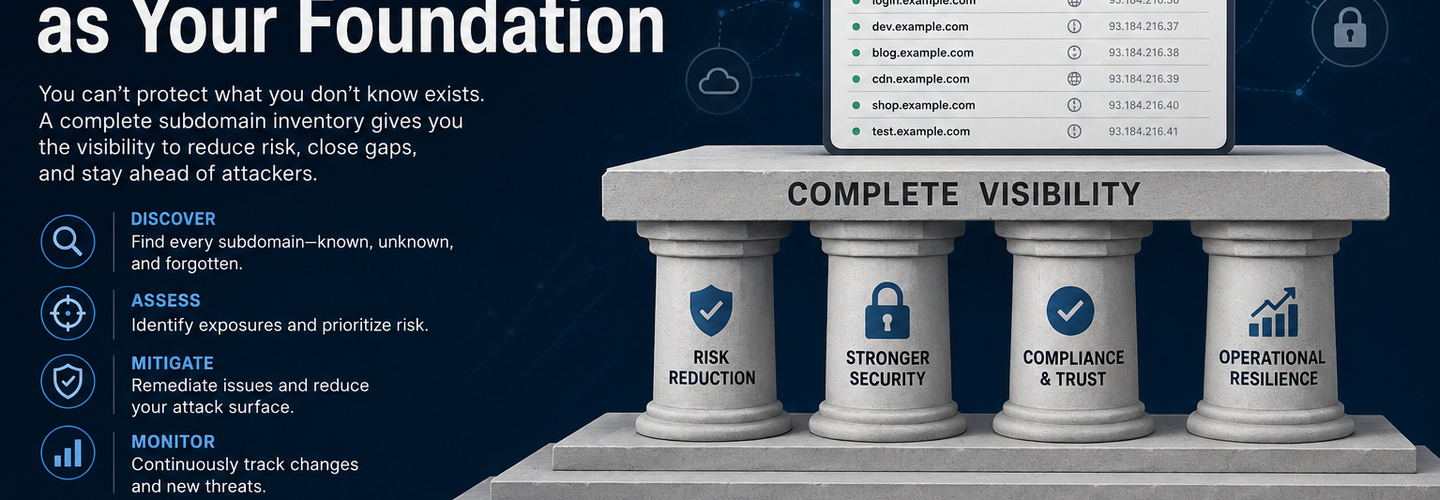
Attack Surface Management Guide: Subdomain Inventory as Your Foundation
Organizations spend billions annually on perimeter security, endpoint protection, and vulnerability scanning — yet remain exposed to attacks through subdomains, forgotten infrastructure, and internet-facing assets that aren't even in their internal inventory. The reason is structural: traditional security programs are built around defending known infrastructure. Attack surface management (ASM) is built around discovering and continuously monitoring everything that's actually exposed to the internet, whether or not the organization formally acknowledged it exists. For most organizations, the gap between "known assets" and "actual internet-facing assets" is massive — often an order of magnitude. In this guide, you'll learn what attack surface management is, why subdomain discovery is the operational foundation, how to build a continuous ASM program, and what the metrics are for measuring success.
## Key Takeaways
- ▸Attack Surface Management (ASM) is the continuous discovery, inventory, and monitoring of all internet-facing assets an organization operates or controls — including forgotten infrastructure, third-party dependencies, and infrastructure launched without formal security review.
- ▸The average organization discovers 10–100x more subdomains through passive reconnaissance than exist in their official asset inventory — representing a massive visibility gap that attackers exploit routinely.
- ▸Subdomain discovery is the operational foundation of ASM because subdomains represent the organization's internet-facing services, APIs, cloud deployments, and third-party integrations — the perimeter that actually faces attack.
- ▸Continuous monitoring for new subdomains, certificate changes, DNS modifications, and port exposure changes is essential because infrastructure changes happen daily while most security teams conduct audits quarterly.
- ▸Orphaned subdomains — DNS records pointing to decommissioned cloud services — are the highest-severity subdomain exposure because they enable direct takeover attacks with minimal effort.
- ▸ASM programs that integrate subdomain discovery with port scanning, vulnerability scanning, and threat intelligence generate 80–90% of the intelligence needed for effective risk prioritization without requiring internal network access.
- ▸Organizations implementing continuous ASM programs reduce their time-to-remediation for exposed assets by 60–70% compared to quarterly vulnerability assessment cycles.
## What Is Attack Surface Management?
Attack surface management is the continuous process of discovering, cataloging, prioritizing, and monitoring all external-facing assets an organization operates or controls — including domains, subdomains, IP addresses, cloud services, APIs, third-party integrations, and any other systems accessible from the public internet. The goal is to maintain a real-time, comprehensive inventory of what's exposed to attack.
The term "attack surface" refers to the sum of all potential vulnerabilities and entry points that an attacker could exploit. A traditional security program focuses on defending the attack surface by patching vulnerabilities and enforcing access controls on known systems. ASM focuses on visibility of the attack surface — ensuring that nothing is unknown or invisible to the organization, and that changes to the attack surface are detected immediately.
The distinction matters operationally. A vulnerability scanner connected to the internal network can scan systems that the network team knows about. But if a developer provisioned a test API endpoint on a cloud platform two months ago and never told the security team, the vulnerability scanner will never see it. That endpoint remains exposed, unpatched, and potentially vulnerable. ASM discovers it through passive reconnaissance, surfaces it, and brings it under management.
The Visibility Gap: Known Assets vs. Actual Assets
The gap between assets an organization officially inventories and assets actually exposed to the internet is the core problem ASM solves. Surveys consistently show organizations discover 10–100x more subdomains and IP ranges through passive reconnaissance than exist in their official asset inventory.
This visibility gap occurs because:
Infrastructure sprawl. Modern organizations run infrastructure across multiple cloud providers, regions, and platforms. A single AWS account might host dozens of services provisioned by different teams without centralized tracking. VPC subnets, Lambda functions, Elastic Beanstalk environments, and S3 buckets are all possible infrastructure vectors that may never be formally added to an asset inventory.
Third-party dependencies. SaaS platforms, CDNs, email providers, and other third-party services often require DNS records or cloud service accounts pointing to the organization's domain. Each third-party integration creates internet-facing exposure that the security team may not be aware of.
Forgotten infrastructure. Test environments, sandbox deployments, and proof-of-concept projects launched during product evaluations frequently remain running months or years after their original purpose ends. These abandoned systems accumulate technical debt and often run outdated, unpatched software.
Organizational changes. Acquisitions, spin-offs, and organizational restructuring often leave infrastructure from acquired companies still running under the parent company's domains but not formally inventoried by the acquiring organization.
Lack of centralization. In organizations large enough to have multiple engineering teams, infrastructure is often provisioned without a formal change control or asset registry process. Teams are incentivized to deploy quickly, not to maintain a comprehensive asset inventory.
Passive subdomain discovery using Certificate Transparency logs and DNS aggregators bypasses all of these organizational and technical barriers to visibility. Every subdomain that received an SSL certificate appears in the logs, regardless of whether an asset inventory includes it.
## Why Subdomain Discovery Is the Foundation of ASM
Subdomain discovery is the operational foundation of attack surface management because subdomains represent the organization's internet-facing services, APIs, cloud deployments, and third-party integrations — the actual perimeter that faces attack. Every major attack surface assessment framework places subdomain enumeration as the first and highest-priority reconnaissance technique.
A subdomain is effectively a pointer to infrastructure. When an attacker discovers api.example.com, they've discovered an API endpoint. When they discover mail.example.com, they've identified email infrastructure. When they discover admin-panel.example.com, they've found administrative interface exposure. Each subdomain represents a potential attack vector that the organization either didn't know was exposed or didn't realize was discoverable.
Subdomain discovery is prioritized in ASM programs because:
Coverage. Subdomain discovery reaches every internet-facing service that has received an SSL certificate, including infrastructure that doesn't appear in DNS, doesn't accept HTTP requests, or is configured to be invisible to web crawlers.
Passivity. Subdomain discovery through Certificate Transparency logs and DNS aggregators is completely passive — zero packets sent to the target, zero detection risk, zero operational footprint. It works against any target regardless of their security posture.
Scale. Subdomain discovery discovers hundreds to thousands of assets per organization in a single query. No other reconnaissance technique achieves this scale without generating detectable traffic.
Continuity. Certificate issuance and DNS changes happen continuously. Continuous subdomain monitoring alerts security teams to new infrastructure the same day it goes online, enabling rapid assessment and remediation before the infrastructure becomes a known-bad pattern in threat feeds or a target in active scanning campaigns.
The relationship between subdomains and ASM is foundational: you cannot manage your attack surface if you don't know what subdomains represent your internet-facing infrastructure. Subdomain discovery is the starting point. Port scanning, vulnerability scanning, and threat intelligence assessment are follow-on steps that depend on subdomain inventory accuracy.
## Building an Attack Surface Management Program
Building an effective ASM program requires moving from reactive, periodic security assessments to continuous, automated discovery and monitoring of external-facing assets. The program architecture follows a consistent pattern: discovery, inventory, assessment, monitoring, and remediation.
Phase 1: Initial External Asset Discovery
The starting point is a comprehensive baseline of everything currently exposed. This phase uses all available passive reconnaissance sources:
Subdomain discovery. Query Certificate Transparency logs, WHOIS history, DNS aggregators, and passive DNS databases to build an initial list of all subdomains. Use ReconShield's passive subdomain finder to conduct this in a single query — typically returning 500–5,000 subdomains for a mid-size organization.
IP and ASN enumeration. Identify all IP address ranges owned or leased by the organization, including ranges assigned to cloud providers (AWS, Azure, Google Cloud, Akamai, Cloudflare). Cross-reference with registrar records and BGP data.
Cloud service discovery. Identify all cloud service accounts and deployments — S3 buckets, Azure Blob Storage, Google Cloud Storage, Lambda functions, App Services, etc. These are frequently discovered through subdomain names pointing to cloud infrastructure, through DNS CNAME records, and through threat intelligence feeds that index misconfigured cloud resources.
Third-party integrations. Identify all third-party services that have received DNS records or cloud resources under the organization's domain — email providers, CDNs, analytics platforms, etc.
Historical records. Query WHOIS history, domain registration history, and certificate history to identify acquisitions, domain portfolio changes, and related domains that may still host infrastructure.
This baseline phase typically takes 1–2 weeks for a comprehensive effort and produces a detailed inventory of actual internet-facing assets — far more comprehensive than any internal asset registry is likely to be.
Phase 2: Assessment and Prioritization
Once the baseline inventory is complete, assess and prioritize the discovered assets:
Port scanning. For every IP address and subdomain, conduct port scanning to identify open ports and running services. Use ReconShield's TCP port analyzer to identify exposure without aggressive scanning that could disrupt services.
Service identification. Identify the specific services running on open ports — web servers, mail servers, SSH services, databases, etc. Cross-reference against known vulnerability databases.
Vulnerability assessment. For each identified service, check vulnerability databases and threat intelligence feeds for known vulnerabilities affecting that service version.
Certificate assessment. Review SSL/TLS certificates for validity, cipher suite strength, and certificate chain integrity. Use ReconShield's SSL/TLS checker to assess cryptographic posture.
Threat intelligence assessment. Cross-reference every discovered IP address and domain against threat intelligence feeds to determine whether the infrastructure is already known to be compromised, hosting malicious content, or listed in blocklists. Use ReconShield's IP reputation tool for this assessment.
This assessment phase produces a prioritized list of assets ranked by risk — highest priority assets are those that are both exposed and known to have exploitable vulnerabilities.
Phase 3: Continuous Monitoring and Change Detection
The difference between a one-time assessment and an ASM program is continuous monitoring. ASM programs automatically detect changes to the attack surface and alert security teams to new exposure.
Set up automated, continuous monitoring for:
New subdomains. Query Certificate Transparency logs daily for new certificates issued to your domain. Alert whenever new subdomains appear. This reveals when new infrastructure is provisioned or when third-party services acquire certificates covering your domain.
DNS changes. Monitor for additions, modifications, and deletions of DNS records (A, AAAA, CNAME, MX, TXT, NS records). Alert on changes that create or modify internet-facing exposure.
Certificate changes. Monitor for certificate issuance, expiry, and revocation. Alert when certificates that were previously issued are no longer appearing in new issuances (potential decommissioning that may leave orphaned DNS records).
Port changes. Periodically re-scan known IP addresses to detect newly opened ports that represent new service exposure.
Threat intelligence updates. Subscribe to threat feeds and continuously check discovered IPs and domains against new threat listings.
The frequency of monitoring varies by organizational risk profile:
- ▸New subdomains: Daily (alerts same-day)
- ▸DNS changes: Daily to weekly
- ▸Certificate changes: Daily to weekly
- ▸Port changes: Weekly to monthly
- ▸Threat intelligence: Continuous (real-time streaming feeds) to weekly (batch feeds)
Organizations with mature ASM programs run continuous monitoring on all vectors, enabling rapid response to new exposure.
Phase 4: Remediation and Decommissioning
When ASM monitoring detects new exposure or finds assets that are vulnerable, the program includes:
Notification workflows. Alert the responsible team (engineering, infrastructure, cloud security) immediately when their assets are discovered to be exposed or vulnerable.
Validation. Confirm that newly discovered assets are authorized — it's possible (though rare) that discovered assets are not actually owned by the organization (DNS hijacking, misconfiguration).
Remediation. For exposed or vulnerable assets, develop and execute remediation plans — patching, reconfiguration, or decommissioning.
Decommissioning. For infrastructure that's no longer in use, execute formal decommissioning — removing DNS records, canceling cloud services, revoking certificates, and removing from inventory.
Documentation. Update asset inventory and document why assets were added, why they're exposed, and what their business purpose is.
Phase 5: Metrics and Reporting
Mature ASM programs track metrics that define program health and maturity:
Asset count. Total number of discovered external-facing assets. Track the trend — is asset count growing faster than the organization's growth (suggesting infrastructure sprawl) or aligned with growth?
Coverage ratio. Ratio of discovered assets to assets in official inventory. A ratio of 5:1 or higher indicates significant visibility gaps.
Time-to-remediation. Average time from asset discovery to vulnerability remediation. Mature programs achieve remediation within days; immature programs take weeks or months.
Critical exposure count. Number of currently exposed, exploitable vulnerabilities. Trend this over time — programs should see this count decreasing as remediation processes mature.
Unauthorized asset detection. Number of assets discovered that the organization doesn't recognize — indicates shadow IT, rogue infrastructure, or account compromise.
## ASM Frameworks and Standards
Multiple frameworks guide ASM program development, each emphasizing different aspects of the attack surface management process.
NIST Cybersecurity Framework: Asset Management and External Risk Management
The NIST Cybersecurity Framework includes "Asset Management" (ID.AM category) and "External Systems" (ID.BE category) functions that directly align with ASM requirements. The framework requires organizations to:
- ▸Maintain an inventory of authorized and unauthorized devices and software
- ▸Identify systems and assets that require protection
- ▸Understand the organization's external dependencies and critical services provided by third parties
These requirements operationalize to ASM practices: maintain external asset inventory, identify what's exposed, understand third-party risk.
ISO 27001: Information Asset Inventory and Inventory Control
ISO 27001 requires organizations to identify and maintain an inventory of information assets. The standard implicitly includes external-facing assets — if an asset is exposed to the internet, it's in scope for information security management.
OWASP: Testing Methodology and Reconnaissance
OWASP's testing methodology places reconnaissance and mapping as the first phase of security testing, specifically including:
- ▸Passive reconnaissance (CT logs, WHOIS, DNS aggregators)
- ▸Active reconnaissance only after passive sources are exhausted
CIS Controls: Asset and Software Inventory
CIS Controls 1 and 2 require organizations to maintain accurate inventories of hardware assets and software assets. While CIS doesn't specifically mandate external asset discovery, it requires completeness — which implicitly includes assets discoverable through external reconnaissance.
Zero Trust Architecture: Inventory of All Assets
Zero Trust architecture requires complete asset visibility as a precondition — you cannot enforce "verify every access" if you don't know all the assets that might grant access. ASM is foundational to Zero Trust implementation.
## Common ASM Challenges and Solutions
Challenge 1: The Visibility Gap Shock
When organizations first conduct passive reconnaissance, they typically discover 10–100x more assets than their internal inventory contains. This creates initial shock and skepticism — "we can't have that many assets, the tool must be wrong."
Solution: Validate discovered assets systematically. For each discovered subdomain, verify the associated infrastructure actually exists and is operated by the organization. Most "false positives" turn out to be real infrastructure that the organization forgot about. Use this as an opportunity to update official asset inventory and understand why the gap existed.
Challenge 2: Prioritization Paralysis
With thousands of newly discovered assets and limited security resources, organizations face paralysis deciding which to remediate first.
Solution: Prioritize by exploitability and business impact. Use vulnerability scanning, threat intelligence, and business context (is this asset business-critical?) to create a risk-ranked queue. Address the most critical exposure first, then work through the rest systematically. Many organizations find that only 5–10% of discovered assets require urgent remediation — the rest have lower priority or are decommissioned quickly once visible.
Challenge 3: Alert Fatigue from Monitoring
Continuous monitoring generates numerous alerts — some real issues, many false positives or lower-priority items. Alert fatigue leads to alerts being ignored.
Solution: Tune alerts based on organizational risk tolerance. For new subdomains, alert on everything initially, then refine rules over time. For port changes, differentiate between expected changes (authorized deployments) and unexpected changes (potential unauthorized access). Use alert suppression for known, authorized changes.
Challenge 4: Attribution of Responsibility
When a newly discovered asset is found to be exposed, it may not be clear who owns it or is responsible for remediation. Large organizations may have dozens of teams operating infrastructure.
Solution: Implement automatic attribution based on domain ownership, IP registration, and DNS record metadata. When automatic attribution fails, escalate to infrastructure/cloud security teams for manual attribution. Once responsibility is assigned, make the responsible team aware of ASM findings and hold them accountable for remediation.
## The Role of Subdomain Finder Tools in ASM
Professional ASM programs use dedicated subdomain finder tools as their primary data source for initial discovery and continuous monitoring. These tools provide:
Comprehensiveness. Querying Certificate Transparency logs, WHOIS history, and DNS aggregators in a single tool produces more complete results than manual queries to each source.
Automation. Continuous monitoring for new certificates, DNS changes, and subdomain appearance requires automated workflows that tools like ReconShield's subdomain finder provide natively.
Correlation and deduplication. Tools cross-reference multiple data sources and deduplicate results, preventing false positives from data source overlaps.
Actionable intelligence. Tools provide not just subdomain names but associated metadata — certificate dates, DNS resolution status, IP addresses, threat intelligence context.
Integration with downstream tools. Tools that feed discovered subdomains into port scanning, vulnerability scanning, and threat intelligence assessment create automated workflows that move from discovery to remediation.
ReconShield's subdomain finder integrates with port scanning, DNS analysis, IP reputation checking, and vulnerability scanning to create a complete ASM workflow within a single platform.
## Measuring ASM Program Maturity
ASM program maturity progresses through stages, from one-time assessments to continuous, automated discovery and remediation workflows.
Stage 1: Ad-Hoc Assessment
Initial state: Manual, one-time security assessments conducted quarterly or annually. No continuous monitoring.
Metrics: Periodic reports of discovered vulnerabilities.
Time-to-remediation: Weeks to months.
Stage 2: Periodic Discovery
State: Quarterly or semi-annual external asset discovery using tools, but no continuous monitoring.
Metrics: Quarterly asset inventory updates, trend analysis of asset growth.
Time-to-remediation: 1–4 weeks.
Stage 3: Continuous Discovery
State: Automated daily or weekly discovery of new subdomains and infrastructure changes, with alerts to responsible teams.
Metrics: Time-to-alert for new infrastructure (same-day), remediation tracking per asset, coverage ratio of discovered vs. inventory.
Time-to-remediation: 3–7 days.
Stage 4: Continuous Discovery + Assessment
State: Automated discovery plus automated assessment — new assets are automatically port-scanned, vulnerability-assessed, and threat-intelligence-checked.
Metrics: Risk score per asset, automated prioritization queue, SLA-driven remediation tracking.
Time-to-remediation: 1–3 days for critical exposure.
Stage 5: Continuous Full ASM Lifecycle
State: Automated discovery, assessment, monitoring, remediation, and decommissioning. New infrastructure is automatically onboarded into security controls. Decommissioned infrastructure is automatically removed from inventory.
Metrics: Mean time-to-remediation in hours, proactive decommissioning of aged assets, trend toward zero critical exposure.
Time-to-remediation: Hours to next business day for critical exposure.
Most organizations today are in Stage 2–3. Stage 4–5 programs remain rare but are becoming increasingly necessary as attack surface complexity grows.
## Conclusion
Attack surface management is not a specific tool or technology — it's a fundamental shift in how organizations approach security visibility. Rather than defending known infrastructure, ASM discovers and continuously monitors everything actually exposed to the internet, whether or not the organization formally acknowledges it.
Subdomain discovery is the operational foundation of this shift. Every major attack, from API breaches to cloud infrastructure compromise, begins with an attacker discovering infrastructure through passive reconnaissance. Organizations that have already mapped their own external exposure can quickly identify new infrastructure and assess risk. Organizations that haven't remain vulnerable to attackers who discover their infrastructure for them.
Start with ReconShield's passive subdomain finder to conduct your initial asset discovery — a completely passive, comprehensive baseline of every subdomain your organization has exposed to the internet. Then build from there: cross-reference with port scanning, assess with vulnerability scanning, check threat context with IP reputation, and validate DNS configuration with DNS analysis. The complete workflow moves from discovery to assessment to prioritization to remediation — the foundation of a mature attack surface management program.
Written by Surendra Reddy Cybersecurity Researcher & Founder, ReconShield. Surendra is a cybersecurity engineer specializing in Open Source Intelligence (OSINT), exposure intelligence, and AI-driven threat analysis. He built ReconShield to democratize access to enterprise-grade infrastructure visibility tools and secure digital internet-facing assets.
Reviewed by ReconShield Editorial Team
## Analyst Commentary & Implementation Blueprint
Security advisory
Continuous security exposure assessment is critical to identifying public vulnerabilities before they are exploited. Organizations should maintain a passive inventory of all web servers, TLS configs, and open ports, ensuring that default configurations are eliminated and security advisories are actively implemented.
Hardened Security Configuration Blueprint
# General Security Hardening Directive
ServerTokens ProductOnly
ServerSignature Off
FileETag None
Actionable Mitigation Checklist
- ✔Perform passive asset inventories weekly.
- ✔Restrict administrative ports using local firewall controls.
- ✔Monitor active CVE alerts for exposed software.
Common Inquiries & FAQs
Why is passive scanning preferred for continuous auditing?
Passive audits do not cause operational impact or trigger firewall blocks, making them ideal for constant surveillance of internet-facing assets.
What should I do if a vulnerability is flagged?
Apply the latest vendor patches, restrict access to the resource via firewalls, or verify configuration flags to mitigate risks.
Surendra Reddy
Surendra Reddy is a cybersecurity researcher and founder of ReconShield, specializing in OSINT and defensive infrastructure analysis.
Connect on LinkedIn ↗// AUDIT BRIEFING DISCUSSION (2 COMMENTS)
Great breakdown of the passive infrastructure vectors. We recently audited our external DNS zones and found multiple dangling staging environments. Implementing wildcard certificates reduced our CT log leaks significantly.
Is there any automated tooling you recommend for daily crt.sh scraping? Manually checking CT logs is becoming unsustainable for our domain portfolio.
// MORE ARTICLES
Security Researchers Warn Critical n8n Flaws May Expose Automation Platforms to RCE
Researchers have disclosed critical vulnerabilities in n8n that could expose automation workflows and connected enterprise systems to remote code execution risks, prompting urgent patch recommendations for users and administrators.

How Agentic AI Is Changing Software Engineering and Expanding Mobile Attack Surfaces
Agentic AI is rapidly transforming software engineering workflows through automation and intelligent coding assistance, while cybersecurity experts warn of expanding mobile attack surfaces and emerging application security risks.

₹250 Crore Cyber Scam Busted: Gujarat Police Arrest 19, Including MBA Student
Gujarat Police bust a ₹250 crore cyber fraud network, arresting 19 including an MBA student. Here's how the mule account scam worked.