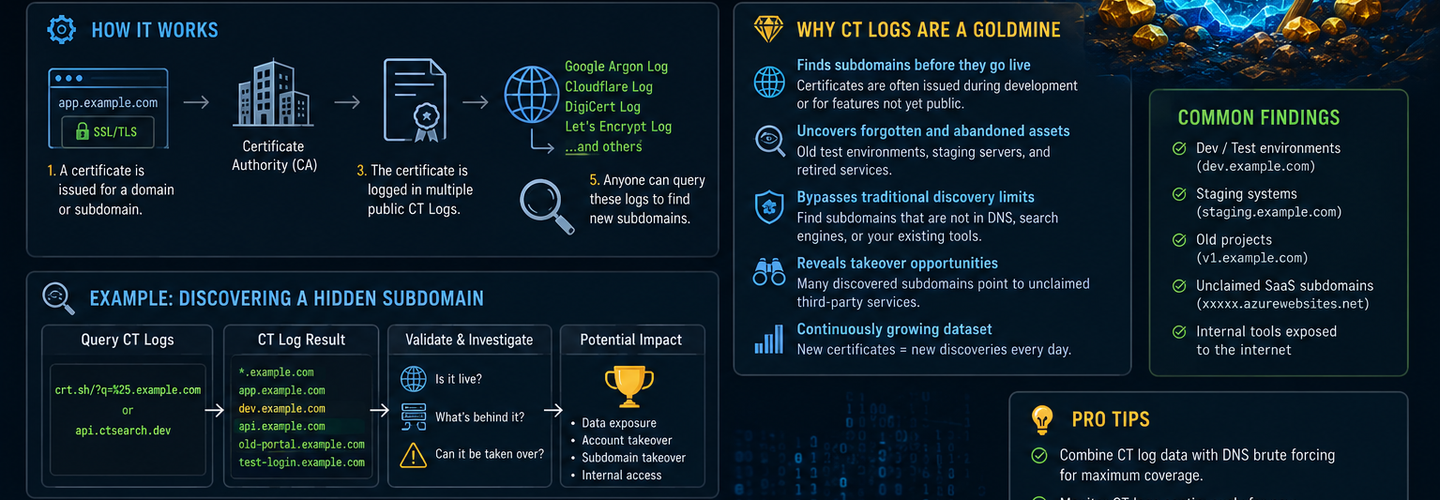
Certificate Transparency Logs Explained: The Hidden Goldmine of Subdomain Discovery
Every SSL/TLS certificate issued for a public domain is automatically logged in a public, searchable database designed to detect fraudulently issued certificates. Yet most organizations have no idea that this same transparency mechanism — Certificate Transparency logs — is simultaneously the single richest source of subdomain intelligence available to security researchers. A domain's certificate history reveals not just the subdomains currently in use, but every subdomain that has ever received a certificate — including development environments, staging servers, forgotten infrastructure, and decommissioned services that still have live DNS records. In this guide, you'll learn exactly how Certificate Transparency logs work, why they expose hidden subdomains at scale, how to query them passively without any target interaction, and how professional security teams use this intelligence to map complete attack surfaces.
## Key Takeaways
- ▸Certificate Transparency (CT) logs are publicly searchable databases where every SSL/TLS certificate issued by a publicly trusted Certificate Authority must be logged — enabling anyone to discover which subdomains have received certificates, even if those subdomains are no longer actively advertised.
- ▸A single domain frequently has 10–100x more subdomains in CT log history than appear in active DNS — including development, staging, internal tools, API endpoints, and third-party integrations that were never intended to be publicly discoverable.
- ▸CT log queries are completely passive — they query public archives, not the target domain's servers — making subdomain discovery through CT logs invisible to the target's security monitoring.
- ▸Orphaned subdomains — CNAMEs pointing to deprovisioned cloud services with CT certificates still in the logs — represent the highest-value attack surface vulnerability for most organizations because they can be claimed by any attacker who registers the underlying service.
- ▸Professional subdomain finder tools query CT logs as their primary data source because CT logs are more comprehensive, more current, and more actionable than DNS-based enumeration or web crawling alone.
- ▸Organizations that conduct regular CT log audits consistently discover subdomains their internal asset inventories have no record of — the "unknown unknowns" that represent exploitable external exposure.
- ▸Combining CT log results with DNS queries, IP reputation checks, and port scanning creates a complete, automated subdomain reconnaissance workflow that requires zero packets sent to the target.
## What Are Certificate Transparency Logs?
Certificate Transparency (CT) logs are publicly accessible, append-only databases maintained by browser vendors, certificate authorities, and independent operators, where every SSL/TLS certificate issued by a publicly trusted Certificate Authority (CA) must be logged before the certificate is trusted by web browsers. This requirement was implemented globally by Google Chrome and other browsers starting in 2013 as a defense against fraudulently issued certificates — a concern that became critical after several CAs were compromised or coerced into issuing unauthorized certificates.
The transparency requirement fundamentally changed the landscape of certificate visibility. Before CT logs existed, certificate issuance was a bilateral transaction between the certificate requester and the CA — nobody else knew which certificates had been issued. With CT logs, every certificate enters a permanent, public record that anyone can query. This transparency serves its intended purpose brilliantly: fraudulent certificates are now discoverable within minutes, and certificate-based attacks that relied on secrecy are immediately visible.
What wasn't fully anticipated when CT logs were standardized is that this same transparency mechanism would become the most comprehensive source of subdomain intelligence available to security researchers. Every subdomain that receives an SSL certificate — whether it's currently in active DNS or not — leaves a permanent record in one or more CT logs. For organizations that issue certificates to large subdomain inventories — which includes virtually every enterprise with any infrastructure complexity — the CT log record reveals far more about their network architecture than they may realize or intend to make public.
How Certificate Transparency Logs Are Structured
Certificate Transparency logs are organized as cryptographically verifiable append-only merkle trees, where each certificate entry includes the certificate content (including all SANs — Subject Alternative Names, i.e., every subdomain covered by the certificate), the timestamp of issuance, and the CA that issued the certificate. Multiple independent CT logs are maintained by competing operators — Google, Cloudflare, DigiCert, Sectigo, and others — and certificates must appear in at least one log (often multiple) to be trusted by browsers.
The append-only structure is cryptographically enforced: once a certificate is logged, it cannot be removed or modified. This immutability is intentional — it prevents malicious actors from erasing evidence of fraudulent certificates. As a side effect, it also means that every subdomain ever issued a certificate remains discoverable indefinitely, even if the certificate has expired, the subdomain is no longer in use, or the organization has gone to great lengths to delete DNS records pointing to it.
Search engines and research platforms like crt.sh, Censys, Shodan, and Rapid7's Project Sonar continuously crawl and index CT logs, making historical certificate data searchable within minutes of issuance. Professional subdomain finder tools query these indexes as their primary data source, because CT logs are more comprehensive, more current, and far more revealing than any other single intelligence source.
## Why Certificate Transparency Logs Expose More Subdomains Than DNS
Certificate Transparency logs reveal hidden subdomains because organizations frequently issue certificates to infrastructure they want to be confidential — development and staging environments, internal APIs, admin panels, third-party integrations — without ever intending those subdomains to appear in public DNS records. The assumption that keeping a subdomain out of DNS makes it secret is fundamentally incompatible with the reality of CT logs.
The typical pattern: a developer provisions a staging server at staging.example.com, requests an SSL certificate (necessary for modern browsers to accept HTTPS connections without warnings), and the certificate issuer logs it to the CT log as required by the Baseline Requirements. The developer may configure DNS to not resolve the domain, or may point it to a private IP only accessible from the corporate network. But the certificate — and the subdomain name embedded in it — is now in the public CT log forever, discoverable by anyone who queries the logs.
Multiply this pattern across an organization with hundreds of engineers, multiple cloud deployments, numerous third-party tools, and frequent infrastructure changes — which is the reality for any enterprise organization — and the gap between "known" subdomains and "subdomains in CT logs" grows rapidly. Organizations routinely discover that CT logs reveal 10–100x more subdomains than their official asset inventory contains. Use ReconShield's passive subdomain finder to query Certificate Transparency logs directly and see the extent of your own organization's hidden subdomain inventory.
The Shelf Life Problem: Certificates Age, Subdomains Don't
Once a certificate is issued and logged, the certificate eventually expires — typically after 90 days for Let's Encrypt DV certificates, or up to 3 years for traditional CAs — but the subdomain name remains in the CT log forever. This creates a persistent inventory of infrastructure that may or may not still be in use. If the organization renews the certificate, there are new log entries. If the organization lets the certificate expire without renewing it, the expired certificate remains logged indefinitely.
From an attacker's perspective, an expired certificate for a subdomain is actually more valuable than an active one in many cases. It proves the subdomain existed, identifies the underlying hosting provider or infrastructure type, and — crucially — may point to infrastructure that has been decommissioned and forgotten. Decommissioned infrastructure frequently retains DNS records, cloud resources, and sometimes even active listening ports. A forgotten API server running on api-v1.example.com that was decommissioned two years ago but still has a DNS CNAME pointing to an AWS endpoint is a perfect target because most security scanning is focused on active, monitored infrastructure.
## How to Query Certificate Transparency Logs Passively
Querying Certificate Transparency logs is completely passive — the queries go to public archives maintained by third parties, not to the target domain or any of its infrastructure — making CT log queries invisible to firewalls, IDS systems, or any security monitoring the target has deployed. This fundamental property makes CT logs the most actionable intelligence source available for initial reconnaissance.
Using crt.sh: The Most Direct CT Log Interface
The simplest and most direct way to query Certificate Transparency logs is through crt.sh, a free, publicly accessible Certificate Transparency search engine maintained by Sectigo. The interface is minimal: enter a domain name, and crt.sh returns every certificate in the CT logs matching that domain.
The query format is straightforward: crt.sh?q=%25.example.com&output=json returns all certificates for subdomains of example.com in JSON format. The %25 represents a wildcard — it matches all subdomains. For example, searching %25.github.com returns thousands of certificates, exposing GitHub's entire subdomain infrastructure.
The results include:
- ▸Exact subdomain names — every Subject Alternative Name (SAN) in each certificate
- ▸Certificate ID — a unique identifier in the CT logs
- ▸Issuance date and expiry date — revealing when infrastructure was provisioned and when it was last renewed
- ▸CA issuer identity — which Certificate Authority issued the certificate
- ▸CT log references — which specific CT logs contain the certificate
A single crt.sh query frequently reveals 50–500 subdomains per domain — far more than most organizations discover through their own internal processes. Professional subdomain discovery is built on systematically querying these logs and correlating the results with other intelligence sources.
Using Censys and Rapid7 Indexes
Censys and Rapid7's Project Sonar maintain their own independent indexes of Certificate Transparency logs with additional search capabilities, including filtering by certificate properties, issuer, and validity period. These platforms provide more sophisticated query interfaces than crt.sh, at the cost of requiring account registration.
Censys allows queries like: certificate.parsed.extensions.subject_alt_name.dns_names: example.com — which returns all certificates containing example.com in any SAN field. Project Sonar provides bulk downloads and API access for researchers conducting large-scale subdomain enumeration across entire TLDs or industry sectors.
Using APIs and Bulk Export for Scale
For security teams conducting enterprise-wide subdomain discovery, querying one domain at a time is impractical. Most professional subdomain finder tools — including ReconShield's subdomain intelligence hub — expose APIs that query CT logs at scale, deduplicating results, cross-referencing with DNS, and returning a comprehensive subdomain inventory in structured format.
These tools batch CT log queries, cache results to avoid redundant API calls, and continuously monitor for newly issued certificates covering your domains — alerting security teams when new subdomains appear in CT logs, often before they're propagated to DNS.
## Orphaned Subdomains: The CT Log Attack Surface Vulnerability
Orphaned subdomains are CNAMEs pointing to deprovisioned third-party services — AWS S3 buckets, Heroku apps, GitHub Pages, Azure App Services — where the certificate still exists in CT logs but the underlying service is no longer provisioned. This configuration creates a subdomain takeover vulnerability: any attacker who registers the underlying service account can claim the subdomain and its certificate.
The attack chain is simple: an organization provisions cdn.example.com as a CNAME to example.s3.amazonaws.com. The S3 bucket is configured for static website hosting, and an SSL certificate is issued to cdn.example.com. Later, the S3 bucket is deleted. The DNS CNAME record remains. The certificate in the CT logs remains. An attacker who knows the S3 bucket name can create a new S3 bucket with the same name, configure it for website hosting, and immediately gain control of cdn.example.com — complete with a valid SSL certificate in the browser's trust store.
CT logs are the reconnaissance tool that makes this attack discoverable: a security researcher queries crt.sh for example.com, finds cdn.example.com with a certificate issued to *.s3.amazonaws.com, checks whether the S3 bucket still exists, and if it doesn't, adds it to their list of potential takeover targets. The vulnerability exists because the CT log reveals infrastructure that DNS no longer points to.
Organizations should audit every CNAME in their subdomain inventory against the underlying service providers to identify orphaned subdomains, decommissioned infrastructure with live DNS records, and certificates for services that no longer exist. Query your complete subdomain inventory using ReconShield's passive subdomain finder — cross-reference the results against your DNS configuration to identify the gap between "what we think is in use" and "what we actually have DNS records for."
## Building a Complete Subdomain Inventory from CT Logs
Building a complete subdomain inventory requires combining CT log queries with DNS resolution, IP reputation checks, and port scanning — creating a multi-layered reconnaissance workflow that identifies not just which subdomains exist in CT logs, but which are currently active, what services they're running, and what threat exposure they represent.
Step 1: Query Certificate Transparency Logs
Start with a CT log query for the target domain using a subdomain finder. The result is a list of all subdomains that have received certificates at any point in the domain's history. This is the most comprehensive list available — it includes active, inactive, and orphaned subdomains all in one result.
Step 2: Cross-Reference with Current DNS
Query DNS for each subdomain discovered in the CT logs. Not every CT log subdomain will resolve in DNS — many will be decommissioned, deprovisioned, or deliberately hidden from DNS. The ones that do resolve reveal the current state of the organization's infrastructure. Use ReconShield's DNS security analysis tool to enumerate all DNS record types (A, AAAA, CNAME, MX, TXT, NS) for each subdomain, identifying hosting providers, cloud dependencies, email infrastructure, and service configurations.
Step 3: Assess IP Reputation and Threat Context
For every resolved IP address, query threat intelligence feeds to understand whether that IP has been previously flagged for malicious activity, command-and-control hosting, or open proxies. Use ReconShield's IP reputation intelligence tool to cross-reference each IP against 50+ global threat blocklists and retrieve ASN, hosting provider, and geolocation data. This step identifies whether any of your subdomains' infrastructure is already known to be compromised or hosting malicious content.
Step 4: Port Scan and Service Enumeration
For subdomains that resolve to IP addresses, conduct port scanning to identify open ports and running services. This reveals which infrastructure is actually internet-accessible and what attack surface each subdomain represents. Use ReconShield's TCP port analyzer to identify open ports on your discovered subdomains and determine which services are exposed.
Step 5: Continuous Monitoring for New Certificates
Set up continuous monitoring to alert whenever new certificates are issued for your domain or its subdomains. This reveals when new infrastructure is provisioned or when third-party services acquire certificates covering your domain. Many organizations discover unauthorized or forgotten infrastructure this way — a team member provisioned a test environment months ago and it's still running with a certificate pointing to your domain, invisible to your regular security reviews.
The complete workflow transforms passive CT log queries into an actionable, comprehensive external asset inventory — the foundation of attack surface management.
## Why Professional Subdomain Finder Tools Use CT Logs
Professional subdomain finder tools prioritize Certificate Transparency logs as their primary data source because CT logs are more comprehensive, more passive, more accurate, and more actionable than any alternative method — DNS brute-forcing, web crawling, or WHOIS history analysis.
A comparison of subdomain discovery methods reveals why CT logs are the standard:
CT logs vs. DNS brute-forcing: DNS brute-forcing requires sending queries to the target domain's name servers — generating traffic that the target may detect and log. It also requires a large wordlist and is fundamentally limited to common subdomain names. CT logs, by contrast, discover subdomains that were never intended to be found through brute-forcing because they return actual certificate data regardless of naming patterns.
CT logs vs. web crawling: Web crawling can discover subdomains mentioned in HTML, JavaScript, or redirects on accessible pages. But it only discovers subdomains that are actively serving web content and linked from crawlable pages. CT logs discover subdomains that have received certificates but may not be serving web content at all — infrastructure that's completely dark to web crawlers.
CT logs vs. WHOIS/registration history: WHOIS data shows which domains have been registered but not which subdomains have certificates. Many subdomains never get registered as standalone domains — they exist only as subdomains of an already-registered domain.
CT logs vs. search engine caches: Search engines may have cached pages mentioning subdomains, but only for subdomains that were ever indexed. Many infrastructure subdomains explicitly block indexing (robots.txt) while still serving certificates.
The combination of CT logs with DNS, IP reputation, and port scanning creates the most comprehensive possible subdomain inventory. Tools that rely on single methods are incomplete. The best subdomain finder tools combine multiple intelligence sources with CT logs as the foundation.
## Defending Against Subdomain Discovery Through CT Logs
Organizations cannot prevent their subdomains from being logged in Certificate Transparency logs — this is a browser requirement enforced globally — but they can minimize exposure and respond to unwanted discoveries through policy and operational hygiene.
Use wildcard certificates strategically. A wildcard certificate for *.example.com covers all subdomains without requiring separate certificate entries for each. While this reduces the number of individual certificate log entries, wildcard certificates are themselves highly visible in CT logs because they signal that an organization has a large subdomain inventory.
Minimize certificate issuance to infrastructure. Every certificate issued to a subdomain becomes a permanent record. Infrastructure that doesn't need public SSL certificates should not receive them — internal-only services should use internal PKI or self-signed certificates.
Rotate and monitor certificate inventory. Regularly audit which subdomains have certificates in CT logs. For every certificate, verify that the associated infrastructure is still in use. Decommissioned infrastructure should have its certificates allowed to expire without renewal.
Implement continuous CT log monitoring for your own domains. Many organizations discover unwanted certificates only when security researchers or attackers tell them about subdomains in CT logs. Setting up continuous monitoring — alerting whenever a new certificate is issued for your domain — catches infrastructure you may not have authorized.
Manage DNS records for decommissioned infrastructure. Even if you allow a certificate to expire, an attacker can request a new certificate for the same subdomain if the DNS record still exists. Remove DNS records for infrastructure that's no longer in use.
The reality is that secrecy around subdomain inventory is no longer viable in the age of Certificate Transparency. The appropriate response is not to hide subdomains but to manage them — maintain an accurate inventory of what exists, regularly audit against CT logs, and proactively remove infrastructure that's no longer authorized.
## Conclusion
Certificate Transparency logs were designed to protect the internet from fraudulently issued certificates. In that mission, they've been spectacularly successful — fraudulent certificate attacks that once were invisible are now immediately discoverable. As a side effect, they've also become the most powerful subdomain discovery tool available to security researchers and attackers alike.
Understanding what your organization's subdomain inventory looks like through the lens of Certificate Transparency is the starting point for any serious attack surface management program. Your organization's subdomains are not a secret — they're logged, indexed, and searchable by anyone with a web browser. The question is whether your security team discovers them first or whether attackers do.
Run ReconShield's passive subdomain finder and query Certificate Transparency logs directly to see your complete subdomain inventory — including the subdomains your internal asset inventory has no record of. Cross-reference the results with your current DNS configuration, IP reputation data, and port scan results to understand which infrastructure is actively exposed. The combination of passive intelligence sources reveals the attack surface your organization is presenting to the internet — and gives you the intelligence to reduce it before attackers find it first.
Written by Surendra Reddy Cybersecurity Researcher & Founder, ReconShield. Surendra is a cybersecurity engineer specializing in Open Source Intelligence (OSINT), exposure intelligence, and AI-driven threat analysis. He built ReconShield to democratize access to enterprise-grade infrastructure visibility tools and secure digital internet-facing assets.
Reviewed by ReconShield Editorial Team
## Analyst Commentary & Implementation Blueprint
Security advisory
Continuous security exposure assessment is critical to identifying public vulnerabilities before they are exploited. Organizations should maintain a passive inventory of all web servers, TLS configs, and open ports, ensuring that default configurations are eliminated and security advisories are actively implemented.
Hardened Security Configuration Blueprint
# General Security Hardening Directive
ServerTokens ProductOnly
ServerSignature Off
FileETag None
Actionable Mitigation Checklist
- ✔Perform passive asset inventories weekly.
- ✔Restrict administrative ports using local firewall controls.
- ✔Monitor active CVE alerts for exposed software.
Common Inquiries & FAQs
Why is passive scanning preferred for continuous auditing?
Passive audits do not cause operational impact or trigger firewall blocks, making them ideal for constant surveillance of internet-facing assets.
What should I do if a vulnerability is flagged?
Apply the latest vendor patches, restrict access to the resource via firewalls, or verify configuration flags to mitigate risks.
Surendra Reddy
Surendra Reddy is a cybersecurity researcher and founder of ReconShield, specializing in OSINT and defensive infrastructure analysis.
Connect on LinkedIn ↗// AUDIT BRIEFING DISCUSSION (2 COMMENTS)
Great breakdown of the passive infrastructure vectors. We recently audited our external DNS zones and found multiple dangling staging environments. Implementing wildcard certificates reduced our CT log leaks significantly.
Is there any automated tooling you recommend for daily crt.sh scraping? Manually checking CT logs is becoming unsustainable for our domain portfolio.
// MORE ARTICLES

Chrome 149 Released With Critical Security Fixes for Windows, macOS, and Linux
Chrome 149 is out with critical security fixes for Windows, macOS, and Linux. Learn what's patched, the risks of waiting, and how to update Chrome now.

Billions of Passwords at Risk After Massive Infostealer Data Leak
Billions of passwords are at risk after a massive infostealer data leak. Learn how the breach happened, who's exposed, and how to secure your accounts now.

Update Firefox Now: Multiple Vulnerabilities Expose Users to RCE Attacks
Update Firefox now: multiple vulnerabilities expose users to RCE attacks. Learn which flaws matter, who's affected, and how to patch your browser safely today.