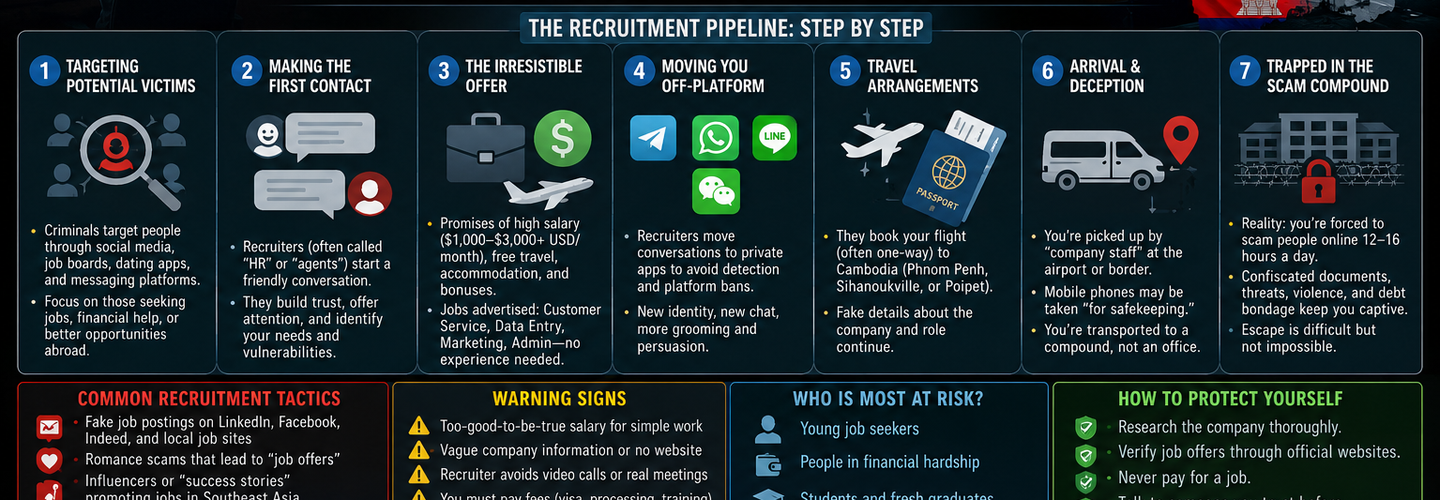
How Cyber Fraud Networks Recruit Victims for Cambodia Scam Compounds: The Complete Investigative Guide
Most people recognize a badly written phishing email. Far fewer understand that behind many of the world's most sophisticated online fraud operations — pig butchering scams, romance fraud, crypto investment schemes — are real people, held against their will, forced to run those scams under threat of violence and debt bondage. Behind Cambodia's scam compounds is a sophisticated, multi-stage recruitment pipeline that targets job seekers with convincing opportunities, credible job interviews, and real travel arrangements. In this guide, you'll learn exactly how these networks find and recruit victims, how the recruitment-to-exploitation process unfolds step by step, what warning signs to watch for, and the specific verification steps that can prevent someone from becoming the next victim.
## Key Takeaways
- ▸Cambodia scam compounds are facilities where organized criminal groups use trafficked or coerced individuals to conduct online fraud operations — including romance scams, crypto investment fraud, and law enforcement impersonation schemes.
- ▸Cyber fraud recruitment commonly begins with fake job advertisements posted on Facebook, LinkedIn, Telegram, TikTok, and WhatsApp, offering high-paying roles in customer service, IT support, data entry, and translation.
- ▸Passport confiscation is a primary control mechanism used by trafficking networks immediately after victims arrive — removing the physical ability to leave independently.
- ▸Americans alone lost at least $10 billion to Southeast Asia-based scam operations in 2024, a 66% increase over the prior year — Source: U.S. Treasury Department, 2025.
- ▸Over 200,000 people are estimated to be held in scam compounds across Southeast Asia, sourced from at least 66 countries — Source: United Nations and INTERPOL, 2025.
- ▸OSINT verification tools — including WHOIS lookups, IP reputation checks, and DNS analysis — can be used to investigate suspicious recruiters and employers before accepting any overseas opportunity.
- ▸Early identification of red flags and verification of employer legitimacy are the most effective individual defenses against recruitment-based trafficking.
## What Are Cambodia Scam Compounds and How Do They Operate?
Cambodia scam compounds are large-scale criminal facilities where organized syndicates — primarily Chinese-run transnational organizations — house and coerce hundreds or thousands of workers to conduct systematic online fraud operations targeting victims globally. These facilities range from converted casino complexes to purpose-built gated compounds, typically located in border regions and special economic zones where governance oversight is minimal and corrupt local officials provide operational cover.
The scale of these operations defies most people's assumptions about cybercrime. Cambodia alone hosts over 50 large scam compounds, with over 80% of the world's total compound-based cyber fraud infrastructure concentrated in Southeast Asia — Source: Global Initiative Against Transnational Organized Crime, 2024. Revenue generated from these operations is estimated at up to $19 billion annually in Cambodia alone — a figure that approaches 40% of Cambodia's formal GDP — Source: Expert Panel Report, 2025. Across the broader Mekong region encompassing Cambodia, Myanmar, and Laos, annual scam revenue is estimated between $50 billion and $75 billion, with an estimated criminal workforce exceeding 350,000 individuals.
The fraud operations run from inside these compounds are diverse. Workers are assigned to run romance scams — building fake emotional relationships with targets over weeks or months before soliciting cryptocurrency investments. Others run pig butchering fraud, where victims are gradually groomed into making escalating crypto investments on fraudulent platforms that show fake returns until a large withdrawal is blocked and the relationship disappears. Still others conduct law enforcement impersonation scams, business email compromise, and investment fraud. For deeper context on how these operations connect to the global cyber threat intelligence landscape, the patterns of organized cybercrime infrastructure are well-documented by researchers and law enforcement agencies worldwide.
Why Cambodia Scam Compounds Are a Human Trafficking Issue
Cambodia scam compounds constitute one of the largest instances of human trafficking for cybercrime in modern history because the majority of workers operating inside them were recruited under false pretenses, transported across international borders, and are held under coercive conditions that prevent free departure. The International Labour Organization and UNODC classify this as a form of forced labor and trafficking that combines traditional exploitation methods with modern digital fraud operations.
Victims are sourced from dozens of countries — including India, Indonesia, Taiwan, Ethiopia, Nigeria, Malaysia, Vietnam, the Philippines, and increasingly Western nations. Most are multilingual, educated, and in many cases hold professional qualifications. They are not naive or uneducated; they are systematically deceived by well-constructed false employment offers. The 2024 U.S. State Department Trafficking in Persons Report documented the complicity of some Cambodian officials in facilitating compound operations, identifying institutional corruption as a structural barrier to enforcement. INTERPOL's March 2025 crime trend update confirmed that victims from 66 countries had been trafficked into online scam centers, with no continent untouched. Understanding the full dimensions of operational cyber risk and resilience is essential for organizations assessing their exposure to fraud operations that originate from these facilities.
## How Do Cyber Fraud Networks Find and Recruit Victims?
Cyber fraud recruitment involves using deceptive job opportunities, social media outreach, third-party employment agencies, and personal referral networks to attract potential victims who are actively seeking legitimate employment. The recruitment operation is professional, multi-channel, and in many cases indistinguishable from a legitimate overseas hiring process at the initial stages.
The primary recruitment funnel is social media. Facebook job groups, LinkedIn postings, TikTok recruitment videos, and Instagram DMs are all used to cast a wide net across multiple countries simultaneously. Roles advertised include customer service representatives, IT support specialists, data entry operators, translators, digital marketing executives, and "AI model" operators — legitimate-sounding job titles designed to appeal to educated, tech-adjacent job seekers. The advertisements frequently feature polished visuals, professional copy, and credible-looking company logos.
The rise of AI-powered social engineering and phishing tactics has accelerated the sophistication of these recruitment campaigns. AI-generated job postings, deepfake video interviews, and automated persona management tools now allow syndicates to conduct convincing recruitment operations at scale with minimal human labor investment. Recruitment for these positions continues even during active law enforcement crackdowns — a 2026 investigation by The Diplomat found active recruitment on Telegram for positions in known scam hubs including Poipet, Bavet, and Sihanoukville, continuing throughout and after government raids.
How Telegram and WhatsApp Enable Recruitment at Scale
Telegram and WhatsApp have become the operational backbone of scam compound recruitment because their end-to-end encryption, large group broadcasting capabilities, and minimal account verification requirements allow syndicates to reach thousands of candidates while evading monitoring. In April 2026, the U.S. Department of Justice seized a Telegram channel called "POGO JOB HIRING 2023" that had accumulated over 6,000 followers and was actively recruiting victims for a scam compound in rural Cambodia — advertising positions requiring American accents and night shift availability.
Telegram groups recruiting for scam compound positions operate openly, often using names referencing "Cambodia jobs," "overseas employment," "call center hiring," or similar legitimate-sounding labels. Administrators post daily, targeting diverse nationalities across multiple language groups. Once a candidate expresses interest, communication moves to a private WhatsApp or Telegram thread — where a recruiter conducts what appears to be a standard screening conversation before escalating to a formal "interview." Recognizing phishing and social engineering tactics at the initial communication stage is the most accessible point of intervention for potential victims.
LinkedIn, Fake Agencies, and Referral-Based Recruitment
LinkedIn is frequently used as a legitimacy signal in scam compound recruitment — fake company profiles with complete employee lists, posted jobs, and engagement history are constructed to pass basic due-diligence checks by job seekers. In many documented cases, victims performed exactly the kind of research a careful person would do — searched the company name, found a LinkedIn page, saw employee profiles — and concluded the opportunity was legitimate. The criminal investment in building credible digital infrastructure reflects the high return on investment from a single successful recruitment.
Employment agencies — both fraudulent entities and in some cases compromised legitimate agencies — serve as trusted middlemen. Victims who discovered a job through a formal-seeming agency reported that their initial skepticism was significantly reduced by the agency's apparent legitimacy. In some cases documented by Indian and Malaysian investigators, sub-recruiters within diaspora communities recruited friends, family members, and acquaintances through personal referral — adding a layer of social trust that made the false opportunity nearly impossible to doubt.
## What Happens After Victims Accept Overseas Job Offers?
Recruitment scams often begin with promises of high-paying overseas jobs that require little experience and offer immediate relocation — and the transition from recruitment to exploitation follows a consistent, documented sequence of steps designed to eliminate the victim's practical ability to leave. Understanding this sequence is essential for identifying intervention points and for recognizing warning signs before the process reaches the point of no return.
Stage 1 — Initial Contact and Interview. A recruiter makes contact via social media, job board, or referral. The interaction is professional, warm, and responsive. A video or voice interview may be conducted — in some cases with AI-assisted deepfake representatives of non-existent company executives. An offer is extended quickly, often within 24–48 hours.
Stage 2 — Travel Arrangements. The employer covers all travel costs — flights, accommodation, visa fees. This generosity removes a key barrier to participation and creates a psychological sense of obligation. Victims are typically not given full details about their work location until they are already in transit.
Stage 3 — Passport and Document Confiscation. Upon arrival at the destination airport or a transit location, the victim's passport is collected by a handler under the pretense of processing a work visa or residence registration. Once the passport is held, the victim's ability to approach immigration authorities or leave independently is eliminated. This is the defining moment of conversion from deceived job seeker to trafficked person.
Stage 4 — Transport to the Compound. Victims are transported — sometimes by armed convoy — to a gated facility, often hours from any major city, in a border region with limited police presence. Compounds are surrounded by high walls, surveillance cameras, and armed security. Communication with the outside world is initially restricted.
Stage 5 — Forced Labor and Quota Systems. Inside the compound, workers are assigned scam operation roles. Monthly fraud quotas are enforced — victims in documented cases were required to defraud $20,000–$40,000 per month. Failure to meet quotas results in physical punishment, increased debt, or sale to another compound. Debt bondage — charges for housing, food, equipment, and "training" — is used as an additional control mechanism that increases with every passing month.
## What Are the Biggest Red Flags in International Job Opportunities?
Recruitment scams targeting scam compound victims share a consistent set of warning signs that, when known in advance, allow job seekers to identify suspicious opportunities before any irreversible decision is made. These indicators are most valuable because they are observable at the early recruitment stage — before travel is arranged or documents are submitted.
Unusually high salary for minimal qualifications. Legitimate overseas positions in customer service, data entry, or translation rarely offer $2,000–$5,000 per month for candidates without specialist experience. If the compensation appears disproportionate to the stated role requirements, treat this as the first red flag.
Vague company information and unverifiable employer identity. Legitimate employers have verifiable corporate registrations, published addresses, operating histories, and named senior leadership. If a company cannot be verified through national business registries, its website has no history on archive tools, or the LinkedIn company page was created recently with a small number of connections, conduct a thorough investigation before proceeding.
Urgent timeline with no formal offer letter. Legitimate employers provide written contracts before requiring commitment. If a recruiter pressures for a verbal confirmation, immediate travel booking, or passport submission without a formal signed employment agreement, stop the process immediately.
Request to submit passport before arrival. No legitimate employer requires a job applicant to surrender their original passport or forward a scanned copy before an employment contract is signed and counter-signed.
All-expenses-paid travel arranged by the employer. Legitimate companies provide relocation assistance after a contract is signed. If a recruiter offers to cover all travel costs immediately — before any formal employment documentation — this is a control mechanism designed to create obligation and eliminate the practical barrier to departure.
## How Can Job Seekers Verify the Legitimacy of Overseas Employers?
OSINT verification involves investigating recruiters, domains, company digital footprints, and registration records before accepting any overseas employment offer — and it requires no specialist tools beyond free, publicly available intelligence platforms. The verification process mirrors the methods used by professional threat analysts, applied to a job search context.
WHOIS and Domain Age Verification
First, look up the employer's website domain using a WHOIS domain intelligence lookup. Check when the domain was registered. Scam operation websites are frequently registered within weeks or months of beginning recruitment — a one-year-old or newer domain for a company claiming to have operated for five years is a critical red flag. Cross-reference the registrant name and organization against any other information provided by the recruiter. For full context on what WHOIS records reveal and what GDPR privacy settings can hide, read the WHOIS privacy protection guide.
Domain verification goes further than creation date. The domain ownership verification guide explains exactly how to identify whether a company website was recently built or transferred, what DNS configurations reveal about the operator's technical sophistication, and how to identify fraudulent lookalike domains designed to impersonate legitimate companies.
IP Reputation and Hosting Infrastructure Analysis
Second, investigate the IP address behind the employer's website. Legitimate companies are typically hosted on commercial hosting infrastructure with established reputations. Scam operation websites are frequently hosted on bulletproof hosting providers, data centers with poor abuse history, or shared hosting accounts associated with multiple fraudulent domains. Use ReconShield's IP reputation intelligence tool to query the IP address of any suspicious employer's website — the tool cross-references 50+ global threat blocklists and returns the hosting ASN, geolocation, and abuse confidence score instantly.
DNS and Email Authentication Analysis
Third, examine the DNS configuration of the employer's domain. Legitimate companies operating email-based communications typically have properly configured SPF, DKIM, and DMARC records — because email authentication is a standard operational requirement. A company website with no email authentication records, or with recently modified MX records pointing to free email providers, raises significant questions about the entity's operational legitimacy. Use ReconShield's DNS security analysis tool to audit all DNS record types for any suspicious employer domain simultaneously.
Passive OSINT Investigation Techniques
Fourth, apply passive OSINT investigation techniques to build a comprehensive picture of the employer's digital footprint without alerting the recruiter. Certificate transparency log searches reveal when an SSL certificate was first issued for the domain — frequently exposing recent domain creation that the company's self-reported history contradicts. Reverse IP lookups identify other domains co-hosted on the same server, which in scam operation infrastructure frequently reveals clusters of fraudulent company websites operated by the same entity. The OSINT fundamentals guide covers the full methodology for building a structured investigation from publicly available data sources.
## How Are Governments and Law Enforcement Responding?
International law enforcement agencies increasingly treat Cambodia scam compounds as both large-scale cybercrime operations and organized human trafficking networks, with coordinated enforcement actions now targeting financial infrastructure, leadership, and recruitment channels simultaneously. The regulatory and enforcement response has accelerated dramatically in 2025–2026.
In April 2026, the U.S. Department of Justice's Scam Center Strike Force announced coordinated enforcement actions including criminal charges against two Chinese nationals who managed a cryptocurrency investment fraud compound in Myanmar and were attempting to open a new compound in Cambodia. Simultaneously, the DOJ seized a Telegram channel with 6,000 followers used for recruitment and removed 503 scam-linked websites. Reported losses from investment scams rose 24% in 2025 to over $7.2 billion according to FBI IC3 data — and Americans lost nearly $21 billion to all forms of cyber-enabled crime in 2025 alone — Source: FBI, 2026.
The U.S. Treasury Department applied sanctions against Prince Group, a Cambodian transnational criminal organization accused of running scam centers involving kidnapping, forced labor, and large-scale cyber fraud — with the UK and South Korea following with parallel sanctions. FinCEN issued a final rule severing Cambodia's Huione Group from the U.S. financial system after finding it had laundered at least $4 billion in criminal proceeds between 2021 and 2025, including funds from North Korean cyber operations. For ongoing OSINT and threat intelligence analysis on organized cybercrime networks, tracking enforcement actions and sanctions is a foundational research activity.
Despite these actions, enforcement effectiveness remains limited by Cambodia's governance challenges. The 2025 UNODC report found that law enforcement crackdowns had caused compounds to temporarily close and relocate to less scrutinized locations — relocating the problem rather than eliminating it.
## What Should You Do If You Suspect a Recruitment Scam?
If you encounter what you believe is a recruitment scam targeting scam compound employment, the most important steps are to preserve evidence, disengage from the recruiter immediately, and report to relevant authorities — because your report directly helps protect the next potential victim in the same recruitment pipeline. The following sequence applies whether you are a potential victim, a researcher, or someone who received a suspicious outreach on behalf of another person.
Do not travel, do not submit passport documents, and do not accept advance payments. Each of these represents a point of no return in the exploitation sequence. If you have already submitted documents but not yet traveled, contact your national police and the embassy of the country you were recruited to work in.
Preserve all communication records. Screenshot every message, email, job advertisement, and call history associated with the recruiter. Note all usernames, profile links, phone numbers, and email addresses used. This digital evidence is directly actionable by law enforcement and enables investigators to trace recruitment networks across multiple cases.
Verify the employer immediately using free tools. Before disengaging, use the free ReconShield cybersecurity investigation toolkit to query the employer's domain (WHOIS), check DNS records, analyze IP reputation, and review email authentication status. This verification takes under five minutes and provides concrete evidence for a law enforcement report.
Report to the relevant authorities. In the United States, report to the FBI's Internet Crime Complaint Center (IC3) at ic3.gov. In India, report to the National Cyber Crime Reporting Portal (cybercrime.gov.in) or Helpline 1930. In the UK, report to Action Fraud. In the Philippines, report to the National Bureau of Investigation Cybercrime Division. INTERPOL's Project HAECHI and the ASEAN Desk are active in coordinating cross-border trafficking and cybercrime investigations.
Contact anti-trafficking support organizations. If you or someone you know is already inside a compound, the International Justice Mission (IJM), the UN Refugee Agency (UNHCR), and national embassies all maintain emergency response capabilities for trafficking victims in Southeast Asia.
## Conclusion
Cambodia scam compounds represent one of the most dangerous intersections of cybercrime and human trafficking operating at scale in the world today. The recruitment pipeline that feeds these operations is not crude — it is professionalized, multi-channel, digitally sophisticated, and specifically designed to neutralize the skepticism of educated, motivated job seekers. The warning signs exist, but they require prior knowledge to recognize in the moment.
Awareness is the first line of defense. Before accepting any overseas employment opportunity — particularly one that moves unusually quickly, offers disproportionately high compensation, or requires early document submission — run a systematic digital verification. Start with a WHOIS lookup on the employer's domain. Check IP reputation on the company's web infrastructure. Analyze DNS configuration for authentication records that indicate legitimate email operations. Apply OSINT fundamentals to build a complete picture of the recruiter's digital footprint in under 15 minutes.
The cybercriminals operating these compounds depend on information asymmetry. Remove it — and the recruitment pipeline breaks down.
Written by Surendra Reddy Cybersecurity Researcher & Founder, ReconShield. Surendra is a cybersecurity engineer specializing in Open Source Intelligence (OSINT), exposure intelligence, and AI-driven threat analysis. He built ReconShield to democratize access to enterprise-grade infrastructure visibility tools and secure digital internet-facing assets.
Reviewed by ReconShield Editorial Team
## Analyst Commentary & Implementation Blueprint
Security advisory
Continuous security exposure assessment is critical to identifying public vulnerabilities before they are exploited. Organizations should maintain a passive inventory of all web servers, TLS configs, and open ports, ensuring that default configurations are eliminated and security advisories are actively implemented.
Hardened Security Configuration Blueprint
# General Security Hardening Directive
ServerTokens ProductOnly
ServerSignature Off
FileETag None
Actionable Mitigation Checklist
- ✔Perform passive asset inventories weekly.
- ✔Restrict administrative ports using local firewall controls.
- ✔Monitor active CVE alerts for exposed software.
Common Inquiries & FAQs
Why is passive scanning preferred for continuous auditing?
Passive audits do not cause operational impact or trigger firewall blocks, making them ideal for constant surveillance of internet-facing assets.
What should I do if a vulnerability is flagged?
Apply the latest vendor patches, restrict access to the resource via firewalls, or verify configuration flags to mitigate risks.
Surendra Reddy
Surendra Reddy is a cybersecurity researcher and founder of ReconShield, specializing in OSINT and defensive infrastructure analysis.
Connect on LinkedIn ↗// AUDIT BRIEFING DISCUSSION (2 COMMENTS)
Great breakdown of the passive infrastructure vectors. We recently audited our external DNS zones and found multiple dangling staging environments. Implementing wildcard certificates reduced our CT log leaks significantly.
Is there any automated tooling you recommend for daily crt.sh scraping? Manually checking CT logs is becoming unsustainable for our domain portfolio.
// MORE ARTICLES

SplitVPN Hacked: Data Breach Exposes 865,000 User Records and 58 Million Hidden Connection Logs (July 2026)
SplitVPN hacked: 865,336 user records and 58 million connection logs exposed, directly contradicting the VPN's "no-logs" promise. What was leaked and what to do now.

Critical WordPress wp2shell RCE Vulnerability Puts Millions of Sites at Risk—Patch Now
wp2shell is a pre-auth RCE in WordPress Core affecting 500M+ sites. Public exploits exist—patch to 7.0.2 or 6.9.5 immediately.
New Windows RDP Flaws Could Lead to Data Theft — Everything You Need to Know
Microsoft patched a dozen Windows RDP flaws in July 2026 that could leak memory data. See affected versions, KB numbers, and how to patch.