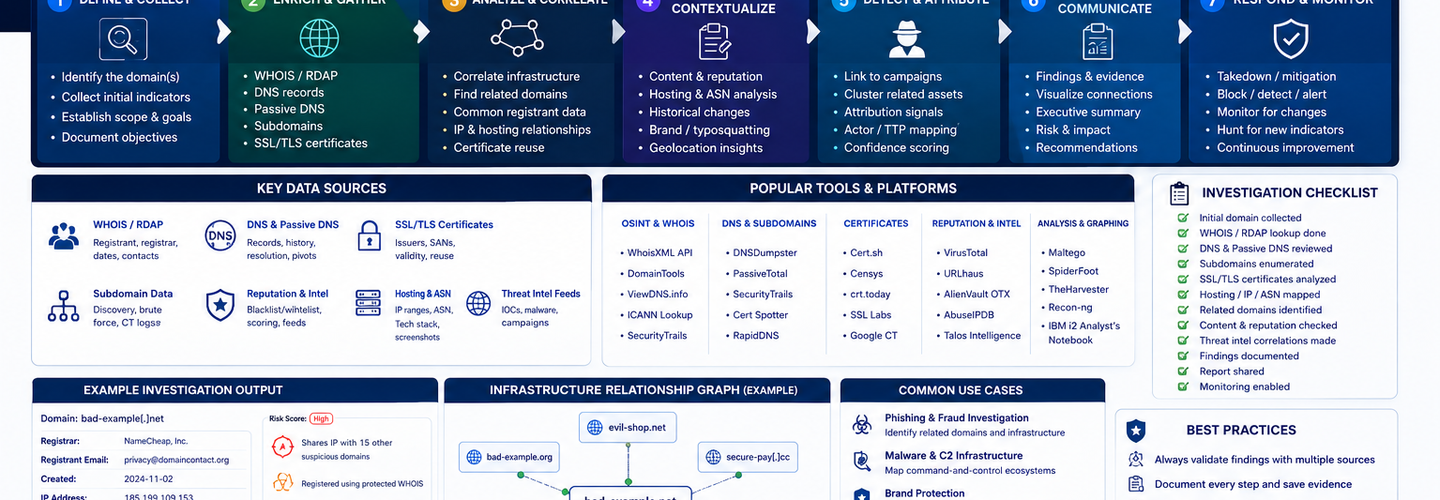
Domain Investigation Guide: Complete Methodology for Security Teams, Analysts, and Threat Hunters (2026)
Summarize this blog post with: ChatGPT | Perplexity | Claude | Grok
You've probably queried a domain during an incident or a brand-protection scan — but if you've never structured those lookups into a repeatable, multi-layered investigation workflow, you're missing the full intelligence picture that passive domain intelligence reveals. A complete domain investigation combines WHOIS registration data, DNS record analysis, SSL certificate intelligence, IP reputation, and passive subdomain enumeration into a single coherent methodology that answers every critical question: Is this domain legitimate or malicious? What infrastructure is behind it? Who controls it? Has it been compromised? What historical patterns does it show? In this guide, you'll learn the exact sequence of domain investigation steps used by professional threat intelligence analysts, security researchers, and incident responders.
## Key Takeaways
- ▸A complete domain investigation combines six independent data sources — WHOIS registration, DNS records, SSL certificates, IP reputation, passive subdomain enumeration, and historical WHOIS archives — each revealing different aspects of domain infrastructure and control.
- ▸The investigation sequence matters — starting with WHOIS gives you structural context, DNS tells you current routing, certificates reveal historical identity claims, IP reputation contextualizes hosting, and passive subdomains expose the full scope. Each answer informs the next question.
- ▸Creation date is the single most predictive field for phishing domain identification — domains created within 7–30 days of a campaign launch are almost certainly malicious infrastructure, while domains with multi-year registration history carry presumption of legitimacy.
- ▸Registrar identity enables clustering — certain registrars are disproportionately represented in malicious domain portfolios, allowing threat actors to be grouped even when registrant contact data is redacted by GDPR.
- ▸Name server mismatches between WHOIS and live DNS are the earliest detectable sign of active domain hijacking — automated monitoring that compares these fields catches compromise attempts within minutes of occurrence.
- ▸Historical WHOIS data from pre-2018 archives exposes registrant information for legacy domains even when current records are fully privacy-protected, enabling attribution for domains registered before GDPR.
- ▸The investigation produces two distinct outputs: a risk verdict (definitively malicious, ambiguous, or legitimate), and a complete infrastructure profile (hosting, registrar, DNS configuration, certificate history) that feeds into blocking, monitoring, or escalation decisions.
## What Is Domain Investigation and Why Does It Matter?
Domain investigation is the systematic passive analysis of a domain's registration, routing, and hosting infrastructure to determine its legitimacy, control authority, and potential malicious use — using publicly available data sources to answer security-critical questions without sending any traffic to the target domain.
Domain investigation serves three distinct operational purposes. Phishing and fraud defense uses domain investigation to rapidly triage suspicious domains discovered in email campaigns, social engineering attempts, or brand monitoring alerts — determining within minutes whether a domain is genuine lookalike infrastructure or a freshly registered campaign domain. Incident response uses domain investigation to attribute attacker infrastructure discovered during active incidents — understanding who registered domains used in the attack, where they are hosted, and what other infrastructure clusters with them. Threat hunting uses domain investigation to proactively discover threat actor infrastructure — correlating registration patterns, name server providers, and SSL certificate behaviors across known malicious domains to surface previously unattributed infrastructure operated by the same actor groups.
The methodology is passive by design — every data source is queried from third-party registries and archives, not from the target domain's servers. This means the investigation is legally defensible, generates no logs on the target infrastructure, and provides complete visibility even for domains the organization does not own.
## The Six Data Sources of Domain Investigation
A complete domain investigation draws from six distinct data sources, each providing independent intelligence that reveals a different facet of domain infrastructure. When correlated together, they produce a complete picture that single-source analysis misses.
1. WHOIS Registration Data
WHOIS is the foundational data source — it tells you what the current registrant claims about the domain, when it was first registered, when it expires, which registrar holds it, and which name servers are authorized.
Query the domain's WHOIS record immediately using the ReconShield WHOIS Intelligence tool. Record the creation date (distinguishes freshly registered phishing domains from established legitimate infrastructure), the registrar (clusters malicious domains by common providers), the EPP status codes (indicates whether the domain is protected against unauthorized transfer), and the registrar-listed name servers (forms the baseline for comparison against current DNS records).
Critical analytical questions from WHOIS:
- ▸How old is the domain? (Recent ≈ suspicious for impersonation domains)
- ▸What registrar? (Certain registrars have higher malicious domain concentrations)
- ▸Are EPP locks active? (Missing locks suggest poor security posture or preparedness for transfer)
- ▸Are name servers listed? (Mismatch with live DNS indicates unauthorized modification or hijacking)
For complete reference on interpreting every WHOIS field, the ReconShield WHOIS domain intelligence guide covers operational analysis depth.
2. Live DNS Records
DNS records tell you where the domain currently resolves and what other infrastructure it claims authority over.
Query every major record type using the ReconShield DNS Security Analysis tool:
- ▸A records: What IPv4 address does the domain resolve to?
- ▸AAAA records: What IPv6 address? (Track separately as some security controls apply only to IPv4)
- ▸MX records: What mail servers handle email for this domain?
- ▸NS records: What are the authoritative name servers? (Compare against WHOIS-listed servers)
- ▸CNAME records: What aliases exist? (Track to identify subdomain takeover risks)
- ▸TXT records: What SPF, DKIM, DMARC, and other security records are published?
Critical analytical questions from DNS:
- ▸Do live NS records match WHOIS-listed name servers? (Mismatch = potential hijacking)
- ▸Is email authentication (SPF/DKIM/DMARC) enforced or missing? (Missing = domain spoofable)
- ▸What IP addresses do A/AAAA records resolve to? (Feed to IP reputation analysis)
For complete DNS record interpretation as security signals, the ReconShield DNS record types guide covers every record type and its security implications.
3. SSL/TLS Certificates and Certificate Transparency Logs
SSL certificates reveal the identity claims the domain owner has made — and the Certificate Transparency logs preserve the complete history of every certificate ever issued for the domain.
Query the current TLS certificate using the ReconShield SSL/TLS Checker. Record the certificate issuer, the Subject Alternative Names (SANs) which reveal related domains on the same certificate, the certificate validity period, and the exact issuance date.
Then query Certificate Transparency logs — searching for every certificate ever issued for the domain. CT logs are authoritative, immutable, and publicly searchable. They reveal:
- ▸Subdomains never listed in DNS — development infrastructure, staging environments, internal services that received certificates
- ▸Certificate issuance patterns — do multiple certificates issue within hours of each other (signature of campaign infrastructure), or do they space out over years (signature of established legitimate operation)?
- ▸Organization identity claims — what organization name appears in the certificate Subject field?
Critical analytical questions from certificates:
- ▸Is the current certificate valid and recent? (Expired or very old = abandoned or legacy domain)
- ▸What SANs are listed? (Related domains cluster infrastructure)
- ▸What organization name is in the certificate? (Legitimate organizations use registered business names; malicious certificates use generic or spoofed names)
- ▸Do CT logs show certificate issuance spikes? (Spike = batch certificate generation for campaign)
For the complete methodology on using CT logs for subdomain discovery, the ReconShield certificate transparency logs explained guide covers CT architecture, query techniques, and intelligence extraction.
4. IP Reputation and Hosting Intelligence
The IP addresses that DNS records resolve to carry their own reputation history — revealing the hosting provider, the geographic location, and any abuse or threat intelligence associated with the address.
For each IP address discovered in A, AAAA, or MX records, run a reputation check using the ReconShield IP Reputation Intelligence tool. Record the ASN operator, the hosting provider, geolocation, proxy/VPN detection, and any threat feed matches.
Bulletproof hosting providers — ASNs specifically marketed to criminal actors with promises of non-responsiveness to abuse reports — are a direct indicator of malicious infrastructure. If the domain's A record resolves to an IP in a bulletproof hosting ASN, the domain is almost certainly malicious regardless of other signals.
Critical analytical questions from IP reputation:
- ▸Is the hosting provider legitimate (AWS, Google Cloud, Azure) or bulletproof (criminal-oriented)?
- ▸Does the IP address appear on threat feeds as known malicious?
- ▸Does the geolocation match the domain's claimed purpose? (US domain hosted in Russia = suspicious)
- ▸Does proxy/VPN detection flag the address? (Some legitimate CDNs trigger this; others indicate masking)
5. Passive Subdomain Enumeration
Passive subdomain enumeration discovers every subdomain that has ever received a DNS resolution or an SSL certificate, revealing the complete scope of infrastructure the domain owner has deployed.
The three primary sources for passive subdomain discovery are: Certificate Transparency logs (every subdomain with a certificate), passive DNS databases (every subdomain that has ever resolved), and search engine indices (subdomains referenced in links or crawled content).
Using ReconShield tools, CT log queries surface all certificated subdomains. DNS queries can reveal some historically-active subdomains if they have been recently queried. For comprehensive passive subdomain discovery methodology, the ReconShield passive reconnaissance guide covers the complete enumeration technique.
Critical analytical questions from subdomains:
- ▸How many unique subdomains exist? (Dozens = established infrastructure; one or two = minimal deployment or campaign-specific)
- ▸Do subdomain names indicate purpose? (admin, staging, api, legacy = infrastructure type disclosure)
- ▸Do subdomains cluster with the main domain in registration or hosting? (Same registrar/IP = unified control; different = third-party services)
6. Historical WHOIS Archives
Pre-GDPR WHOIS archives captured domain registration data before privacy protection became standard — exposing registrant names, organizations, email addresses, and phone numbers for domains registered before 2018.
Query historical WHOIS databases (DomainTools, SecurityTrails, WhoisXML API) for any domain with a creation date before 2018. Discover registrant email addresses, organizational affiliations, and phone numbers that may have been reused across multiple domains or associated with known threat actors.
Critical analytical questions from historical archives:
- ▸Can the registrant be identified through historical data? (Email, phone, org name)
- ▸Do historical registrant details match known threat actor profiles?
- ▸Have the registrant details changed over time? (Registrant change = ownership transfer or hijacking)
For the complete methodology on historical WHOIS investigation and its role in legacy domain threat attribution, the ReconShield WHOIS privacy protection guide covers archive access and interpretation.
## The Domain Investigation Workflow: Step-by-Step
Following this exact sequence ensures that each investigation step informs the next and that no relevant data source is overlooked.
Step 1 — Initial WHOIS and Basic Classification (2 minutes)
Run the target domain through the ReconShield WHOIS Intelligence tool. Extract creation date, registrar, EPP status, and WHOIS-listed name servers. Immediately classify by creation date:
- ▸Created in last 30 days + impersonating established brand = Likely phishing
- ▸Created 1-2 years ago + legitimate registrar + active EPP locks = Likely legitimate
- ▸Created 3-7 years ago + any registrar + inconsistent configuration = Ambiguous, requires deeper analysis
- ▸Created 10+ years ago = Presumption of legitimacy unless other signals contradict
Step 2 — DNS Record Collection and NS Mismatch Detection (2 minutes)
Query the domain's complete DNS record set using the ReconShield DNS Security Analysis tool. Extract A, AAAA, MX, TXT, NS, and CNAME records. Immediately flag any mismatch between WHOIS-listed name servers and live DNS-returned name servers — this is the earliest sign of active domain hijacking.
Validate SPF, DKIM, and DMARC configuration. Missing email authentication on a domain claiming to be a legitimate organization is a secondary indicator of poor security posture or criminal infrastructure.
Step 3 — SSL Certificate and Certificate Transparency Analysis (5 minutes)
Query the current TLS certificate using the ReconShield SSL/TLS Checker. Check validity, organization name, and SANs. Then search Certificate Transparency logs for all historical certificates issued for the domain and all discovered subdomains.
Analyze the certificate issuance pattern:
- ▸Single certificate, issued once, renewed periodically = Established domain
- ▸Multiple certificates issued within hours = Campaign infrastructure
- ▸Certificates issued by unusual CAs or with suspicious subjects = Potential malicious domain
Step 4 — IP Reputation and Hosting Analysis (3 minutes)
For each IP address discovered in A, AAAA, and MX records, run the ReconShield IP Reputation Intelligence tool. Extract ASN, hosting provider, threat feed presence, and geolocation.
Flag immediately if any IP belongs to a bulletproof hosting provider — this is a near-definitive malicious indicator. Flag if the geolocation contradicts the domain's stated purpose (US company hosted in known cybercriminal jurisdiction).
Step 5 — Passive Subdomain Enumeration (5 minutes)
Discover all subdomains using CT log queries and passive DNS correlation. For established legitimate domains, you will discover dozens or hundreds of subdomains spanning multiple infrastructure purposes. For recently created phishing domains, you will discover zero or one subdomain (the main domain only).
Analyze subdomain naming patterns:
- ▸admin, api, staging, legacy, dev = Legitimate infrastructure type disclosure
- ▸payment, billing, secure-login, account-verify = Phishing/spoofing patterns
- ▸randomstrings or number-sequences = Campaign infrastructure
Step 6 — Historical WHOIS Investigation (If Applicable) (3-5 minutes)
For domains older than 2018, query historical WHOIS archives to recover registrant contact information. Cross-reference registrant email addresses against known threat actor profiles, OSINT databases, and previous threat intelligence.
Step 7 — Correlation and Verdict Formulation (5 minutes)
Correlate all findings into a risk verdict:
Definitively Malicious: Creation date within 30 days AND impersonating known brand AND bulletproof hosting AND missing/misconfigured email authentication. Action: Block immediately.
Highly Suspicious: Creation date within 90 days AND registrar with high malicious-domain concentration AND bulletproof hosting ASN. Action: Block with monitoring for false positives.
Ambiguous: Older domain (>1 year) AND legitimate registrar AND cloud hosting AND modern infrastructure. Action: Enhanced monitoring, no blocking.
Likely Legitimate: Creation date 5+ years ago AND consistent organization identity across WHOIS/DNS/certificates AND enterprise cloud hosting AND enforced email authentication. Action: Whitelist, monitor for hijacking indicators only.
## Red Flags and Indicators That Require Escalation
Specific domain investigation findings that demand immediate escalation and incident response activation:
- ▸Name server mismatch: WHOIS lists legitimate name servers but live DNS returns different servers = Active domain hijacking in progress. Escalate immediately.
- ▸EPP lock removal: WHOIS shows no transfer or update protection locks = Domain vulnerable to registrar account compromise. Verify registrar account integrity immediately.
- ▸Recent unauthorized WHOIS modification: Creation date unchanged but updated/registrant fields modified recently = Registrant account compromise or unauthorized modification. Verify account access logs.
- ▸Bulletproof hosting ASN: A or MX records resolve to known criminal-oriented hosting provider = Presumptively malicious, high-confidence block. Escalate for law enforcement coordination if domain impersonates critical infrastructure.
- ▸Certificate issued to unexpected organization: TLS certificate Subject lists an organization unrelated to the domain's stated purpose = Spoofing or compromise. Investigate certificate issuance authorization.
- ▸Sudden certificate issuance spike: Multiple certificates for related subdomains issued within hours of each other = Campaign infrastructure batch deployment. Cross-reference with other threat intelligence on concurrent phishing/malware campaigns.
- ▸Historical WHOIS matches known threat actor: Registrant email or organization name matches profiles from threat intelligence = Attributed malicious domain. Escalate with full IOC package.
## Common Investigation Mistakes and How to Avoid Them
The most common domain investigation failures are: stopping after WHOIS lookup, treating single data sources as sufficient for high-confidence verdicts, and ignoring historical context.
Mistake 1 — WHOIS-Only Verdict: A domain with a recent creation date and a suspicious registrar is flagged as phishing without checking WHOIS-listed name servers against live DNS. The live DNS shows legitimate name servers that WHOIS does not list, indicating the domain was transferred and the WHOIS record was not updated — common for domains acquired in good faith after previous registration. The correct verdict requires the additional DNS verification step.
Mistake 2 — Single Reputation Source: An IP address is checked against a single threat feed that returns no match, resulting in a clean verdict. That same IP appears on eight other threat feeds when cross-checked, indicating a delayed propagation of the address to the first feed. The correct verdict requires multi-feed cross-referencing.
Mistake 3 — Ignoring Registration Age: A domain created three months ago with a registrar known for malicious domains is immediately classified as phishing without examining whether the infrastructure is actually serving phishing content. Upon further investigation, the domain was legitimately registered for a startup, with all expected infrastructure in place. The verdict should have weighted creation date as only one of multiple signals, not as a deterministic indicator.
## Tools for Domain Investigation at Scale
When you move from individual domain investigations to systematic domain portfolio monitoring, the ReconShield toolset provides the foundation:
The ReconShield WHOIS Intelligence tool handles bulk domain lookups for registration data, the DNS Security Analysis tool validates DNS configuration across your inventory, the SSL/TLS Checker audits certificate validity, and the IP Reputation tool cross-references hosting infrastructure against threat feeds.
For continuous monitoring of your own domain portfolio against hijacking and unauthorized changes, establish a baseline WHOIS snapshot and schedule daily or weekly comparison queries that flag any field modifications. For threat hunting across malicious domain clusters, compile registration patterns (creation date ranges, registrars, name server providers) and use these patterns to surface related unattributed domains.
## Conclusion
Domain investigation is not a single lookup — it is a structured, multi-source methodology that transforms scattered data points into a coherent intelligence picture. Every data source answers a specific question: WHOIS tells you about registration and control, DNS tells you about current routing, certificates reveal identity claims and historical scope, IP reputation contextualizes hosting infrastructure, and subdomains expose the full infrastructure footprint.
Start with your own domain portfolio. Run each domain through the ReconShield WHOIS Intelligence tool to establish baseline registration data. Cross-reference with live DNS using the DNS Security Analysis tool. Verify TLS configuration using the SSL/TLS Checker. Check hosting IP reputation with the IP Reputation tool.
Then apply the same methodology to suspicious domains you encounter during threat hunting or incident response. Follow the six-step investigation sequence, correlate findings across data sources, and produce a high-confidence verdict that informs blocking, monitoring, or escalation decisions.
Written by Surendra Reddy Cybersecurity Researcher & Founder, ReconShield. Surendra specializes in OSINT, exposure intelligence, and AI-driven threat analysis. Author Profile →
Reviewed by ReconShield Editorial Team — Peer-reviewed for technical accuracy against current domain investigation standards and threat intelligence best practices.
## Analyst Commentary & Implementation Blueprint
Security advisory
Continuous security exposure assessment is critical to identifying public vulnerabilities before they are exploited. Organizations should maintain a passive inventory of all web servers, TLS configs, and open ports, ensuring that default configurations are eliminated and security advisories are actively implemented.
Hardened Security Configuration Blueprint
# General Security Hardening Directive
ServerTokens ProductOnly
ServerSignature Off
FileETag None
Actionable Mitigation Checklist
- ✔Perform passive asset inventories weekly.
- ✔Restrict administrative ports using local firewall controls.
- ✔Monitor active CVE alerts for exposed software.
Common Inquiries & FAQs
Why is passive scanning preferred for continuous auditing?
Passive audits do not cause operational impact or trigger firewall blocks, making them ideal for constant surveillance of internet-facing assets.
What should I do if a vulnerability is flagged?
Apply the latest vendor patches, restrict access to the resource via firewalls, or verify configuration flags to mitigate risks.
Surendra Reddy
Surendra Reddy is a cybersecurity researcher and founder of ReconShield, specializing in OSINT and defensive infrastructure analysis.
Connect on LinkedIn ↗// AUDIT BRIEFING DISCUSSION (2 COMMENTS)
Great breakdown of the passive infrastructure vectors. We recently audited our external DNS zones and found multiple dangling staging environments. Implementing wildcard certificates reduced our CT log leaks significantly.
Is there any automated tooling you recommend for daily crt.sh scraping? Manually checking CT logs is becoming unsustainable for our domain portfolio.
// MORE ARTICLES
SplitVPN Hacked: Data Breach Exposes 865,000 User Records and 58 Million Hidden Connection Logs (July 2026)
SplitVPN hacked: 865,336 user records and 58 million connection logs exposed, directly contradicting the VPN's "no-logs" promise. What was leaked and what to do now.

Critical WordPress wp2shell RCE Vulnerability Puts Millions of Sites at Risk—Patch Now
wp2shell is a pre-auth RCE in WordPress Core affecting 500M+ sites. Public exploits exist—patch to 7.0.2 or 6.9.5 immediately.
New Windows RDP Flaws Could Lead to Data Theft — Everything You Need to Know
Microsoft patched a dozen Windows RDP flaws in July 2026 that could leak memory data. See affected versions, KB numbers, and how to patch.