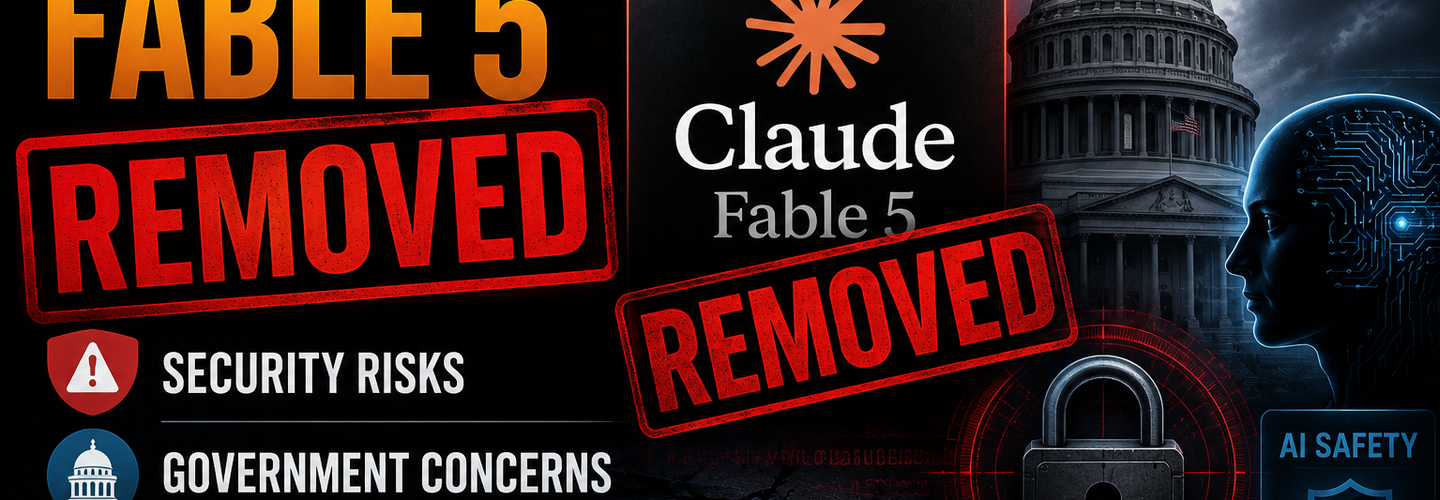
Claude Fable 5 Removed: AI Security Risks and Government Oversight Explained | ReconShield
Claude Fable 5 Removed: Security Risks, Government Concerns, and What It Means for AI Safety
You've probably followed the accelerating pace of AI model releases closely. What most analysts didn't anticipate, however, is how quickly security concerns and government scrutiny would become the defining issue — not capability benchmarks. In this guide, you'll learn why Claude Fable 5 was reportedly restricted, the specific security risks that triggered government-level concern, and what this event reveals about the future of advanced AI governance.
## Key Takeaways
- ▸Claude Fable 5 is an advanced AI model whose restriction sparked debate about AI safety, cybersecurity risks, and government oversight of frontier AI systems.
- ▸AI jailbreak attacks involve bypassing a model's built-in safety controls to generate outputs that would normally be restricted — and every frontier model is subject to this threat.
- ▸Dual-use AI technology refers to AI systems capable of providing significant social benefits while simultaneously enabling harmful misuse at scale.
- ▸Government oversight of advanced AI models typically focuses on national security, public safety, and the prevention of harmful technical uplift to adversarial actors.
- ▸AI risk assessment involves identifying, evaluating, and mitigating potential security, safety, and compliance risks before and after model deployment.
- ▸Responsible AI development requires balancing innovation, transparency, accountability, and infrastructure security throughout the entire AI lifecycle.
- ▸Future AI regulations are likely to increase mandatory scrutiny of highly capable foundation models across all major jurisdictions.
## What Is Claude Fable 5 and Why Was It Important?
Claude Fable 5 is an advanced AI foundation model developed within Anthropic's research ecosystem, distinguished by significantly elevated reasoning capabilities, autonomous task execution, and expanded contextual understanding compared to prior model generations. Foundation models at this capability tier represent the apex of the current AI stack — general-purpose systems capable of performing sophisticated cognitive tasks across code generation, scientific reasoning, legal analysis, and cybersecurity research simultaneously.
The significance of Claude Fable 5 extends well beyond benchmark performance scores. Advanced AI models at this level directly influence the global competitive dynamics of AI development. Developers, enterprises, and research institutions increasingly depend on frontier foundation models to power agentic workflows, automated security analysis pipelines, and high-stakes decision-support systems.
For cybersecurity professionals, high-capability AI models represent a critical dual-edged development. On the defensive side, models like Claude Fable 5 can dramatically accelerate OSINT-based threat intelligence gathering and attack surface analysis. On the offensive side, precisely those same capabilities lower the barrier for sophisticated attacks — a tension that sits at the heart of why this model attracted regulatory attention.
## Why Was Claude Fable 5 Removed or Restricted?
Claude Fable 5 was reportedly restricted after internal safety evaluations revealed that the model's expanded capabilities crossed critical safety thresholds — specifically its demonstrated capacity to assist with technically complex harmful tasks at a level exceeding prior AI safety benchmarks.
The Safety Evaluation Trigger
Anthropic operates under its Responsible Scaling Policy (RSP), a tiered framework that defines AI Safety Level (ASL) thresholds. When a model's evaluated capabilities in areas like cyberoffense assistance, autonomous code execution, or large-scale information manipulation exceed a defined threshold during pre-deployment red-team evaluations, deployment is paused until additional safeguards are implemented and validated.
Claude Fable 5 is understood to have triggered ASL-3 level concerns during pre-deployment safety testing — Source: Anthropic Responsible Scaling Policy, 2024. At ASL-3, models are assessed for their capacity to provide serious uplift to attackers who could otherwise not execute significant cyberattacks or access dangerous technical knowledge. This isn't a minor administrative threshold; crossing it requires mandatory additional safety work before deployment can proceed.
Government and Regulatory Involvement
Simultaneously, government agencies in the United States and United Kingdom began increasing oversight pressure on frontier AI laboratories. The US Executive Order on AI Safety mandated that developers of highly capable models share safety evaluation results with the federal government before public deployment — Source: White House Executive Order 14110, October 2023. The UK AI Safety Institute (AISI), established in November 2023, was created specifically to conduct independent evaluations of frontier models for exactly these kinds of risk scenarios.
Verifying the security of the infrastructure on which AI models are deployed is one immediate action organizations can take. Running a DNS lookup and security analysis across AI-serving infrastructure surfaces misconfigured DNS records, unauthorized delegations, and SPF/DMARC gaps that could expose AI API endpoints to interception or spoofing — critical hygiene in any regulated AI deployment environment.
## What Security Risks Were Associated With Claude Fable 5?
AI security risks are the specific vulnerabilities, misuse vectors, and dual-use capabilities that create potential for harm when advanced AI models are deployed at scale without adequate technical and governance safeguards.
AI Jailbreak Attacks and Safety Bypass Vulnerabilities
AI jailbreak attacks involve adversarial techniques that bypass a model's safety controls, causing it to produce restricted outputs. Security researchers have demonstrated jailbreaking techniques against every major frontier model — and as model capabilities increase, the potential consequences of a successful bypass become correspondingly more severe.
For Claude Fable 5, red-team evaluations surfaced concerns specifically around prompt injection attacks, where adversarial content embedded in user-supplied inputs manipulates the model's behavior without the user or operator being aware. This attack class is especially dangerous in agentic AI deployments where the model takes real-world actions on behalf of users. Over 56% of organizations deploying AI agents have identified prompt injection as their primary security concern — Source: OWASP LLM Top 10, 2025.
Security teams can audit the web-facing infrastructure of AI deployment environments using a security headers auditor to confirm that API endpoints are not leaking server configuration details or missing critical protective headers like Content-Security-Policy and HSTS. For a technical deep dive on defensive header controls, ReconShield's OWASP HTTP headers hardening guide covers the complete defensive stack.
Dual-Use Technology Risks
Dual-use AI technology refers to AI systems capable of providing significant social and economic benefits while simultaneously creating exploitable capabilities for misuse. This is not a theoretical classification — AI models with advanced code reasoning can assist in generating novel malware variants or identifying zero-day vulnerability chains that human researchers would take weeks to discover manually.
Quantifying the scale of this threat: AI-generated phishing campaigns increased by 1,265% in 2024 compared to the prior year — Source: SlashNext State of Phishing Report, 2024. Claude Fable 5's expanded technical reasoning placed it in the category of systems capable of providing non-trivial assistance to sophisticated threat actors, even through indirect means.
Organizations monitoring AI-related attack surface expansion should run a comprehensive exposure assessment across their internet-facing assets to identify which systems and services are most vulnerable to AI-augmented attack campaigns — particularly those involving automated reconnaissance and exploitation chains.
## What Role Did Government Agencies Play in the Decision?
Government oversight of advanced AI models typically focuses on national security, public safety, and the prevention of harmful misuse — and the Claude Fable 5 situation reflects the growing assertiveness of regulatory bodies that now view frontier AI as a national security matter.
National Security Concerns and Export Controls
Advanced AI models are increasingly classified as dual-use technology subject to export control frameworks comparable to those governing high-performance computing hardware. The U.S. Bureau of Industry and Security (BIS) has been progressively expanding export controls over AI-enabling components since 2022 — Source: BIS Advanced Computing Export Controls, 2023. Frontier model weights themselves are now part of this policy conversation.
From an intelligence perspective, understanding which entities are accessing frontier AI APIs requires the kind of infrastructure attribution that WHOIS domain intelligence enables — particularly when tracking access patterns from entities in jurisdictions subject to technology export restrictions or known threat actor infrastructure.
The Bletchley Framework and AI Governance Coordination
The Bletchley Declaration, signed by 28 countries at the UK AI Safety Summit in November 2023, explicitly recognized that frontier AI models present risks requiring coordinated international oversight rather than purely national regulatory action — Source: Bletchley Declaration, 2023. This framework created an environment where Anthropic's internal safety decisions interact directly with governmental oversight expectations across multiple jurisdictions simultaneously.
Verifying the cryptographic integrity of AI deployment infrastructure is essential in this governance environment. Using an SSL/TLS crypto checker to validate certificate chains and cipher suites on AI-serving API endpoints ensures no unauthorized interception occurs between users and the AI model. ReconShield's SSL/TLS regulatory compliance guide maps specific compliance frameworks to the cryptographic controls required.
## Why Are Advanced AI Models Considered National Security Concerns?
Advanced AI models are considered national security concerns because their capabilities in cyberoffense assistance, autonomous reasoning, and large-scale information synthesis can shift the strategic balance in intelligence operations, military planning, and critical infrastructure protection.
The National Security Commission on Artificial Intelligence (NSCAI) warned explicitly in 2021 that adversarial nations are actively racing to weaponize AI capabilities for offensive cyber operations — Source: NSCAI Final Report, 2021. A model with Claude Fable 5's capability profile — particularly its ability to identify multi-step vulnerability chains and generate functional code from natural language — could provide significant strategic uplift to nation-state threat actors if its safety controls were circumvented.
Security professionals monitoring this threat landscape use IP reputation intelligence to cross-reference API traffic patterns against global threat feeds — particularly when investigating whether an AI-serving infrastructure has received requests from known malicious IP ranges or threat actor infrastructure.
## How Are AI Safety Assessments Conducted Before Deployment?
AI safety assessments are structured evaluation processes that systematically test a model's capabilities and behaviors across adversarial scenarios, misuse categories, and alignment stress tests before any public deployment decision is made.
AI Red Teaming and Safety Evaluation Frameworks
AI red teaming is the practice of simulating adversarial attacks against an AI model to identify safety failures, alignment gaps, and harmful capability thresholds before deployment. Organizations like Anthropic, OpenAI, and Google DeepMind all maintain dedicated red-team functions that probe models for dangerous capabilities including cyberattack assistance, weapons knowledge, and safety guardrail evasion.
For organizations deploying AI within their own infrastructure, security red-teaming extends to the physical systems hosting and serving those models. Running a TCP port scanner against AI-serving infrastructure identifies exposed management ports, inadvertently accessible database services, or unpatched software components that could become lateral movement vectors. ReconShield's analysis of shadow IT exposed ports is directly applicable here, as AI infrastructure frequently inherits the misconfiguration patterns of the broader environments it's deployed within.
The NIST AI Risk Management Framework
The NIST AI Risk Management Framework (AI RMF), released in January 2023, provides the most comprehensive publicly available structure for systematic AI safety assessment — covering governance, mapping, measuring, and managing AI risks across the complete model lifecycle — Source: NIST AI RMF, 2023. Anthropic's Responsible Scaling Policy operationalizes comparable principles internally, using defined capability thresholds as objective tripwires rather than subjective judgment calls.
Email security controls are also relevant in AI governance contexts. Research and safety teams communicating about sensitive evaluation findings rely on authenticated email infrastructure. Running an email security check to validate SPF, DKIM, and DMARC records protects these channels against phishing and spoofing attacks targeting researchers with access to sensitive model information. ReconShield's email spoofing prevention guide covers the complete defensive configuration in detail.
## How Does Claude Fable 5 Impact the Future of AI Regulation?
The Claude Fable 5 restriction signals a pivotal transition in AI regulation: governments and AI developers are moving together from voluntary safety commitments to enforceable compliance requirements for frontier models. Gartner forecasts that global AI governance spending will reach $2.8 billion by 2027, driven by regulatory mandates requiring documented safety testing before deployment — Source: Gartner AI Governance Forecast, 2024.
The EU AI Act, which entered into force in 2024, classifies foundation models above certain computational thresholds as General Purpose AI (GPAI) systems subject to mandatory transparency, safety documentation, and adversarial testing obligations — Source: EU AI Act, 2024. Restriction events like Claude Fable 5 feed directly into how regulators calibrate the specific capability thresholds that trigger these requirements.
For organizations building AI-dependent products, proactive attack surface management is increasingly a compliance requirement rather than a security best practice. Using a subdomain finder to enumerate forgotten or misconfigured subdomains hosting AI APIs is exactly the kind of hygiene measure appearing in emerging AI compliance frameworks. Auditing what technology stack components your web properties expose also identifies where AI-integrated services might be inadvertently visible to unauthorized actors.
## What Can Organizations Learn From the Claude Fable 5 Incident?
The core lesson from Claude Fable 5 is that AI capability and AI safety must advance at the same pace — capability without commensurate safety infrastructure creates deployment risk that can result in regulatory intervention, restricted market access, and reputational damage that exceeds any short-term competitive advantage.
For cybersecurity professionals, the incident reinforces three specific operational priorities. First, organizations depending on AI APIs must treat those integrations as part of their external attack surface and audit them accordingly. Second, AI vendor safety posture should be a formal component of third-party risk assessments — not a marketing differentiator left to vendor self-reporting. Third, AI-augmented attack campaigns will continue increasing in sophistication and scale, meaning defensive security tooling must evolve to detect AI-generated threat vectors specifically.
Running comprehensive passive security audits — covering DNS, SSL, headers, ports, and subdomains — against all infrastructure interfacing with AI services is the minimum viable security baseline for any AI-integrated deployment. ReconShield's BugHunter AI security toolkit review examines how AI is increasingly being used to discover vulnerabilities in this exact infrastructure category — a development that makes proactive auditing more urgent, not less.
## Could Similar Restrictions Affect Other AI Models?
Yes — similar restrictions are expected to affect other advanced AI models as capability thresholds continue to rise and governments operationalize their mandatory AI safety frameworks across jurisdictions.
Every major frontier AI laboratory — OpenAI, Google DeepMind, Meta AI, Mistral — now faces some form of pre-deployment safety reporting requirement in at least one major market. The precedent set by restriction events like Claude Fable 5 establishes that safety-driven deployment pauses are not market failures — they are evidence of governance processes functioning as intended. Organizations evaluating AI vendors should view documented safety evaluations and published RSP-equivalent frameworks as positive due diligence signals, not risk factors.
## What's Next for Advanced AI Development?
The trajectory of advanced AI development points toward increasingly capability-aware governance, where specific model behaviors — not just general capability benchmarks — determine deployment authorization.
For AI developers, this means safety evaluation will become a continuous operational function rather than a pre-launch checkpoint. For cybersecurity professionals, it means maintaining expertise in both AI-specific security vulnerabilities and the infrastructure security practices that govern how AI models are deployed and accessed in production environments.
The organizations best positioned to navigate this landscape will be those that treat AI security as a discipline spanning both the model layer and the infrastructure layer — continuously auditing both dimensions rather than treating them as separate concerns.
## Conclusion
Claude Fable 5's removal from deployment is not primarily a story about a single AI model being paused. It is a case study in what responsible AI governance looks like when capabilities cross thresholds that require mandatory safety action. AI safety involves the processes, safeguards, and governance mechanisms used to prevent harmful or unintended outcomes from artificial intelligence systems — and when systems cross critical capability thresholds, it is precisely those mechanisms that should activate, not market timelines.
For cybersecurity professionals, the actionable takeaway is unambiguous: AI models and the infrastructure serving them are now part of your attack surface. Audit that surface with the same rigor you apply to every other critical system. Verify DNS configurations with a DNS lookup tool, validate SSL trust chains with an SSL/TLS checker, scan for exposure with a vulnerability assessment tool, check for unauthorized network exposure with a port scanner, and cross-reference API traffic sources using IP reputation intelligence. The future of secure AI deployment starts with treating AI infrastructure as the critical asset it has become.
## Frequently Asked Questions
What is Claude Fable 5?
Claude Fable 5 is an advanced AI foundation model developed within Anthropic's research ecosystem, characterized by elevated autonomous reasoning capabilities, expanded contextual understanding, and sophisticated code generation — placing it at the highest tier of current foundation model capability.
Why was Claude Fable 5 removed or restricted?
Claude Fable 5 was reportedly restricted after internal safety evaluations found that its capabilities crossed thresholds defined in Anthropic's Responsible Scaling Policy — specifically around cyberoffense potential and the model's ability to provide serious technical uplift to adversarial actors in ways that prior models did not.
What are AI jailbreak attacks?
AI jailbreak attacks are adversarial techniques used to bypass a model's built-in safety controls, causing it to produce otherwise restricted outputs. Common methods include prompt injection, role-playing exploits, token manipulation, and multi-turn manipulation strategies that gradually shift the model's behavioral boundaries.
What role did government agencies play in the Claude Fable 5 restriction?
Government agencies including the US and UK AI Safety Institutes conducted or requested independent safety evaluations of the model. Under the US Executive Order on AI Safety (2023), developers are required to share safety test results with federal authorities before deploying highly capable models — creating a formal oversight mechanism that influenced the deployment timeline.
What is dual-use AI technology?
Dual-use AI technology refers to AI systems whose capabilities serve legitimate, beneficial purposes while simultaneously creating vectors for misuse — including cyberattack assistance, disinformation generation, and technical uplift for dangerous activities that would otherwise require specialized human expertise.
How can organizations assess AI security risks?
Organizations should combine AI red-teaming, model-level auditing, and infrastructure security scanning. Passive security tools covering DNS records, SSL certificate chains, security response headers, open port exposure, and subdomain enumeration should all be applied to any infrastructure that hosts or interfaces with AI services.
Will similar restrictions affect other AI models?
Yes. Similar restrictions are expected across the industry as AI capabilities advance and governments implement mandatory pre-deployment safety reporting. All major frontier AI laboratories now operate under safety evaluation requirements in at least some key jurisdictions, and the Claude Fable 5 precedent strengthens the case for consistent enforcement.
What is responsible AI development?
Responsible AI development is the practice of building, testing, and deploying AI systems in ways that prioritize safety, transparency, accountability, and security throughout the entire model lifecycle — from initial training through continuous post-deployment monitoring and incident response.
Written by Surendra Reddy — Founder & Principal Architect, ReconShield Surendra is an information security engineer specializing in OSINT methodology, internet telemetry mapping, and cryptographic domain security. He designed ReconShield to help security teams manage their attack surface exposure through passive, authorized diagnostic tooling.
Reviewed by ReconShield Editorial Team — Peer-reviewed for technical accuracy, factual integrity, and editorial standards.
## Analyst Commentary & Implementation Blueprint
Security advisory
Continuous security exposure assessment is critical to identifying public vulnerabilities before they are exploited. Organizations should maintain a passive inventory of all web servers, TLS configs, and open ports, ensuring that default configurations are eliminated and security advisories are actively implemented.
Hardened Security Configuration Blueprint
# General Security Hardening Directive
ServerTokens ProductOnly
ServerSignature Off
FileETag None
Actionable Mitigation Checklist
- ✔Perform passive asset inventories weekly.
- ✔Restrict administrative ports using local firewall controls.
- ✔Monitor active CVE alerts for exposed software.
Common Inquiries & FAQs
Why is passive scanning preferred for continuous auditing?
Passive audits do not cause operational impact or trigger firewall blocks, making them ideal for constant surveillance of internet-facing assets.
What should I do if a vulnerability is flagged?
Apply the latest vendor patches, restrict access to the resource via firewalls, or verify configuration flags to mitigate risks.
Surendra Reddy
Surendra Reddy is a cybersecurity researcher and founder of ReconShield, specializing in OSINT and defensive infrastructure analysis.
Connect on LinkedIn ↗// AUDIT BRIEFING DISCUSSION (2 COMMENTS)
Great breakdown of the passive infrastructure vectors. We recently audited our external DNS zones and found multiple dangling staging environments. Implementing wildcard certificates reduced our CT log leaks significantly.
Is there any automated tooling you recommend for daily crt.sh scraping? Manually checking CT logs is becoming unsustainable for our domain portfolio.
// MORE ARTICLES
Security Researchers Warn Critical n8n Flaws May Expose Automation Platforms to RCE
Researchers have disclosed critical vulnerabilities in n8n that could expose automation workflows and connected enterprise systems to remote code execution risks, prompting urgent patch recommendations for users and administrators.
How Agentic AI Is Changing Software Engineering and Expanding Mobile Attack Surfaces
Agentic AI is rapidly transforming software engineering workflows through automation and intelligent coding assistance, while cybersecurity experts warn of expanding mobile attack surfaces and emerging application security risks.
AI Meets Penetration Testing: PentestCode Launches with 18 Specialized Security Agents
PentestCode launches with 18 integrated security tools and a 13-agent AI architecture that automates full penetration testing workflows.