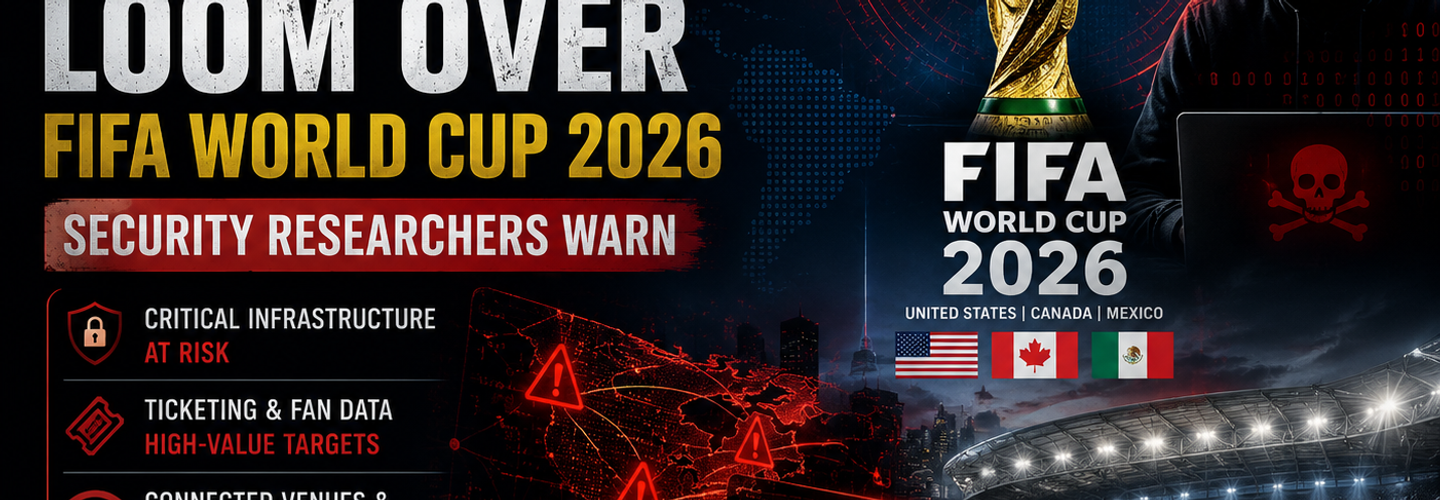
Massive Cyber Threats Loom Over FIFA World Cup 2026, Security Researchers Warn
If you're planning to attend FIFA World Cup 2026 matches — or your organization is supporting the tournament in any capacity — you're already inside one of the most actively targeted threat landscapes in cybersecurity right now. What most coverage doesn't tell you is that the attack infrastructure isn't just being planned: it's already operational, positioned, and waiting for peak fan engagement to pay off. In this intelligence briefing, you'll learn exactly who is targeting the World Cup, how they're doing it, and what defenders and fans need to do right now.
## Key Takeaways
- ▸Over 13,000 FIFA World Cup 2026-themed malicious domains were registered between January and May 2026 — with approximately 8.8% classified as malicious or suspicious, according to FortiGuard Labs.
- ▸State-sponsored threat groups from Russia, China, and Iran are assessed as likely to conduct intelligence collection and disruptive operations against the tournament, per Recorded Future's Insikt Group.
- ▸Hacktivists will very likely launch DDoS attacks and website defacement campaigns against organizations associated with the World Cup, according to the Canadian Centre for Cyber Security.
- ▸CISA has conducted cyber and physical vulnerability assessments at 10 host stadiums and conducted six exercises in January alone, reflecting the scale of preparedness required.
- ▸Fake ticketing sites, malicious mobile apps, AI-generated deepfake scams, and credential theft operations are already active — not emerging threats, but operational attack infrastructure.
- ▸Organizations in travel, hospitality, media, finance, and critical infrastructure face elevated ransomware risk during the tournament's 39-day window.
- ▸Security teams must monitor for lookalike domains, brand impersonation, credential exposure, phishing lures, and exposed network services throughout the entire tournament lifecycle.
## What Is the FIFA World Cup 2026 Cyber Threat Landscape?
The FIFA World Cup 2026 cyber threat landscape is the collection of financially motivated, hacktivist, and state-sponsored attack campaigns that have been deliberately built and positioned around the tournament — exploiting its global visibility, 5 million expected attendees, and vast digital supporting infrastructure as a coordinated attack surface.
The 2026 tournament is the largest in FIFA history: 48 teams, 104 matches, 39 days, across 16 cities in three countries — the United States, Canada, and Mexico — Source: FIFA World Cup 2026 Official Schedule. That unprecedented scale translates directly into an unprecedented attack surface. Every digital ticketing system, streaming platform, hotel booking interface, stadium Wi-Fi network, and third-party vendor integration becomes a potential exploitation point.
Major sporting events have a documented history of triggering exactly this kind of coordinated threat escalation. The 2018 Winter Olympics in PyeongChang suffered the Olympic Destroyer malware attack, which disrupted ticketing systems and stadium Wi-Fi during the opening ceremony. During Qatar 2022, a Chinese-linked threat group reportedly compromised telecommunications infrastructure supporting tournament operations. In 2014, hacktivists launched sustained DDoS campaigns against FIFA World Cup websites in Brazil — Source: Check Point Research, FIFA World Cup 2026 Threat Analysis, 2026. History makes clear: the World Cup doesn't just attract fans — it attracts every category of threat actor simultaneously.
Security teams responsible for any organization touching the World Cup ecosystem should begin with baseline infrastructure validation. Using a DNS lookup and security analysis tool to audit the DNS records of tournament-adjacent domains — your organization's own domains, partner domains, and any infrastructure serving World Cup integrations — surfaces misconfigured records and spoofing vectors before attackers exploit them.
## How Big Is the Malicious Domain Problem Targeting FIFA World Cup 2026?
The malicious domain problem targeting FIFA World Cup 2026 is the largest documented pre-event cybercriminal infrastructure buildout in sporting event history, with over 13,000 tournament-themed domains registered between January and May 2026 alone.
FortiGuard Labs identified more than 13,000 FIFA World Cup 2026-themed domains registered in that five-month window, with approximately 8.8% — roughly 1,145 domains — classified as malicious or suspicious based on naming patterns and confirmed scam activity — Source: Fortinet FIFA World Cup 2026 Cyberthreat Landscape Report, June 2026. Domain registrations spiked sharply from March through May, with April alone accounting for nearly 4,750 new registrations, signaling a coordinated infrastructure buildout timed to precede peak fan engagement.
Arctic Wolf's parallel research documented over 10,000 World Cup-themed malicious domains, with social media posts actively directing victims toward these sites through Discord, WhatsApp, and Telegram channels — Source: Arctic Wolf World Cup 2026 Threat Report, June 2026. The Canadian Centre for Cyber Security had already identified over 4,300 likely fraudulent domain registrations as of August 2025, many deliberately combining host city names with tournament years — Source: Canadian Centre for Cyber Security, Cyber Threat Bulletin, May 2026.
Fake Ticket Sites, Streaming Scams, and Phishing Infrastructure
Fake FIFA ticketing websites represent the highest-volume active threat category, exploiting the combination of genuine ticket scarcity and high demand to harvest payment credentials and personal information from fans who believe they are purchasing legitimate match access.
Researchers documented fraudulent sites that precisely replicate FIFA branding, official checkout flows, and legitimate domain structure — differing only by subtle variations in the URL that most users don't scrutinize. Fake hospitality booking sites accounted for 56% of all observed brand impersonation activity, with accommodation brands being the most targeted category — Source: Check Point Research, 2026.
Beyond ticketing, the threat portfolio spans fake streaming services offering unauthorized match access, fraudulent sports betting applications, fake merchandise stores, cryptocurrency scams positioned around player marketplaces, and fake recruitment portals targeting job seekers wanting to work at the tournament. Tracking which of these domains resolve to hosting infrastructure with suspicious registration patterns requires WHOIS domain intelligence, the primary tool threat analysts use to attribute newly-registered domains to threat actor campaigns. ReconShield's guide to WHOIS privacy protection explains how attackers exploit privacy features to register malicious domains without attribution — a tactic heavily used in this campaign.
Stealer Malware and Credential Exposure
Credential theft operations targeting FIFA World Cup 2026 are already active, with FortiGuard Labs identifying thousands of FIFA-related credential entries in stealer malware logs tied to families including Vidar, LummaC2, and RedLine — Source: Fortinet, 2026.
A trojanized version of the 1xBet betting application was specifically observed exhibiting ransomware-related behaviors, including encrypted communications routed through legitimate cloud services — Supabase and Render — to blend malicious traffic with normal API activity. This technique of blending malicious communications with legitimate cloud service traffic is a hallmark of professional, well-resourced threat actor operations rather than opportunistic fraud.
Even credentials stolen in previous, unrelated breaches become newly relevant during high-profile events. When combined with targeted social engineering lures built around the World Cup, even outdated credentials enable credential stuffing, account takeover, and targeted phishing against fans and event employees alike. Organizations can assess their own certificate and domain security posture against this threat by running an SSL/TLS crypto checker to verify that their domains are not being impersonated via fraudulent certificates issued to lookalike domains. ReconShield's SSL/TLS troubleshooting guide covers the certificate verification steps that surface fraudulent impersonation at the infrastructure level.
## Who Are the Threat Actors Targeting FIFA World Cup 2026?
Three distinct categories of threat actor — financially motivated cybercriminals, ideologically motivated hacktivists, and state-sponsored advanced persistent threat groups — are simultaneously targeting the FIFA World Cup 2026, each pursuing different objectives through overlapping attack methods.
Financially Motivated Cybercriminals
Financially motivated cybercriminals represent the highest-volume, highest-likelihood threat to the tournament. Their objective is straightforward: exploit the global attention on the World Cup to maximize returns on phishing, credential theft, payment fraud, ransomware, and ticket scam operations. The 13,000+ malicious domain registrations documented by FortiGuard Labs reflect this category — organized criminal campaigns, not isolated opportunists.
"Attackers are using the World Cup as cover to run high-volume phishing operations against both fans and the organizations supporting the event," said Ismael Valenzuela, vice president of threat intelligence research at Arctic Wolf — Source: Cybersecurity Dive, June 11, 2026. Researchers found infrastructure aimed specifically at event organizers, including fake career sites designed to steal Google Workspace credentials and weaponized "employee onboarding" documents.
Detecting this threat at the organizational level starts with monitoring your email authentication infrastructure. Running a periodic email security check to validate SPF, DKIM, and DMARC record configurations for all organizational domains confirms that attackers cannot spoof your brand in phishing campaigns targeting your customers, partners, or employees. ReconShield's email spoofing prevention guide is a practical reference for organizations needing to harden their email authentication stack against impersonation during high-risk periods like the World Cup.
Hacktivists and Ideologically Motivated Actors
The Canadian Centre for Cyber Security assesses that ideologically motivated non-state actors — hacktivists — will very likely conduct disruptive attacks against World Cup-associated organizations, including DDoS attacks and website defacement campaigns designed to draw attention to domestic issues within host countries, environmental causes, or geopolitical grievances — Source: Canadian Centre for Cyber Security, May 2026.
NoName057(16), a pro-Russian hacktivist group, has maintained consistent operational tempo against Western targets and already demonstrated the capability to take state and local government websites offline for hours during sustained DDoS campaigns. The UK NCSC issued a specific alert in January 2026 calling out persistent NoName057(16) targeting of local government services — Source: Palo Alto Networks Unit 42, 2026. During the 2024 UEFA Euro opening match, a DDoS attack specifically targeted Poland's network infrastructure during the high-visibility event window.
Organizations can assess their web application exposure to defacement and DDoS attacks by first understanding what services they're publicly exposing. A TCP port scanner identifies which services are reachable from the internet — including management interfaces and web services that should never be directly exposed. ReconShield's shadow IT port exposure analysis guide explains how exposed ports become DDoS amplification and defacement entry points during high-pressure event windows.
State-Sponsored Threat Groups
State-sponsored cyber threat actors are assessed as posing a roughly even chance of conducting disruptive operations against FIFA World Cup 2026 infrastructure, with Russian, Chinese, and Iranian groups identified as the most capable and motivated — Source: Recorded Future Insikt Group, June 2026.
Russia is assessed as likely to focus on DDoS attacks, website defacement, hack-and-leak operations, and activity through proxy hacktivist personas, providing plausible deniability while still generating significant operational disruption. Russian state-sponsored groups are also assessed as highly likely to use the World Cup for intelligence collection operations. Pro-Russian hacktivists already demonstrated capability at the 2026 Winter Olympics in Italy.
Iran poses additional risk due to ongoing tensions with host nation government positions. Iranian Football Federation personnel were denied entry into Canada ahead of the tournament, creating a diplomatic context that elevates the likelihood of Iran-linked hacktivist and state proxy activity — Source: Recorded Future, 2026. Chinese-linked threat groups have previously compromised telecommunications infrastructure supporting major sporting events and are assessed as likely to continue intelligence collection operations targeting tournament networks.
Tracking suspicious traffic originating from known threat actor infrastructure requires IP reputation intelligence — cross-referencing inbound connection sources against global threat feeds, ASN registrations, and proxy/VPN detection to identify potentially adversarial access patterns. Understanding the attack surface you're exposing to these actors starts with mapping your subdomains through a subdomain finder, since forgotten or misconfigured subdomains are frequent entry points for both state and hacktivist intrusions.
## What Attack Types Should Organizations Prepare For?
The primary attack types threatening organizations associated with FIFA World Cup 2026 are DDoS campaigns targeting service availability, ransomware extortion against critical operations, phishing infrastructure targeting employees and partners, and supply chain compromise through third-party vendor integrations.
DDoS Attacks and Infrastructure Disruption
DDoS attacks targeting World Cup-associated organizations represent a near-certain hacktivist threat and a significant state-actor risk. The most serious risk scenarios involve not just tournament websites going offline, but critical infrastructure serving the tournament's host cities — municipal transit systems, water utilities, emergency communications, and stadium operational technology — Source: CSIS, 2026.
Palo Alto Networks' senior manager of threat intelligence, Justin Moore, assessed that the "most serious risk may come in the form of cyberattacks from state-aligned actors" using DDoS as their primary tool — Source: Cybersecurity Dive, 2026.
Assessing web application exposure ahead of a DDoS-risk period includes validating that security headers like HSTS, CSP, and X-Frame-Options are properly configured. A security headers auditor reveals whether applications are missing the defensive headers that reduce the blast radius of application-layer DDoS and injection attacks simultaneously. ReconShield's OSINT fundamentals guide covers the passive reconnaissance techniques attackers use to profile targets before launching DDoS campaigns.
Ransomware and Extortion Against Tournament Supporters
The Canadian Centre for Cyber Security explicitly assesses that cybercriminals will very likely attempt ransomware extortion against organizations associated with or supporting the FIFA World Cup 2026 — Source: Canadian Centre for Cyber Security, May 2026. The high reputational stakes of the tournament, combined with tight operational windows, make it an ideal pressure context for ransomware operators: organizations supporting the tournament cannot afford lengthy recovery periods without catastrophic reputational and contractual consequences.
Organizations should run a comprehensive exposure assessment against all internet-facing assets to identify OWASP misconfigurations and web server vulnerabilities that ransomware operators use as initial access vectors. Pre-event vulnerability assessment is consistently the highest-ROI defensive investment during major event threat windows.
## What Is CISA Doing to Protect the World Cup?
CISA has been conducting an extensive pre-event preparedness program for FIFA World Cup 2026, including cyber and physical vulnerability assessments at 10 host stadiums, FIFA base camps, hotels, and related critical infrastructure.
CISA conducted six exercises related to the World Cup in January 2026 alone and has been coordinating with federal, private sector, and international partners across all three host countries — Source: CISA, 2026. "Today's preparations for the World Cup will help strengthen our nation's readiness for future events, including Freedom 250 and the 2028 Summer Olympics," CISA Acting Director Nick Andersen confirmed publicly. CISA earlier provided technical cyber assistance to the 2026 Winter Olympics in Milan, creating a direct knowledge transfer pathway for World Cup preparations.
The FBI has additionally published advisories warning specifically about spoofed FIFA websites, PII theft operations, and fake ticketing campaigns — recommending that victims of fraudulent sites report activity to IC3.gov.
## How Can Fans Protect Themselves During FIFA World Cup 2026?
Fans can protect themselves from FIFA World Cup 2026 cyber threats by purchasing tickets exclusively from FIFA's official platform, avoiding third-party apps and social media offers, using unique strong passwords with multi-factor authentication, and verifying all job offers and travel arrangements through official channels before providing any personal or payment information.
Specific threat patterns to watch for include unsolicited ticket offers pushed through Telegram, Discord, or WhatsApp channels; streaming links shared through unofficial social media groups; mobile betting applications downloaded outside official app stores; and recruitment messages promising World Cup employment that require upfront credential submission.
SMS blasters represent a particularly insidious physical-world threat. In April 2026, arrests were made following the discovery of an SMS blaster operating in the Greater Toronto Area, connecting to tens of thousands of devices over several months — Source: Canadian Centre for Cyber Security, 2026. At crowded World Cup venues, similar devices could send mass smishing messages to thousands of fans simultaneously, appearing to come from legitimate event organizers or rideshare services.
## How Can Organizations Defend Against World Cup Cyber Threats?
Organizations can defend against FIFA World Cup 2026 cyber threats through a layered defensive posture covering email authentication hardening, lookalike domain monitoring, credential exposure auditing, network perimeter assessment, and supply chain partner security reviews — all implemented before the tournament's peak operational windows.
Security teams should monitor continuously for brand impersonation, lookalike domains using your organization's name or logos, malicious advertisements referencing your brand, and credential leaks involving employee accounts in stealer malware datasets. FortiGuard Labs summarized the defensive posture clearly: "Attackers capitalize on attention. With the FIFA World Cup 2026 attracting worldwide focus, defenders must ensure their visibility matches the threat actor's preparation timeline" — Source: Fortinet, 2026.
Passive security auditing covers the most critical defensive checklist items without touching the target. Validating DNS records and email authentication configuration ensures your domains can't be spoofed in phishing campaigns. Running an SSL/TLS checker confirms your certificates haven't been compromised or superseded by fraudulent lookalike certificates. Checking security response headers validates that web-facing systems meet baseline hardening standards. Running a port scan identifies any unexpectedly exposed services. Cross-referencing IPs accessing your systems through IP reputation intelligence surfaces adversarial traffic patterns before they escalate to breaches.
ReconShield's BugHunter AI security toolkit review is a direct reference for security teams seeking to automate the vulnerability discovery pipeline for exactly this kind of pre-event security sprint.
## What's Next for Mega-Event Cybersecurity?
FIFA World Cup 2026 is establishing the threat precedent for all subsequent mega-events, including America 250 and the 2028 Summer Olympics in Los Angeles — meaning the preparedness investments and governance frameworks built now will define the security posture of American mega-events for the next decade.
CISA has already stated that World Cup preparations are building readiness capacity for these subsequent events. The convergence of AI-generated deepfakes, SMS blasters, stealer malware credential harvesting, coordinated domain registration campaigns, and state-sponsored disruption operations represents the new normal for high-visibility global events — not an exceptional threat scenario.
For security teams and fans alike, the lesson is the same: verification before engagement. Verify domain legitimacy. Verify certificate authenticity. Verify sender identity. Check that the platform you're interacting with has the security controls in place that legitimate organizations maintain. When these baseline checks are part of every interaction — for organizations and individuals both — the coordinated infrastructure attackers spend months building becomes dramatically less effective.
## Conclusion
The FIFA World Cup 2026 is not just the largest sporting event in history — it is the most comprehensively targeted cybersecurity environment of 2026. Cyber threats to major events include financially motivated criminal campaigns, hacktivist disruption operations, and state-sponsored intelligence and sabotage activity — all converging simultaneously against a single, highly visible target over a defined 39-day window.
The good news is that preparation depth matches the threat. CISA's vulnerability assessments, government threat bulletins from three host nations, and detailed research from FortiGuard Labs, Arctic Wolf, Recorded Future, Palo Alto, and Check Point have mapped this threat landscape with unusual completeness. The intelligence is available. The question is whether defenders and fans act on it before, not after, the attack infrastructure activates.
For security teams, start with the basics: validate your DNS security with a DNS lookup tool, audit SSL certificate integrity with an SSL/TLS checker, check your email authentication with an email security tool, scan for exposure with a vulnerability assessment, and enumerate your full subdomain surface with a subdomain finder. These five checks, run now, close the gaps that make the most common attack vectors viable. The infrastructure is ready. The question is: are you?
## Frequently Asked Questions
What are the main cyber threats to FIFA World Cup 2026? The main cyber threats to FIFA World Cup 2026 include fake ticketing websites and phishing campaigns, malicious mobile applications, DDoS attacks by hacktivists, ransomware operations against tournament-supporting organizations, state-sponsored intelligence collection and disruption operations, SMS blasting at crowded venues, AI-generated deepfake scams, and credential theft through stealer malware and fake recruitment portals.
How many malicious domains have been registered for FIFA World Cup 2026? FortiGuard Labs identified more than 13,000 FIFA World Cup 2026-themed domains registered between January and May 2026, with approximately 8.8% classified as malicious or suspicious. Arctic Wolf separately documented over 10,000 World Cup-themed malicious domains, confirming the scale of coordinated pre-event criminal infrastructure buildout.
Which state-sponsored groups are targeting FIFA World Cup 2026? Recorded Future's Insikt Group assessed that Russian, Chinese, and Iranian state-sponsored threat groups are most likely to conduct intelligence collection and potentially disruptive operations. Russia is expected to focus on DDoS attacks and operations through hacktivist proxy groups. Iran poses elevated risk due to ongoing geopolitical tensions with host nations. China is primarily assessed as an intelligence collection threat targeting telecommunications and tournament networks.
What is CISA doing about FIFA World Cup 2026 cybersecurity? CISA has conducted cyber and physical vulnerability assessments at 10 host stadiums, FIFA base camps, hotels, and related critical infrastructure. The agency ran six preparedness exercises in January 2026 alone and is coordinating with federal, state, private sector, and international partners across all three host countries to mitigate both cyber and physical risks.
How can fans protect themselves from FIFA World Cup 2026 cyber scams? Fans should purchase tickets exclusively from FIFA's official platform, avoid social media offers or unofficial resale sites, refrain from downloading apps outside official app stores, use unique passwords with multi-factor authentication, verify job postings on official websites before submitting credentials, and treat all urgent payment or login requests with skepticism regardless of the sender's apparent identity.
What should organizations do to prepare for World Cup cyber threats? Organizations should harden email authentication (SPF, DKIM, DMARC), monitor for lookalike domain registrations impersonating their brand, audit exposed network services and web application security headers, validate SSL certificate integrity, run vulnerability assessments against internet-facing assets, and assess third-party vendor security posture — all before peak tournament activity intensifies attacker focus.
What is a smishing or SMS blaster attack? An SMS blaster is a portable device that impersonates a legitimate cellular tower, connecting to nearby phones and sending mass smishing messages that appear to come from trusted sources like event organizers or rideshare services. In April 2026, an SMS blaster was discovered operating in Greater Toronto, connecting to tens of thousands of devices. Deployed at World Cup venues, such devices could reach tens of thousands of fans simultaneously with malicious links or fraudulent instructions.
Could state actors disrupt FIFA World Cup matches directly? Security analysts assess that direct disruption of match operations is a lower-likelihood but high-impact scenario. More probable targets include the surrounding digital ecosystem: ticketing platforms, broadcast infrastructure, hotel and transport booking systems, and municipal services in host cities. CSIS specifically identified municipal critical infrastructure — transit, water, power, and emergency services — as realistic state-actor targets given their dependence on OT systems with internet-facing management interfaces.
Written by Surendra Reddy — Founder & Principal Architect, ReconShield Surendra is an information security engineer specializing in OSINT methodology, internet telemetry mapping, and cryptographic domain security. He designed ReconShield to help security teams manage their attack surface exposure through passive, authorized diagnostic tooling.
Reviewed by ReconShield Editorial Team — Peer-reviewed for technical accuracy, factual integrity, and sourcing against primary research reports.
## Analyst Commentary & Implementation Blueprint
Security advisory
Continuous security exposure assessment is critical to identifying public vulnerabilities before they are exploited. Organizations should maintain a passive inventory of all web servers, TLS configs, and open ports, ensuring that default configurations are eliminated and security advisories are actively implemented.
Hardened Security Configuration Blueprint
# General Security Hardening Directive
ServerTokens ProductOnly
ServerSignature Off
FileETag None
Actionable Mitigation Checklist
- ✔Perform passive asset inventories weekly.
- ✔Restrict administrative ports using local firewall controls.
- ✔Monitor active CVE alerts for exposed software.
Common Inquiries & FAQs
Why is passive scanning preferred for continuous auditing?
Passive audits do not cause operational impact or trigger firewall blocks, making them ideal for constant surveillance of internet-facing assets.
What should I do if a vulnerability is flagged?
Apply the latest vendor patches, restrict access to the resource via firewalls, or verify configuration flags to mitigate risks.
Surendra Reddy
Surendra Reddy is a cybersecurity researcher and founder of ReconShield, specializing in OSINT and defensive infrastructure analysis.
Connect on LinkedIn ↗// AUDIT BRIEFING DISCUSSION (2 COMMENTS)
Great breakdown of the passive infrastructure vectors. We recently audited our external DNS zones and found multiple dangling staging environments. Implementing wildcard certificates reduced our CT log leaks significantly.
Is there any automated tooling you recommend for daily crt.sh scraping? Manually checking CT logs is becoming unsustainable for our domain portfolio.
// MORE ARTICLES
Security Researchers Warn Critical n8n Flaws May Expose Automation Platforms to RCE
Researchers have disclosed critical vulnerabilities in n8n that could expose automation workflows and connected enterprise systems to remote code execution risks, prompting urgent patch recommendations for users and administrators.
How Agentic AI Is Changing Software Engineering and Expanding Mobile Attack Surfaces
Agentic AI is rapidly transforming software engineering workflows through automation and intelligent coding assistance, while cybersecurity experts warn of expanding mobile attack surfaces and emerging application security risks.
SplitVPN Hacked: Data Breach Exposes 865,000 User Records and 58 Million Hidden Connection Logs (July 2026)
SplitVPN hacked: 865,336 user records and 58 million connection logs exposed, directly contradicting the VPN's "no-logs" promise. What was leaked and what to do now.