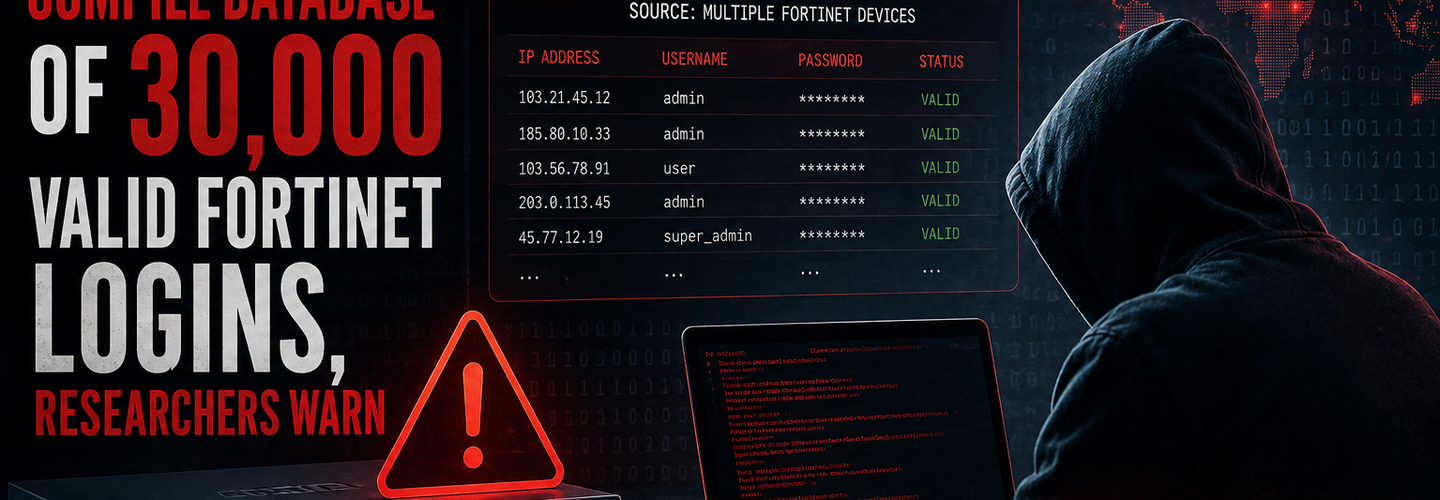
Hackers Compile Database of 30,000 Valid Fortinet Logins: A Definitive Threat Analysis and Remediation Guide
Summarize this blog post with: ChatGPT | Perplexity | Claude | Grok
Most organizations rely on firewalls and VPN gateways as their first line of defense against cyber threats. What many security teams don't realize is that stolen administrative credentials can bypass those defenses entirely. In this guide, you'll learn how researchers uncovered a database of 30,000 valid Fortinet logins, what risks it creates, and the exact steps organizations should take to protect their networks.
## Key Takeaways
- ▸A database reportedly containing 30,000 valid Fortinet logins highlights ongoing risks from credential theft and exposed network devices.
- ▸Fortinet credentials can give attackers access to VPNs, firewalls, and other critical enterprise infrastructure.
- ▸Historical vulnerabilities and weak credential management often contribute to large-scale credential exposure.
- ▸Multi-factor authentication significantly reduces the risk associated with stolen usernames and passwords.
- ▸Security teams should review authentication logs and rotate credentials if exposure is suspected.
- ▸Continuous monitoring and timely firmware updates help reduce the attack surface of Fortinet environments.
- ▸Threat intelligence and incident response planning are essential for mitigating credential-based attacks.
## What Is the Database of 30,000 Valid Fortinet Logins?
A database of 30,000 valid Fortinet logins is an aggregated collection of working usernames and passwords that grant access to Fortinet security appliances such as firewalls and VPNs. Researchers warn that such a dataset gives attackers a ready-made list of entry points into corporate networks.
First, define the core terms. Fortinet credentials are authentication details that grant administrative or user access to Fortinet security products, including firewalls, VPNs, and network management systems. Possessing these means an attacker can often log in as a legitimate user.
Moreover, the aggregation is what makes it dangerous. A database containing 30,000 reportedly valid Fortinet logins demonstrates how attackers can aggregate credentials from multiple sources to create large-scale access opportunities. For example, credentials harvested from old exploits, infostealer malware, and prior leaks can be merged and re-validated into one weaponized list.
In addition, scale provides context. Fortinet ships hundreds of thousands of devices, and FortiOS protects a large share of enterprise perimeters worldwide. For ongoing tracking, follow the latest Fortinet vulnerability disclosures and related advisories.
## Why This Fortinet Credential Exposure Matters
This Fortinet credential exposure matters because firewalls and VPN gateways sit at the network perimeter, so compromised logins can grant direct access to internal systems. A single valid credential can undermine an entire defense stack.
First, perimeter devices are high-value targets. Credential-based attacks involve using valid usernames and passwords to gain unauthorized access while bypassing many traditional security controls. For example, an attacker logging into a VPN with stolen credentials looks like a normal employee to most monitoring tools.
Second, the financial stakes are severe. The global average cost of a data breach reached $4.88 million in 2024 — Source: IBM Cost of a Data Breach Report, 2024. Perimeter compromise frequently precedes these expensive incidents.
Third, stolen credentials drive most breaches. Stolen or compromised credentials were involved in a large share of breaches analyzed in recent industry reporting — Source: Verizon Data Breach Investigations Report, 2024. This is why incidents like the FortiBleed firewall compromise affecting 80,000 systems draw urgent attention.
## How Hackers Compiled the Database
Hackers compiled the database by aggregating credentials from historical vulnerabilities, infostealer malware, and previous leaks, then validating which logins still work. The result is a curated list of confirmed-active access.
First, old vulnerabilities provide raw material. Unpatched Fortinet flaws have historically exposed configuration files and credentials. For example, a years-old path traversal flaw could leak VPN credentials that organizations never rotated afterward.
Second, malware harvests fresh credentials. Infostealers capture saved logins from infected administrator machines. By collecting these continuously, attackers refresh their datasets over time.
How Do Threat Actors Validate Stolen Fortinet Credentials?
Threat actors validate stolen credentials by testing them against live login portals to confirm which remain active. This validation step transforms a raw dump into a high-confidence target list.
For example, attackers run automated tools against VPN portals to separate working logins from expired ones. Notably, this overlaps with how credential stuffing attacks work, where leaked passwords are replayed at scale across services.
What Role Do Historical Fortinet Vulnerabilities Play in Credential Exposure?
Historical Fortinet vulnerabilities play a major role because unpatched flaws have repeatedly leaked configuration data and credentials. Old exposure often resurfaces years later.
For example, organizations that patched a flaw but never rotated credentials remain exposed if those passwords were already stolen. As such, incidents like the FortiBleed breach exposing 70,000 systems show how credential reuse extends the lifespan of a single vulnerability.
## Which Fortinet Products Are Most at Risk From Credential Exposure?
The most at-risk products are internet-facing Fortinet appliances, especially FortiGate firewalls and VPN services. Any device exposed to remote login is a priority target.
The highest-risk components include:
- ▸FortiGate firewalls — perimeter devices controlling network traffic.
- ▸FortiProxy systems — secure web gateway and proxy services.
- ▸SSL/IPsec VPN services — remote access entry points for employees.
- ▸Remote administrative interfaces — management portals reachable over the internet.
First, internet exposure multiplies risk. Devices with administrative interfaces reachable from the internet are scanned constantly. For example, an exposed FortiGate admin portal can receive thousands of automated login attempts per day.
Second, VPNs are prime targets. Remote access gateways are gateways to the internal network. Strengthen them using an enterprise VPN security checklist that addresses authentication bypass risks seen in similar appliances.
## What Risks Do Organizations Face?
Organizations face unauthorized network access, VPN compromise, lateral movement, data theft, and ransomware deployment from stolen Fortinet credentials. These risks compound quickly once an attacker is inside.
First, initial access leads to escalation. Once inside, attackers move laterally to reach high-value systems. For example, a foothold on a VPN can lead to domain controllers and sensitive file servers within hours.
Second, ransomware crews prize this access. Perimeter logins are a favored entry point for extortion attacks. To understand the chain, review ransomware initial access techniques seen in enterprise appliance intrusions.
How Can Attackers Use Stolen Fortinet Credentials?
Attackers use stolen Fortinet credentials to log in legitimately, alter firewall rules, establish persistence, and tunnel into internal networks. Valid logins make their activity blend in.
For example, an attacker may add a hidden VPN account to maintain access even after the original credential is reset. This persistence lets them return repeatedly, which is why credential exposure demands a full investigation, not just a password change.
## How Can Organizations Determine Whether Their Fortinet Accounts Are Exposed?
Organizations can determine exposure by reviewing authentication logs, checking for unfamiliar logins, and threat hunting across VPN and admin activity. Evidence usually appears in the logs first.
First, audit authentication events. Look for logins from unexpected countries, odd hours, or unknown IP addresses. For example, a successful admin login from a foreign IP at 3 a.m. is a strong red flag.
Second, hunt proactively. Threat hunting involves analyzing logs, authentication events, and network activity to identify signs of unauthorized access or compromise. Use a structured threat hunting approach for unauthorized access to find subtle indicators.
Third, verify external exposure. You can check which services are reachable from the internet using ReconShield's free port scanner to catalog exposed management interfaces. [Insert image: ReconShield port scanner showing exposed admin and VPN ports | Alt text: Scan for exposed Fortinet ports with ReconShield port scanner]
## How to Protect Fortinet Environments Immediately
The fastest protections are rotating credentials, enabling multi-factor authentication, updating firmware, and restricting administrative access. These steps close the most common attack paths.
Follow this priority order:
Rotate all credentials, especially admin and VPN accounts.
Enable multi-factor authentication on every remote login.
Update FortiOS firmware to the latest patched version.
Restrict admin interfaces to trusted IPs or internal networks only.
Enforce Zero Trust controls for remote access.
First, prioritize MFA. Multi-factor authentication reduces the effectiveness of stolen credentials by requiring additional verification beyond a password. For example, even a valid stolen password fails when a hardware token or app approval is required.
Second, rotate thoroughly. Pair resets with a review of password rotation and credential management practices, since infostealers continuously target saved logins.
Why Is Multi-Factor Authentication Critical for Fortinet Security?
Multi-factor authentication is critical because it blocks attackers who hold valid passwords but lack the second verification factor. It is the single most effective control against credential theft.
For example, an attacker with a working FortiGate password still cannot log in without the one-time code or token. As such, MFA neutralizes the core value of a 30,000-credential database almost entirely.
## Tools, Detection Methods, and Security Resources
Effective detection combines SIEM monitoring, vulnerability scanning, threat intelligence, and log analysis. Layered visibility catches what any single tool misses.
First, centralize logs. A SIEM correlates authentication events across devices to surface anomalies. For example, it can flag repeated failed logins followed by one success — a classic brute-force signature. Build this into broader network security monitoring strategies.
Second, scan for weaknesses. You can assess perimeter exposure with ReconShield's free vulnerability scanner, which scores configuration gaps against CVSS guidelines. [Insert image: ReconShield vulnerability scanner perimeter results | Alt text: Scan Fortinet exposure with ReconShield vulnerability scanner]
Third, enrich with intelligence. Check suspicious source addresses using the IP lookup tool, and explore the full free cybersecurity tools suite. For balance, Fortinet's official PSIRT advisories and free SIEM tiers are valuable complementary resources.
## What's Next for Organizations Using Fortinet?
The next step is sustained monitoring, security hardening, and a formal incident response plan. Credential exposure is an ongoing risk, not a one-time event.
First, monitor continuously. Attackers retry validated credentials for months. For example, a credential reset today does little if MFA is missing and logs go unwatched tomorrow.
Second, formalize response. Adopt a clear security incident response process so teams act fast when alerts fire. Long term, move toward a Zero Trust network architecture that verifies every access request, and track emerging risks through the ReconShield threat intelligence hub.
## Conclusion
A database of 30,000 valid Fortinet logins is a serious reminder that stolen credentials can defeat even strong perimeter defenses. Firewalls and VPNs only protect networks when the accounts behind them are secured, monitored, and backed by multi-factor authentication.
The good news is that defense is achievable today. By rotating credentials, enforcing MFA, patching firmware, restricting admin access, and monitoring authentication logs, you can dramatically reduce your exposure. Treat credential security as a continuous discipline, verify your environment now, and stay ahead of the threat actors aggregating these lists.
Written by the ReconShield Editorial Team — a cybersecurity publication covering cyber threats, data breaches, vulnerabilities, malware, threat intelligence, and online privacy, delivering practical insights to help readers stay informed and secure.
Reviewed by Surendra Reddy, Founder & Principal Security Engineer at ReconShield, specializing in vulnerability management, network diagnostics, and attack surface analytics.
## Analyst Commentary & Implementation Blueprint
Security advisory
Continuous security exposure assessment is critical to identifying public vulnerabilities before they are exploited. Organizations should maintain a passive inventory of all web servers, TLS configs, and open ports, ensuring that default configurations are eliminated and security advisories are actively implemented.
Hardened Security Configuration Blueprint
# General Security Hardening Directive
ServerTokens ProductOnly
ServerSignature Off
FileETag None
Actionable Mitigation Checklist
- ✔Perform passive asset inventories weekly.
- ✔Restrict administrative ports using local firewall controls.
- ✔Monitor active CVE alerts for exposed software.
Common Inquiries & FAQs
Why is passive scanning preferred for continuous auditing?
Passive audits do not cause operational impact or trigger firewall blocks, making them ideal for constant surveillance of internet-facing assets.
What should I do if a vulnerability is flagged?
Apply the latest vendor patches, restrict access to the resource via firewalls, or verify configuration flags to mitigate risks.
Surendra Reddy
Surendra Reddy is a cybersecurity researcher and founder of ReconShield, specializing in OSINT and defensive infrastructure analysis.
Connect on LinkedIn ↗// AUDIT BRIEFING DISCUSSION (2 COMMENTS)
Great breakdown of the passive infrastructure vectors. We recently audited our external DNS zones and found multiple dangling staging environments. Implementing wildcard certificates reduced our CT log leaks significantly.
Is there any automated tooling you recommend for daily crt.sh scraping? Manually checking CT logs is becoming unsustainable for our domain portfolio.
// MORE ARTICLES
Security Researchers Warn Critical n8n Flaws May Expose Automation Platforms to RCE
Researchers have disclosed critical vulnerabilities in n8n that could expose automation workflows and connected enterprise systems to remote code execution risks, prompting urgent patch recommendations for users and administrators.

How Agentic AI Is Changing Software Engineering and Expanding Mobile Attack Surfaces
Agentic AI is rapidly transforming software engineering workflows through automation and intelligent coding assistance, while cybersecurity experts warn of expanding mobile attack surfaces and emerging application security risks.
SplitVPN Hacked: Data Breach Exposes 865,000 User Records and 58 Million Hidden Connection Logs (July 2026)
SplitVPN hacked: 865,336 user records and 58 million connection logs exposed, directly contradicting the VPN's "no-logs" promise. What was leaked and what to do now.