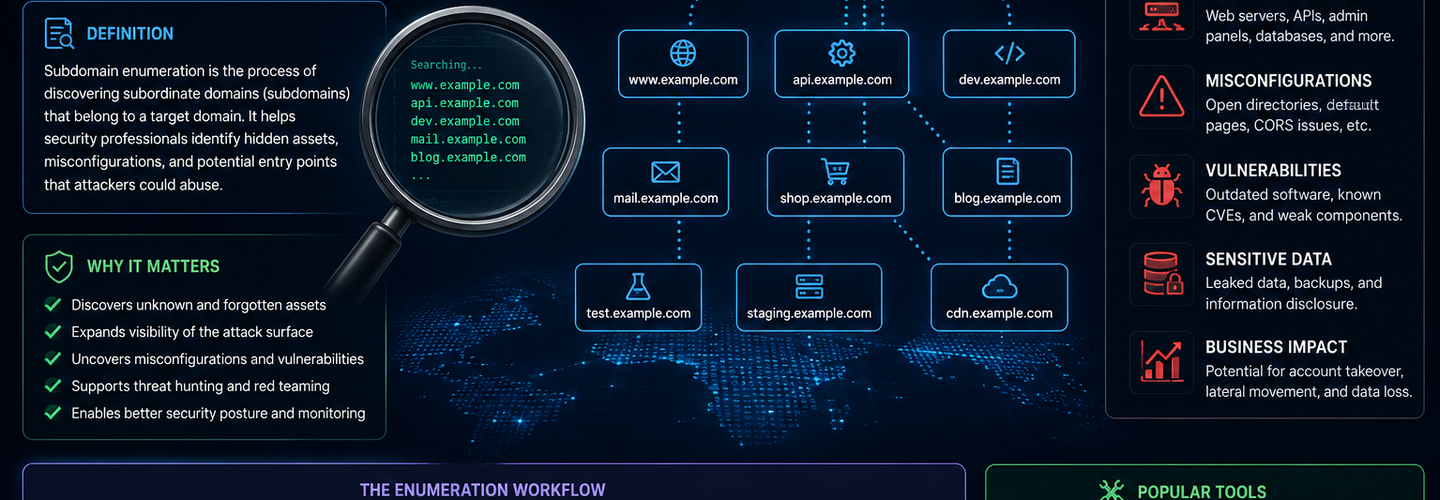
What Is Subdomain Enumeration? The Definitive Guide to Discovering Hidden Assets and Mapping Attack Surfaces
You've probably already seen organizations use domains like api.company.com, blog.company.com, or support.company.com. What many people don't realize is that large organizations often have hundreds or even thousands of hidden subdomains that expose forgotten applications, development environments, and potential security risks. In this guide, you'll learn exactly what subdomain enumeration is, how it works, the techniques professionals use, and how to discover subdomains efficiently and responsibly.
## Key Takeaways
- ▸Subdomain enumeration is the process of discovering subdomains associated with a target domain to identify internet-facing assets and services.
- ▸Passive subdomain enumeration gathers information from external sources without directly interacting with target infrastructure.
- ▸Active subdomain enumeration uses DNS queries, brute forcing, and direct discovery techniques to uncover additional assets.
- ▸Attack surface management relies on continuous subdomain enumeration to maintain visibility into exposed systems.
- ▸Certificate Transparency logs are one of the most effective sources for discovering publicly known subdomains.
- ▸Hidden subdomains can expose forgotten applications, staging environments, and misconfigured services.
- ▸Combining passive and active techniques typically produces the most comprehensive subdomain discovery results.
## What Is Subdomain Enumeration in Cybersecurity?
Subdomain enumeration is the process of discovering subdomains associated with a parent domain to identify internet-facing assets and services.
First, a domain is the primary web address owned by an organization. A subdomain is a separate section that exists beneath the main domain.
For example:
- ▸example.com → Root domain
- ▸blog.example.com → Subdomain
- ▸api.example.com → Subdomain
- ▸support.example.com → Subdomain
Subdomain enumeration helps security professionals build a complete inventory of digital assets. For example, an organization may publicly advertise its main website while unintentionally exposing development or testing environments through hidden subdomains.
According to industry research, organizations frequently lose visibility into internet-facing assets due to cloud adoption and decentralized deployments — Source: Gartner, 2025.
Moreover, subdomain discovery is a foundational component of cybersecurity reconnaissance, attack surface discovery, penetration testing, and bug bounty hunting.
If you want to discover subdomains quickly, you can use the subdomain finder tool
Domain vs Subdomain
A domain represents the primary identity of a website.
A subdomain represents a separate service, application, environment, or department operating under that domain.
Examples include:
- ▸mail.google.com
- ▸developers.google.com
- ▸support.microsoft.com
- ▸api.github.com
Every subdomain can represent a unique attack surface.
## Why Is Subdomain Enumeration Important for Security Assessments?
Subdomain enumeration is important because organizations cannot secure assets they do not know exist.
According to IBM's Cost of a Data Breach Report, attack surface complexity continues to be a major factor in breach costs — Source: IBM, 2025.
Attack Surface Discovery
First, attack surface discovery begins with asset visibility.
For example, if a company owns 500 subdomains but monitors only 300 of them, the remaining 200 assets may introduce unknown risks.
For a deeper understanding, see the attack surface management guide
Hidden Asset Identification
Second, subdomain enumeration helps uncover forgotten infrastructure.
Examples include:
- ▸Staging servers
- ▸Development environments
- ▸Legacy applications
- ▸Internal portals accidentally exposed
- ▸Deprecated APIs
Hidden subdomains can expose forgotten applications, staging environments, and services that increase an organization's security risk.
Bug Bounty and Penetration Testing
Third, bug bounty hunters frequently begin engagements with subdomain discovery.
A single forgotten subdomain may reveal:
- ▸Login portals
- ▸Old CMS installations
- ▸Vulnerable frameworks
- ▸Exposed administrative panels
Asset Inventory Management
Moreover, attack surface management depends on continuous subdomain enumeration to maintain visibility into exposed organizational assets.
Organizations using cloud infrastructure often launch new services weekly, making continuous monitoring essential.
## How Does Subdomain Enumeration Work?
Subdomain enumeration works by collecting DNS, certificate, OSINT, and infrastructure data to identify subdomains associated with a target domain.
DNS-Based Discovery
First, DNS records provide information about domain infrastructure.
Researchers examine:
- ▸A records
- ▸AAAA records
- ▸CNAME records
- ▸NS records
- ▸TXT records
For example, a DNS lookup might reveal hidden infrastructure relationships.
You can investigate records using the dns lookup tool
Information Gathering Workflow
A standard workflow looks like this:
Identify target domain
Gather passive intelligence
Query CT logs
Perform DNS analysis
Validate findings
Probe live services
Map attack surface
Enumeration Lifecycle
The typical lifecycle includes:
- ▸Discovery
- ▸Validation
- ▸Classification
- ▸Monitoring
- ▸Risk assessment
Subdomain enumeration is not a one-time task. Continuous monitoring produces the best results.
## What Is the Difference Between Active and Passive Subdomain Enumeration?
The difference between active and passive subdomain enumeration is how information is collected.
Passive Subdomain Enumeration
Passive subdomain enumeration involves collecting subdomain information from third-party sources without directly interacting with the target's infrastructure.
Sources include:
- ▸Certificate Transparency logs
- ▸Search engines
- ▸Security datasets
- ▸Public DNS databases
- ▸OSINT repositories
For more information, read our guide on passive reconnaissance techniques
Benefits:
- ▸Low detection risk
- ▸Fast execution
- ▸Highly scalable
Limitations:
- ▸Incomplete coverage
- ▸Reliance on public data
Active Subdomain Enumeration
Active subdomain enumeration involves querying DNS infrastructure and performing discovery techniques to identify additional subdomains.
Methods include:
- ▸DNS brute forcing
- ▸Zone transfer testing
- ▸Recursive discovery
- ▸Direct DNS resolution
Benefits:
- ▸Greater coverage
- ▸Discovery of hidden assets
Limitations:
- ▸Increased noise
- ▸Potential rate limits
Hybrid Enumeration
Most professionals combine both approaches.
Combining passive and active enumeration techniques typically produces the most comprehensive subdomain discovery results.
## What Are the Most Common Subdomain Enumeration Techniques?
The most common subdomain enumeration techniques combine OSINT, DNS analysis, certificate intelligence, and validation workflows.
Certificate Transparency Log Analysis
First, CT logs provide public records of SSL/TLS certificate issuance.
Certificate Transparency logs provide publicly accessible records of issued SSL/TLS certificates and are widely used for subdomain discovery.
For example, if a certificate was issued for:
- ▸api.company.com
- ▸vpn.company.com
those names may appear in CT databases.
Learn more about certificate transparency logs
Search Engine Reconnaissance
Second, search engines can reveal indexed subdomains.
Examples:
- ▸site:*.example.com
- ▸site:example.com
DNS Brute Forcing
Third, DNS brute forcing attempts common subdomain names.
Examples:
- ▸admin
- ▸api
- ▸dev
- ▸test
- ▸staging
DNS Zone Transfers
Fourth, misconfigured DNS servers may allow zone transfers.
Although uncommon today, successful transfers can expose complete DNS inventories.
Reverse DNS Lookups
Fifth, reverse DNS analysis maps IP addresses back to hostnames.
For infrastructure investigations, use a reverse ip lookup workflow
Web Archive Analysis
Finally, archived content frequently reveals historical subdomains no longer publicly linked.
## How Do Certificate Transparency Logs Help Discover Subdomains?
Certificate Transparency logs help discover subdomains by providing publicly accessible records of issued SSL/TLS certificates.
Google introduced CT logging requirements to improve certificate visibility across the internet.
When organizations issue certificates for domains such as:
- ▸app.company.com
- ▸portal.company.com
- ▸vpn.company.com
those entries often become searchable.
According to Let's Encrypt ecosystem data, CT logs contain billions of certificate records globally — Source: Let's Encrypt, 2025.
Because of this, CT logs have become one of the most valuable reconnaissance resources available today.
## What Tools Are Best for Subdomain Enumeration?
The best subdomain enumeration tools combine multiple data sources and validation mechanisms.
ReconShield Subdomain Finder
The ReconShield Subdomain Finder performs passive subdomain discovery using CT logs and DNS datasets. Tool
Subfinder
Subfinder is a popular passive reconnaissance tool developed by ProjectDiscovery.
Best for:
- ▸Fast discovery
- ▸Automation
- ▸Bug bounty workflows
Amass
Amass is an advanced attack surface mapping framework.
Best for:
- ▸Enterprise reconnaissance
- ▸Deep asset discovery
- ▸Infrastructure graphing
Assetfinder
Assetfinder is lightweight and effective for rapid enumeration.
Best for:
- ▸Quick OSINT collection
- ▸Automation pipelines
DNSRecon
DNSRecon focuses on DNS intelligence gathering.
Best for:
- ▸DNS auditing
- ▸Record analysis
- ▸Validation
Findomain
Findomain provides fast certificate and DNS-based discovery.
Best for:
- ▸Continuous monitoring
- ▸Large-scale enumeration
## How Is Subdomain Enumeration Used in Bug Bounty Hunting?
Subdomain enumeration is often the first phase of bug bounty reconnaissance.
First, researchers identify every reachable asset belonging to the target.
Second, they validate which systems are active.
Third, they prioritize assets likely to contain vulnerabilities.
Examples include:
- ▸Admin panels
- ▸Legacy applications
- ▸Exposed APIs
- ▸Test environments
Many high-severity findings originate from forgotten infrastructure rather than primary websites.
## What Security Risks Can Hidden Subdomains Create?
Hidden subdomains create security risks because they often escape routine monitoring and security testing.
Common risks include:
- ▸Outdated software
- ▸Exposed login portals
- ▸Legacy APIs
- ▸Misconfigured cloud resources
- ▸Abandoned services
Subdomain Takeovers
A particularly dangerous issue is subdomain takeover.
For example, a CNAME record pointing to an abandoned third-party service may allow attackers to claim the resource.
Learn more about subdomain takeover risks
Shadow IT
Shadow IT occurs when systems are deployed without security team oversight.
These systems frequently become high-risk attack vectors.
## How Do You Validate Discovered Subdomains?
Validating discovered subdomains confirms whether assets are real, active, and relevant.
DNS Validation
First, verify DNS records.
Use the dns lookup tool
WHOIS Investigation
Second, investigate ownership and attribution.
DNS Propagation Verification
Third, verify DNS consistency across regions.
Use a dns propagation checker workflow to validate changes.
HTTP Probing
Fourth, test web accessibility.
Researchers commonly identify:
- ▸Active websites
- ▸Redirect chains
- ▸Login portals
- ▸API endpoints
Validation transforms raw discovery data into actionable intelligence.
## Is Subdomain Enumeration Legal and Ethical?
Subdomain enumeration is legal when conducted on assets you own or have explicit authorization to assess.
Always follow these principles:
- ▸Obtain permission
- ▸Respect program scope
- ▸Follow disclosure policies
- ▸Avoid intrusive testing
- ▸Adhere to local laws
Bug bounty platforms typically define acceptable reconnaissance activities within their program rules.
Ethical research protects organizations while improving security visibility.
## What Should You Do After Finding Subdomains?
After finding subdomains, you should validate assets, assess risk, and establish continuous monitoring.
Recommended workflow:
Validate DNS records
Identify live hosts
Classify assets
Assess vulnerabilities
Monitor continuously
Update asset inventory
For broader asset discovery techniques, explore
For a complete security monitoring workflow, explore
Additionally, use a cybersecurity reconnaissance checklist to standardize future investigations:
## Conclusion
Subdomain enumeration is the foundation of attack surface discovery and cybersecurity reconnaissance.
Throughout this guide, we've explored what subdomain enumeration is, why it matters, the differences between passive and active discovery, common enumeration techniques, popular tools, validation workflows, and security best practices.
Most importantly, organizations cannot protect assets they cannot see. By implementing continuous subdomain discovery and monitoring, security teams can maintain accurate asset inventories, reduce risk exposure, and identify hidden infrastructure before attackers do.
Whether you're a student, bug bounty hunter, penetration tester, SOC analyst, or security engineer, mastering subdomain enumeration will significantly improve your reconnaissance and attack surface management capabilities.
## Author Information
Written by: ReconShield Research Team
The ReconShield Research Team specializes in attack surface management, DNS infrastructure mapping, OSINT methodologies, and cybersecurity reconnaissance research. The team develops educational resources and security intelligence content focused on improving infrastructure visibility and defensive security practices.
Reviewed by: Senior Security Researcher
Expertise Areas: Attack Surface Management, DNS Security, Infrastructure Intelligence, Security Research, and Cyber Threat Analysis.
## Analyst Commentary & Implementation Blueprint
Security advisory
Continuous security exposure assessment is critical to identifying public vulnerabilities before they are exploited. Organizations should maintain a passive inventory of all web servers, TLS configs, and open ports, ensuring that default configurations are eliminated and security advisories are actively implemented.
Hardened Security Configuration Blueprint
# General Security Hardening Directive
ServerTokens ProductOnly
ServerSignature Off
FileETag None
Actionable Mitigation Checklist
- ✔Perform passive asset inventories weekly.
- ✔Restrict administrative ports using local firewall controls.
- ✔Monitor active CVE alerts for exposed software.
Common Inquiries & FAQs
Why is passive scanning preferred for continuous auditing?
Passive audits do not cause operational impact or trigger firewall blocks, making them ideal for constant surveillance of internet-facing assets.
What should I do if a vulnerability is flagged?
Apply the latest vendor patches, restrict access to the resource via firewalls, or verify configuration flags to mitigate risks.
Surendra Reddy
Surendra Reddy is a cybersecurity researcher and founder of ReconShield, specializing in OSINT and defensive infrastructure analysis.
Connect on LinkedIn ↗// AUDIT BRIEFING DISCUSSION (2 COMMENTS)
Great breakdown of the passive infrastructure vectors. We recently audited our external DNS zones and found multiple dangling staging environments. Implementing wildcard certificates reduced our CT log leaks significantly.
Is there any automated tooling you recommend for daily crt.sh scraping? Manually checking CT logs is becoming unsustainable for our domain portfolio.
// MORE ARTICLES

Chrome 149 Released With Critical Security Fixes for Windows, macOS, and Linux
Chrome 149 is out with critical security fixes for Windows, macOS, and Linux. Learn what's patched, the risks of waiting, and how to update Chrome now.

Billions of Passwords at Risk After Massive Infostealer Data Leak
Billions of passwords are at risk after a massive infostealer data leak. Learn how the breach happened, who's exposed, and how to secure your accounts now.

Update Firefox Now: Multiple Vulnerabilities Expose Users to RCE Attacks
Update Firefox now: multiple vulnerabilities expose users to RCE attacks. Learn which flaws matter, who's affected, and how to patch your browser safely today.