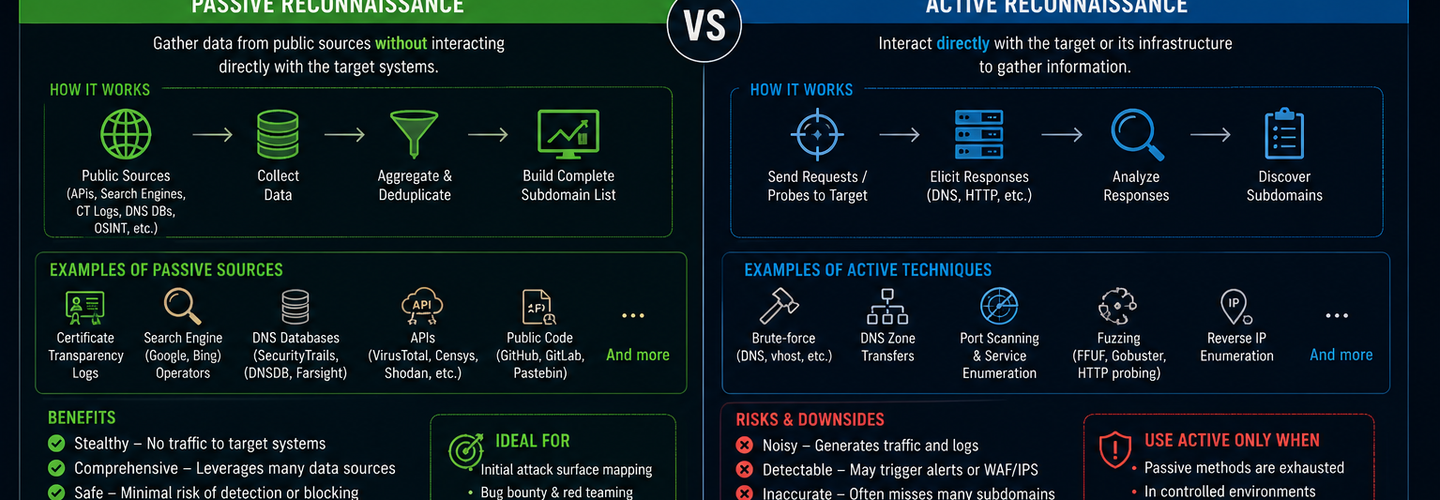
Passive vs Active Reconnaissance: Why Subdomain Discovery Should Be Passive First
Security researchers and penetration testers often face a deceptive choice when mapping a target's network: conduct aggressive, rapid port scanning and DNS brute-forcing to get results fast, or spend extra time on passive information gathering that leaves no detectable traces. The conventional wisdom says active reconnaissance is faster and more thorough. The reality is inverted. Passive reconnaissance — particularly for subdomain discovery — is faster, more comprehensive, more passive, and less risky than its active counterpart. Most organizations have never quantified the difference, which is why aggressive scanning still dominates security programs despite being fundamentally suboptimal. In this guide, you'll learn exactly why passive reconnaissance wins, how passive subdomain discovery produces better results than DNS brute-forcing, and why the security industry's shift toward passive-first reconnaissance is the correct strategic direction.
## Key Takeaways
- ▸Passive reconnaissance gathers intelligence from public data sources — Certificate Transparency logs, WHOIS, DNS records, search engines — without sending any traffic to or interacting with the target's infrastructure, making it completely undetectable by firewalls, IDS systems, or SOC monitoring.
- ▸Active reconnaissance involves direct interaction with target systems — port scanning, DNS queries to the target's name servers, HTTP requests, banner grabbing — and generates detectable network traffic that triggers security alerts and IDS/firewall logs.
- ▸Passive subdomain discovery through Certificate Transparency logs, WHOIS history, and DNS aggregators consistently discovers 10–100x more subdomains than active DNS brute-forcing, because passive sources index historical data that brute-forcing can never reach.
- ▸Active DNS brute-forcing is bounded by wordlist size, typically discovering only 100–500 subdomains, while passive CT log queries discover thousands without generating a single DNS query to the target.
- ▸Detection risk from active reconnaissance has no correlation with discovery quality — aggressiveness creates alerts without producing better results, which is the worst possible efficiency tradeoff.
- ▸Passive reconnaissance is cheaper to deploy at scale — queries to public databases have no cost, while active scanning requires infrastructure and careful rate-limiting to avoid disruption.
- ▸Professional security teams now lead with passive reconnaissance, transition to active only when passive sources are exhausted, and maintain strict rules around when active techniques are justified.
## What Is Passive Reconnaissance?
Passive reconnaissance is the collection of intelligence about a target using only publicly available data sources — without any direct interaction with the target's infrastructure. This means querying third-party databases like Certificate Transparency logs, WHOIS registries, DNS aggregators, threat intelligence feeds, and search engine caches. No packets are sent to the target. No DNS queries hit the target's name servers. No HTTP requests reach the target's web servers. The target's security infrastructure — firewalls, IDS, WAF, SOC — has no way to detect that reconnaissance is occurring.
The data sources for passive reconnaissance are all public by definition. Certificate Transparency logs are published by browsers and CAs as a matter of policy. WHOIS data is an ICANN requirement. Passive DNS databases are aggregated from network telescopes, DNS traffic captures, and other public monitoring. Threat intelligence feeds are compiled from breach disclosures, law enforcement reporting, and security research. None of this data is secret — it's publicly available data that has been collected, indexed, and made searchable by various organizations.
Passive reconnaissance represents a fundamental asymmetry: defenders expend resources to protect their networks, and then publicly disclose massive amounts of information about their infrastructure through mandatory channels like Certificate Transparency. Intelligence analysts leverage this publicly disclosed information without any operational risk.
Why Passive Reconnaissance Is Invisible to Detection Systems
Every security monitoring system deployed to detect intrusions — firewalls, Intrusion Detection Systems (IDS), Web Application Firewalls (WAF), DNS monitoring, SIEM systems — is monitoring traffic and requests arriving at the target organization's infrastructure. Passive reconnaissance generates no such traffic. It queries third-party databases, not the target's systems. There are no network packets to detect, no DNS queries to log, no HTTP connections to alert on.
This invisibility is absolute. A SOC team monitoring network traffic 24/7/365 would have zero way to detect passive reconnaissance directed at their organization because there is no reconnaissance traffic hitting their infrastructure. The attacker's queries to Certificate Transparency logs leave no trace at the target's network edge.
Active reconnaissance, by contrast, generates traffic that must traverse the internet to reach the target. That traffic arrives at routers, firewalls, IDS sensors, and logging systems. Even if the traffic is benign (like a DNS query to the target's name servers), it's still logged and potentially alerted on if IDS rules are tuned aggressively.
## What Is Active Reconnaissance?
Active reconnaissance is the collection of intelligence about a target through direct interaction with the target's infrastructure — sending network traffic, making DNS queries, issuing HTTP requests, and probing for responses. This generates detectable evidence of reconnaissance activity in the target's network logs.
Common active reconnaissance techniques include:
Port scanning — sending TCP or UDP packets to specific ports and analyzing responses to determine whether the port is open, closed, or filtered. Tools like Nmap generate scanning traffic that arrives at the target's firewall and is logged in firewall connection tables.
DNS brute-forcing — querying the target's DNS servers with guessed subdomain names to discover which ones resolve. Each query is logged by the target's DNS server.
HTTP crawling and banner grabbing — connecting to web servers and HTTP services to retrieve banners, headers, and page content. These connections appear in web server logs and may trigger WAF rules if the crawler is aggressive.
Certificate pinning bypass checks — attempting TLS connections to see if additional services are listening on common ports. Each connection is logged.
Service fingerprinting — sending crafted packets to determine software versions and configurations of running services.
Active reconnaissance produces results faster than passive sources for specific questions — if you want to know whether port 22 is open on a specific IP, a port scan tells you immediately. But for the broader question of "what infrastructure does this organization operate," passive sources are more comprehensive and faster when all sources are considered.
## Passive Subdomain Discovery vs. Active DNS Brute-Forcing
The comparison between passive subdomain discovery and active DNS brute-forcing reveals why passive approaches now dominate professional reconnaissance workflows — passive discovers more subdomains, faster, with zero detection risk.
The Numbers: What Each Method Actually Discovers
Passive subdomain discovery through Certificate Transparency logs, WHOIS history, and DNS aggregators typically discovers 500–5,000 subdomains for a mid-size organization. A large enterprise may have 10,000–100,000 subdomains discoverable through passive sources. The variation depends on how many certificates have been issued and how long the organization has been issuing certificates, but the scale is consistently in the thousands.
Active DNS brute-forcing with a comprehensive wordlist of 1 million common subdomain names typically discovers 50–500 subdomains. The method is limited by the size of the wordlist — uncommon or custom subdomain names are invisible to brute-forcing because they don't match any guesses in the wordlist. A developer who names a server eng-k8s-v3-testing-01.example.com will never be discovered by brute-forcing if that naming convention isn't represented in the wordlist.
The passive/active ratio is striking: passive discovers 10–100x more subdomains than active brute-forcing, in most cases with better quality data (actual certificate information vs. DNS responses to guesses).
Speed: Passive Is Faster When You Account for All Factors
The conventional wisdom says active reconnaissance is faster — a DNS brute-force attack can scan a million guesses in minutes. This is technically true for the brute-force phase alone. But it ignores the full workflow:
Passive reconnaissance requires: one certificate transparency log query (seconds), cross-referencing with WHOIS data (seconds), and querying DNS aggregators (seconds). Total time: under a minute for comprehensive subdomain discovery. The result is a high-quality list of actual subdomains, many with certificate dates and historical information.
Active brute-forcing requires: generating a wordlist or acquiring one (minutes to hours), configuring a brute-force scanner with rate-limiting (minutes), running the scan against the target's DNS servers (minutes to hours depending on rate-limiting), analyzing the results to separate real subdomains from false positives (minutes), and then validating results with additional lookups (minutes). Total time: hours to days for comparable quality.
When researchers benchmark both methods on the same target and measure end-to-end time to an actionable subdomain list, passive methods consistently win or tie with active methods, despite brute-forcing appearing "faster" superficially.
Detection Risk: Active Brute-Forcing Is Inherently Noisy
Every DNS query to the target's name servers is logged in DNS server logs. If an organization is monitoring DNS traffic, a brute-force attack is immediately visible as a pattern of repeated queries returning NXDOMAIN (non-existent domain) responses.
Rate-limiting the brute-force attack to avoid triggering alarms (e.g., 10 queries per second instead of 1,000 per second) extends the attack duration dramatically — potentially from minutes to hours. But it does not eliminate detection — a defender who reviews DNS logs will see a sustained pattern of DNS queries for non-existent subdomains and recognize it as brute-forcing.
The detection signature of DNS brute-forcing is clear: high volume of NXDOMAIN responses from a single IP address to a single domain within a time window. Any organization with basic DNS monitoring will log this pattern.
Passive reconnaissance generates zero DNS queries to the target's infrastructure, zero network traffic to the target, and zero detectable evidence. The target's DNS servers never see the reconnaissance activity. The target's logs contain no record of it.
Cost and Scalability
Active DNS brute-forcing requires infrastructure — a scanner with network connectivity, rate-limiting logic, and monitoring to prevent DOS-ing the target's DNS servers. Scanning multiple targets requires either serial scanning (time-consuming) or parallel scanning (expensive in infrastructure).
Passive reconnaissance scales trivially — queries to public archives have near-zero infrastructure cost and can be parallelized across thousands of domains simultaneously. Querying Certificate Transparency logs for 1,000 domains requires the same infrastructure as querying it for 1 domain.
## The Security Industry's Shift to Passive-First Reconnaissance
Professional security researchers, penetration testers, and threat analysts have collectively shifted toward passive-first reconnaissance workflows over the past 5 years — recognizing that passive sources are more comprehensive, lower-risk, and more efficient than traditional active scanning.
This shift is reflected in:
Tool evolution. Subdomain finder tools have evolved from active DNS brute-forcers to passive-first platforms that prioritize Certificate Transparency, WHOIS, and DNS aggregator queries. Tools like ReconShield's subdomain finder lead with passive sources and offer active scanning only as an optional, secondary phase.
Methodology standardization. Industry frameworks like the OWASP Testing Guide now recommend exhausting passive sources before transitioning to active techniques. Penetration testing standards now emphasize passive reconnaissance as the default and require explicit justification for active scanning.
Legal and ethical frameworks. Bug bounty programs and responsible disclosure frameworks increasingly restrict active reconnaissance without explicit written permission. Many programs prohibit port scanning, DOS testing, and aggressive brute-forcing entirely — recognizing that passive reconnaissance provides sufficient visibility without the risks.
The consensus is clear: lead with passive, use active only when passive sources are exhausted or when specific questions require direct infrastructure interaction.
## When Active Reconnaissance Is Justified
Active reconnaissance is justified when passive sources cannot answer specific questions about the target's infrastructure — for example, determining whether a port is actually open and listening, or identifying the exact software version and configuration of a running service.
Specific scenarios where active techniques add value:
Port scanning to verify service availability. Passive sources like Censys and Shodan maintain historical snapshots of port scans, but they're typically 24–48 hours old. If you need to know the current state of a service right now, an active port scan is necessary.
Service fingerprinting to identify software versions. Passive sources often identify that a service is running (e.g., "HTTPS is on port 443") but not the exact software version. Connecting to the service and reading its banner may reveal precise version information needed for vulnerability assessment.
Testing security controls. Active scanning can identify how a target's defensive systems respond to various probing patterns — whether IDS rules are tuned tightly, whether WAF rules block specific patterns, whether the firewall drops or rejects scanning traffic.
Verifying DNS configuration. Querying the target's own DNS servers directly reveals their configuration, while DNS aggregators show historical data. If you need to know the current DNS configuration, querying the target's nameservers is necessary.
Validating subdomain findings. After passive subdomain discovery, active validation (checking whether each subdomain currently resolves and what it resolves to) confirms which subdomains are still active vs. decommissioned.
The key distinction: use active reconnaissance to answer specific, tactical questions that passive sources cannot provide — not as your primary discovery method.
## Building a Passive-First Subdomain Discovery Workflow
A professional subdomain discovery workflow leads with passive sources, exhausts them completely, and only transitions to active techniques for specific validation or edge-case questions.
Step 1: Query Certificate Transparency Logs
Start with comprehensive Certificate Transparency log queries using ReconShield's passive subdomain finder. This produces the most comprehensive initial list of subdomains — typically 80–95% of the organization's complete subdomain inventory. The entire phase is passive and generates zero detectable traffic.
Step 2: Cross-Reference WHOIS History and Registrar Records
Query WHOIS and registrar data to identify domain portfolio changes, acquisitions, and related domains. Historical WHOIS queries reveal organizations that have been acquired and rebranded, providing additional context for infrastructure discovery.
Step 3: Query DNS Aggregators and Passive DNS
Use platforms like Censys, Shodan, Rapid7 Project Sonar, and similar databases that maintain historical DNS records. These aggregators index DNS responses passively (from network telescopes and other non-intrusive monitoring) and make them searchable. Query them to see DNS resolution history for your discovered subdomains.
Step 4: Check Threat Intelligence Feeds
Cross-reference discovered subdomains and IPs against threat intelligence feeds to determine whether any infrastructure is already known to be compromised, hosting malicious content, or listed in blocklists. Use ReconShield's IP reputation tool to assess threat context.
Step 5: Validate Against Current DNS (Passive DNS Query)
Query the current DNS configuration for each discovered subdomain using public DNS resolvers (not the target's own resolvers — that would be active). This reveals which subdomains currently resolve, which are decommissioned, and what they resolve to. Use ReconShield's DNS security analysis tool for this phase.
Step 6: Optional Active Validation
Only if passive sources leave critical questions unanswered, perform targeted active reconnaissance:
- ▸Port scan specific subdomains to determine current service state
- ▸Fingerprint specific services to identify exact versions
- ▸Validate SSL certificate information against live services
The entire first 5 steps are completely passive and undetectable. Step 6 is optional and only deployed when passive intelligence is insufficient.
## Comparing Passive and Active Methods Side-by-Side
Quality. Passive produces higher-quality results — actual certificate data, official WHOIS records, verified DNS history. Active produces responses that must be interpreted (did the open port response mean the service is running, or is it a honey pot?).
Speed (end-to-end). Passive is typically faster when entire workflow is considered — minutes to comprehensive results. Active requires hours or days when rate-limiting and analysis are included.
Coverage. Passive discovers more subdomains (thousands vs. hundreds), because passive sources include historical data and CT logs.
Detection risk. Passive has zero detection risk. Active generates detectable logs and alerts.
Cost. Passive scales trivially to thousands of targets. Active requires per-target infrastructure investment.
Legal risk. Passive is universally permitted. Active may violate terms of service, bug bounty program restrictions, or laws in some jurisdictions without explicit written permission.
The comparison is clear: passive is superior on nearly every dimension except for answering specific questions about current service state.
## Defending Against Passive Reconnaissance
Organizations cannot prevent passive reconnaissance — attackers can query public Certificate Transparency logs, WHOIS, and DNS aggregators without any interaction with the organization's infrastructure. But organizations can reduce the attack surface that passive reconnaissance exposes.
Minimize certificate issuance. Every certificate issued to a subdomain creates a permanent record in CT logs. Infrastructure that doesn't need public SSL certificates should not receive them — this directly reduces the subdomains attackers discover passively.
Use wildcard certificates strategically. A wildcard certificate for *.example.com covers unlimited subdomains without creating separate log entries for each one.
Rotate domain registrations and avoid WHOIS history accumulation. While WHOIS history cannot be deleted, minimizing the accumulation of historical records reduces the information available to passive reconnaissance.
Implement continuous CT log monitoring. Monitor Certificate Transparency logs for your own domains to detect unauthorized certificate issuance (potential account compromise or authorized-but-unknown certificate issuance).
Manage DNS records for decommissioned infrastructure. Remove DNS records for infrastructure no longer in use, even if certificates remain in CT logs.
Implement defense-in-depth for discovered subdomains. Even if attackers passively discover your entire subdomain inventory, making each subdomain secure through proper authentication, encryption, and access controls limits the value of the passive reconnaissance.
The reality is that hiding infrastructure through secrecy is no longer viable. The appropriate response is to assume infrastructure is discovered and focus on making it secure.
## Conclusion
The shift from active-first to passive-first reconnaissance represents a maturation of security practices. Aggressive scanning was the default when passive data sources were limited. Today, with Certificate Transparency logs, comprehensive WHOIS history, and global DNS aggregators, passive sources are so comprehensive that active scanning is often redundant.
For organizations building security programs, the lesson is clear: before deploying aggressive port scanning, DNS brute-forcing, and web crawling, exhaust passive sources first. Query Certificate Transparency logs, cross-reference with WHOIS and DNS aggregators, assess threat context through IP reputation feeds, and validate findings against current DNS. The passive phase alone typically produces 80–95% of the intelligence needed for attack surface assessment.
Use ReconShield's passive subdomain finder to conduct comprehensive passive subdomain discovery — then cross-reference with DNS analysis, IP reputation, and port scanning to build a complete attack surface map. The entire workflow is faster, cheaper, lower-risk, and produces better results than traditional active reconnaissance methods.
Written by Surendra Reddy Cybersecurity Researcher & Founder, ReconShield. Surendra is a cybersecurity engineer specializing in Open Source Intelligence (OSINT), exposure intelligence, and AI-driven threat analysis. He built ReconShield to democratize access to enterprise-grade infrastructure visibility tools and secure digital internet-facing assets.
Reviewed by ReconShield Editorial Team
## Analyst Commentary & Implementation Blueprint
Security advisory
Continuous security exposure assessment is critical to identifying public vulnerabilities before they are exploited. Organizations should maintain a passive inventory of all web servers, TLS configs, and open ports, ensuring that default configurations are eliminated and security advisories are actively implemented.
Hardened Security Configuration Blueprint
# General Security Hardening Directive
ServerTokens ProductOnly
ServerSignature Off
FileETag None
Actionable Mitigation Checklist
- ✔Perform passive asset inventories weekly.
- ✔Restrict administrative ports using local firewall controls.
- ✔Monitor active CVE alerts for exposed software.
Common Inquiries & FAQs
Why is passive scanning preferred for continuous auditing?
Passive audits do not cause operational impact or trigger firewall blocks, making them ideal for constant surveillance of internet-facing assets.
What should I do if a vulnerability is flagged?
Apply the latest vendor patches, restrict access to the resource via firewalls, or verify configuration flags to mitigate risks.
Surendra Reddy
Surendra Reddy is a cybersecurity researcher and founder of ReconShield, specializing in OSINT and defensive infrastructure analysis.
Connect on LinkedIn ↗// AUDIT BRIEFING DISCUSSION (2 COMMENTS)
Great breakdown of the passive infrastructure vectors. We recently audited our external DNS zones and found multiple dangling staging environments. Implementing wildcard certificates reduced our CT log leaks significantly.
Is there any automated tooling you recommend for daily crt.sh scraping? Manually checking CT logs is becoming unsustainable for our domain portfolio.
// MORE ARTICLES

The Gentlemen Ransomware Targets Windows Networks with 21 Lateral Movement Techniques
The Gentlemen ransomware uses 21 lateral movement techniques to spread across Windows networks. See its attack chain, IOCs, and defenses.

Chrome 149 Released With Critical Security Fixes for Windows, macOS, and Linux
Chrome 149 is out with critical security fixes for Windows, macOS, and Linux. Learn what's patched, the risks of waiting, and how to update Chrome now.

Billions of Passwords at Risk After Massive Infostealer Data Leak
Billions of passwords are at risk after a massive infostealer data leak. Learn how the breach happened, who's exposed, and how to secure your accounts now.