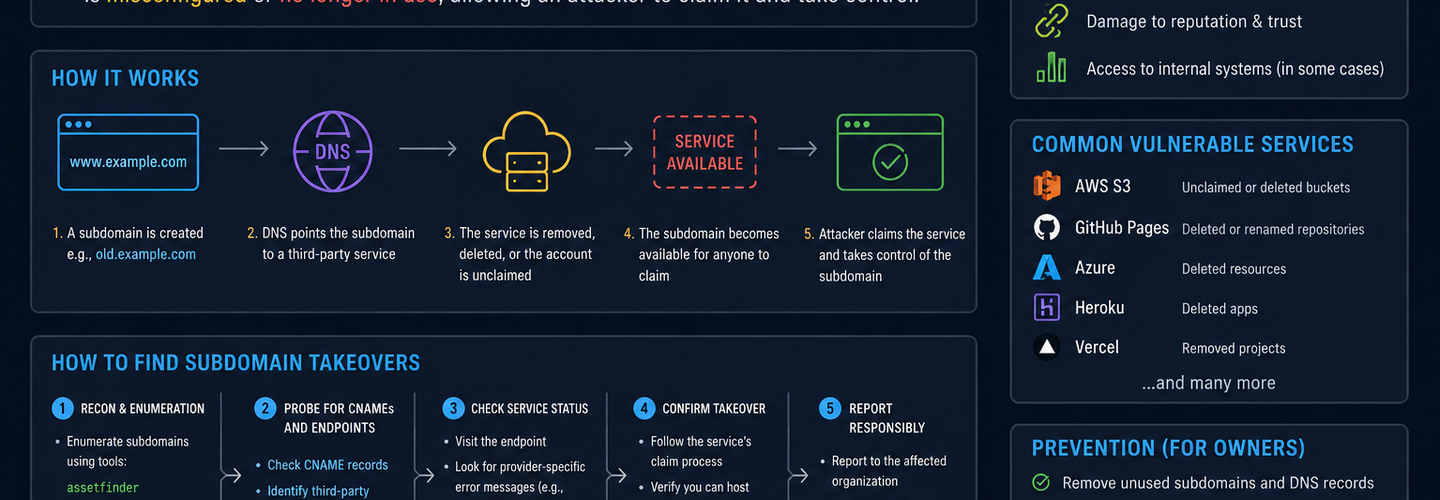
Subdomain Takeover Guide: The Definitive Guide to Understanding, Detecting, and Preventing Subdomain Hijacking
You probably know that organizations use subdomains for applications, APIs, cloud services, and third-party platforms. What many teams don't realize is that abandoned DNS configurations can leave these subdomains vulnerable to takeover by attackers. In this guide, you'll learn exactly what subdomain takeovers are, how they happen, how to detect vulnerable assets, and how to prevent them from becoming security risks.
## Key Takeaways
- ▸Subdomain takeover occurs when a DNS record points to an external service that is no longer claimed or active.
- ▸Attackers can hijack abandoned cloud resources and serve content from trusted organizational subdomains.
- ▸Dangling DNS records are the most common cause of subdomain takeover vulnerabilities.
- ▸Continuous subdomain enumeration helps identify exposed and forgotten assets before attackers do.
- ▸Cloud platforms and SaaS providers are common sources of takeover opportunities.
- ▸Regular DNS audits significantly reduce takeover risk.
- ▸Attack surface management programs should continuously monitor for vulnerable subdomains.
What Is a Subdomain Takeover?
A subdomain takeover is a security vulnerability that occurs when a subdomain points to an external service that is no longer provisioned, allowing an attacker to claim the resource and gain control of the subdomain.
For example, a company may create a DNS CNAME record pointing blog.company.com to a third-party hosting platform. If the hosting account is later deleted but the DNS record remains active, an attacker may be able to register the abandoned resource and take control of the subdomain.
Subdomain takeovers occur because DNS ownership and service ownership become disconnected.
When organizations remove services but forget to remove corresponding DNS records, they create opportunities for attackers to claim those resources.
Why Are Subdomain Takeovers Dangerous?
Subdomain takeovers are dangerous because attackers can gain control over trusted organizational assets without compromising the primary domain.
First, users often trust subdomains belonging to legitimate organizations.
For example, a visitor is more likely to trust portal.company.com than an unrelated external website.
Second, attackers can leverage this trust to conduct phishing campaigns, malware delivery, social engineering attacks, or brand impersonation.
Third, search engines may continue indexing compromised subdomains, increasing exposure.
A hijacked subdomain inherits organizational trust even when the organization no longer controls the underlying service.
How Does a Subdomain Takeover Work?
A subdomain takeover works when a DNS record remains active after the associated service has been removed or abandoned.
The attack process typically follows several steps:
Discover organizational subdomains.
Identify external service integrations.
Detect dangling DNS records.
Verify whether the target service is unclaimed.
Register or claim the abandoned resource.
Serve content through the vulnerable subdomain.
Typical Takeover Flow
Consider the following scenario:
- ▸A company creates support.example.com
- ▸The subdomain points to a cloud-hosted application
- ▸The application is later deleted
- ▸The DNS record remains active
- ▸An attacker claims the deleted cloud resource
- ▸The attacker gains control of the subdomain
The DNS record becomes the bridge that enables unauthorized control.
What Causes Subdomain Takeovers?
Subdomain takeovers are primarily caused by dangling DNS records that reference inactive external services.
Abandoned SaaS Platforms
Organizations frequently use third-party services for:
- ▸Marketing websites
- ▸Documentation portals
- ▸Customer support platforms
- ▸Landing pages
- ▸Knowledge bases
When these services are removed but DNS records remain, takeover opportunities may emerge.
Decommissioned Cloud Infrastructure
Cloud resources are often created temporarily and forgotten.
Examples include:
- ▸Development environments
- ▸Test applications
- ▸Temporary project deployments
- ▸Campaign microsites
Temporary infrastructure frequently becomes permanent security debt.
Poor Asset Management
Many organizations struggle to maintain accurate asset inventories.
As a result, DNS records may remain active long after underlying services disappear.
This is one reason why an effective attack surface management guide emphasizes continuous asset visibility.
Which DNS Records Are Most Commonly Associated With Subdomain Takeovers?
CNAME records are the DNS records most commonly associated with subdomain takeover vulnerabilities.
Common vulnerable record types include:
CNAME Records
CNAME records point one hostname to another hostname.
Example:
app.example.com → provider.service.com
If the provider resource is deleted, attackers may be able to claim it.
NS Records
Misconfigured delegated subdomains occasionally create takeover opportunities.
A Records
Although less common, cloud infrastructure reassignment can sometimes create risks involving IP-based resources.
Most documented subdomain takeover vulnerabilities involve dangling CNAME records.
What Services Are Commonly Vulnerable to Subdomain Takeovers?
Third-party hosting providers and cloud services are frequently involved in subdomain takeover scenarios.
Historically, vulnerable platforms have included:
- ▸Cloud application platforms
- ▸Website hosting services
- ▸Documentation platforms
- ▸Customer support portals
- ▸Marketing automation services
- ▸Static site hosting providers
- ▸Cloud storage services
The exact risk depends on whether the service allows abandoned resources to be reclaimed.
Because provider behavior changes over time, organizations should continuously monitor exposed integrations rather than relying on outdated vulnerability lists.
How Do You Find Vulnerable Subdomains?
Finding vulnerable subdomains requires a combination of subdomain enumeration, DNS analysis, and service validation.
Step 1: Discover Subdomains
Begin by identifying all subdomains associated with a target domain.
Tools commonly used include:
- ▸ReconShield Subdomain Finder
- ▸Amass
- ▸Subfinder
- ▸Assetfinder
- ▸Findomain
A complete inventory is the foundation of takeover detection.
Step 2: Validate DNS Records
Next, review:
- ▸CNAME records
- ▸A records
- ▸NS records
- ▸MX records
A dns lookup tool helps determine where services are hosted and whether external dependencies exist.
Step 3: Identify Dangling Records
Look for:
- ▸Deleted services
- ▸Unclaimed cloud resources
- ▸Error messages indicating missing projects
- ▸Expired configurations
Step 4: Verify Service Ownership
Determine whether the resource can be claimed by another user.
Not every dangling DNS record results in a takeover vulnerability.
Verification is essential.
What Security Risks Can a Subdomain Takeover Create?
A subdomain takeover can create phishing, malware, brand abuse, and reputational risks.
Phishing Attacks
Attackers can host convincing login portals on trusted subdomains.
For example:
Employees may trust a phishing page hosted on a legitimate organizational subdomain.
Credential Theft
Users often reuse passwords across services.
Compromised subdomains can become effective credential harvesting platforms.
Malware Distribution
Hijacked assets may distribute malicious files or scripts.
Brand Impersonation
Attackers can impersonate:
- ▸Corporate communications
- ▸Customer support portals
- ▸Product documentation
- ▸Marketing campaigns
Trust is often the most valuable asset attackers gain through a subdomain takeover.
How Do You Prevent Subdomain Takeovers?
Preventing subdomain takeovers requires proactive DNS management and continuous attack surface monitoring.
Maintain Accurate Asset Inventories
Organizations should continuously track:
- ▸Domains
- ▸Subdomains
- ▸Cloud assets
- ▸SaaS integrations
June 2026 Cybersecurity Review: Top Cyber Attacks, Data Breaches & Critical Vulnerabilities
Remove Unused DNS Records
DNS records should be removed immediately when services are retired.
Perform Continuous Monitoring
A mature security monitoring workflow continuously identifies abandoned assets.
Validate Third-Party Dependencies
Regular reviews help identify:
- ▸Expired services
- ▸Deleted projects
- ▸Unused integrations
Implement Governance Controls
Security teams should establish procedures for:
- ▸Resource creation
- ▸Service retirement
- ▸DNS change management
Governance failures often create takeover opportunities long before attackers discover them.
How Does Subdomain Enumeration Help Prevent Takeovers?
Subdomain enumeration helps prevent takeovers by identifying exposed assets before attackers find them.
First, enumeration provides visibility into organizational infrastructure.
Second, discovered assets can be validated and classified.
Third, forgotten resources can be retired or secured.
A comprehensive what is subdomain enumeration workflow often uncovers dormant assets that would otherwise remain unnoticed.
You cannot secure infrastructure that you cannot see.
Is Subdomain Takeover Legal to Test?
Subdomain takeover testing is legal only when performed on assets you own or have authorization to assess.
Organizations should always:
- ▸Follow bug bounty program rules
- ▸Respect testing scope
- ▸Obtain permission
- ▸Follow responsible disclosure practices
- ▸Comply with applicable laws
Ethical researchers validate findings responsibly and report vulnerabilities through approved channels.
What Should You Do After Discovering a Vulnerable Subdomain?
After discovering a vulnerable subdomain, you should validate the finding, document evidence, and remediate the underlying DNS configuration.
Recommended response process:
Confirm vulnerability status.
Capture supporting evidence.
Notify stakeholders.
Remove or update DNS records.
Validate remediation.
Monitor for recurrence.
Additionally, organizations should review similar assets for related exposure.
Many takeover issues indicate broader asset management weaknesses rather than isolated configuration mistakes.
Conclusion
Subdomain takeover is a high-impact vulnerability caused by abandoned DNS configurations and unclaimed external services.
Throughout this guide, we've explored how subdomain takeovers occur, why they matter, common causes, vulnerable record types, detection methodologies, prevention strategies, and remediation workflows.
The most effective defense is continuous visibility. Organizations that combine subdomain enumeration, DNS validation, asset inventory management, and continuous monitoring are far less likely to expose vulnerable subdomains.
As cloud adoption continues to grow, proactive attack surface management will remain essential for preventing subdomain hijacking and protecting organizational trust.
## Author Information
Written by: ReconShield Research Team
The ReconShield Research Team specializes in attack surface management, DNS infrastructure mapping, cybersecurity reconnaissance, and asset discovery methodologies.
Reviewed by: Senior Security Researcher
Expertise Areas: DNS Security, Attack Surface Management, Cloud Security, Vulnerability Research, and Security Operations.
## Analyst Commentary & Implementation Blueprint
Security advisory
Continuous security exposure assessment is critical to identifying public vulnerabilities before they are exploited. Organizations should maintain a passive inventory of all web servers, TLS configs, and open ports, ensuring that default configurations are eliminated and security advisories are actively implemented.
Hardened Security Configuration Blueprint
# General Security Hardening Directive
ServerTokens ProductOnly
ServerSignature Off
FileETag None
Actionable Mitigation Checklist
- ✔Perform passive asset inventories weekly.
- ✔Restrict administrative ports using local firewall controls.
- ✔Monitor active CVE alerts for exposed software.
Common Inquiries & FAQs
Why is passive scanning preferred for continuous auditing?
Passive audits do not cause operational impact or trigger firewall blocks, making them ideal for constant surveillance of internet-facing assets.
What should I do if a vulnerability is flagged?
Apply the latest vendor patches, restrict access to the resource via firewalls, or verify configuration flags to mitigate risks.
Surendra Reddy
Surendra Reddy is a cybersecurity researcher and founder of ReconShield, specializing in OSINT and defensive infrastructure analysis.
Connect on LinkedIn ↗// AUDIT BRIEFING DISCUSSION (2 COMMENTS)
Great breakdown of the passive infrastructure vectors. We recently audited our external DNS zones and found multiple dangling staging environments. Implementing wildcard certificates reduced our CT log leaks significantly.
Is there any automated tooling you recommend for daily crt.sh scraping? Manually checking CT logs is becoming unsustainable for our domain portfolio.
// MORE ARTICLES
Chrome 149 Released With Critical Security Fixes for Windows, macOS, and Linux
Chrome 149 is out with critical security fixes for Windows, macOS, and Linux. Learn what's patched, the risks of waiting, and how to update Chrome now.

Billions of Passwords at Risk After Massive Infostealer Data Leak
Billions of passwords are at risk after a massive infostealer data leak. Learn how the breach happened, who's exposed, and how to secure your accounts now.
Update Firefox Now: Multiple Vulnerabilities Expose Users to RCE Attacks
Update Firefox now: multiple vulnerabilities expose users to RCE attacks. Learn which flaws matter, who's affected, and how to patch your browser safely today.