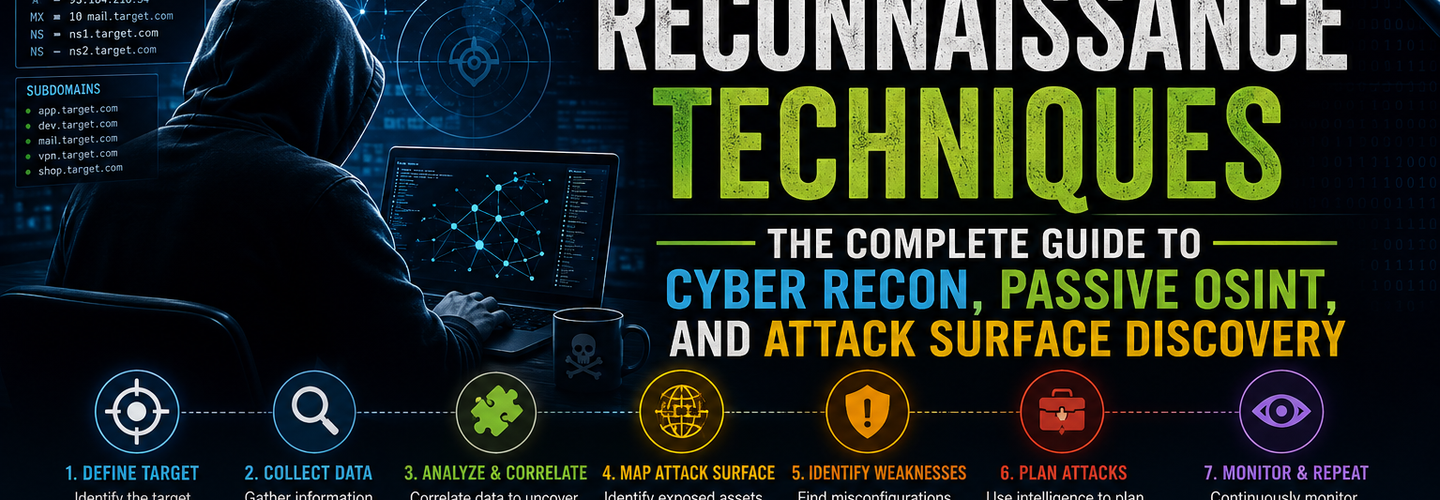
How Hackers Use Reconnaissance Techniques: The Complete Guide to Cyber Recon, Passive OSINT, and Attack Surface Discovery
If you've spent time in cybersecurity, you already know that attackers don't break into systems blindly. Every successful intrusion begins long before the first exploit fires — with systematic intelligence gathering that maps every exploitable surface of the target. Yet many organizations focus their defenses entirely on the breach moment, leaving the reconnaissance phase almost completely unmonitored. In this guide, you'll learn exactly how hackers use reconnaissance techniques at every layer — DNS, WHOIS, ports, certificates, subdomains, and web technologies — what data they extract at each step, and how defenders can use the same techniques to audit their own exposure before attackers do it first.
## Key Takeaways
- ▸Cyber reconnaissance is the systematic collection of intelligence about a target's infrastructure, technologies, personnel, and vulnerabilities before any attack begins — it determines the precision and success rate of every subsequent attack phase.
- ▸Passive reconnaissance gathers intelligence from public data sources without interacting directly with target systems, making it completely undetectable by the target's security monitoring.
- ▸Active reconnaissance involves direct interaction with target infrastructure — port scans, banner grabs, and web crawls — and can trigger intrusion detection alerts if poorly timed.
- ▸DNS enumeration, WHOIS lookups, port scanning, IP/ASN mapping, SSL certificate analysis, subdomain discovery, and HTTP header fingerprinting are the seven primary technical reconnaissance disciplines.
- ▸A single passive reconnaissance session can reveal open ports, running services, software versions, email infrastructure, SSL certificate history, subdomain inventory, web technologies, and organizational details — all without sending a single malicious packet.
- ▸Defenders who run the same reconnaissance techniques against their own infrastructure consistently discover exposures that internal vulnerability scanning misses — because attackers see what is publicly visible, not what is internally inventoried.
- ▸Reducing recon surface means reducing attacker advantage: organizations that continuously monitor their external exposure footprint measurably increase the cost and complexity of targeted attacks against them.
## What Is Cyber Reconnaissance?
Cyber reconnaissance is the systematic intelligence-gathering phase of an attack in which an adversary collects detailed information about a target organization's digital infrastructure, personnel, technologies, and potential vulnerabilities before attempting any exploitation. Reconnaissance is not a precursor to an attack — it is the attack's foundation, and the quality of the intelligence gathered at this stage directly determines the precision, speed, and success rate of every subsequent phase.
In the Cyber Kill Chain framework developed by Lockheed Martin, reconnaissance is the first stage — predating weaponization, delivery, exploitation, installation, command-and-control, and actions on objective. In the MITRE ATT&CK framework, reconnaissance maps to the "Reconnaissance" tactic (TA0043), which catalogs techniques including active scanning, gathering host and network information, searching open technical databases, and searching open websites and domains. The breadth of documented ATT&CK sub-techniques reflects how comprehensively professional threat actors approach this phase.
Understanding how reconnaissance works begins with understanding the full scope of OSINT fundamentals — the methodology, data sources, and collection workflows that form the intelligence-gathering backbone of both offensive and defensive cyber operations.
Where Reconnaissance Fits in the Cyber Attack Lifecycle
Reconnaissance provides the targeting intelligence that makes every downstream attack phase more effective — the more precise the recon, the lower the noise, the higher the success rate, and the less time an attacker spends exposed inside a target environment. Advanced Persistent Threat (APT) groups routinely spend weeks or months in the reconnaissance phase before any active intrusion attempt, building detailed target profiles that enable surgical exploitation with minimal detection risk.
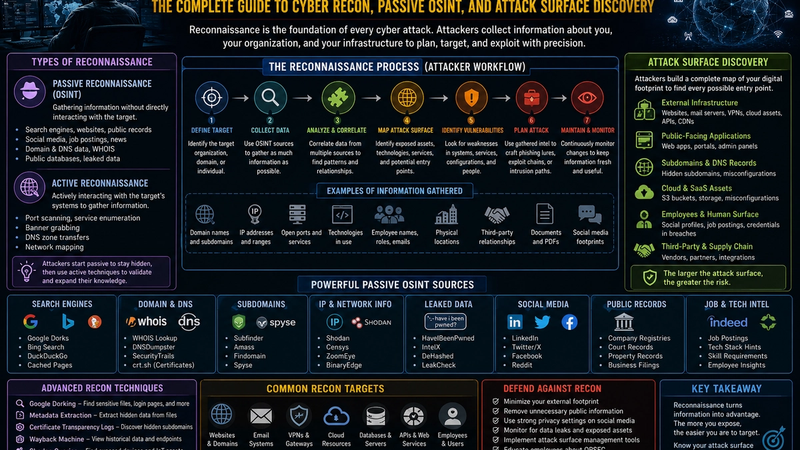
For a specific organization, a complete reconnaissance profile typically includes: all public IP address ranges, every open port and running service, the software stack powering each application, the SSL/TLS certificate history and subdomain inventory, the email infrastructure and authentication policies, organizational structure and employee data from professional networks, and any historically leaked credentials or breach data associated with corporate email domains. Each of these data points is a potential attack vector. Combined, they form an attack surface map that experienced threat actors treat as the primary input to their exploitation strategy.
## What Is the Difference Between Passive and Active Reconnaissance?
Passive reconnaissance is the collection of intelligence about a target using only publicly available data sources — without sending any traffic to or interacting with the target's infrastructure in any way — making it completely invisible to the target's security monitoring stack. Active reconnaissance, by contrast, involves direct interaction with target systems through port scans, banner grabs, web application crawls, and similar probing techniques that can generate detectable network traffic.
The distinction matters enormously from both attacker and defender perspectives. For attackers, passive reconnaissance represents a period of unrestricted, risk-free intelligence gathering with zero exposure to detection. For defenders, the fact that passive reconnaissance is undetectable means that an attacker can build a comprehensive target profile without triggering a single alert. This is why many incident post-mortems reveal that threat actors had been conducting reconnaissance for weeks before any internal system was touched. The complete methodology behind passive reconnaissance for attack surface mapping covers the full technical workflow for both offensive research and defensive auditing.
Why Attackers Always Start with Passive Recon Before Going Active
Attackers prioritize passive reconnaissance before active techniques because it eliminates the risk of early detection while still delivering the majority of actionable intelligence needed to plan a targeted intrusion. The strategic sequence is clear: exhaust all passive sources first, build the most complete picture possible from public data, and only transition to active techniques when passive intelligence is insufficient for the specific objective.
The depth of intelligence available through passive techniques consistently surprises security teams who have not audited their own external posture. DNS records reveal mail servers, cloud infrastructure, third-party service dependencies, and often internal hostnames. Certificate transparency logs expose subdomains that were never intended to be publicly visible. WHOIS history reveals organizational acquisitions, domain portfolio changes, and registrant email patterns. The anatomy of passive OSINT documents exactly how these public data sources interconnect to deliver a comprehensive intelligence picture without any target interaction.
## How Hackers Use DNS Reconnaissance
DNS reconnaissance is the process of querying the Domain Name System to enumerate all publicly visible records associated with a target domain, revealing mail servers, IP addresses, cloud services, third-party integrations, email authentication policies, and often internal infrastructure details. DNS is the phonebook of the internet — and most organizations expose far more information through their DNS records than they realize.
The primary DNS record types targeted in reconnaissance each reveal different intelligence. A and AAAA records map hostnames to IP addresses, identifying web servers, API endpoints, and public-facing infrastructure. MX records reveal the email infrastructure — whether the organization uses Google Workspace, Microsoft 365, a self-hosted mail server, or a third-party provider — and provide targeting data for email-based attacks. TXT records expose SPF policies (which IP addresses are authorized to send email), DMARC configurations (how strict the email authentication enforcement is), DKIM selector references, domain verification strings for third-party services, and sometimes internal infrastructure metadata inadvertently published by DevOps teams.
NS records identify which name servers are authoritative for the domain — and historically, misconfigured name servers have permitted zone transfer attacks (AXFR requests) that dump the entire DNS zone, revealing every subdomain, internal hostname, and service record in a single query. SOA records expose the primary name server, zone administrator email, and zone change timestamps. CNAME records frequently reveal cloud provider identities — an CNAME pointing to something.s3.amazonaws.com or something.azurewebsites.net immediately identifies the underlying hosting platform. Enumerate all of these simultaneously using ReconShield's DNS security analysis tool, which queries every record type in real time and surfaces SPF policy errors, missing DMARC records, and misconfigured CNAMEs in a single interface. For the intelligence analyst's perspective on what DNS data reveals during a threat investigation, the DNS intelligence research guide covers passive DNS pivoting, historical record analysis, and infrastructure attribution techniques.
## How Hackers Use WHOIS and Domain Intelligence
WHOIS reconnaissance is the collection of domain registration intelligence — registrant identity, registrar details, name server assignments, registration and expiry dates, and domain status flags — that provides attackers with organizational attribution data and reveals the full domain portfolio of a target entity. WHOIS data is the first query in most structured reconnaissance workflows because it establishes the organizational context into which all subsequent intelligence is placed.
From a WHOIS record, a skilled analyst extracts: the registrar and the vulnerabilities or social engineering potential that specific registrar presents; the creation date (which indicates whether a domain is new enough to be suspicious or old enough to have accumulated trust); the expiry date (which reveals whether the organization maintains good domain hygiene or leaves assets to lapse); the name servers (which identify hosting providers and CDN dependencies); and the organization name (which links the domain to a corporate entity for further research). Domain status codes — particularly the presence or absence of clientTransferProhibited and serverTransferProhibited flags — directly indicate whether the domain is locked against hijacking. Attackers who identify unlocked high-value domains add them to monitoring watchlists targeting registration lapse events.
Use ReconShield's WHOIS domain intelligence tool to query live RDAP data for any domain — retrieving registrant details, registrar identity, name server assignments, status codes, and registration history in a structured, instantly readable format. For the complete technical breakdown of how WHOIS and RDAP work and what each field reveals, the WHOIS lookup guide is the authoritative reference on this platform.
## How Hackers Use Port Scanning and Service Enumeration
Port scanning is the systematic probing of a host's TCP and UDP ports to identify which services are running, which ports are open, and which software versions are exposed — providing an attacker with a direct inventory of potential exploitation targets. Port scanning transitions from passive into active reconnaissance, but it remains one of the most fundamental technical techniques in any attacker's workflow because it identifies the exact attack surface available on a given IP address.
TCP SYN scanning — the most common approach — sends a SYN packet to each port and analyzes responses: a SYN-ACK indicates an open port, a RST indicates a closed port, and no response suggests a filtered port behind a firewall. The resulting open port inventory reveals running services directly: port 22 indicates SSH, port 443 indicates HTTPS, port 3306 indicates MySQL, port 27017 indicates MongoDB — each a potential attack vector depending on the service version and configuration.
Banner grabbing extends port scanning by connecting to open ports and reading the service banner — the initial response string that often includes the exact software name and version number. A banner response of OpenSSH_8.2p1 Ubuntu-4ubuntu0.5 tells an attacker the precise SSH version, which can be cross-referenced against the CVE database to identify any known unpatched vulnerabilities. ReconShield's TCP port analyzer performs non-intrusive port visibility checks against any domain, surfacing open ports and running services that represent the target's externally visible network attack surface. For the complete technical explanation of TCP vs UDP scanning, SYN scan mechanics, and what open ports reveal about security posture, the port scanning techniques guide covers every aspect of this technique.
## How Hackers Map IP Addresses and ASN Intelligence
IP address and ASN (Autonomous System Number) reconnaissance maps an organization's entire network address space — identifying all IP ranges owned or leased by the target, the hosting providers and data centers involved, and the geographic distribution of infrastructure. This intelligence is foundational for understanding the full scope of a target's internet-facing footprint beyond the specific domains identified in DNS reconnaissance.
ASN lookups reveal the network operator routing traffic for a given IP — immediately identifying whether an address is hosted on AWS, Google Cloud, Azure, a colocation facility, or a residential ISP. This distinction is operationally significant: cloud-hosted assets operate under different security models and may have publicly exposed management APIs, object storage buckets, or serverless functions that are not visible through DNS alone. Cross-referencing IP addresses against threat intelligence blocklists reveals whether the address has been previously flagged for phishing, spam, brute-force attacks, or botnet command-and-control activity — information that intelligence analysts use to assess whether an IP is part of existing attack infrastructure. Use ReconShield's IP reputation intelligence tool to query any IP address against 50+ global threat feeds, retrieve ASN and hosting provider details, and assess geolocation — all from a single query. For comprehensive IP attribution research, the IP intelligence hub provides ASN ranges, hosting provider maps, and historical abuse records.
## How Hackers Use SSL/TLS Certificate Reconnaissance
SSL/TLS certificate reconnaissance extracts intelligence from the public certificate infrastructure — using certificate transparency logs, certificate chain analysis, and cipher suite fingerprinting to discover subdomains, identify software stacks, and assess cryptographic hygiene. Every publicly trusted SSL/TLS certificate is logged in Certificate Transparency (CT) logs, which are publicly searchable and maintained by browser vendors as a mechanism to detect fraudulently issued certificates.
For an attacker, CT logs are an unintentional goldmine. Because every subdomain that receives an SSL certificate is logged publicly, a CT log search against a target domain frequently reveals development environments, staging servers, internal tools, API endpoints, and administrative interfaces that were never intended to be publicly discoverable. Many of these subdomains run outdated software, lack authentication controls, or are misconfigured precisely because they were not expected to be visible. The certificate itself also reveals the issuing CA (indicating whether the organization uses free DV certificates or paid OV/EV certificates), the exact domains covered by a wildcard certificate, and the certificate validity period (which may indicate how frequently the organization rotates certificates). Analyze the full certificate chain for any domain using ReconShield's SSL/TLS cryptographic checker — surfacing cipher suite strength, certificate transparency log entries, expiry windows, and validation level classification instantly.
## How Hackers Discover Subdomains and Hidden Assets
Subdomain enumeration is one of the highest-value reconnaissance techniques because it consistently reveals a broader, less-secured attack surface than the primary domain — including development environments, internal tools, decommissioned services, and forgotten third-party integrations that retain live DNS records. Most organizations' primary domains are well-maintained; their subdomain inventories are not.
Passive subdomain enumeration uses public data sources exclusively: certificate transparency logs (CT), passive DNS databases that aggregate historical DNS queries, search engine caches, public repository code searches, and threat intelligence data feeds. Active subdomain enumeration adds wordlist-based brute forcing against DNS resolvers, which is faster but detectable. The passive approach is sufficient to discover the majority of a target's subdomain surface for most corporate environments, and does so with zero detection risk. Orphaned subdomains — CNAMEs pointing to deprovisioned cloud resources — are a particularly high-priority discovery target because they can be claimed by any attacker who registers the underlying cloud service account, immediately yielding control of a trusted subdomain. Explore ReconShield's subdomain intelligence hub to understand the full scope of passive subdomain enumeration methodology. The relationship between forgotten subdomains and exploitable infrastructure is documented extensively in the shadow IT and exposed-port analysis guide.
## How Hackers Use HTTP Header and Web Technology Fingerprinting
Web technology fingerprinting is the process of identifying the specific software stack powering a web application — including the server software, programming framework, CMS, JavaScript libraries, and CDN — using HTTP response headers, HTML source code analysis, and behavioral fingerprinting techniques. This intelligence directly maps to the CVE database, enabling an attacker to identify which known, unpatched vulnerabilities apply to the target's specific software versions.
HTTP response headers are the richest single source of web technology intelligence. The Server header frequently reveals the web server software and version — nginx/1.18.0 or Apache/2.4.41 both provide exact version data for CVE matching. The X-Powered-By header often exposes backend framework versions — PHP/7.4.3 or ASP.NET. The Set-Cookie header reveals session management frameworks — PHPSESSID indicates PHP, JSESSIONID indicates Java/Spring, and laravel_session identifies Laravel. Even security headers reveal intelligence through their absence: a missing Content-Security-Policy header indicates the application has not implemented XSS mitigation; missing Strict-Transport-Security indicates the site does not enforce HTTPS connections. Audit any domain's complete HTTP security header posture using ReconShield's HTTP security headers auditor. For technology detection beyond headers — including JavaScript library detection, plugin identification, and CMS fingerprinting — explore the web technology detection hub.
## How Defenders Use Reconnaissance Techniques to Audit Their Own Exposure
Defenders use the same reconnaissance techniques hackers use — running a systematic passive audit of their own organization's external exposure from the attacker's perspective — to discover vulnerabilities, misconfigurations, and forgotten assets before they appear in a threat actor's reconnaissance report. This attacker-perspective audit is the highest-fidelity external security assessment available to any security team, because it reveals exactly what is visible from the public internet rather than what is catalogued in internal inventories.
The methodology is identical to attacker reconnaissance. Start with DNS enumeration against all owned domains — identifying misconfigured records, overly permissive SPF policies, missing DMARC enforcement, and orphaned CNAME records vulnerable to subdomain takeover. Run WHOIS audits across the full domain portfolio — identifying unlocked domains, near-expiry assets, and WHOIS records where outdated contact information could enable social engineering against the registrar. Cross-reference CT logs against the internal subdomain inventory to identify assets with certificates that are not tracked in official documentation. Scan externally visible IP ranges for open ports and services that should not be internet-accessible. Check each public-facing service's HTTP headers for missing security controls and version disclosure.
This is exactly the workflow that attack surface management programs formalize — turning attacker-perspective reconnaissance into a continuous, systematic security discipline rather than a one-time exercise. Run ReconShield's passive exposure assessment tool against any domain for an immediate assessment of publicly visible vulnerabilities, misconfigurations, and security control gaps.
## What Tools Do Hackers and Security Researchers Use for Passive Reconnaissance?
Passive reconnaissance tools query public data sources — DNS registries, WHOIS databases, certificate transparency logs, threat intelligence feeds, and web technology indexes — to build comprehensive target intelligence profiles without generating any direct interaction with target systems. These tools are used by both attackers and authorized security researchers; the difference is authorization, not methodology.
ReconShield's passive intelligence platform provides the full passive reconnaissance toolkit in a single interface:
DNS Security Analysis — real-time enumeration of all DNS record types (A, AAAA, CNAME, MX, TXT, NS, SOA) with SPF policy parsing, DMARC enforcement assessment, and CNAME chain validation. Access at /tools/dns-lookup.
WHOIS Domain Intelligence — RDAP-backed domain registration queries returning registrant details, registrar identity, name server assignments, domain status flags, and registration history. Access at /tools/whois.
TCP Port Analyzer — external port visibility assessment revealing open services and running applications accessible from the public internet. Access at /tools/port-scanner.
IP Reputation Intelligence — cross-references any IP against 50+ global threat blocklists, returning ASN identity, hosting provider, geolocation, and abuse confidence score. Access at /tools/ip-lookup.
SSL/TLS Checker — full certificate chain analysis including cipher suites, CT log entries, expiry countdown, and validation level classification. Access at /tools/ssl-checker.
HTTP Security Headers Auditor — assesses the complete HTTP response header posture, identifying missing security controls and software version disclosures. Access at /tools/http-headers.
The full security tools suite combines all of the above into a unified passive intelligence platform — the complete external reconnaissance stack accessible from a single interface, with no active scanning, no target interaction, and no account registration required.
## Conclusion
Cyber reconnaissance is not preparation for an attack — it is the attack's foundation. Every exploit that succeeds was preceded by intelligence gathering that identified the exact vulnerability to target, the exact software version to exploit, and the exact pathway to reach it. Organizations that understand how hackers use reconnaissance techniques — and run those same techniques against their own infrastructure — eliminate the asymmetric information advantage that makes targeted attacks so effective.
Start your defensive reconnaissance audit today. Use the full ReconShield passive intelligence toolkit to enumerate your DNS exposure, audit your WHOIS records, scan your port surface, analyze your certificate inventory, check your IP reputation, and assess your HTTP security posture — all from one platform, all passively, with zero impact on your live systems. The single most effective thing you can do to improve your organization's security posture is to see your infrastructure exactly the way your attackers see it — and act on what you find before they do.
Written by Surendra Reddy Cybersecurity Researcher & Founder, ReconShield. Surendra is a cybersecurity engineer specializing in Open Source Intelligence (OSINT), exposure intelligence, and AI-driven threat analysis. He built ReconShield to democratize access to enterprise-grade infrastructure visibility tools and secure digital internet-facing assets.
Reviewed by ReconShield Editorial Team
## Analyst Commentary & Implementation Blueprint
Security advisory
Continuous security exposure assessment is critical to identifying public vulnerabilities before they are exploited. Organizations should maintain a passive inventory of all web servers, TLS configs, and open ports, ensuring that default configurations are eliminated and security advisories are actively implemented.
Hardened Security Configuration Blueprint
# General Security Hardening Directive
ServerTokens ProductOnly
ServerSignature Off
FileETag None
Actionable Mitigation Checklist
- ✔Perform passive asset inventories weekly.
- ✔Restrict administrative ports using local firewall controls.
- ✔Monitor active CVE alerts for exposed software.
Common Inquiries & FAQs
Why is passive scanning preferred for continuous auditing?
Passive audits do not cause operational impact or trigger firewall blocks, making them ideal for constant surveillance of internet-facing assets.
What should I do if a vulnerability is flagged?
Apply the latest vendor patches, restrict access to the resource via firewalls, or verify configuration flags to mitigate risks.
Surendra Reddy
Surendra Reddy is a cybersecurity researcher and founder of ReconShield, specializing in OSINT and defensive infrastructure analysis.
Connect on LinkedIn ↗// AUDIT BRIEFING DISCUSSION (2 COMMENTS)
Great breakdown of the passive infrastructure vectors. We recently audited our external DNS zones and found multiple dangling staging environments. Implementing wildcard certificates reduced our CT log leaks significantly.
Is there any automated tooling you recommend for daily crt.sh scraping? Manually checking CT logs is becoming unsustainable for our domain portfolio.
// MORE ARTICLES

The Gentlemen Ransomware Targets Windows Networks with 21 Lateral Movement Techniques
The Gentlemen ransomware uses 21 lateral movement techniques to spread across Windows networks. See its attack chain, IOCs, and defenses.
Critical Chrome Extension Flaws Put Millions of Browsers at Risk of Account Takeover: The Definitive 2026 Security Guide
Critical Chrome extension flaws expose millions to account takeover. Learn how the attacks work, which extensions are at risk, and how to protect your accounts.
Domain Registration Lifecycle Explained: Every Phase From Registration Through Deletion and Why Security Matters at Each Stage (2026)
Domain registration lifecycle explained: registration, renewal, expiry, grace period, redemption, deletion, and security implications for every phase in 2026.