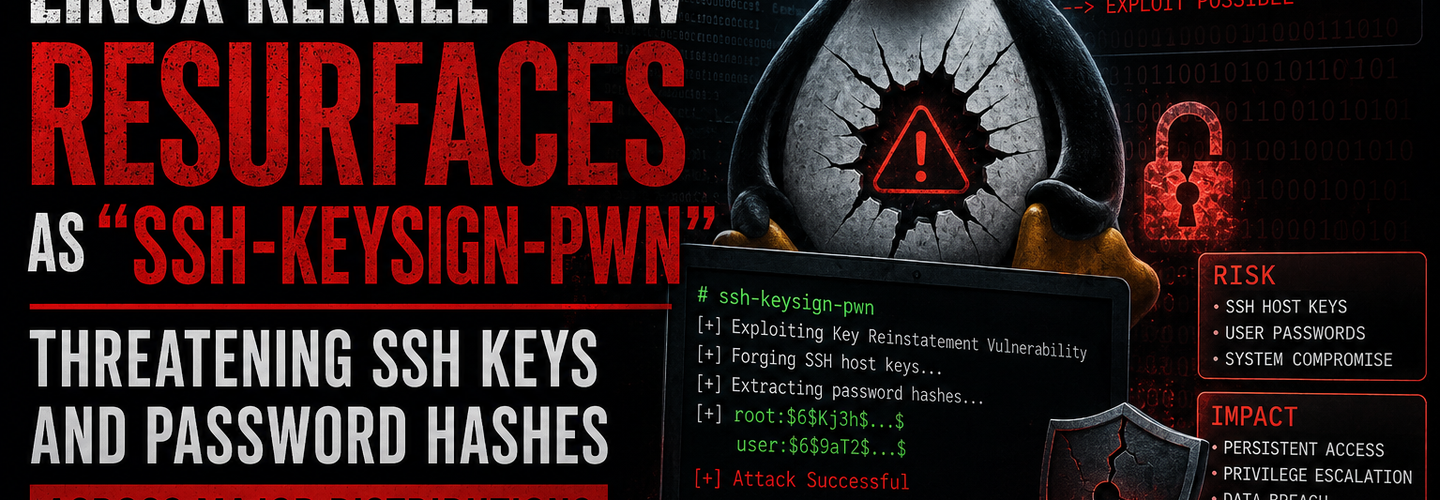
Nine-Year-Old Linux Kernel Flaw Resurfaces as "ssh-keysign-pwn" — Threatening SSH Keys and Password Hashes Across Major Distributions
## Introduction
Security doesn't always fail at the perimeter. Sometimes it unravels from the inside — quietly, at the operating system level, in code that has been trusted for nearly a decade. That's exactly the story behind CVE-2026-46333, a Linux kernel vulnerability that sat undetected since November 2016 before researchers at Qualys pulled it into daylight this month.
The flaw, which the community has taken to calling "ssh-keysign-pwn" after one of its public proof-of-concept exploits, doesn't require remote access or administrative credentials to trigger. Any unprivileged local user on an affected system can potentially walk away with the machine's SSH host private keys and the contents of /etc/shadow — the file that stores every local user's password hash. For organizations running multi-user Linux environments, shared hosting infrastructure, CI/CD pipelines, or cloud-based workloads, the implications are serious enough to warrant immediate attention.
This is also not an isolated event. CVE-2026-46333 is the fourth distinct Linux kernel security issue disclosed in a three-week span this May, following Copy Fail (April 29), Dirty Frag (May 7), and Fragnesia (May 13). Each vulnerability affects different kernel subsystems and requires its own remediation. The pace of disclosure alone signals that enterprise Linux administrators should be operating at an elevated state of alertness right now.
## Threat Overview
The vulnerability lives inside the Linux kernel's __ptrace_may_access() function — a component of the kernel's process tracing subsystem that governs which processes are permitted to inspect or interact with other running processes. Qualys researchers identified a logic flaw introduced in Linux kernel v4.10-rc1 in November 2016 that persisted undetected for approximately nine years.
The core of the problem is a race condition in the process exit path. When certain privileged processes are in the act of exiting, the kernel's ptrace access-check logic can, under the right timing conditions, bypass a "dumpable" check that should have been enforced. Because the target task no longer has a memory descriptor at that precise moment, the safeguard fails silently.
The attack path that Qualys demonstrated leverages SUID (Set User ID) binaries — specifically ssh-keysign and chage — which are present in default installations of major Linux distributions. The ssh-keysign binary is part of the OpenSSH package and is briefly invoked by SSH clients to sign authentication challenges using the host's private keys. During that window, the process has root-owned SSH key files open. By racing against that binary's normal exit using the pidfd_getfd system call, an unprivileged user can steal the open file descriptor handles and read those keys directly.
The second variant targets chage, a standard utility for modifying user password expiry settings. Its exit path momentarily opens /etc/shadow — the file containing every local account's hashed password — creating a similar theft opportunity.
Qualys developed four working exploit chains in total, demonstrating the flaw against chage, ssh-keysign, pkexec, and accounts-daemon. The researchers noted explicitly that these four were drawn from prior research rather than a comprehensive sweep of the attack surface, meaning additional exploitation paths through other SUID or capability-bearing binaries may exist.
## Technical Impact Analysis
The assets at risk here are not trivial. SSH host private keys are the cryptographic credentials a server uses to prove its identity to connecting clients. When a client connects via SSH, the server presents these keys to confirm it is who it claims to be — and not an impersonator intercepting the connection.
If an attacker possesses stolen SSH host private keys, several downstream threats become possible. First, the attacker gains the ability to impersonate the server in an on-path (man-in-the-middle) attack against SSH sessions. Second, on deployments using SSH host-based authentication — where trust is granted based on the server's identity rather than a user's credentials — key disclosure can directly enable unauthorized access to linked systems.
The /etc/shadow exposure is equally concerning. While the file stores hashed passwords rather than plaintext ones, password hashes are the raw material for offline cracking attacks. With modern GPU-accelerated cracking rigs, weak or reused passwords can be recovered from their hashes in hours or days. For enterprise environments where password reuse across accounts is a reality, a shadow file disclosure can cascade into a broader credential compromise.
CISA assigned the vulnerability a CVSS 3.1 score of 5.5, classifying it as Medium severity. The score reflects the local-access requirement — a remote attacker cannot trigger this flaw without an existing foothold on the system. That said, the severity classification has prompted some discussion in the security community, because the value of the data exposed — live SSH host keys and a full password hash database — can substantially exceed what a "Medium" rating typically implies.
The pidfd_getfd syscall dependency is worth noting: CloudLinux 7 and CloudLinux 8 on their 4.18 kernel lines are not exploitable by the current public proof-of-concept because the syscall is not exposed. However, the underlying kernel race is present in those versions and patches are being prepared regardless.
Container environments represent a partial exception. On container deployments where the kernel is shared but the filesystem is isolated, what can be disclosed is constrained to what's accessible within the container itself, and in most configurations that limits the practical impact.
## Industry Implications
The cascading nature of May 2026's Linux disclosures is prompting some security practitioners to revisit assumptions about kernel patching cadence. Historically, many organizations have treated kernel updates as high-disruption, low-urgency maintenance items — something to schedule during quarterly patch windows rather than treat as emergency remediation. The events of this month challenge that posture directly.
"Attackers are moving faster than our patch cycles were designed for," noted a recurring theme in threat intelligence briefings published this spring. The Qualys advisory itself underscores that working exploits are publicly circulating, meaning the window between disclosure and active exploitation is effectively zero. Any system with a low-privileged user account — a developer with SSH access, an application service account, a compromised web application running as www-data — is one kernel version away from a potential credential theft.
The CI/CD pipeline angle is particularly relevant in 2026's cloud-heavy infrastructure landscape. Build systems, test runners, and deployment agents routinely operate as non-root service accounts with local access to the underlying host kernel. An attacker who compromises a CI job, injects malicious code into a build dependency, or gains access through a leaked service account token could potentially weaponize CVE-2026-46333 to extract SSH keys and move laterally into production infrastructure.
Shared hosting environments face comparable exposure. Any platform where multiple tenants' workloads share kernel space — a description that fits a large proportion of budget hosting providers and some container-as-a-service platforms — presents a surface where one tenant's compromise could be leveraged against the host.
## Why This Matters
The reason CVE-2026-46333 deserves attention beyond its CVSS score comes down to a fundamental principle of breach investigation: initial footholds are rarely the end of the story.
Modern intrusions are rarely clean, single-step affairs. An attacker gains initial access through a phishing email, a misconfigured web application, or a leaked API token. From that initial position — running as an underprivileged account — they look for ways to expand. A local kernel vulnerability that hands over SSH host keys and a shadow database is precisely the kind of escalation primitive that transforms a limited shell into a comprehensive credential compromise.
The fact that this flaw existed since 2016 — and that a fix was actually proposed in a 2020 patch submission by Google researcher Jann Horn, only to never be merged — is a reminder that open-source security relies on sustained, coordinated attention. Code that isn't being actively reviewed can accumulate dangerous assumptions.
It is also worth contextualizing this flaw within the broader trend Experian and other firms have been tracking: AI-assisted attacks are accelerating time-to-exploitation, threat actors are increasingly targeting supply chain entry points, and the gap between disclosure and weaponization is compressing. CVE-2026-46333 didn't stay a theoretical concern for long after disclosure — public proof-of-concept code appeared within hours.
## How Users and Administrators Can Stay Safe
The good news: patches are available and straightforward to apply. The bad news for unpatched systems: public exploits are already circulating.
Immediate steps for system administrators:
Apply kernel updates without delay. The upstream fix — commit 31e62c2ebbfd by Linus Torvalds — has been distributed to production package repositories across Debian, Ubuntu, Fedora, AlmaLinux, CloudLinux, and other major distributions. Running sudo apt update && sudo apt upgrade (Debian/Ubuntu) or sudo dnf clean metadata && sudo dnf upgrade (Fedora/RHEL-based) followed by a reboot will deliver the patched kernel.
Apply the interim mitigation if patching is delayed. Setting the Yama ptrace scope to level 2 (admin-only attach) or level 3 (no attach) blocks the known public exploitation paths. Ubuntu's official guidance specifies: echo kernel.yama.ptrace_scope=2 | sudo tee /etc/sysctl.d/99-CVE-2026-46333.conf followed by sudo sysctl -p /etc/sysctl.d/99-CVE-2026-46333.conf. This is a mitigation measure, not a permanent fix, and should be removed once the kernel update is in place. Note that changing ptrace scope may affect debugging workflows and should be tested in non-production environments first.
Rotate SSH host keys on sensitive systems. If there is any uncertainty about whether a system was exposed prior to patching — especially on internet-facing or multi-tenant hosts — rotating SSH host keys is a prudent step. Old keys should be invalidated in known_hosts files and any trust relationships dependent on host-based authentication should be audited.
Audit /etc/shadow exposure risk. On systems where non-root accounts could plausibly have triggered this flaw, consider auditing for unusual activity, reviewing password strength policies, and in high-risk environments, requiring password resets for sensitive accounts.
Verify the patch is applied. After rebooting into the updated kernel, confirm the running version with uname -r and cross-reference against your distribution's patched kernel version announcement.
Treat the previous three Linux kernel patches as separate. The mitigations for Copy Fail, Dirty Frag, and Fragnesia (which involved blacklisting specific kernel modules) do not address CVE-2026-46333. Administrators who applied those fixes are not automatically protected here.
For end users on shared or managed Linux systems: Contact your hosting provider, cloud service, or IT team to confirm that the patched kernel has been applied. If you use password-based SSH authentication and your system was potentially exposed, consider changing passwords as a precaution.
## Official Responses
Linux Kernel / Upstream: Linus Torvalds committed the fix on May 14, 2026 (commit 31e62c2ebbfd, titled "ptrace: slightly saner get_dumpable() logic"). The patch modifies the logic for tasks that no longer have a memory descriptor by caching the last user-dumpable state and requiring proper CAP_SYS_PTRACE authority where it was previously being bypassed.
Qualys: The Qualys Threat Research Unit published a full advisory and coordinated disclosure with the kernel security team before public exploit code appeared. The advisory recommends immediate kernel updates and confirms that setting ptrace_scope to 2 or higher blocks known exploitation paths while noting that other theoretical paths cannot be ruled out.
Ubuntu: Canonical published official guidance on May 19, 2026, confirming that Ubuntu 24.04 LTS and 26.04 LTS are affected. Patched kernels are available in the standard Ubuntu repositories. Ubuntu's advisory also documents the interim ptrace_scope workaround and notes that container environments have limited exposure.
AlmaLinux: Patches were pushed to production repositories on May 16, 2026. AlmaLinux confirmed that the same update addresses both CVE-2026-46333 and the previously disclosed Fragnesia (CVE-2026-46300).
Fedora / Red Hat: Patches are available for Fedora Workstation 43 and 44. Enterprise Linux users should consult Red Hat's security errata portal for distribution-specific update guidance.
CISA: The vulnerability has been assigned a CVSS 3.1 score of 5.5 and catalogued in the National Vulnerability Database. Organizations under CISA's guidance should treat this as part of active patch prioritization given the public availability of proof-of-concept code.
## Sources & References
- ▸Qualys Threat Research Unit Advisory — CVE-2026-46333 Full Advisory: blog.qualys.com
- ▸Ubuntu Security Advisory — CVE-2026-46333 Mitigation and Fixes: ubuntu.com
- ▸AlmaLinux Security Announcement — ssh-keysign-pwn Patches Released: almalinux.org
- ▸CloudLinux Blog — Mitigation and Kernel Update: blog.cloudlinux.com
- ▸The Hacker News — CVE-2026-46333 Coverage: thehackernews.com
- ▸CISA / NVD — CVE-2026-46333 Entry: nvd.nist.gov
- ▸Linux Kernel Commit — Upstream Fix 31e62c2ebbfd: github.com/torvalds/linux
- ▸Experian 2026 Data Breach Industry Forecast: businesswire.com
## Conclusion
CVE-2026-46333 is a reminder that security debt doesn't expire — it accumulates interest. A logic flaw introduced in 2016, flagged in a 2020 patch proposal that never moved forward, resurfaced in 2026 with working public exploits and a real-world exposure window measured in days, not weeks. The vulnerability doesn't require sophisticated attack infrastructure or nation-state resources to exploit. It requires local access and a brief race against a process that runs on virtually every Linux server with OpenSSH installed.
The appropriate response is proportional: patch immediately, apply the interim mitigation where patching is delayed, rotate keys on sensitive systems, and treat this month's Linux kernel disclosures as a collective signal that kernel maintenance deserves the same urgency as application-layer security work.
May 2026 has been an unusually active month for Linux kernel security. That pace should recalibrate any organization's assumptions about how quickly trusted infrastructure can shift beneath its feet.
ReconShield covers threat intelligence, vulnerability research, and defensive security for IT professionals and security teams. This article is for informational and educational purposes only.
Read More:
Gremlin Stealer Conceals C2 URLs and Exfiltration Paths in Encrypted Resource Sections
Copy Fail (CVE-2026-31431): The Linux Kernel Flaw That Handed Root to Anyone Who Asked
Malicious VS Code Extension Linked to Unauthorized Access of GitHub Internal Repositories
AI-Powered Cyber Threats Are Escalating Faster Than Enterprise Defenses Can Adapt
Urgent Chrome Update Released After Critical Remote Code Execution Vulnerabilities Discovered
Hackers Exploit Vulnerable Lenovo Driver to Disable EDR Security Protections
QR Code Phishing Explodes in 2026 as Microsoft Detects 8.3 Billion Email Threats
## Analyst Commentary & Implementation Blueprint
Security advisory
Continuous security exposure assessment is critical to identifying public vulnerabilities before they are exploited. Organizations should maintain a passive inventory of all web servers, TLS configs, and open ports, ensuring that default configurations are eliminated and security advisories are actively implemented.
Hardened Security Configuration Blueprint
# General Security Hardening Directive
ServerTokens ProductOnly
ServerSignature Off
FileETag None
Actionable Mitigation Checklist
- ✔Perform passive asset inventories weekly.
- ✔Restrict administrative ports using local firewall controls.
- ✔Monitor active CVE alerts for exposed software.
Common Inquiries & FAQs
Why is passive scanning preferred for continuous auditing?
Passive audits do not cause operational impact or trigger firewall blocks, making them ideal for constant surveillance of internet-facing assets.
What should I do if a vulnerability is flagged?
Apply the latest vendor patches, restrict access to the resource via firewalls, or verify configuration flags to mitigate risks.
Surendra Reddy
Surendra Reddy is a cybersecurity researcher and founder of ReconShield, specializing in OSINT and defensive infrastructure analysis.
Connect on LinkedIn ↗// AUDIT BRIEFING DISCUSSION (2 COMMENTS)
Great breakdown of the passive infrastructure vectors. We recently audited our external DNS zones and found multiple dangling staging environments. Implementing wildcard certificates reduced our CT log leaks significantly.
Is there any automated tooling you recommend for daily crt.sh scraping? Manually checking CT logs is becoming unsustainable for our domain portfolio.
// MORE ARTICLES
Security Researchers Warn Critical n8n Flaws May Expose Automation Platforms to RCE
Researchers have disclosed critical vulnerabilities in n8n that could expose automation workflows and connected enterprise systems to remote code execution risks, prompting urgent patch recommendations for users and administrators.

How Agentic AI Is Changing Software Engineering and Expanding Mobile Attack Surfaces
Agentic AI is rapidly transforming software engineering workflows through automation and intelligent coding assistance, while cybersecurity experts warn of expanding mobile attack surfaces and emerging application security risks.

SplitVPN Hacked: Data Breach Exposes 865,000 User Records and 58 Million Hidden Connection Logs (July 2026)
SplitVPN hacked: 865,336 user records and 58 million connection logs exposed, directly contradicting the VPN's "no-logs" promise. What was leaked and what to do now.