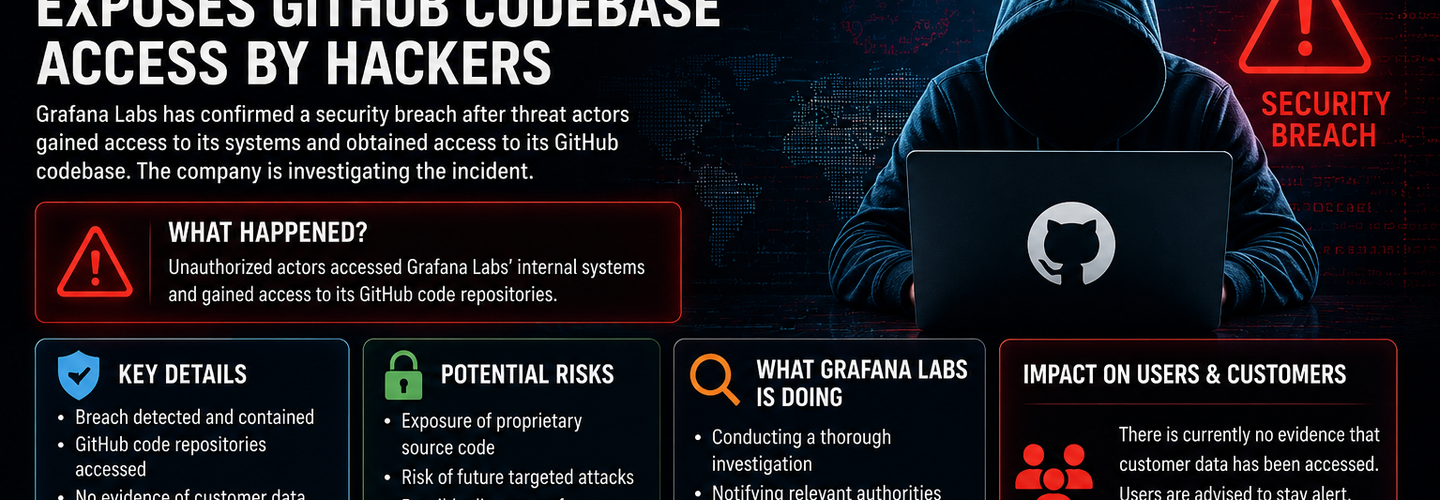
Grafana Labs Security Breach Exposes GitHub Codebase Access by Hackers
Grafana Labs Confirms GitHub Security Incident
Grafana Labs has disclosed a significant security incident after an unauthorized party gained access to its GitHub environment and downloaded portions of the company’s codebase using a compromised access token. The attackers allegedly attempted to extort the company by demanding ransom in exchange for not publicly releasing the stolen source code.
According to available reports, Grafana Labs confirmed that the breach did not impact customer data, production systems, or operational services. However, the incident raises serious concerns about the growing risks surrounding developer infrastructure, GitHub security, and software supply-chain attacks.
How The Grafana Security Breach Happened
Investigators revealed that the attackers obtained a leaked or compromised GitHub token that provided unauthorized access to Grafana’s GitHub environment. Using this token, the threat actors reportedly downloaded source code repositories and later attempted extortion.
While Grafana has not publicly disclosed the full technical details, compromised access tokens remain one of the most common entry points in modern cyberattacks targeting software companies.
GitHub tokens are highly valuable because they can grant access to:
- ▸Source code repositories
- ▸CI/CD pipelines
- ▸Deployment workflows
- ▸Cloud credentials
- ▸Internal automation systems
- ▸Developer secrets
Once attackers gain access to developer infrastructure, they can potentially manipulate software releases, inject malicious code, or steal intellectual property.
No Customer Data Exposure Reported
Grafana Labs stated that its investigation found no evidence of:
- ▸Customer data exposure
- ▸Unauthorized access to production environments
- ▸Service disruption
- ▸Compromised release artifacts
The company reportedly refused to pay the ransom demand and immediately launched a forensic investigation while strengthening internal security controls.
Cybersecurity experts note that even when customer systems are unaffected, source code theft still poses serious long-term risks.
Why Source Code Theft Matters
Source code repositories contain valuable information about software architecture, integrations, APIs, and internal development processes.
Attackers who obtain source code may attempt to:
- ▸Discover undisclosed vulnerabilities
- ▸Analyze authentication mechanisms
- ▸Develop targeted exploits
- ▸Identify hardcoded credentials
- ▸Launch future supply-chain attacks
- ▸Reverse-engineer internal systems
Although open-source companies already publish large portions of code publicly, private repositories may still contain sensitive configurations, unreleased features, or proprietary tooling.
Rising Threats Against Developer Infrastructure
The Grafana incident reflects a broader trend in cybercrime where attackers increasingly target developer ecosystems instead of traditional endpoints.
Recent attacks have focused heavily on:
- ▸GitHub repositories
- ▸GitHub Actions workflows
- ▸CI/CD systems
- ▸Open-source package managers
- ▸Cloud development environments
- ▸AI development pipelines
Security researchers warn that compromising developer infrastructure can provide attackers with indirect access to thousands of downstream organizations.
Previous GitHub-Related Security Concerns
The incident comes amid growing concerns surrounding GitHub ecosystem security.
Researchers recently disclosed a critical GitHub vulnerability identified as CVE-2026-3854, which reportedly allowed remote code execution on GitHub infrastructure under certain conditions. Security experts warned that millions of repositories could potentially have been exposed before patches were deployed.
Although there is currently no confirmed connection between the GitHub vulnerability and the Grafana breach, the timing highlights increasing pressure on software development platforms to strengthen infrastructure security.
Supply-Chain Attacks Continue To Grow
Cybercriminals increasingly target trusted software ecosystems because they offer scalable attack opportunities.
Modern supply-chain attacks may involve:
- ▸Compromised software packages
- ▸Malicious updates
- ▸Stolen developer credentials
- ▸CI/CD pipeline compromise
- ▸Dependency injection attacks
- ▸GitHub token theft
Recent malware campaigns targeting npm and PyPI ecosystems have already demonstrated how attackers exploit developer trust relationships to spread malicious code across thousands of systems.
Lessons Organizations Should Learn
The Grafana breach highlights several important cybersecurity lessons for software companies and development teams.
## Strengthen Token Security
Organizations should:
- ▸Rotate access tokens regularly
- ▸Limit token permissions
- ▸Use short-lived credentials
- ▸Monitor suspicious token usage
- ▸Implement secret scanning tools
## Secure CI/CD Pipelines
Continuous integration and deployment systems should be isolated and monitored for unauthorized activity.
## Adopt Zero-Trust Security Models
Every access request should be continuously verified regardless of user or system location.
## Monitor GitHub Activity
Security teams should track unusual repository access patterns, downloads, and privilege escalations.
## Protect Open-Source Dependencies
Companies should verify third-party packages and continuously monitor software dependencies for malicious modifications.
Open-Source Ecosystems Are Increasingly Targeted
Open-source software platforms like Grafana play a critical role in modern cloud infrastructure, observability, and monitoring systems.
Because these platforms are widely integrated into enterprise environments, attackers see them as attractive targets for:
- ▸Credential theft
- ▸Intellectual property theft
- ▸Supply-chain compromise
- ▸Infrastructure infiltration
Security analysts believe cyberattacks against developer platforms will continue increasing as organizations rely more heavily on cloud-native development and AI-assisted coding workflows.
Final Thoughts
The Grafana Labs security breach demonstrates how compromised developer credentials and GitHub access tokens can create significant cybersecurity risks even without direct customer data exposure.
While Grafana says production systems and user data remain unaffected, the incident underscores the growing importance of securing software development infrastructure, source code repositories, and CI/CD environments against modern cyber threats.
As software supply-chain attacks become more advanced, organizations must prioritize developer security, token management, and continuous threat monitoring to reduce the risk of future breaches.
## FAQs
What happened in the Grafana Labs security breach?
Hackers reportedly gained unauthorized access to Grafana’s GitHub environment using a compromised token and downloaded parts of the company’s codebase.
Was customer data compromised?
Grafana stated that no customer data, production systems, or operational services were affected.
What is a GitHub token?
A GitHub token is a credential that allows automated or authenticated access to repositories, workflows, and developer systems.
Why is source code theft dangerous?
Stolen source code can help attackers discover vulnerabilities, analyze internal systems, and prepare future cyberattacks.
What are supply-chain attacks?
Supply-chain attacks target trusted software ecosystems, dependencies, or development infrastructure to compromise downstream users or organizations.
Read More:
Foxconn Cyberattack: Hackers Claim Apple & Google Data Stolen
Arctic Wolf Launches AI Mobile Threat Defense
The Mythos Stress Test: Are Indian Banks & Fintechs Ready for AI-Native Cyber Threats?
India Lost ₹52,000 Crore to Cyber Frauds in 5 Years – Govt Tightens Telecom Security
## Analyst Commentary & Implementation Blueprint
Security advisory
Continuous security exposure assessment is critical to identifying public vulnerabilities before they are exploited. Organizations should maintain a passive inventory of all web servers, TLS configs, and open ports, ensuring that default configurations are eliminated and security advisories are actively implemented.
Hardened Security Configuration Blueprint
# General Security Hardening Directive
ServerTokens ProductOnly
ServerSignature Off
FileETag None
Actionable Mitigation Checklist
- ✔Perform passive asset inventories weekly.
- ✔Restrict administrative ports using local firewall controls.
- ✔Monitor active CVE alerts for exposed software.
Common Inquiries & FAQs
Why is passive scanning preferred for continuous auditing?
Passive audits do not cause operational impact or trigger firewall blocks, making them ideal for constant surveillance of internet-facing assets.
What should I do if a vulnerability is flagged?
Apply the latest vendor patches, restrict access to the resource via firewalls, or verify configuration flags to mitigate risks.
Surendra Reddy
Surendra Reddy is a cybersecurity researcher and founder of ReconShield, specializing in OSINT and defensive infrastructure analysis.
Connect on LinkedIn ↗// AUDIT BRIEFING DISCUSSION (2 COMMENTS)
Great breakdown of the passive infrastructure vectors. We recently audited our external DNS zones and found multiple dangling staging environments. Implementing wildcard certificates reduced our CT log leaks significantly.
Is there any automated tooling you recommend for daily crt.sh scraping? Manually checking CT logs is becoming unsustainable for our domain portfolio.
// MORE ARTICLES
Security Researchers Warn Critical n8n Flaws May Expose Automation Platforms to RCE
Researchers have disclosed critical vulnerabilities in n8n that could expose automation workflows and connected enterprise systems to remote code execution risks, prompting urgent patch recommendations for users and administrators.
How Agentic AI Is Changing Software Engineering and Expanding Mobile Attack Surfaces
Agentic AI is rapidly transforming software engineering workflows through automation and intelligent coding assistance, while cybersecurity experts warn of expanding mobile attack surfaces and emerging application security risks.
Microsoft Defender Zero-Day Patched: What IT Teams Need to Know
Microsoft patches RoguePlanet, a Defender zero-day (CVE-2026-50656) letting attackers gain SYSTEM access. Here's what IT teams need to know.