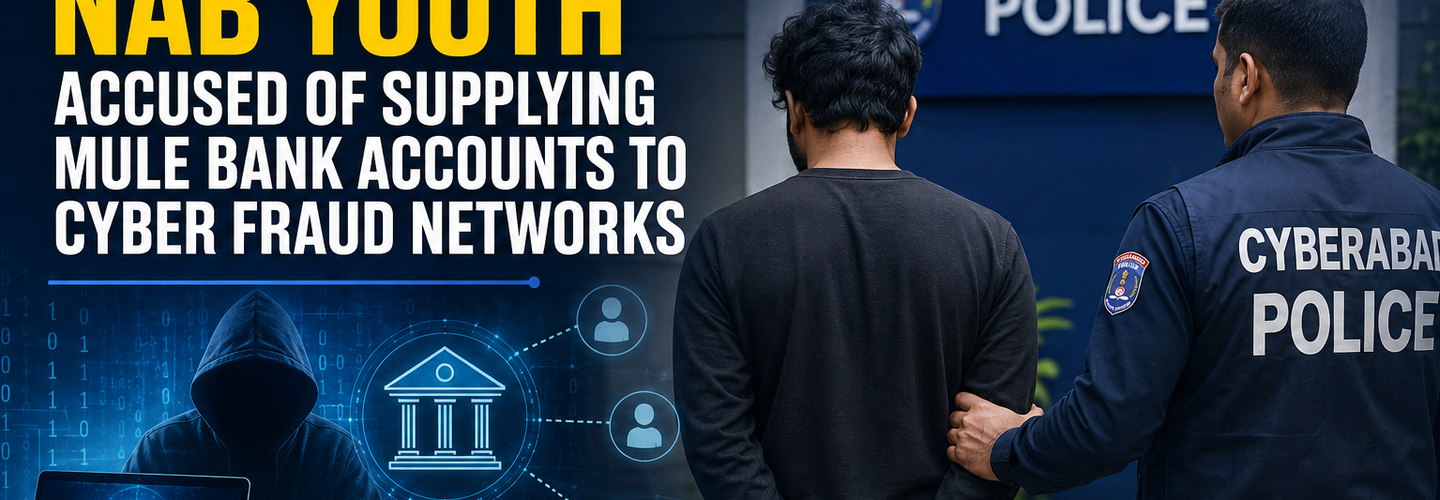
Cyberabad Police Nab Youth Accused of Supplying Mule Bank Accounts to Cyber Fraud Networks
India’s escalating cybercrime crisis has once again drawn attention to the underground ecosystem that enables large-scale digital fraud. Cyberabad Police have arrested a young man accused of supplying mule bank accounts to cybercriminal groups involved in online financial scams, according to officials familiar with the investigation.
The arrest sheds light on a critical but often overlooked layer of cyber-enabled financial crime: the use of “mule” accounts to move stolen money through legitimate banking infrastructure. While ransomware groups and phishing operators often dominate headlines, investigators say mule account suppliers play a foundational role in helping fraud networks hide transaction trails and rapidly cash out stolen funds.
Authorities believe the suspect allegedly facilitated access to multiple bank accounts that were later used in cyber fraud operations targeting victims across different Indian states. The case reflects a broader trend seen across South Asia and other regions where organized cybercrime syndicates increasingly rely on recruited intermediaries to bypass banking safeguards and anti-money laundering controls.
The development also comes amid intensified enforcement efforts by Indian law enforcement agencies as digital payment fraud cases continue to surge alongside the rapid adoption of UPI-based transactions and online banking services.
## Threat Overview
Financial mule networks have become a major operational pillar for cybercrime groups involved in phishing scams, investment fraud, impersonation attacks, fake job schemes, and social engineering operations.
In many cases, mule accounts belong to individuals who knowingly rent or sell access to their bank accounts for commissions. Others may be manipulated through deceptive employment offers or fake online earning schemes. Once fraud proceeds enter these accounts, funds are quickly dispersed through layered transactions, cryptocurrency conversions, prepaid wallets, or withdrawals to obscure the money trail.
Investigators say the Cyberabad case highlights how cybercriminal operations are no longer limited to isolated hackers working independently. Instead, modern fraud ecosystems increasingly resemble organized supply chains where different actors specialize in separate functions, including:
- ▸Social engineering and victim targeting
- ▸Fraudulent payment collection
- ▸Mule account acquisition
- ▸Money laundering coordination
- ▸SIM card procurement
- ▸Digital identity misuse
Cybersecurity analysts warn that mule account suppliers have become especially valuable to fraud groups because banks and payment platforms continue strengthening detection systems around suspicious transfers.
“Financial mule networks act as the connective tissue of cyber fraud operations,” said a Hyderabad-based cybercrime analyst familiar with digital banking investigations. “Without access to accounts that appear legitimate, large-scale scam operations would struggle to move funds efficiently.”
Law enforcement agencies across India have repeatedly issued warnings about criminals recruiting students, unemployed youth, and financially vulnerable individuals to open or share bank accounts under false pretenses.
## Technical Impact Analysis
The misuse of mule bank accounts creates serious challenges for financial institutions, digital payment providers, and cybercrime investigators.
Unlike direct account takeovers, mule-based laundering operations exploit legitimate banking relationships. Fraudulent transfers often appear normal at first glance because they move through verified accounts tied to real identities. This complicates automated fraud detection efforts.
Cybersecurity and banking experts say several factors are contributing to the growth of mule account abuse:
Rapid Expansion of Digital Payments
India’s digital payments ecosystem has grown dramatically over the past few years. Unified Payments Interface (UPI) adoption, mobile wallets, and instant bank transfers have transformed financial accessibility, but they have also expanded the attack surface for cyber-enabled financial fraud.
According to data published by the National Payments Corporation of India (NPCI), billions of UPI transactions are processed monthly, creating an enormous transaction volume that fraud actors attempt to exploit.
Social Engineering at Scale
Modern fraud campaigns increasingly rely on psychological manipulation rather than sophisticated malware. Scam operators impersonate bank officials, delivery companies, law enforcement personnel, or investment advisors to trick victims into transferring money voluntarily.
Once funds are transferred, mule accounts help rapidly fragment and redistribute the stolen assets before victims can report the fraud.
Identity Abuse and Synthetic Verification
Some mule accounts are opened using stolen identity documents, manipulated KYC information, or synthetic identities assembled from leaked personal data. This creates additional complications for investigators attempting to identify the true operators behind the fraud chain.
Cross-Platform Fraud Ecosystems
Cybercrime groups often combine mule banking infrastructure with encrypted messaging apps, anonymous communication channels, cryptocurrency platforms, and disposable mobile numbers to reduce attribution risks.
Security researchers note that the increasing professionalization of cyber fraud ecosystems mirrors operational models traditionally associated with organized financial crime groups.
## Industry Implications
The Cyberabad case highlights growing pressure on banks, fintech firms, and digital payment providers to strengthen fraud detection and transaction monitoring systems.
Financial institutions now face a dual challenge:
Reducing fraudulent transactions without disrupting legitimate customers
Detecting mule behavior before accounts become deeply embedded in laundering networks
Banks are increasingly deploying:
- ▸Behavioral analytics
- ▸AI-driven fraud detection
- ▸Device fingerprinting
- ▸Risk-based authentication
- ▸Transaction anomaly monitoring
- ▸Real-time payment screening
However, experts caution that technology alone cannot fully solve the mule account problem.
“One of the biggest difficulties is that many mule accounts initially behave like normal consumer accounts,” said a financial crime consultant who advises payment companies in India. “The suspicious activity may only emerge after fraud operations begin moving money through them.”
The reputational and regulatory consequences for financial institutions can also be significant. Regulators worldwide are intensifying scrutiny around anti-money laundering (AML) compliance, suspicious activity reporting, and digital payment monitoring.
Indian authorities have also stepped up coordination between cybercrime units, banks, telecom providers, and payment platforms to freeze suspicious accounts faster and recover stolen funds where possible.
## Why This Matters
The arrest is important because it demonstrates that cybercrime investigations are increasingly targeting the infrastructure supporting digital fraud — not just the scammers directly interacting with victims.
Financial mule networks represent a major enabler of online fraud. Without them, criminals would face greater difficulty laundering stolen funds and monetizing scams at scale.
The case also reflects broader cybersecurity concerns affecting rapidly digitizing economies:
- ▸Increased dependence on instant digital payments
- ▸Growing cyber fraud targeting consumers
- ▸Abuse of financial inclusion systems
- ▸Exploitation of vulnerable populations
- ▸Rising operational sophistication among fraud networks
For ordinary users, mule account activity can create devastating financial consequences. Victims of cyber-enabled scams often struggle to recover stolen money once it passes through multiple intermediary accounts.
For account holders who knowingly participate, legal exposure can be severe. Individuals allowing their accounts to be used for suspicious financial activity may face criminal investigations, frozen accounts, reputational damage, and banking restrictions.
Cybersecurity experts say public awareness remains one of the most effective defensive measures.
## How Users Can Stay Safe
As financial scams continue evolving, cybersecurity professionals recommend several protective measures for consumers and businesses.
Never Share Banking Access
Users should never provide bank account access, ATM cards, online banking credentials, or OTP codes to unknown individuals or third parties promising commissions or “easy money.”
Avoid Suspicious Job Offers
Many mule recruitment schemes disguise themselves as:
- ▸Work-from-home jobs
- ▸Payment processing roles
- ▸Commission-based transfer jobs
- ▸Online earning opportunities
Any request involving the use of personal bank accounts to receive or transfer money should be treated as highly suspicious.
Monitor Financial Activity
Consumers should regularly review:
- ▸Bank statements
- ▸UPI transaction history
- ▸SMS alerts
- ▸Linked devices
Unexpected transactions should be reported immediately.
Enable Security Controls
Banks and payment apps often provide:
- ▸Transaction alerts
- ▸Device management controls
- ▸Spending limits
- ▸Biometric authentication
- ▸Fraud reporting channels
Users should enable these protections wherever possible.
Verify Requests Independently
Scammers frequently impersonate:
- ▸Banks
- ▸Police agencies
- ▸Government departments
- ▸Delivery companies
- ▸Telecom providers
Users should independently verify suspicious calls or messages using official contact channels.
Report Fraud Quickly
Rapid reporting improves the chances of freezing fraudulent transfers before funds are dispersed across multiple mule accounts.
Indian authorities encourage victims to report cyber financial fraud through:
- ▸The National Cyber Crime Reporting Portal
- ▸Local cybercrime police stations
- ▸Official banking fraud helplines
## Official Responses
Indian law enforcement agencies have repeatedly emphasized the growing threat posed by financial mule networks.
Cyberabad Police and other cybercrime units have expanded operations focused on:
- ▸Fraud infrastructure disruption
- ▸Digital payment monitoring
- ▸Money trail analysis
- ▸Account freezing coordination
- ▸Cross-state cybercrime investigations
The Reserve Bank of India (RBI) has also issued multiple advisories urging banks to strengthen fraud monitoring and customer awareness initiatives.
Meanwhile, cybersecurity agencies and financial institutions continue urging users to remain cautious about unsolicited financial offers and suspicious payment requests.
Industry observers expect increased collaboration between:
- ▸Banks
- ▸Telecom providers
- ▸Payment gateways
- ▸Cybercrime units
- ▸Financial intelligence agencies
as authorities attempt to reduce the scale of digital payment abuse.
## Sources & References
- ▸Indian Cyber Crime Coordination Centre (I4C) advisories
- ▸Reserve Bank of India (RBI) fraud awareness guidance
- ▸National Payments Corporation of India (NPCI) transaction data
- ▸Public statements from Indian cybercrime enforcement agencies
- ▸Financial crime and AML industry analysis reports
- ▸Cybersecurity threat intelligence research on financial mule operations
## Conclusion
The Cyberabad Police investigation underscores how cyber fraud has evolved into a complex financial ecosystem supported by networks of intermediaries, facilitators, and infrastructure providers.
While public attention often focuses on phishing emails or scam calls, the financial backbone enabling these operations is equally critical. Mule bank accounts allow cybercriminals to move illicit funds rapidly, complicate investigations, and scale fraud operations across regions.
As India’s digital economy continues expanding, authorities, banks, and consumers face increasing pressure to strengthen cyber resilience around financial transactions. The latest arrest serves as another reminder that cybercrime is no longer confined to the digital realm alone it now intersects deeply with financial systems, identity verification processes, and everyday online behavior.
For defenders, awareness and rapid response remain essential. For users, vigilance around banking activity and suspicious financial requests may be the strongest line of defense against becoming part of the growing cyber fraud economy either as a victim or an unwitting participant.
Read More:
How Agentic AI Is Changing Software Engineering and Expanding Mobile Attack Surfaces
UK Says AI-Fueled Cyber Risks Are Tied to Security Weaknesses Rather Than Repository Transparency
Everpure strengthens cyber resilience by positioning data management as the final layer of defence
Gremlin Stealer Conceals C2 URLs and Exfiltration Paths in Encrypted Resource Sections
Copy Fail (CVE-2026-31431): The Linux Kernel Flaw That Handed Root to Anyone Who Asked
Malicious VS Code Extension Linked to Unauthorized Access of GitHub Internal Repositories
## Analyst Commentary & Implementation Blueprint
Security advisory
Continuous security exposure assessment is critical to identifying public vulnerabilities before they are exploited. Organizations should maintain a passive inventory of all web servers, TLS configs, and open ports, ensuring that default configurations are eliminated and security advisories are actively implemented.
Hardened Security Configuration Blueprint
# General Security Hardening Directive
ServerTokens ProductOnly
ServerSignature Off
FileETag None
Actionable Mitigation Checklist
- ✔Perform passive asset inventories weekly.
- ✔Restrict administrative ports using local firewall controls.
- ✔Monitor active CVE alerts for exposed software.
Common Inquiries & FAQs
Why is passive scanning preferred for continuous auditing?
Passive audits do not cause operational impact or trigger firewall blocks, making them ideal for constant surveillance of internet-facing assets.
What should I do if a vulnerability is flagged?
Apply the latest vendor patches, restrict access to the resource via firewalls, or verify configuration flags to mitigate risks.
Surendra Reddy
Surendra Reddy is a cybersecurity researcher and founder of ReconShield, specializing in OSINT and defensive infrastructure analysis.
Connect on LinkedIn ↗// AUDIT BRIEFING DISCUSSION (2 COMMENTS)
Great breakdown of the passive infrastructure vectors. We recently audited our external DNS zones and found multiple dangling staging environments. Implementing wildcard certificates reduced our CT log leaks significantly.
Is there any automated tooling you recommend for daily crt.sh scraping? Manually checking CT logs is becoming unsustainable for our domain portfolio.
// MORE ARTICLES
Security Researchers Warn Critical n8n Flaws May Expose Automation Platforms to RCE
Researchers have disclosed critical vulnerabilities in n8n that could expose automation workflows and connected enterprise systems to remote code execution risks, prompting urgent patch recommendations for users and administrators.

How Agentic AI Is Changing Software Engineering and Expanding Mobile Attack Surfaces
Agentic AI is rapidly transforming software engineering workflows through automation and intelligent coding assistance, while cybersecurity experts warn of expanding mobile attack surfaces and emerging application security risks.

SplitVPN Hacked: Data Breach Exposes 865,000 User Records and 58 Million Hidden Connection Logs (July 2026)
SplitVPN hacked: 865,336 user records and 58 million connection logs exposed, directly contradicting the VPN's "no-logs" promise. What was leaked and what to do now.