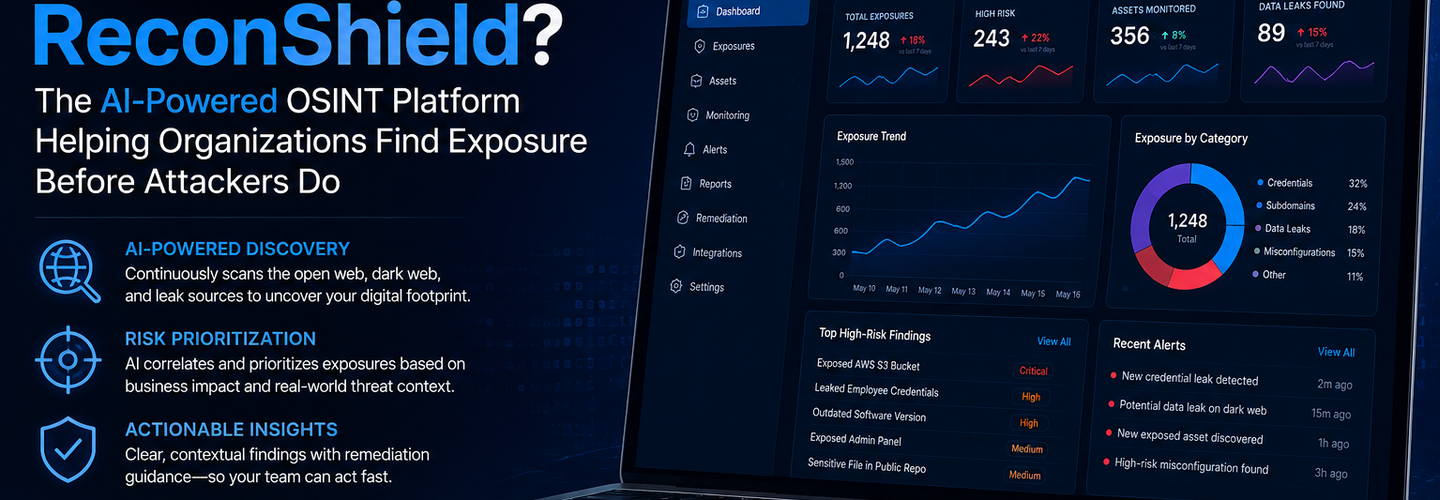
What Is ReconShield? The AI-Powered OSINT Platform Helping Organizations Find Exposure Before Attackers Do
Modern organizations operate across cloud platforms, SaaS applications, APIs, remote endpoints, third-party vendors, and constantly changing digital infrastructure. While businesses move faster than ever, security teams are left trying to answer one difficult question:
What exactly is exposed to the internet right now?
That question has become one of the most important in cybersecurity.
Attackers no longer rely solely on sophisticated malware or advanced intrusion techniques. In many incidents, the initial entry point is surprisingly simple — an exposed admin panel, a forgotten subdomain, leaked credentials, an outdated service, or a cloud misconfiguration that nobody noticed.
ReconShield was built to help solve that problem.
As an AI-powered OSINT and exposure intelligence platform, ReconShield helps organizations identify publicly visible assets, uncover potential security risks, monitor attack surfaces, and improve defensive visibility before threats escalate into incidents.
In today’s cybersecurity landscape, knowing your exposure may be just as important as blocking attacks themselves.
## The Growing Problem of Digital Exposure
The internet continuously changes. Infrastructure expands, developers deploy new services, cloud environments scale automatically, and external-facing assets appear faster than many organizations can track them.
This creates hidden risk.
According to multiple industry studies, organizations often underestimate the size of their public-facing infrastructure. Shadow IT, unmanaged services, abandoned development environments, and third-party integrations frequently remain exposed long after teams forget about them.
Threat actors actively scan the internet searching for these weak points.
Public attack surface discovery has become heavily automated. Security researchers and defenders use automation for defensive visibility — but malicious operators use similar methods to locate vulnerable systems, exposed applications, weak configurations, and outdated software.
That means organizations need continuous visibility into their exposure footprint.
ReconShield addresses this challenge by helping users identify external assets, analyze security posture, and gain actionable intelligence about publicly accessible infrastructure.
## What Is ReconShield?
ReconShield is a cybersecurity intelligence and attack surface visibility platform designed to help organizations understand how their digital presence appears from an external perspective.
Rather than focusing only on internal monitoring, ReconShield emphasizes internet-facing exposure analysis, OSINT-driven reconnaissance visibility, and proactive security awareness.
The platform is designed for:
- ▸Security researchers
- ▸SOC analysts
- ▸Developers
- ▸IT administrators
- ▸Startups
- ▸Enterprises
- ▸Red teams and blue teams
- ▸Cybersecurity consultants
- ▸Digital risk monitoring teams
ReconShield combines automation, threat intelligence principles, and AI-assisted analysis to provide better visibility into exposed systems and potential security gaps.
## Key Features of ReconShield
AI-Powered Exposure Analysis
ReconShield leverages AI-enhanced intelligence workflows to help users identify patterns, prioritize risks, and analyze exposure data more efficiently.
As enterprise attack surfaces grow, manual analysis becomes increasingly difficult. AI-assisted systems help security teams process large volumes of data faster while reducing blind spots.
Attack Surface Monitoring
External attack surfaces change constantly.
New subdomains appear. Cloud services are deployed. Development environments become publicly reachable. APIs evolve. Third-party vendors introduce additional risk.
ReconShield helps organizations monitor these changes continuously so security teams can detect exposure issues earlier.
OSINT Intelligence Integration
Open-source intelligence has become a major part of modern cybersecurity operations.
Public metadata, certificate transparency logs, DNS records, leaked credentials, exposed repositories, and internet-wide scanning data can reveal valuable information about organizational exposure.
ReconShield helps centralize and analyze these intelligence signals in a defensive security context.
Exposure Visibility for Security Teams
One of the biggest operational challenges in cybersecurity is simply knowing what exists.
Many organizations lack complete visibility into:
- ▸Internet-facing assets
- ▸Legacy systems
- ▸Public services
- ▸Old development environments
- ▸Unused domains
- ▸External dependencies
ReconShield helps security teams maintain stronger awareness of their digital footprint.
Risk Prioritization
Not every exposure issue carries the same level of risk.
Security teams often face alert fatigue due to overwhelming volumes of security findings. ReconShield helps prioritize issues based on visibility, potential impact, and exposure relevance so organizations can focus remediation efforts more effectively.
## Why External Exposure Matters More Than Ever
Cybersecurity has shifted dramatically over the last decade.
Traditional perimeter security models assumed organizations operated inside clearly defined networks. That model no longer reflects reality.
Today’s environments are distributed across:
- ▸Multi-cloud infrastructure
- ▸SaaS ecosystems
- ▸Remote work environments
- ▸Third-party integrations
- ▸APIs
- ▸Hybrid networks
As a result, external visibility has become one of the most important areas of cybersecurity defense.
A single exposed service can become an entry point into a broader environment.
A forgotten development server can expose sensitive information.
A leaked credential can create significant downstream risk.
ReconShield helps organizations identify these risks before they become operational incidents.
## Industry Impact of Exposure Intelligence Platforms
The rise of exposure management platforms reflects a broader industry shift toward proactive cybersecurity.
Organizations are increasingly investing in:
- ▸External attack surface management (EASM)
- ▸Continuous threat exposure management (CTEM)
- ▸OSINT intelligence workflows
- ▸Cloud security posture management
- ▸AI-enhanced vulnerability analysis
This shift is being driven by both attacker behavior and regulatory pressure.
Government agencies and cybersecurity regulators worldwide continue emphasizing:
- ▸Asset visibility
- ▸Secure-by-design practices
- ▸Vulnerability management
- ▸Supply chain security
- ▸Continuous monitoring
Frameworks from organizations like NIST, CISA, and ENISA increasingly focus on visibility as a foundational security requirement.
ReconShield aligns with this evolving security model by helping organizations reduce unknown exposure and improve external awareness.
## Why This Matters
Most cyber incidents begin long before a breach is detected.
Attackers often spend time identifying exposed systems, collecting publicly available information, and mapping targets before organizations realize they are at risk.
The problem is not always sophisticated malware.
Sometimes the issue is simply exposure.
That is why platforms focused on visibility and proactive intelligence are becoming essential.
ReconShield helps organizations move from reactive security toward preventive security by identifying what attackers may already see publicly.
In cybersecurity, awareness creates defensive advantage.
Organizations that understand their exposure earlier can remediate faster, reduce risk sooner, and strengthen resilience before incidents escalate.
## How Users Can Stay Safe
Organizations and individuals can reduce exposure risk by adopting several defensive best practices.
Maintain Accurate Asset Inventories
Security begins with visibility.
Organizations should continuously track domains, subdomains, servers, APIs, cloud services, and external-facing systems.
Unknown assets often become unmanaged risks.
Implement Continuous Monitoring
Attack surfaces evolve constantly.
Routine scans and exposure monitoring help organizations detect changes quickly and identify newly exposed systems before they create larger security issues.
Strengthen Identity Security
Multi-factor authentication (MFA), least-privilege access controls, and strong credential management remain critical defensive measures.
Credential exposure continues to play a major role in cybersecurity incidents.
Review Cloud Configurations Regularly
Misconfigured cloud infrastructure remains one of the leading causes of accidental data exposure.
Organizations should regularly audit permissions, storage settings, API access, and publicly accessible resources.
Prioritize Vulnerability Management
Patch management remains essential.
Internet-facing systems should receive priority during remediation cycles, especially when vulnerabilities involve authentication systems, remote access services, or exposed APIs.
Invest in Security Awareness
Human error remains a major cybersecurity factor.
Regular awareness training helps employees recognize phishing attempts, suspicious activity, and unsafe operational practices.
## Official Security Trends Supporting Exposure Management
Several major cybersecurity trends reinforce the importance of attack surface visibility:
- ▸Increased ransomware targeting internet-facing systems
- ▸Growth of supply chain attacks
- ▸Rapid cloud adoption
- ▸Expansion of remote work infrastructure
- ▸Rising API security concerns
- ▸AI-assisted reconnaissance capabilities
- ▸Increased regulatory focus on cybersecurity resilience
Security teams increasingly recognize that visibility gaps often become security gaps.
ReconShield operates within this evolving reality by helping organizations understand and reduce external exposure risk.
## The Future of AI in Cybersecurity Visibility
Artificial intelligence is transforming cybersecurity operations across multiple areas:
- ▸Threat detection
- ▸Log analysis
- ▸Behavioral analytics
- ▸Security automation
- ▸Vulnerability prioritization
- ▸Exposure intelligence
AI-assisted security systems can process massive datasets faster than traditional manual workflows, helping teams identify patterns and prioritize issues more efficiently.
However, cybersecurity experts also emphasize that AI should support not replace human security judgment.
The most effective security programs combine automation, analyst expertise, and continuous monitoring.
ReconShield reflects this balanced approach by using intelligent analysis to improve visibility while supporting defensive cybersecurity operations.
## Conclusion
Cybersecurity is no longer just about building stronger defenses.
It is about understanding what is exposed before attackers discover it first.
As organizations continue expanding across cloud environments, APIs, remote infrastructure, and interconnected digital ecosystems, visibility becomes one of the most valuable security capabilities available.
ReconShield helps organizations strengthen that visibility.
By combining AI-powered intelligence, exposure monitoring, OSINT-driven analysis, and attack surface awareness, the platform supports a more proactive and modern approach to cybersecurity defense.
In a world where digital exposure changes every day, continuous visibility may be one of the strongest defenses organizations can build.
## Sources & References
- ▸National Institute of Standards and Technology (NIST)
- ▸U.S. Cybersecurity and Infrastructure Security Agency (CISA)
- ▸European Union Agency for Cybersecurity (ENISA)
- ▸OWASP Security Best Practices
- ▸Industry research on Attack Surface Management (ASM)
- ▸Public cloud security posture management studies
- ▸Threat intelligence reporting on exposure-driven cyber incidents
Read More:
Hackers Exploit Vulnerable Lenovo Driver to Disable EDR Security Protections
QR Code Phishing Explodes in 2026 as Microsoft Detects 8.3 Billion Email Threats
Public Exploit Code Emerges for Chromium Flaw Potentially Affecting Millions Worldwide
F5 BIG-IP Appliances Targeted by Hackers for SSH Intrusions Into Enterprise Linux Systems
Vellore Man Arrested in Cambodia Cyber Slavery Racket Linked to Online Scam Networks
Cyber Fraud in Bengaluru: Elderly Woman Loses Rs 7.69 Lakh After Clicking Fake WhatsApp Link
10,000+ Zero-Day Vulnerabilities Identified by Anthropic Claude Mythos in Glasswing Project
## Analyst Commentary & Implementation Blueprint
Security advisory
Continuous security exposure assessment is critical to identifying public vulnerabilities before they are exploited. Organizations should maintain a passive inventory of all web servers, TLS configs, and open ports, ensuring that default configurations are eliminated and security advisories are actively implemented.
Hardened Security Configuration Blueprint
# General Security Hardening Directive
ServerTokens ProductOnly
ServerSignature Off
FileETag None
Actionable Mitigation Checklist
- ✔Perform passive asset inventories weekly.
- ✔Restrict administrative ports using local firewall controls.
- ✔Monitor active CVE alerts for exposed software.
Common Inquiries & FAQs
Why is passive scanning preferred for continuous auditing?
Passive audits do not cause operational impact or trigger firewall blocks, making them ideal for constant surveillance of internet-facing assets.
What should I do if a vulnerability is flagged?
Apply the latest vendor patches, restrict access to the resource via firewalls, or verify configuration flags to mitigate risks.
Surendra Reddy
Surendra Reddy is a cybersecurity researcher and founder of ReconShield, specializing in OSINT and defensive infrastructure analysis.
Connect on LinkedIn ↗// AUDIT BRIEFING DISCUSSION (2 COMMENTS)
Great breakdown of the passive infrastructure vectors. We recently audited our external DNS zones and found multiple dangling staging environments. Implementing wildcard certificates reduced our CT log leaks significantly.
Is there any automated tooling you recommend for daily crt.sh scraping? Manually checking CT logs is becoming unsustainable for our domain portfolio.
// MORE ARTICLES
Security Researchers Warn Critical n8n Flaws May Expose Automation Platforms to RCE
Researchers have disclosed critical vulnerabilities in n8n that could expose automation workflows and connected enterprise systems to remote code execution risks, prompting urgent patch recommendations for users and administrators.

How Agentic AI Is Changing Software Engineering and Expanding Mobile Attack Surfaces
Agentic AI is rapidly transforming software engineering workflows through automation and intelligent coding assistance, while cybersecurity experts warn of expanding mobile attack surfaces and emerging application security risks.

SplitVPN Hacked: Data Breach Exposes 865,000 User Records and 58 Million Hidden Connection Logs (July 2026)
SplitVPN hacked: 865,336 user records and 58 million connection logs exposed, directly contradicting the VPN's "no-logs" promise. What was leaked and what to do now.