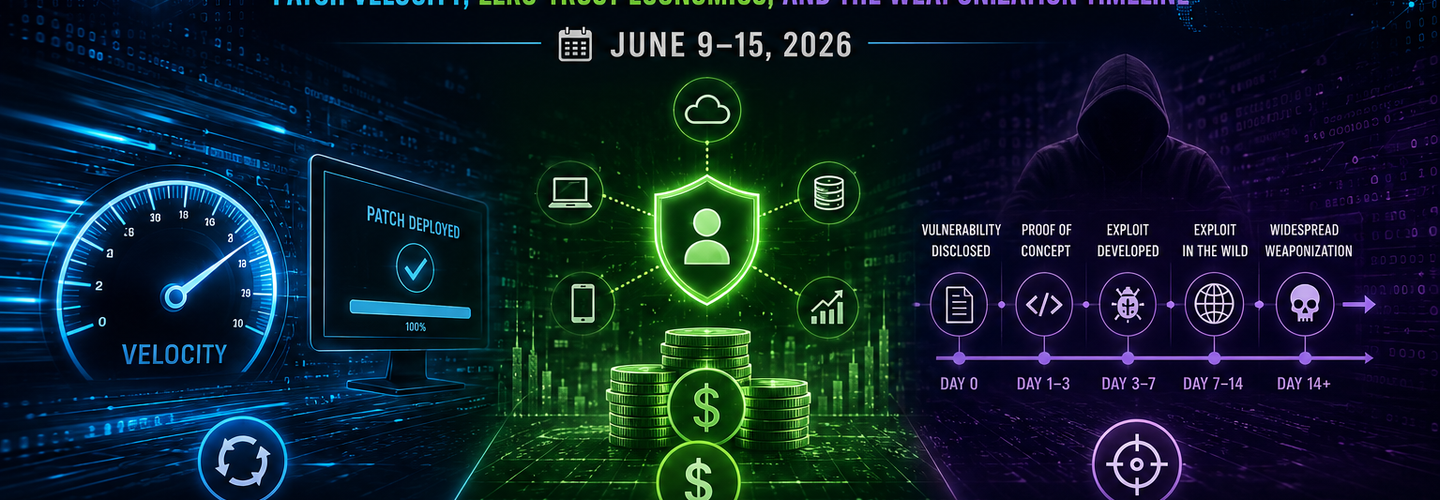
This Week in Cybersecurity Concepts: Patch Velocity, Zero-Trust Economics, and the Weaponization Timeline (June 9-15, 2026)
In the second week of June 2026, the cybersecurity industry faced a convergence of challenges that defines the operational reality for security teams in 2026: a record-breaking Microsoft Patch Tuesday (200 vulnerabilities), critical zero-days dropped within hours of patches, and a new wave of supply chain attacks leveraging open-sourced weaponized code. These incidents aren't separate problems — they're interconnected symptoms of fundamental structural shifts in how vulnerabilities are discovered, exploited, and weaponized. This weekly roundup breaks down the key incidents, extracts the operational concepts that matter, and translates them into actionable guidance for security teams.
## Key Concepts This Week
- ▸Patch Velocity Acceleration — The time between patch release and active exploitation has compressed from weeks to hours, fundamentally changing remediation strategy from "quarterly patch cycles" to "emergency response within 24 hours."
- ▸Zero-Trust Economics — Trusting no infrastructure is now cost-justified; building zero-trust architecture is cheaper than managing breach aftermath, shifting organizational security investment priorities.
- ▸Supply Chain Weaponization — Open-sourced attack tooling democratizes sophisticated capability, meaning threat actors no longer need in-house expertise; they can rent or copy public code.
- ▸Detection is Privilege — Detecting active exploitation matters more than preventing vulnerabilities; visibility into attack timelines determines survival more than patch completeness.
- ▸Reconnaissance → Exploitation Pipeline — Attack surface visibility directly correlates with exploitation risk; every publicly discoverable asset is a target.
## The Incidents: What Happened This Week
Incident 1: Microsoft Patch Tuesday - 200 Vulnerabilities (June 10, 2026)
Event: Microsoft released a record-breaking patch addressing 200 vulnerabilities, the largest single-month release in the company's history, including 33 Critical-severity flaws.
Technical Details: Five zero-days were publicly disclosed before patches existed, meaning organizations had a window of vulnerability before remediation was possible.
Operational Impact: Organizations with traditional quarterly patch cycles faced impossible decisions: patch immediately (risky, breaking applications), or delay (accepting exploitation risk). The day demonstrated that quarterly patching is now obsolete.
Incident 2: RoguePlanet - Unpatched Defender Zero-Day (June 10, 2026)
Event: Within hours of Microsoft's Patch Tuesday, security researcher Nightmare Eclipse published RoguePlanet, an unpatched zero-day in Windows Defender that enables privilege escalation on fully patched systems.
Technical Details: A Time-of-Check to Time-of-Use (TOCTOU) race condition allows local attackers to spawn system-level shells on Windows 10 and 11.
Significance: This demonstrates the "patch treadmill": organizations patch the Patch Tuesday vulnerabilities, then face new zero-days that patches don't cover. The attack surface is never fully remediated.
Incident 3: DentaQuest Breach - 2.6 Million Records (June 2, 2026)
Event: DentaQuest, a major dental benefits administrator, disclosed a breach impacting 2.6 million accounts with exposed names, addresses, dates of birth, and Social Security numbers.
Operational Lesson: Healthcare-adjacent companies (dental, pharmacy, insurance) aggregating personal data at scale are high-value targets. The breach underscores the persistent threat to organizations handling sensitive data for millions of individuals.
Incident 4: Windows Netlogon Buffer Overflow (June 2-8, 2026)
Event: A stack-based buffer overflow in the Windows Netlogon service (CVSS 9.8) is under active exploitation, with the Belgian government issuing an urgent warning.
Impact: Unauthenticated remote code execution allows attackers to achieve full Active Directory domain compromise from the network perimeter.
Defensive Response: The vulnerability requires patching every domain-joined server and monitoring for unusual authentication activity.
Incident 5: Citrix NetScaler RCE (June 2-8, 2026)
Event: A critical vulnerability in Citrix NetScaler ADC and Gateway (CVSS 9.8) is being exploited at scale when configured as a SAML Identity Provider.
Exploitation Pattern: Attackers target the identity provider role because it guards access to hundreds of downstream applications; compromising the identity layer grants access to entire enterprise ecosystems.
Incident 6: Chrome Zero-Day #5 of 2026 (June 12, 2026)
Event: Google released security updates to address CVE-2026-11645 (CVSS 8.8), an out-of-bounds memory access in Chrome's V8 JavaScript engine that is actively exploited in the wild.
The Metric: This is the fifth actively exploited Chrome zero-day of 2026, demonstrating that browser security is no longer a "patch when convenient" situation but an operational security requirement.
## The Concepts: What These Incidents Mean
Concept 1: The Patch Velocity Acceleration
Traditional Model (2015-2020): Vendors release patches on Tuesday; organizations patch on Friday or the following Tuesday; attackers develop exploits over the following weeks.
New Model (2026): Vendors release patches on Tuesday; zero-days appear Wednesday; active exploitation by Thursday; organizations still patching on Friday.
Operational Change: The remediation window has shrunk from weeks to 24-48 hours. This fundamentally breaks quarterly patch management. Organizations face a choice:
- ▸Patch immediately and accept breaking changes, incompatibilities, and business disruption
- ▸Monitor actively and respond to detected exploitation even before patching
- ▸Segment networks to limit blast radius when inevitable compromises occur
The optimal strategy for 2026 is not "comprehensive patching" but "surgical monitoring + rapid response."
Concept 2: Zero-Trust Architecture Becomes Economically Justified
The Math: A single domain compromise (Netlogon buffer overflow) costs organizations $5-50M depending on:
- ▸Duration of attacker presence
- ▸Data exfiltrated
- ▸Regulatory fines (HIPAA, GDPR, etc.)
- ▸Incident response cost
- ▸Reputational damage
Building zero-trust architecture (network segmentation, identity verification for every access, encryption everywhere) costs $2-10M upfront but prevents these catastrophic scenarios.
The Decision: Zero-trust is no longer "security theater" or "nice to have" — it's the most cost-justified security architecture in 2026.
Concept 3: Supply Chain Weaponization Acceleration
The Shai-Hulud supply chain worm, with open-sourced tooling publicly released, marks a structural shift from targeted criminal campaigns to democratized attack capability available to any threat actor.
The Implication: Organizations no longer face sophisticated threat actors with proprietary tools. They face masses of generic threat actors with copy-pasted open-source weaponization code. The barrier to entry has collapsed.
Defensive Response: Assume every package dependency is a potential entry point. Implement:
- ▸Supply chain visibility (SBOM — Software Bill of Materials)
- ▸Dependency scanning (vulnerable packages, malicious packages)
- ▸Least-privilege dependency permissions (packages shouldn't access credentials by default)
Concept 4: Detection is Now More Valuable Than Prevention
Old assumption: Patch everything, prevent breaches
New reality: Patching is incomplete (zero-days, missed patches, unknown vulnerabilities). Assume breach.
New priority: Detect active exploitation in real-time and respond before damage scales.
Operational Shift: Organizations are shifting from "prevent all compromises" (impossible) to "detect and respond to compromises in minutes" (achievable with proper visibility).
Concept 5: The Reconnaissance-Exploitation Pipeline
Every incident this week required attackers to know their targets existed:
- ▸Netlogon RCE — Required knowledge of Windows domains in scope
- ▸Citrix NetScaler — Required knowledge of identity provider deployment
- ▸Chrome zero-day — Required knowledge of browser versions in use
- ▸Supply chain attacks — Required knowledge of package ecosystems
The Connection: Reconnaissance visibility (your attack surface as attackers see it) directly determines exploitation risk.
The Tool: Use passive reconnaissance to audit external exposure and understand your attack surface from the attacker's perspective, identifying the assets you're actually exposing to the internet.
## Actionable Guidance for This Week
Immediate (24 hours)
Patch critical Microsoft and Google vulnerabilities — Don't wait for the full Tuesday cycle. CVE-2026-45586, RoguePlanet, and CVE-2026-11645 are actively exploited.
Audit Citrix NetScaler deployments — If you're using Citrix as a SAML identity provider, patch immediately. This is a trusted gateway to your entire enterprise.
Enable logging for Windows Netlogon — Monitor for buffer overflow exploitation attempts and unusual authentication patterns. Set alerts on:
- ▸Excessive failed auth attempts
- ▸Unusual service account login activity
- ▸Domain admin elevation from unexpected machines
Short-term (1 week)
Conduct supply chain audit — Review npm, PyPI, and GitHub package dependencies for Shai-Hulud variants or other malicious packages. Use SBOM tools to get complete visibility.
Update browser auto-update policies — Verify Chrome, Firefox, Safari, and Edge auto-update is enforced. Manual browser updates are no longer safe.
Implement network segmentation for domain controllers — If Netlogon is exploited on a single machine, the entire domain becomes exposed without segmentation.
Strategic (ongoing)
Shift from quarterly to continuous patching — Quarterly cycles are obsolete. Implement:
- ▸Daily vulnerability scanning
- ▸Weekly patch releases (not quarterly)
- ▸24-hour critical patch SLA
- ▸Automated patch testing in staging
Build zero-trust network architecture — Not next year. Start immediately. Segment networks so domain compromise doesn't equal enterprise compromise.
Implement continuous reconnaissance monitoring — Use tools to continuously audit your external attack surface. Know what's exposed before attackers do. Use passive subdomain discovery and certificate transparency log monitoring to discover your own exposed infrastructure.
Monitor active threats in real-time — Build visibility into:
- ▸Active exploitation attempts (IDS/IPS tuning)
- ▸Post-exploitation persistence (EDR/XDR)
- ▸Data exfiltration patterns (DLP)
## The Bigger Picture: 2026 Security Realities
Vulnerability discovery is accelerating. AI-assisted vulnerability research (as noted this week in OpenSSL's CVE-2026-45447 discovery using Claude) is shortening the discovery-to-disclosure timeline. More vulnerabilities will be found, faster.
Exploitation velocity has compressed. Zero-days that would have remained secret for months are now public within days. Weaponized code is deployed within hours.
Prevention is no longer possible. The number of vulnerabilities, complexity of infrastructure, and sophistication of attacks makes perfect prevention impossible. Defense must shift to detection and response.
Attack surface visibility is survival. Organizations that don't know their own external exposure can't defend against attackers who will discover it. Reconnaissance isn't optional; it's foundational.
## Conclusion
This week demonstrates that cybersecurity in 2026 is fundamentally different from even 2024. Quarterly patch cycles don't work. Preventing all vulnerabilities is impossible. Building defenses assuming breaches won't happen is negligent.
The organizations that survive 2026 and beyond are the ones that:
Assume breach and focus on detection and response rather than perfect prevention
Segment networks so no single compromise cascades to full infrastructure loss
Audit their external attack surface continuously using passive reconnaissance to understand their exposure before attackers do
Monitor for active exploitation in real-time rather than waiting for patches to be available
Implement zero-trust architecture because it's now the most cost-justified security model
Start today. Use ReconShield's passive reconnaissance tools to audit your external exposure. Monitor certificate transparency logs for unexpected subdomains. Build the visibility foundation that makes all other security decisions possible.
Written by Surendra Reddy Cybersecurity Researcher & Founder, ReconShield. Surendra is a cybersecurity engineer specializing in Open Source Intelligence (OSINT), exposure intelligence, and AI-driven threat analysis. He built ReconShield to democratize access to enterprise-grade infrastructure visibility tools and secure digital internet-facing assets.
Reviewed by ReconShield Editorial Team
Articles:
Claude Fable 5 Removed: AI Security Risks and Government Oversight Explained | ReconShield
Massive Cyber Threats Loom Over FIFA World Cup 2026, Security Researchers Warn
What Is Attack Surface Management? Complete Guide 2026 | ReconShield
BugHunter Review 2026: AI Bug Bounty Toolkit Powered by Claude (Free and Paid Options)
## Analyst Commentary & Implementation Blueprint
Security advisory
Continuous security exposure assessment is critical to identifying public vulnerabilities before they are exploited. Organizations should maintain a passive inventory of all web servers, TLS configs, and open ports, ensuring that default configurations are eliminated and security advisories are actively implemented.
Hardened Security Configuration Blueprint
# General Security Hardening Directive
ServerTokens ProductOnly
ServerSignature Off
FileETag None
Actionable Mitigation Checklist
- ✔Perform passive asset inventories weekly.
- ✔Restrict administrative ports using local firewall controls.
- ✔Monitor active CVE alerts for exposed software.
Common Inquiries & FAQs
Why is passive scanning preferred for continuous auditing?
Passive audits do not cause operational impact or trigger firewall blocks, making them ideal for constant surveillance of internet-facing assets.
What should I do if a vulnerability is flagged?
Apply the latest vendor patches, restrict access to the resource via firewalls, or verify configuration flags to mitigate risks.
Surendra Reddy
Surendra Reddy is a cybersecurity researcher and founder of ReconShield, specializing in OSINT and defensive infrastructure analysis.
Connect on LinkedIn ↗// AUDIT BRIEFING DISCUSSION (2 COMMENTS)
Great breakdown of the passive infrastructure vectors. We recently audited our external DNS zones and found multiple dangling staging environments. Implementing wildcard certificates reduced our CT log leaks significantly.
Is there any automated tooling you recommend for daily crt.sh scraping? Manually checking CT logs is becoming unsustainable for our domain portfolio.
// MORE ARTICLES
Security Researchers Warn Critical n8n Flaws May Expose Automation Platforms to RCE
Researchers have disclosed critical vulnerabilities in n8n that could expose automation workflows and connected enterprise systems to remote code execution risks, prompting urgent patch recommendations for users and administrators.

How Agentic AI Is Changing Software Engineering and Expanding Mobile Attack Surfaces
Agentic AI is rapidly transforming software engineering workflows through automation and intelligent coding assistance, while cybersecurity experts warn of expanding mobile attack surfaces and emerging application security risks.
Microsoft Defender Zero-Day Patched: What IT Teams Need to Know
Microsoft patches RoguePlanet, a Defender zero-day (CVE-2026-50656) letting attackers gain SYSTEM access. Here's what IT teams need to know.