Reverse WHOIS Explained: Find All Domains by Email, Name, and Registrant Attributes
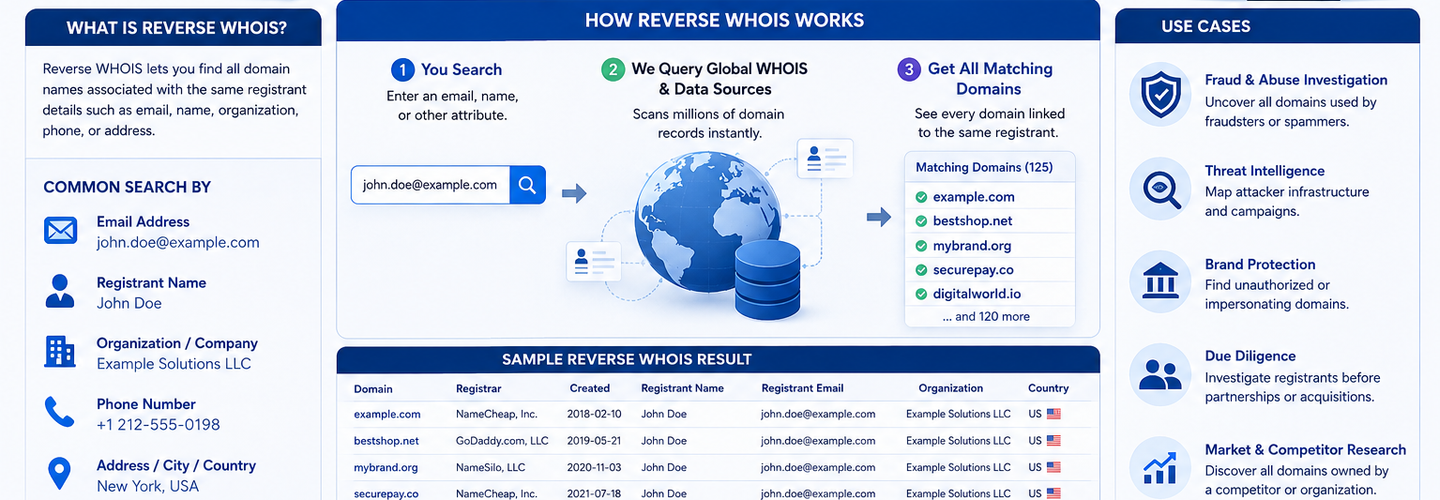
Standard WHOIS lookup is straightforward: you have a domain, you query WHOIS, and you find out who registered it. Reverse WHOIS inverts this relationship entirely. You provide a registrant attribute — an email address, name, organization, or phone number — and the system returns every domain registered under that attribute. For security researchers, investigators, and brand protection teams, reverse WHOIS is one of the most powerful OSINT techniques available. A single phishing email traces to a registrant address; that address, queried via reverse WHOIS, reveals 20 more malicious domains under the same registrant. A threat actor's phone number appears in one domain's WHOIS record; reverse WHOIS on that phone number exposes their entire infrastructure portfolio. In this guide, you'll learn exactly how reverse WHOIS works, what data is searchable, the use cases where it provides the highest value, and how to conduct reverse WHOIS investigations at scale.
## Key Takeaways
- ▸Reverse WHOIS is a database query that inverts the standard WHOIS relationship — instead of providing a domain to find its registrant, you provide a registrant attribute and receive all domains registered under that attribute.
- ▸Searchable registrant attributes include email address, registrant name, organization name, phone number, and registrant address — any data point visible in a standard WHOIS record can be used as a reverse lookup query.
- ▸The most powerful reverse WHOIS pivot is email address — a single registrant email frequently reveals 50–500 domains across multiple TLDs, exposing threat actor infrastructure in one query.
- ▸Historical WHOIS data dating back to 1986 is retained in commercial databases — domains that currently show privacy-protected registrant information can often be traced using historical pre-redaction data.
- ▸Reverse WHOIS is most valuable for threat intelligence (mapping attacker infrastructure), brand protection (finding unauthorized domain registrations), and fraud investigation (linking domains to scam operators).
- ▸Privacy-protected domains (using privacy proxy services) will not appear in reverse WHOIS results when searched by the actual registrant's details — this is the primary limitation of the technique.
- ▸Bulk and API-based reverse WHOIS queries enable security teams to investigate hundreds of domains in minutes — turning a single indicator of compromise into a complete threat landscape map.
## What Is Reverse WHOIS?
Reverse WHOIS is a database query method that accepts a registrant attribute (email, name, organization, phone) and returns all domain names whose WHOIS registration record contains that attribute. It inverts the standard WHOIS lookup relationship, transforming a single registrant detail into a complete portfolio of all domains controlled by that registrant.
How Reverse WHOIS Works
Standard WHOIS workflow:
You have a domain: malicious-bank.com
Query WHOIS: whois malicious-bank.com
Receive registrant details: Email: attacker@email.com, Organization: Fake Bank Inc
Reverse WHOIS workflow:
You have a registrant email: attacker@email.com
Query Reverse WHOIS: "Find all domains registered with this email"
Receive all domains: malicious-bank.com, phishing-paypal.com, fake-crypto-exchange.net, etc. (potentially 50–500 results)
The power of this inversion is immediate visibility into an entire threat actor's infrastructure without needing to discover each individual domain independently.
Data Sources for Reverse WHOIS
Reverse WHOIS queries access historical WHOIS databases that aggregate domain registration records from all accredited registrars. These databases include:
Current public WHOIS data — the live registration records visible when you query WHOIS directly.
Historical WHOIS data — snapshots of WHOIS records dating back to 1986 for older domains, capturing registrant information before privacy protection became standard.
Privacy-protected registrant mappings — in some cases, the underlying registrant contact information is known even if the public-facing WHOIS record shows a privacy proxy.
Commercial reverse WHOIS databases typically aggregate records from multiple registries and registrars, providing comprehensive coverage across all TLDs. The database is updated daily to capture new domain registrations and WHOIS record updates.
## Reverse WHOIS Use Cases and Applications
Threat Intelligence: Mapping Threat Actor Infrastructure
Threat intelligence analysts use reverse WHOIS to pivot from a single known malicious domain to the complete infrastructure portfolio of a threat actor or cybercriminal group. This is one of the highest-value OSINT techniques in the security analyst's toolkit.
Example workflow:
Identify a phishing domain: bank-login-verify.com
Query standard WHOIS: Registrant email is support@secure-mail.net
Query reverse WHOIS on that email: Returns 47 additional domains
Cross-reference with threat intelligence feeds: 12 of the 48 domains are flagged as malicious
Complete threat actor infrastructure map created from a single indicator
This technique has repeatedly exposed large-scale phishing and fraud operations: a single email address used across dozens of malicious domains, all discoverable in a single reverse WHOIS query. Organizations that monitor reverse WHOIS results on known threat actor registrant attributes receive alerts whenever the attacker registers new infrastructure, often before the new domain is widely known to be malicious.
Brand Protection: Finding Unauthorized Domain Registrations
Brand protection teams use reverse WHOIS to identify unauthorized domain registrations using the company name, product names, trademark terms, and executive names. This enables early detection of typosquatters, lookalike domains, and cybersquatters before phishing campaigns launch.
Example workflow:
Run reverse WHOIS query on company name: "TechCorp Inc"
Results include expected company domains plus suspicious lookalikes:
- ▸Expected: techcorp.com (company domain)
- ▸Suspicious: techcorp-support.com (lookalike domain)
- ▸Suspicious: techcorp-login.net (phishing-ready domain)
Investigate suspicious domains: Registrant appears to be a cybersquatter
File UDRP (Uniform Domain-Name Dispute-Resolution Policy) complaint: Domain transferred to legitimate owner
Reverse WHOIS run on company trademarks, product names, and executive names frequently surfaces unauthorized registrations the company was completely unaware of. By running these queries regularly and investigating results, brand protection teams catch and remediate cybersquatting before attacker campaigns launch.
Fraud and Criminal Investigation
Law enforcement and fraud investigators use reverse WHOIS to link domains together under investigation to establish connection to a defendant, organization, or scheme.
Example workflow:
Investigate suspected Ponzi scheme: Website is invest-secure.com
Query WHOIS: Registrant is listed under privacy proxy, but historical data shows phone number +1-555-0123
Query reverse WHOIS on that phone number: Returns 15 domains
All 15 domains are investment-related scam sites, registered over a 3-year period
Evidence establishes that the defendant controlled all 15 scam domains — a complete fraudulent operation exposed by a single phone number
Reverse WHOIS frequently reveals that what appeared to be multiple unrelated scams are actually controlled by a single operator. The connection is established through shared registrant attributes. This evidence is then used in legal proceedings to establish coordinated fraud.
Competitive Intelligence and Due Diligence
Organizations conducting competitive intelligence or acquiring domain portfolios use reverse WHOIS to identify all domains a target company owns or controls.
Example workflow:
Considering acquisition of Domain Reseller Corp
Query reverse WHOIS on company name: Returns 200+ domains
Identify portfolio composition: TLDs, registration dates, value properties
Assess hidden asset value before negotiating acquisition price
Reverse WHOIS on a target company's name, CEO name, and corporate email domain reveals every domain the company owns or has owned historically. This provides complete visibility into their domain portfolio for due diligence purposes.
## How to Conduct Reverse WHOIS Queries
Manual Reverse WHOIS Using Free Tools
Several free reverse WHOIS tools provide limited query capabilities for one-off investigations.
QueryWhois and similar aggregators — free websites that accept a registrant attribute and return results. Results are typically limited (first 100 matching domains) and the interface is web-based, not suitable for bulk processing.
ICANN WHOIS — the official ICANN repository includes reverse search capability for WHOIS records. Query directly by registrant email or name.
Domain name marketplaces — platforms like ExpiredDomains.net and similar allow searching by registrant for inventory management.
Structured Approach for Investigation
For serious reverse WHOIS investigations, a structured query methodology yields better results:
1. Identify the registrant attribute. Start with a known domain, query standard WHOIS, and extract the registrant email, name, organization, phone, or address.
2. Execute the reverse WHOIS query. Query all searchable attributes separately:
- ▸Registrant email
- ▸Registrant name
- ▸Organization name
- ▸Phone number
- ▸Address (partial, if available)
Each attribute may return different results. Email queries typically return the most results (highest precision). Name-based queries are broader but generate more false positives.
3. Deduplicate and cross-reference. Results from email, name, organization, and phone queries will overlap. Combine results, deduplicate, and remove false positives.
4. Validate with standard WHOIS. For each result, query standard WHOIS to confirm the registrant attribute actually appears in the record. This filters out search artifacts.
5. Cross-reference with threat intelligence. Query each discovered domain against threat intelligence feeds to identify which domains are flagged as malicious, phishing, or otherwise suspicious.
6. Investigate registrar and registrants. Examine registrar identity, registration dates, and renewal patterns to identify operational trends (do domains get renewed regularly or abandoned after a campaign?).
Commercial API-Based Reverse WHOIS
For bulk operations and continuous monitoring, commercial reverse WHOIS APIs provide:
Unlimited query capacity — search thousands of registrant attributes without rate limiting
Historical data access — query domains registered decades ago using registrant information from that time period
Structured response format — JSON output containing all matching domains, registrant history, and registrar details
Real-time updates — daily database updates capturing new registrations and WHOIS record changes
Integration capabilities — API endpoints for custom workflows, SIEM integration, and automated investigation pipelines
Organizations investigating large-scale operations or conducting continuous threat monitoring typically use commercial APIs for practical efficiency.
## Privacy and GDPR Impact on Reverse WHOIS
The widespread adoption of privacy proxy services and GDPR-enforced registrant redaction has significantly reduced the effectiveness of reverse WHOIS queries on post-2018 domain registrations.
The Privacy Protection Problem
When domain registrants enable privacy protection, the public WHOIS record shows privacy proxy contact information:
Standard WHOIS output (privacy enabled):
Registrant Name: Privacy Proxy Service Registrant Email: privacy@proxy-service.com Registrant Phone: +1-800-PRIVACY Registrant Address: [Privacy Service Address]
A reverse WHOIS query on the privacy proxy's own email returns thousands of domains (every domain using that proxy) — not the specific registrant's domains. The query becomes noise.
Historical Data Workaround
The key limitation is overcome using historical WHOIS data. Domains registered before mid-2018 (before widespread privacy protection) retain pre-redaction registrant information in historical databases.
If a threat actor registered malicious.com in 2015 with their real email, privacy protection applied later does not retroactively redact the historical record. Reverse WHOIS on that email reveals not only newer domains (which may be privacy-protected) but also older infrastructure registered before privacy became standard.
For investigations spanning years, combining current and historical reverse WHOIS yields a complete picture of a registrant's infrastructure across time.
Privacy-Protected Domain Enumeration
For domains where current WHOIS is privacy-protected, alternative OSINT techniques complement reverse WHOIS:
Certificate Transparency logs — every domain that received an SSL certificate appears in public CT logs with the domain name visible, regardless of WHOIS privacy. Certificate Transparency log queries discover subdomains that would otherwise be hidden behind privacy protection.
Passive DNS records — DNS query history is captured passively and indexed. A domain may have privacy-protected WHOIS but its DNS resolution history is public.
WHOIS history snapshots — services like DomainTools retain historical WHOIS snapshots showing registrant information before privacy was enabled.
The most effective approach for newer domains is multi-vector investigation: reverse WHOIS on known attributes + Certificate Transparency log searches + passive DNS pivoting + threat intelligence feeds. The combination typically exposes infrastructure even when individual techniques are limited by privacy protection.
## Building a Reverse WHOIS Investigation Workflow
Professional security teams integrate reverse WHOIS into systematic threat investigation workflows that move from a single indicator to complete threat landscape mapping.
Step 1: Initial Domain Identification
Start with a known malicious domain (from honeypots, phishing reports, malware C2 communications, etc.). Query standard WHOIS to extract registrant attributes:
Use ReconShield's WHOIS domain intelligence tool to query the domain and extract:
- ▸Registrant email
- ▸Registrant name
- ▸Organization name
- ▸Phone number
- ▸Registrar identity
Step 2: Reverse WHOIS Queries
Execute reverse WHOIS queries on each extracted attribute. Start with email (most specific) and progress to name-based queries (broader):
Email query: "Find all domains with registrant email = X" Name query: "Find all domains with registrant name = X" Organization query: "Find all domains with organization = X" Phone query: "Find all domains with phone = X"
Step 3: Deduplication and Validation
Combine results from all queries, remove duplicates, and validate each result by querying standard WHOIS to confirm the attribute actually appears in the record.
Step 4: Threat Intelligence Cross-Reference
Query each discovered domain against threat intelligence feeds using ReconShield's threat intelligence integration. Cross-reference with:
- ▸IP reputation feeds
- ▸Malware C2 databases
- ▸Phishing domain blocklists
- ▸Ransomware payment site indicators
- ▸Known scam domain databases
Step 5: Timeline and Pattern Analysis
Analyze the complete set of discovered domains by:
Registration date progression — Are domains registered in clusters (campaign phases) or continuously?
Renewal patterns — Are domains renewed regularly (active operations) or abandoned after campaigns?
TLD selection — Do the domains favor specific TLDs (.com, .net, ccTLDs)? This reveals registrant preferences.
Registrar patterns — Does the threat actor consistently use the same registrar or rotate?
These patterns often reveal operational phases, campaign timelines, and organizational structure.
Step 6: Continuous Monitoring
For known threat actors, set up continuous reverse WHOIS monitoring:
Alert on new registrations — Subscribe to alerts whenever a domain is registered with a known threat actor's email or phone number
Track WHOIS updates — Monitor for WHOIS record modifications (name changes, contact updates) that might indicate account compromise
Follow registration trends — Track whether the threat actor is ramping up (more domains registered) or scaling down
This continuous monitoring catches new campaigns at the earliest stages before malicious infrastructure becomes widely recognized.
## Limitations of Reverse WHOIS
Reverse WHOIS is powerful but has important limitations that investigators must understand.
Privacy-protected domains. Domains registered with privacy proxy services return proxy contact information, not the underlying registrant. Until privacy protection expires or historical pre-redaction data is available, these domains won't link to the true registrant.
Shared registrant attributes. Some registrants legitimately register many domains. A company's CEO name might appear on hundreds of legitimate company-owned domains, requiring manual filtering to identify only the suspicious ones.
Incomplete database coverage. While commercial databases are comprehensive, some older or obscure ccTLD registrations may not be indexed.
Registrant attribute variability. A single individual may use different email addresses, name variations, or phone numbers across different registrations, requiring multiple queries to get a complete picture.
Time lag in database updates. While most databases update daily, there can be a lag of 24–48 hours between a domain registration and its appearance in a reverse WHOIS database.
## Conclusion
Reverse WHOIS is one of the most effective OSINT techniques available for threat intelligence, brand protection, and investigation work. A single registrant attribute — an email address, phone number, or name — becomes a thread that unravels an entire threat actor's infrastructure portfolio. The combination of current WHOIS data, historical WHOIS records, and complementary OSINT techniques (Certificate Transparency logs, passive DNS, threat intelligence feeds) provides nearly complete visibility into a registrant's domain ecosystem.
Start with ReconShield's WHOIS domain intelligence tool to query the initial domain and extract registrant attributes. Then conduct systematic reverse WHOIS queries to expose the complete infrastructure. Cross-reference with threat intelligence feeds to identify which discovered domains are malicious. The complete workflow transforms a single phishing email or malicious domain into a comprehensive threat landscape map.
For organizations with continuous threat monitoring needs, implement reverse WHOIS monitoring on known threat actor attributes. Automated alerts on new domain registrations enable rapid response to emerging campaigns before they reach scale.
Written by Surendra Reddy Cybersecurity Researcher & Founder, ReconShield. Surendra is a cybersecurity engineer specializing in Open Source Intelligence (OSINT), exposure intelligence, and AI-driven threat analysis. He built ReconShield to democratize access to enterprise-grade infrastructure visibility tools and secure digital internet-facing assets.
Reviewed by ReconShield Editorial Team
June 2026 Cybersecurity Review: Top Cyber Attacks, Data Breaches & Critical Vulnerabilities
WHOIS vs RDAP: Understanding the Protocol Transition for Domain Intelligence in 2026
## Analyst Commentary & Implementation Blueprint
Security advisory
Continuous security exposure assessment is critical to identifying public vulnerabilities before they are exploited. Organizations should maintain a passive inventory of all web servers, TLS configs, and open ports, ensuring that default configurations are eliminated and security advisories are actively implemented.
Hardened Security Configuration Blueprint
# General Security Hardening Directive
ServerTokens ProductOnly
ServerSignature Off
FileETag None
Actionable Mitigation Checklist
- ✔Perform passive asset inventories weekly.
- ✔Restrict administrative ports using local firewall controls.
- ✔Monitor active CVE alerts for exposed software.
Common Inquiries & FAQs
Why is passive scanning preferred for continuous auditing?
Passive audits do not cause operational impact or trigger firewall blocks, making them ideal for constant surveillance of internet-facing assets.
What should I do if a vulnerability is flagged?
Apply the latest vendor patches, restrict access to the resource via firewalls, or verify configuration flags to mitigate risks.
Surendra Reddy
Surendra Reddy is a cybersecurity researcher and founder of ReconShield, specializing in OSINT and defensive infrastructure analysis.
Connect on LinkedIn ↗// AUDIT BRIEFING DISCUSSION (2 COMMENTS)
Great breakdown of the passive infrastructure vectors. We recently audited our external DNS zones and found multiple dangling staging environments. Implementing wildcard certificates reduced our CT log leaks significantly.
Is there any automated tooling you recommend for daily crt.sh scraping? Manually checking CT logs is becoming unsustainable for our domain portfolio.
// MORE ARTICLES
The Gentlemen Ransomware Targets Windows Networks with 21 Lateral Movement Techniques
The Gentlemen ransomware uses 21 lateral movement techniques to spread across Windows networks. See its attack chain, IOCs, and defenses.

Chrome 149 Released With Critical Security Fixes for Windows, macOS, and Linux
Chrome 149 is out with critical security fixes for Windows, macOS, and Linux. Learn what's patched, the risks of waiting, and how to update Chrome now.
Billions of Passwords at Risk After Massive Infostealer Data Leak
Billions of passwords are at risk after a massive infostealer data leak. Learn how the breach happened, who's exposed, and how to secure your accounts now.