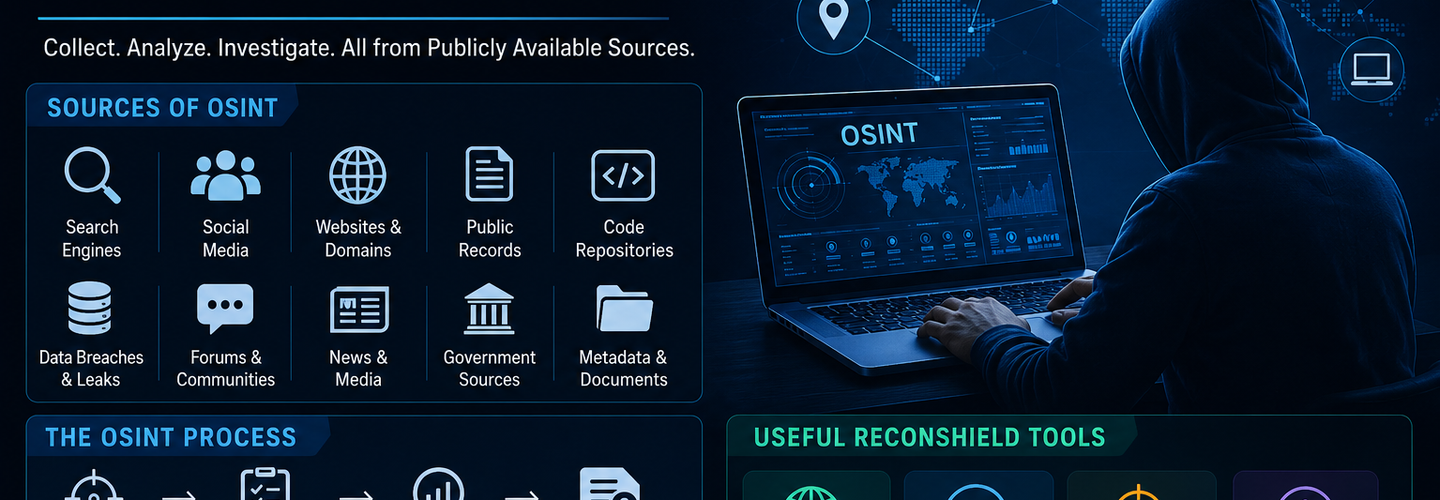
What Is OSINT? Complete Beginner’s Guide to Open Source Intelligence
Modern cyberattacks rarely begin with malware. Most start with reconnaissance.
Before targeting an organization, attackers often collect publicly available information about employees, domains, servers, email addresses, and exposed infrastructure. This process is known as Open Source Intelligence, or OSINT.
OSINT has become one of the most valuable disciplines in cybersecurity. Security researchers, ethical hackers, journalists, investigators, and threat intelligence analysts use OSINT daily to uncover digital footprints and identify potential risks.
In this beginner-friendly guide, ReconShield explains what OSINT is, how it works, the most popular OSINT tools, real-world use cases, and how beginners can start learning open source intelligence safely and ethically.
What Is OSINT?
OSINT (Open Source Intelligence) is the process of collecting and analyzing information from publicly available sources to produce actionable intelligence.
The key difference between OSINT and hacking is legality. OSINT relies only on information that is openly accessible without unauthorized access.
Publicly available sources may include:
- ▸Search engines
- ▸Social media platforms
- ▸Public government records
- ▸Domain and DNS data
- ▸Public GitHub repositories
- ▸Online forums
- ▸News websites
- ▸Public breach databases
- ▸Metadata from files and images
In cybersecurity, OSINT helps analysts understand what information attackers can discover about a company or individual before launching an attack.
Why OSINT Matters in Cybersecurity
Every organization leaves a digital footprint online. Domains, IP addresses, employee accounts, cloud assets, and exposed services can often be discovered publicly.
Threat actors use OSINT to:
- ▸Identify attack surfaces
- ▸Gather employee information
- ▸Discover exposed services
- ▸Find leaked credentials
- ▸Map company infrastructure
- ▸Research technologies in use
Defenders use the exact same techniques to strengthen security before attackers exploit weaknesses.
This is why OSINT plays a major role in:
- ▸Threat intelligence
- ▸Penetration testing
- ▸Red team assessments
- ▸Incident response
- ▸Vulnerability research
- ▸Brand monitoring
- ▸Digital investigations
Modern cybersecurity teams rely heavily on reconnaissance and open-source analysis to detect risks early.
How OSINT Works
OSINT investigations typically follow four major phases.
## 1. Information Gathering
The first phase involves collecting public data from multiple online sources.
Researchers may gather:
- ▸Domain records
- ▸Employee email addresses
- ▸Social media activity
- ▸IP addresses
- ▸Public documents
- ▸Metadata
- ▸Technology fingerprints
This phase often combines manual research with automated tools.
## 2. Data Verification
Public information is not always accurate.
Researchers must verify:
- ▸Source credibility
- ▸Data freshness
- ▸Authenticity
- ▸Relevance
False positives and outdated information are common in OSINT investigations.
## 3. Data Analysis
Once information is collected, analysts correlate and organize findings to identify meaningful patterns.
For example:
- ▸Linking leaked credentials to employees
- ▸Mapping exposed infrastructure
- ▸Identifying forgotten subdomains
- ▸Discovering misconfigured services
The goal is to turn raw data into useful intelligence.
## 4. Reporting
The final stage involves documenting findings clearly.
A professional OSINT report usually explains:
- ▸What was discovered
- ▸Why it matters
- ▸Associated risks
- ▸Recommended remediation steps
Effective reporting helps organizations take corrective action quickly.
Common Sources of OSINT
OSINT can come from thousands of publicly accessible sources.
Below are some of the most commonly used intelligence sources in cybersecurity investigations.
Search Engines
Search engines are among the most powerful OSINT resources available.
Advanced search operators can uncover:
- ▸Public login portals
- ▸Exposed files
- ▸Backup directories
- ▸Sensitive documents
- ▸Public databases
Security researchers often use techniques known as “Google Dorking” to refine searches and identify publicly exposed information.
Examples include:
- ▸site:domain.com
- ▸filetype:pdf
- ▸intitle:index of
These searches help analysts discover unintentionally exposed content.
Social Media Intelligence (SOCMINT)
Social media platforms contain enormous amounts of publicly available intelligence.
Researchers analyze:
- ▸Usernames
- ▸Employee profiles
- ▸Photos
- ▸Geolocation data
- ▸Public posts
- ▸Connections between individuals
Platforms commonly used for OSINT include:
- ▸X (Twitter)
- ▸Telegram
Threat actors frequently target employee information gathered from social media.
Domain and DNS Intelligence
Domain analysis is a critical part of OSINT.
Researchers investigate:
- ▸WHOIS records
- ▸DNS records
- ▸Subdomains
- ▸SSL certificates
- ▸Hosting providers
- ▸Nameservers
These details help analysts understand how infrastructure is configured.
ReconShield provides several tools useful for domain intelligence investigations:
These tools help security researchers identify ownership data, DNS configurations, and internet-facing assets.
IP Address Intelligence
Public IP addresses reveal valuable infrastructure information.
Researchers use IP intelligence to identify:
- ▸Hosting locations
- ▸Open ports
- ▸Running services
- ▸Service banners
- ▸Exposed systems
Useful ReconShield tools include:
- ▸IP Scanner Tool
- ▸Port Scanner Tool
These tools help organizations understand their external attack surface.
Public Data Breaches
Credential leaks and breach databases are major OSINT resources.
Analysts monitor:
- ▸Exposed passwords
- ▸Compromised email addresses
- ▸API keys
- ▸Sensitive company data
This helps organizations identify potential account compromise early.
GitHub and Public Code Repositories
Developers sometimes accidentally expose secrets in public repositories.
Researchers commonly find:
- ▸Cloud credentials
- ▸API tokens
- ▸Internal URLs
- ▸Database credentials
- ▸Hardcoded secrets
GitHub reconnaissance has become a major component of modern threat intelligence.
Popular OSINT Tools for Beginners
There are hundreds of OSINT tools available today. Beginners should focus on learning foundational tools first.
## Maltego
Maltego is widely used for relationship mapping and data visualization.
It helps investigators connect:
- ▸Domains
- ▸Email addresses
- ▸Organizations
- ▸People
- ▸Infrastructure
Maltego is especially popular in cyber investigations and intelligence analysis.
## Shodan
Shodan is often called the “search engine for internet-connected devices.”
It indexes:
- ▸Servers
- ▸Routers
- ▸Databases
- ▸Cameras
- ▸IoT devices
- ▸Open services
Researchers use Shodan to identify exposed infrastructure globally.
## theHarvester
theHarvester helps collect:
- ▸Email addresses
- ▸Subdomains
- ▸Employee names
- ▸Public hosts
It is commonly used during reconnaissance phases of penetration testing.
## SpiderFoot
SpiderFoot automates OSINT collection from multiple public sources.
It supports:
- ▸Infrastructure mapping
- ▸Threat intelligence
- ▸Breach analysis
- ▸Domain intelligence
The platform is beginner-friendly and highly effective for automated investigations.
## Recon-ng
Recon-ng is a modular reconnaissance framework widely used by security professionals.
It includes modules for:
- ▸Domain analysis
- ▸Contact discovery
- ▸Infrastructure mapping
- ▸Social intelligence
Recon-ng is powerful for advanced OSINT workflows.
Real-World OSINT Use Cases
OSINT is used across many cybersecurity operations.
Threat Intelligence
Threat intelligence teams monitor:
- ▸Malware campaigns
- ▸Threat actors
- ▸Phishing infrastructure
- ▸Fake domains
- ▸Credential leaks
Public information often reveals early indicators of cyber threats.
Incident Response
During security incidents, analysts use OSINT to investigate:
- ▸Malicious IP addresses
- ▸Suspicious domains
- ▸Malware infrastructure
- ▸Data exposure
OSINT helps accelerate digital investigations.
Penetration Testing and Red Teaming
Ethical hackers perform reconnaissance before security testing begins.
OSINT helps identify:
- ▸Public-facing systems
- ▸Subdomains
- ▸Technology stacks
- ▸Employee exposure
- ▸Misconfigured services
Attackers follow similar reconnaissance processes before launching attacks.
Brand Monitoring
Organizations use OSINT to detect:
- ▸Typosquatting domains
- ▸Brand impersonation
- ▸Credential leaks
- ▸Fraud campaigns
Early detection reduces reputational and financial damage.
Journalism and Investigations
Investigative journalists increasingly rely on OSINT to:
- ▸Verify public claims
- ▸Analyze online activity
- ▸Trace digital evidence
- ▸Monitor public records
OSINT has become essential in modern investigative reporting.
Is OSINT Legal?
In most countries, OSINT itself is legal because it uses publicly available information.
However, legality depends on:
- ▸Local regulations
- ▸Privacy laws
- ▸Data collection methods
- ▸Intended use of information
Ethical OSINT does not involve:
- ▸Unauthorized access
- ▸Password cracking
- ▸Exploiting vulnerabilities
- ▸Illegal surveillance
Researchers should always operate responsibly and follow applicable laws.
Challenges of OSINT
While powerful, OSINT also presents challenges.
## Information Overload
The internet contains massive amounts of data.
Analysts must filter useful intelligence from irrelevant information efficiently.
## Misinformation
Not all public information is accurate.
Verification is essential during investigations.
## Rapidly Changing Data
Infrastructure changes constantly.
Domains disappear, IP addresses rotate, and online profiles change frequently.
## Privacy and Ethical Concerns
OSINT investigations can expose sensitive personal information.
Researchers must respect privacy boundaries and avoid unethical practices.
How Beginners Can Start Learning OSINT
Beginners should start with foundational reconnaissance skills and safe learning environments.
Learn Search Techniques
Understanding advanced search operators is one of the best starting points.
Mastering search engine reconnaissance builds strong OSINT fundamentals.
Practice Domain Intelligence
Beginners can safely analyze public infrastructure using ReconShield tools such as:
These tools help researchers understand how internet-facing infrastructure works.
Join Cybersecurity Communities
Many OSINT researchers share techniques and educational resources online.
Good places to learn include:
- ▸Reddit cybersecurity communities
- ▸GitHub projects
- ▸Research blogs
- ▸Threat intelligence communities
- ▸Capture The Flag (CTF) platforms
Learning from real investigations improves analytical skills quickly.
Use Safe Practice Platforms
Platforms such as:
- ▸Hack The Box
- ▸TryHackMe
- ▸CTF labs
allow beginners to practice reconnaissance and cybersecurity skills legally and safely.
Best Practices for Ethical OSINT
Responsible OSINT researchers follow strict ethical guidelines.
Important best practices include:
- ▸Respect privacy laws
- ▸Avoid unauthorized access
- ▸Verify information carefully
- ▸Use data responsibly
- ▸Follow responsible disclosure practices
- ▸Document findings accurately
Ethics are critical in cybersecurity research.
The Future of OSINT
OSINT continues evolving rapidly as digital ecosystems expand.
Emerging trends include:
- ▸AI-powered intelligence analysis
- ▸Automated threat correlation
- ▸Dark web intelligence
- ▸Deepfake detection
- ▸Real-time monitoring systems
Artificial intelligence is helping analysts process large amounts of public data faster than ever before.
At the same time, organizations face growing risks from publicly exposed infrastructure and data leaks.
OSINT will remain a core part of cybersecurity defense and digital investigations for years to come.
Final Thoughts
OSINT has become one of the most important skills in modern cybersecurity.
By analyzing publicly available information, security researchers can uncover vulnerabilities, identify threats, investigate incidents, and strengthen organizational defenses.
For beginners, learning OSINT provides an excellent introduction to reconnaissance, threat intelligence, and cybersecurity analysis.
The best approach is to start with foundational techniques, practice ethical research methods, and gradually explore advanced tools and workflows.
As cyber threats continue evolving, organizations that understand and monitor their public exposure will be far better prepared to defend against attacks.
For more cybersecurity research, threat intelligence insights, and reconnaissance tools, explore the resources available on ReconShield.
Read More:
F5 BIG-IP Appliances Targeted by Hackers for SSH Intrusions Into Enterprise Linux Systems
Vellore Man Arrested in Cambodia Cyber Slavery Racket Linked to Online Scam Networks
Cyber Fraud in Bengaluru: Elderly Woman Loses Rs 7.69 Lakh After Clicking Fake WhatsApp Link
10,000+ Zero-Day Vulnerabilities Identified by Anthropic Claude Mythos in Glasswing Project
PyrsistenceSniper Detects 117 Malware Persistence Techniques Across Windows, Linux, and macOS
Greenwood Cyber + AI Lab Opens in Tulsa Through Microsoft and Black Tech Street Collaboration
Open-Source Ecosystem Under Threat as Hackers Breach 34 Software Packages
## Analyst Commentary & Implementation Blueprint
Security advisory
Continuous security exposure assessment is critical to identifying public vulnerabilities before they are exploited. Organizations should maintain a passive inventory of all web servers, TLS configs, and open ports, ensuring that default configurations are eliminated and security advisories are actively implemented.
Hardened Security Configuration Blueprint
# General Security Hardening Directive
ServerTokens ProductOnly
ServerSignature Off
FileETag None
Actionable Mitigation Checklist
- ✔Perform passive asset inventories weekly.
- ✔Restrict administrative ports using local firewall controls.
- ✔Monitor active CVE alerts for exposed software.
Common Inquiries & FAQs
Why is passive scanning preferred for continuous auditing?
Passive audits do not cause operational impact or trigger firewall blocks, making them ideal for constant surveillance of internet-facing assets.
What should I do if a vulnerability is flagged?
Apply the latest vendor patches, restrict access to the resource via firewalls, or verify configuration flags to mitigate risks.
Surendra Reddy
Surendra Reddy is a cybersecurity researcher and founder of ReconShield, specializing in OSINT and defensive infrastructure analysis.
Connect on LinkedIn ↗// AUDIT BRIEFING DISCUSSION (2 COMMENTS)
Great breakdown of the passive infrastructure vectors. We recently audited our external DNS zones and found multiple dangling staging environments. Implementing wildcard certificates reduced our CT log leaks significantly.
Is there any automated tooling you recommend for daily crt.sh scraping? Manually checking CT logs is becoming unsustainable for our domain portfolio.
// MORE ARTICLES
SplitVPN Hacked: Data Breach Exposes 865,000 User Records and 58 Million Hidden Connection Logs (July 2026)
SplitVPN hacked: 865,336 user records and 58 million connection logs exposed, directly contradicting the VPN's "no-logs" promise. What was leaked and what to do now.

Critical WordPress wp2shell RCE Vulnerability Puts Millions of Sites at Risk—Patch Now
wp2shell is a pre-auth RCE in WordPress Core affecting 500M+ sites. Public exploits exist—patch to 7.0.2 or 6.9.5 immediately.
New Windows RDP Flaws Could Lead to Data Theft — Everything You Need to Know
Microsoft patched a dozen Windows RDP flaws in July 2026 that could leak memory data. See affected versions, KB numbers, and how to patch.