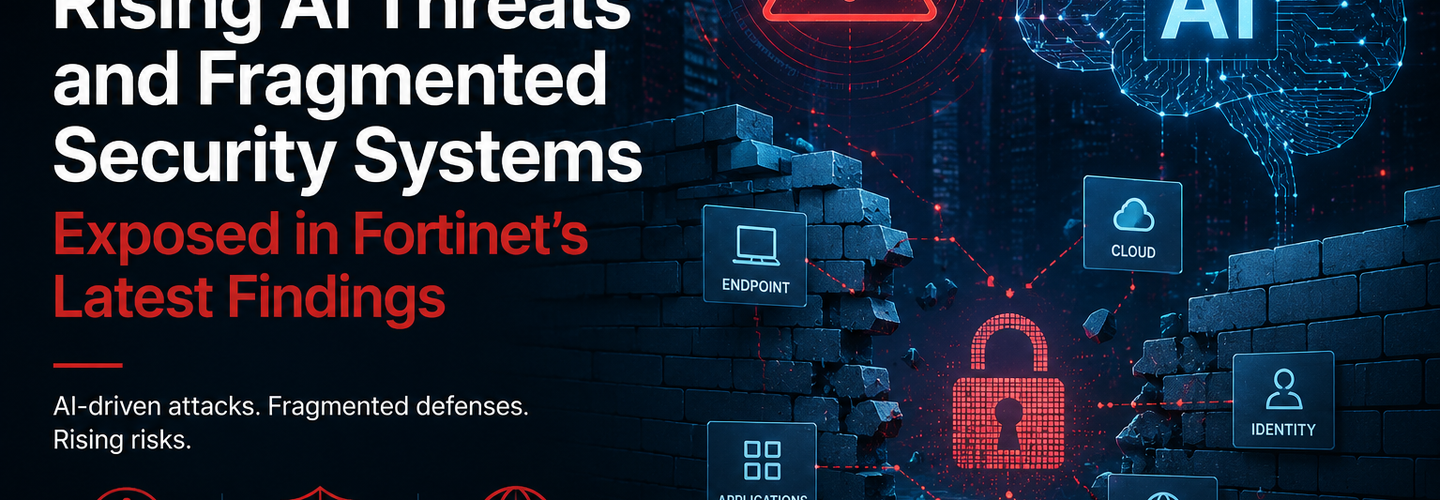
Rising AI Threats and Fragmented Security Systems Exposed in Fortinet’s Latest Findings
FortiGuard Labs · 2026 Global Threat Landscape Report"Cybercrime is no longer a series of isolated campaigns — it operates as a system, with shadow agents compressing the attack life cycle and agentic AI replacing the need for skilled operators."
Numbers can lose their meaning when they grow large enough. But one figure from Fortinet's newly released 2026 Global Threat Landscape Report resists abstraction: ransomware victims identified by FortiRecon intelligence jumped from roughly 1,600 to 7,831 in a single year — a 389% increase that represents tens of thousands of people, disrupted organizations, compromised patient records, frozen supply chains, and shuttered businesses. That's not a trend line. That's a collapse in the effectiveness of conventional defense.
Released on April 30, 2026, the report draws exclusively from FortiGuard Labs telemetry and maps its findings across the full MITRE ATT&CK framework. What it documents is not a single threat evolution but a structural shift in how cybercrime is organized, resourced, and executed — one driven in large part by the commoditization of AI-enabled offensive tooling and the persistent failure of organizations to consolidate fragmented security architectures before attackers can exploit the gaps between them.
389%Ransomware victim increase year-over-year24–48hTime-to-exploit for critical vulnerabilities79%Additional increase in infostealer log availability67.12%Dark web "database" activity dominated by stealer logs
## The Velocity Problem Has Become Critical
Perhaps the most operationally consequential finding in the report is the dramatic compression of time-to-exploit (TTE). As recently as prior Fortinet reporting cycles, the median TTE for critical vulnerabilities hovered around 4.76 days — not comfortable, but enough time for organizations with mature patch management programs to act before mass exploitation began. That window has collapsed. FortiGuard Intelligence now places TTE for critical outbreaks at 24 to 48 hours, with some vulnerabilities attracting active exploitation within hours of public disclosure.
The React2Shell vulnerability illustrates the point with uncomfortable precision. Exploitation attempts appeared within hours of the vulnerability becoming publicly known — meaning that for any organization that hadn't already patched or mitigated, the attacker was already in the room while the security team was still reading the advisory. This is the operational reality that AI-accelerated reconnaissance and automated weaponization have created, and most organizations' patching cadences were not built for it.
Context: Why TTE Compression Changes Everything
Traditional vulnerability management programs operate on weekly or monthly patch cycles, assuming defenders have days to assess risk and deploy fixes. When exploitation begins within hours of disclosure, that model breaks down entirely. Organizations that rely on scheduled maintenance windows rather than continuous patching processes are now structurally exposed — not because their tools are inadequate, but because their operational assumptions are wrong. The report's TTE findings should prompt an immediate review of how vulnerability prioritization and emergency response protocols are structured.
## Ransomware's Industrialization, Explained
The 389% spike in confirmed ransomware victims does not reflect a sudden surge in novel techniques. It reflects the maturation of a service economy. FortiGuard Labs attributes much of the increase to the proliferation of AI-enabled crime service kits — tools like WormGPT, FraudGPT, and BruteForceAI that have been widely advertised on dark web forums, lowering the technical floor required to conduct sophisticated attacks while accelerating execution timelines for operators who would previously have needed weeks to prepare a campaign.
Manufacturing bore the heaviest ransomware burden with 1,284 confirmed victims, followed by business services at 824 and retail at 682. Geographically, the United States accounted for 3,381 confirmed victims — more than the next nine countries combined. Canada and Germany followed at 374 and 291 respectively. These numbers reflect both the density of high-value targets in those markets and the degree to which criminal infrastructure has been calibrated to operate against English-speaking organizations with complex digital supply chains.
Key Ransomware Threat Indicators — 2026 Report
- ▸7,831 confirmed ransomware victims globally — up from ~1,600 in the prior year's report
- ▸Manufacturing (1,284), business services (824), and retail (682) are the top three targeted sectors
- ▸U.S. organizations account for 3,381 victims; Canada (374) and Germany (291) follow
- ▸Crime service kits including WormGPT, FraudGPT, and BruteForceAI directly contributed to the surge
- ▸Top ransomware groups operated as semi-autonomous enterprises with access brokers and botnet services
## Shadow Agents and the Deskilling of Cybercrime
FortiGuard Labs had predicted in its 2026 Cyberthreat Predictions that the most capable threat groups would begin functioning as semi-autonomous enterprises. The 2026 report confirms that prediction has materialized. The concept of the lone, technically sophisticated hacker has largely given way to something far more dangerous: coordinated criminal ecosystems where shadow agents handle reconnaissance, access brokers sell verified footholds into target networks, and botnet operators provide infrastructure on demand — all without requiring the end-user of the attack to possess meaningful technical expertise.
This deskilling dynamic has been turbocharged by agentic AI tooling. FortiRecon dark web signals captured several notable offerings: HexStrike AI markets itself as an offensive reconnaissance tool with automated attack path generation, while BruteForceAI positions as a penetration testing tool that integrates large language models for intelligent form analysis and multi-threaded credential attacks. These are not proof-of-concept demonstrations. They are products, sold with customer service channels, advertised with feature updates, and priced for accessibility.
"As cybercriminals increasingly use AI to bolster their tactics, cyber defenders must evolve cybersecurity operations into an industrialized defense and adopt AI-enabled tools that respond at the same velocity as modern threats."— Derek Manky, Chief Security Strategist and Global VP of Threat Intelligence, Fortinet FortiGuard Labs
## The Infostealer Economy Is Expanding Rapidly
One of the report's most revealing threads concerns the shift in how stolen identity data is packaged and traded on criminal marketplaces. The 2025 Fortinet report had already flagged a 500% increase in infostealer logs available from compromised systems. The 2026 report finds an additional 79% increase on top of that baseline, along with a qualitative change: attackers are moving away from simple credential dumps toward comprehensive data sets that bundle browser-resident artifacts, session tokens, and behavioral context alongside passwords.
Within dark web database activity, stealer logs now account for 67.12% of all advertised and shared data — dwarfing combolists at 16.47% and plain leaked credentials at just 5.96%. The leading infostealer families by infection count were RedLine at 911,968 infections (50.80% of detections), Lumma at 499,784 (27.84%), and Vidar at 236,778 (13.19%). The shift toward richer data packages reflects a straightforward economic logic: a stealer log that includes session cookies, autofill data, and saved passwords can be immediately replayed against target accounts without requiring password cracking or brute force, compressing the time between theft and unauthorized access to near zero.
Infostealer Intelligence Summary
Stealer logs now dominate 67% of dark web database activity — meaning credential dumps and combolists are becoming secondary commodities. The value proposition is straightforward: a stealer log bundles passwords with browser sessions, cookies, and behavioral artifacts, enabling immediate account access without the need for additional credential processing.
FortiGuard telemetry also observed a counterintuitive finding: brute force attempts dropped 22% year-over-year in volume. The reason is efficiency, not restraint. AI-optimized targeting means fewer attempts against better-selected targets, translating to roughly 185 million brute force attempts per day globally — concentrated and precise rather than scattershot.
## Cloud Identity Sprawl: The Attack Surface No One Is Managing Well
FortiCNAPP intelligence adds a cloud-specific dimension to the credential theft picture. Throughout 2025, the majority of confirmed cloud incidents did not originate from exploitation of cloud infrastructure vulnerabilities — they originated from stolen, exposed, or misused credentials. Hospitals and physician clinics topped the sector rankings as the most targeted cloud environments, followed by retail establishments. Large identity populations, federated access models, and complex integrations across cloud services create compounded exposure: each new identity added to a cloud environment that isn't properly governed is another potential entry point that attackers can acquire through stealer logs, phishing, or credential markets rather than by finding and weaponizing a vulnerability.
This finding directly implicates the fragmented security architectures that many organizations have assembled over years of piecemeal tool acquisition. When identity governance, cloud security, endpoint protection, and network monitoring operate as separate, non-integrated systems, the gaps between them are not just administrative inconveniences — they are the seams attackers exploit to move laterally, escalate privileges, and establish persistence without triggering any individual tool's detection logic.
## Industry Implications: The Architecture Problem
What the 2026 Fortinet report ultimately describes is a mismatch between the speed and integration of the threat and the speed and integration of the defense. Cybercrime has achieved a degree of operational coherence — shared tooling, specialized roles, automated workflows, agentic AI coordination — that most enterprise security programs have not yet matched. The top line insight is not that any single vulnerability or tactic is uniquely alarming. It's that the system as a whole has matured on the attacker side in ways that expose fundamental architectural weaknesses on the defender side.
Organizations that have accumulated security tools without investing in integration and correlation are particularly exposed. When a stealer log surfaces on a dark web forum containing credentials for a company's cloud environment, the effective response window is measured in hours — not the days or weeks it might take a fragmented security stack to connect an authentication anomaly to a credential intelligence alert. Platform convergence, which Fortinet has long advocated, is not a vendor pitch. It is an operational necessity given the detection timelines the report describes.
Report Background: Methodology & Scope
The Fortinet 2026 Global Threat Landscape Report was released on April 30, 2026 and is derived exclusively from FortiGuard Labs telemetry. It covers threat activity across 2025 and maps findings to the full MITRE ATT&CK framework. The report encompasses FortiRecon dark web intelligence, FortiGate IPS telemetry, FortiCNAPP cloud security data, and adversary intelligence. It represents one of the broadest single-vendor threat intelligence datasets available in the public market.
## Why This Matters
The 2026 Fortinet report arrives at a moment when many organizations are still calibrating their understanding of what AI means for their threat exposure. The popular conversation around AI and cybersecurity has focused heavily on AI as a defensive tool — copilots for analysts, automated alert triage, accelerated threat hunting. The report's findings document the other half of that equation with hard numbers: AI has already significantly enhanced offensive capability, lowered the barrier to entry for sophisticated attacks, and accelerated exploitation timelines past the threshold that most conventional security programs were designed to handle.
The 7,831 ransomware victims identified represent confirmed, documented cases — the actual figure is almost certainly higher, as many incidents go unreported or undetected. Manufacturing, healthcare, and retail organizations reading this report should treat those sector-specific rankings not as abstract statistics but as direct indicators of their relative risk exposure. The attackers running campaigns against those industries in 2025 are better resourced, better organized, and more automated than they were in 2024. The operational gap between attacker capability and defender capability has widened, not narrowed.
## How Organizations and Users Can Stay Safe
Mitigation Recommendations — Aligned to Report Findings
- ▸Compress your patch cycle immediately.The 24–48 hour TTE window means scheduled monthly patching is no longer a viable strategy for critical vulnerabilities. Organizations should implement emergency patch protocols that can mobilize within hours of a critical CVE disclosure, prioritizing internet-facing systems and those processing credentials or identity data.
- ▸Treat credential hygiene as an ongoing operation, not a one-time remediation.Given the 79% additional increase in stealer log availability and their dominance of dark web markets, continuous monitoring for exposed credentials — including browser-cached sessions — should be embedded in standard SOC operations. Services that monitor dark web forums for organizational credential exposure provide measurable early warning capability.
- ▸Audit identity governance across all cloud environments.FortiCNAPP findings confirm that cloud incidents are driven primarily by identity failures, not infrastructure exploits. Every privileged cloud identity that lacks multi-factor authentication, has excessive permissions, or belongs to a departed employee is an open door. Quarterly access reviews are a minimum; continuous identity posture management is the appropriate standard.
- ▸Evaluate your security stack for integration gaps.A collection of point solutions that don't share telemetry is not a security architecture — it's a detection gap in disguise. Map the handoffs between your endpoint, identity, network, and cloud security tools. Anywhere that a threat signal detected in one system does not automatically propagate to the others is a gap attackers can exploit to move laterally undetected.
- ▸Account for AI-enabled offensive tooling in tabletop exercises.If your incident response simulations assume attackers are operating manually, they are not modeling the threat as it currently exists. Exercises should incorporate scenarios where reconnaissance is automated, credential replay is near-instantaneous, and dwell time before ransomware deployment is compressed to hours.
- ▸End users should enable hardware-bound MFA wherever available.Passkeys and hardware security keys resist credential replay attacks in ways that SMS or authenticator app codes do not. For individuals, enabling these authentication methods on high-value accounts — financial, email, corporate — directly reduces exposure to the infostealer ecosystem documented in the report.
## Official Response and Collaborative Action
Fortinet has positioned the report not just as a threat briefing but as a foundation for action. The company noted a recent joint operation — Operation Red Card 2.0, spearheaded by INTERPOL and supported by Fortinet through the World Economic Forum's Cybercrime Atlas — that successfully took down infrastructure and operators behind online scams, mobile money fraud, and fraudulent loan operations across Africa. Fortinet is a founding member of the Cybercrime Atlas, a global public-private initiative that uses open-source intelligence to map criminal networks and support law enforcement disruption operations.
Separately, Fortinet and Crime Stoppers International have launched a Cybercrime Bounty program — a secure, anonymous channel allowing citizens and insiders to report cybercriminal activity. The initiative reflects an increasingly accepted view in the security industry that technical controls alone cannot outpace a threat ecosystem of this scale and organization. Disruption of criminal infrastructure, prosecution of operators, and intelligence sharing across jurisdictions are necessary complements to defensive tooling.
The 2026 Global Threat Landscape Report is ultimately a document about speed — the speed at which vulnerabilities are weaponized, credentials are stolen and replayed, ransomware is deployed, and criminal ecosystems adapt. The defenders who will fare best in this environment are not necessarily those with the most tools but those who have eliminated the latency between detection and response, consolidated the data those tools produce into coherent intelligence, and built operational processes that can move at the pace the threat actually demands. The gap documented in this report is real and measurable. Whether it narrows in 2027 will depend on decisions being made in security programs right now.
Sources & References
- ▸Fortinet Official Press Release — 2026 Global Threat Landscape Report (April 30, 2026)
- ▸GlobeNewswire — Full report findings and executive commentary (April 30, 2026)
- ▸Fortinet Investor Relations — Report announcement and telemetry overview
- ▸FortiGuard Labs — MITRE ATT&CK framework analysis, FortiRecon dark web telemetry, FortiCNAPP cloud intelligence, FortiGate IPS telemetry (2025 data)
- ▸World Economic Forum — Cybercrime Atlas, Operation Red Card 2.0 (INTERPOL collaborative operation)
- ▸NIST — National Vulnerability Database (NVD), CVE disclosure and patch guidance resources
- ▸MITRE ATT&CK Framework — Tactics, techniques, and procedures reference (attack.mitre.org)
Read More:
F5 BIG-IP Appliances Targeted by Hackers for SSH Intrusions Into Enterprise Linux Systems
Vellore Man Arrested in Cambodia Cyber Slavery Racket Linked to Online Scam Networks
Cyber Fraud in Bengaluru: Elderly Woman Loses Rs 7.69 Lakh After Clicking Fake WhatsApp Link
10,000+ Zero-Day Vulnerabilities Identified by Anthropic Claude Mythos in Glasswing Project
PyrsistenceSniper Detects 117 Malware Persistence Techniques Across Windows, Linux, and macOS
Greenwood Cyber + AI Lab Opens in Tulsa Through Microsoft and Black Tech Street Collaboration
## Analyst Commentary & Implementation Blueprint
Security advisory
Continuous security exposure assessment is critical to identifying public vulnerabilities before they are exploited. Organizations should maintain a passive inventory of all web servers, TLS configs, and open ports, ensuring that default configurations are eliminated and security advisories are actively implemented.
Hardened Security Configuration Blueprint
# General Security Hardening Directive
ServerTokens ProductOnly
ServerSignature Off
FileETag None
Actionable Mitigation Checklist
- ✔Perform passive asset inventories weekly.
- ✔Restrict administrative ports using local firewall controls.
- ✔Monitor active CVE alerts for exposed software.
Common Inquiries & FAQs
Why is passive scanning preferred for continuous auditing?
Passive audits do not cause operational impact or trigger firewall blocks, making them ideal for constant surveillance of internet-facing assets.
What should I do if a vulnerability is flagged?
Apply the latest vendor patches, restrict access to the resource via firewalls, or verify configuration flags to mitigate risks.
Surendra Reddy
Surendra Reddy is a cybersecurity researcher and founder of ReconShield, specializing in OSINT and defensive infrastructure analysis.
Connect on LinkedIn ↗// AUDIT BRIEFING DISCUSSION (2 COMMENTS)
Great breakdown of the passive infrastructure vectors. We recently audited our external DNS zones and found multiple dangling staging environments. Implementing wildcard certificates reduced our CT log leaks significantly.
Is there any automated tooling you recommend for daily crt.sh scraping? Manually checking CT logs is becoming unsustainable for our domain portfolio.
// MORE ARTICLES
SplitVPN Hacked: Data Breach Exposes 865,000 User Records and 58 Million Hidden Connection Logs (July 2026)
SplitVPN hacked: 865,336 user records and 58 million connection logs exposed, directly contradicting the VPN's "no-logs" promise. What was leaked and what to do now.

Critical WordPress wp2shell RCE Vulnerability Puts Millions of Sites at Risk—Patch Now
wp2shell is a pre-auth RCE in WordPress Core affecting 500M+ sites. Public exploits exist—patch to 7.0.2 or 6.9.5 immediately.
New Windows RDP Flaws Could Lead to Data Theft — Everything You Need to Know
Microsoft patched a dozen Windows RDP flaws in July 2026 that could leak memory data. See affected versions, KB numbers, and how to patch.