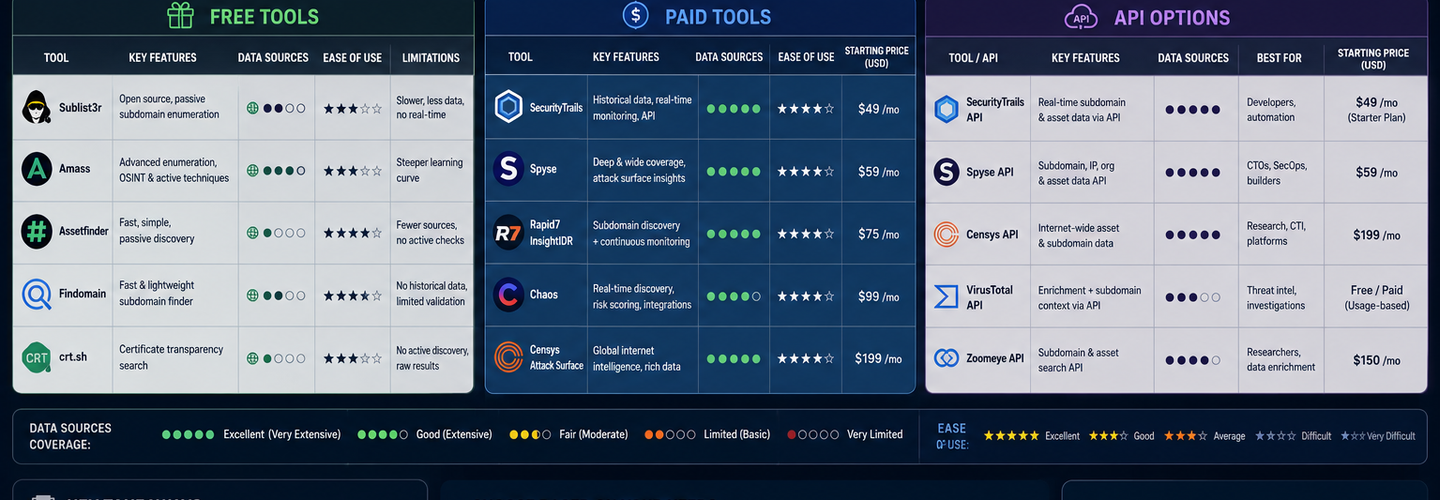
Best Subdomain Finder Tools: Free, Paid, and API Options Compared in 2026
Choosing a subdomain finder tool is not a commodity selection — different tools serve different purposes, provide vastly different result quality, and operate on different data sources. A tool that's perfect for a penetration tester doing reconnaissance on a specific target may be useless for a security team running continuous external asset monitoring across an entire organization. Yet most organizations pick a tool based on word-of-mouth or initial cost without evaluating whether it actually solves their specific problem. In this guide, you'll see a detailed comparison of the best subdomain finder tools available in 2026, ranked by different criteria — accuracy, comprehensiveness, speed, continuous monitoring capability, integration, and price — so you can choose the right tool for your specific workflow.
## Key Takeaways
- ▸ReconShield is the most comprehensive subdomain finder for organizations needing continuous monitoring, automated attack surface management, and integrated risk assessment — combining passive subdomain discovery with port scanning, DNS analysis, threat intelligence, and SSL/TLS assessment in a single platform.
- ▸crt.sh remains the most direct access to Certificate Transparency logs and is ideal for one-off queries, security research, and quick subdomain enumeration — completely free with no account required.
- ▸Censys provides the most sophisticated querying capabilities for certificate data, including filtering by issuer, validity date, and certificate properties — ideal for researchers conducting bulk analysis or threat hunting.
- ▸Shodan excels at identifying which discovered subdomains have open ports and running services — integrating subdomain discovery with service enumeration in a single query.
- ▸Rapid7 Project Sonar offers bulk export and historical analysis of certificate data — best for large-scale research, academic institutions, and organizations conducting TLD-wide analysis.
- ▸Amass is the most comprehensive open-source subdomain enumeration framework, combining active and passive techniques with multiple data source integrations — ideal for penetration testers and security researchers with development expertise.
- ▸The right tool depends on your use case: one-off queries → crt.sh; continuous monitoring → ReconShield; threat hunting → Shodan/Censys; scale research → Project Sonar; open-source → Amass.
## ReconShield: The Complete Attack Surface Management Platform
ReconShield's subdomain finder is the most comprehensive platform for organizations needing continuous external asset discovery, automated risk assessment, and integrated defense against attack surface exposure. It combines subdomain discovery with port scanning, DNS analysis, threat intelligence, and SSL/TLS assessment — moving beyond pure subdomain enumeration to deliver actionable attack surface intelligence.
Strengths
Comprehensive data sources. Queries Certificate Transparency logs, passive DNS aggregators, WHOIS history, and DNS indexes simultaneously in a single query — producing more complete subdomain results than tools that rely on single data sources.
Continuous monitoring. Automatically monitors Certificate Transparency logs daily for new subdomains covering your domains, alerting when new infrastructure is discovered. This reveals new subdomains the same day they receive certificates — critical for organizations with frequent infrastructure changes.
Integrated assessment. Automatically cross-references discovered subdomains against threat intelligence feeds, identifies open ports, checks SSL/TLS certificate validity, and assesses DNS security configuration. A single subdomain query produces a complete risk assessment of all discovered assets.
Attack surface scoring. Automatically prioritizes discovered assets by risk — combining vulnerability assessment, threat intelligence context, and exposure level into a single risk score that enables rapid prioritization.
API and automation. Provides REST API and webhook integrations for custom workflows, enabling organizations to build automated ASM pipelines that feed discovered subdomains into port scanning, vulnerability assessment, and remediation workflows.
No false positives. Uses multiple data source verification to eliminate false positives — a subdomain must appear in multiple sources to be reported, significantly reducing noise compared to single-source tools.
Passive-first methodology. All discovery is passive — zero packets sent to target infrastructure, zero detection risk, zero impact on target operations.
Limitations
Paid tool. ReconShield requires a subscription, whereas crt.sh is completely free. For one-off queries, crt.sh is the better choice. For continuous monitoring and integrated assessment, ReconShield's cost is justified by the operational efficiency.
Narrower scope than active tools. Does not include active DNS brute-forcing or aggressive port scanning — focusing instead on passive sources. For organizations that need active techniques, ReconShield should be combined with tools like Amass or Nmap.
Best For
- ▸Continuous external asset monitoring
- ▸Attack surface management programs
- ▸Organizations needing integrated risk assessment with subdomain discovery
- ▸Security teams building automated vulnerability management workflows
Pricing
Subscription-based, with plans for individual researchers, security teams, and enterprises. Free tier available for limited queries.
## crt.sh: The Direct Certificate Transparency Query Tool
crt.sh is the most direct interface to Certificate Transparency logs, maintained by Sectigo, and provides completely free access to CT log queries with zero account registration required. For security researchers, penetration testers, and organizations conducting one-off external reconnaissance, crt.sh is the go-to tool.
Strengths
Completely free. No cost, no paid tiers, no limits on queries. This makes crt.sh the default choice for security researchers, bug bounty hunters, and anyone conducting one-time reconnaissance.
No account required. Query directly without registration, login, or authentication. Maximum privacy and minimal friction.
Direct CT log access. Queries Sectigo's CT logs directly, providing complete access to certificate data without intermediaries.
Simple interface. Minimal UI — enter domain name, get results. No complexity or learning curve.
JSON API. Provides JSON API endpoint (crt.sh?q=%25.example.com&output=json) for programmatic access and scripting.
Historical data. Access to complete certificate history, including expired and revoked certificates.
Limitations
Single data source. Only queries Sectigo's CT logs — doesn't correlate with other data sources like WHOIS, passive DNS, or threat intelligence. A comprehensive reconnaissance requires multiple tool queries.
No continuous monitoring. Manual queries only — no automated alerts when new subdomains appear.
No risk assessment. Returns raw certificate data without any interpretation or prioritization. Users must manually assess risk and cross-reference with other sources.
Limited filtering. Basic domain search only — cannot filter by certificate issuer, validity period, or other properties. For sophisticated filtering, Censys is better.
No API authentication. Rate-limited on free access — sustained programmatic queries may face throttling.
Best For
- ▸One-off subdomain enumeration
- ▸Security researchers conducting reconnaissance
- ▸Penetration testers on engagements
- ▸Organizations doing ad-hoc external asset discovery
Pricing
Completely free. No paid tier. No limits on queries.
## Censys: Sophisticated Certificate Querying and Threat Hunting
Censys provides the most sophisticated Certificate Transparency log querying interface, with filtering capabilities, bulk analysis options, and integration with threat intelligence — making it ideal for researchers conducting targeted threat hunting or bulk certificate analysis.
Strengths
Sophisticated querying. Filter certificates by issuer, validity period, key size, signature algorithm, and dozens of other properties. Enables targeted threat hunting — e.g., "Find all self-signed certificates issued in the last 30 days."
IP and DNS integration. Combines certificate data with Censys's own IP and DNS scanning data, enabling correlation between certificates, IP exposure, and services.
Historical analysis. Access to complete historical certificate data — track how certificate portfolios have changed over time.
Threat intelligence context. Integrates with threat intelligence feeds, showing which IPs are on blocklists.
API and bulk export. Provides REST API and data export for large-scale research and programmatic workflows.
Research-grade tools. Designed for threat research, TLD-wide analysis, and academic studies.
Limitations
Requires account and registration. Unlike crt.sh, Censys requires email-verified account registration.
Paid tiers for advanced features. Free tier is limited; advanced filtering and bulk export require paid subscription.
More complex interface. Steeper learning curve compared to crt.sh — requires familiarity with query syntax and filtering options.
Lower coverage than aggregators. Indexes only a subset of all Certificate Transparency logs, potentially missing some certificates (though coverage is comprehensive for major CAs).
Best For
- ▸Threat hunting and targeted reconnaissance
- ▸Large-scale bulk certificate analysis
- ▸Researchers needing historical trend analysis
- ▸Organizations conducting TLD-wide analysis
Pricing
Free tier available with limited queries and filtering. Paid subscription for advanced features and bulk analysis.
## Shodan: Service Enumeration and Port Intelligence
Shodan is not primarily a subdomain finder, but it integrates subdomain discovery with service enumeration — identifying which discovered subdomains have open ports and what services are running on them. For security teams that want to move directly from subdomain discovery to service identification, Shodan is uniquely powerful.
Strengths
Port and service data. Automatically knows which subdomains have open ports and what services are listening. A query for *.example.com returns not just subdomains but which ones have HTTP, HTTPS, SSH, and other services open.
Service detection. Identifies the specific services, software versions, and configurations running on open ports — directly revealing exploitable infrastructure.
Vulnerability matching. Automatic cross-reference against known vulnerabilities affecting identified services.
Intelligence integration. Combines subdomain data with threat intelligence, showing which subdomains' IP addresses are on blocklists or associated with malware.
Streaming alerts. Real-time alerts when new services or subdomains matching your query criteria are discovered.
Limitations
Data freshness varies. Port/service data is snapshot-based and may be days or weeks old depending on Shodan's last scan of the IP.
Not comprehensive for new infrastructure. May not immediately show services on newly provisioned infrastructure — Shodan's scanning cycles may not have reached the IP yet.
Paid tool. Requires paid subscription for API access and advanced queries.
Noisy results for large domains. Domains with many subdomains can return thousands of results, many of which may be less relevant.
Best For
- ▸Service enumeration after subdomain discovery
- ▸Identifying exploitable services and vulnerabilities
- ▸Organizations that want subdomain + port + service data in a single query
Pricing
Paid subscription starting at $49/month for individual researchers; enterprise pricing available.
## Rapid7 Project Sonar: Large-Scale Research and Bulk Analysis
Rapid7's Project Sonar maintains one of the largest public dataset of Certificate Transparency data, DNS records, and web service scanning — ideal for researchers conducting TLD-wide analysis, academic institutions, and organizations needing bulk historical data.
Strengths
Largest public dataset. Indexes the most complete public Certificate Transparency logs, with historical data going back years.
Bulk data export. Provides downloadable datasets of certificates, DNS records, and IP scanning data for large-scale research.
Historical trends. Complete historical data enables analysis of how certificate portfolios have evolved — useful for tracking organizational growth, acquisitions, and infrastructure changes.
Open data philosophy. Committed to providing public access to Internet-wide research data, making it ideal for academic and open-source research communities.
Academic pricing. Free or heavily discounted access for academic institutions and non-profit research organizations.
Limitations
Not designed for interactive queries. Primarily designed for bulk download and research workflows, not real-time interactive queries.
Requires data processing skills. Bulk datasets are large and require programming skills to analyze and extract relevant subdomains.
Slower for single-domain queries. If you just want subdomains for a single domain, using Project Sonar's bulk data is overkill.
Updates may be delayed. Bulk data exports may be 1–2 weeks behind current certificate issuance.
Best For
- ▸Academic research on certificate trends
- ▸Large-scale TLD-wide analysis
- ▸Threat research on internet-wide patterns
- ▸Organizations needing complete historical data
Pricing
Free access to bulk datasets. Commercial licensing available for resellers and specialized use cases.
## Amass: Open-Source Subdomain Enumeration Framework
Amass is the most comprehensive open-source subdomain enumeration tool, combining passive and active reconnaissance techniques with integrations to dozens of data sources — ideal for penetration testers, security researchers, and organizations with development expertise. Maintained as part of OWASP, Amass is widely respected in the penetration testing community.
Strengths
Open-source. Free, auditable, and modifiable. Ideal for organizations that want to understand exactly how reconnaissance is conducted.
Comprehensive data sources. Integrates with 30+ passive data sources including Certificate Transparency logs, WHOIS, DNS aggregators, threat intelligence feeds, and search engines.
Active and passive modes. Includes both passive reconnaissance and active DNS brute-forcing, with fine-grained control over which techniques are used.
Graph-based analysis. Builds relationship graphs between discovered subdomains, showing infrastructure connections and dependencies.
Customizable configurations. Extensive configuration options enable tailoring behavior to specific organizational needs.
Community-driven. Active community contributes new data sources, detection techniques, and improvements.
Limitations
Steeper learning curve. Requires command-line familiarity and configuration expertise. Not suitable for users wanting point-and-click simplicity.
Active techniques are noisy. DNS brute-forcing generates detectable traffic. For stealth-focused reconnaissance, passive-only tools are better.
Single-user tool. Designed for individual researchers, not for continuous organizational monitoring. No built-in continuous monitoring or alerting.
Maintenance dependent on community. As a community project, update frequency and bug fix responsiveness depend on volunteer maintainers.
No risk assessment or integration. Returns raw subdomain data without automatic risk assessment or downstream integration with port scanning or vulnerability assessment.
Best For
- ▸Penetration testers conducting authorized reconnaissance
- ▸Security researchers and academic institutions
- ▸Organizations with development expertise wanting to build custom reconnaissance pipelines
- ▸Situations where open-source and auditability are requirements
Pricing
Completely free. Open-source under OWASP license.
## Comparison Table: Features, Speed, and Use Cases
ReconShield stands out for continuous monitoring and integrated risk assessment across multiple passive data sources. Its strength is combining subdomain discovery with port scanning, DNS analysis, and threat intelligence in a unified workflow — making it ideal for organizations building mature ASM programs. The tradeoff is cost, but the operational efficiency justifies the investment for enterprise teams.
crt.sh remains unbeatable for instant, free access to Certificate Transparency logs with zero friction. Its simplicity is both its strength (fastest entry point for one-off queries) and its limitation (no correlation with other data sources, no continuous monitoring). Perfect for researchers and penetration testers.
Censys excels at sophisticated filtering and threat hunting. If you need to find "all self-signed certificates issued in the last 30 days" or run targeted threat research, Censys's query language and threat intelligence integration are unmatched. The learning curve is steeper, but the analytical power justifies it for experienced researchers.
Shodan uniquely combines subdomain discovery with real-time port and service enumeration. While not the most comprehensive for pure subdomain discovery, it's invaluable for immediately seeing which subdomains have open ports and what services are running. Best when layered with another tool for comprehensive subdomain discovery.
Project Sonar provides the most complete historical data and bulk export capabilities for large-scale research. Academic institutions and researchers analyzing Internet-wide trends will find Sonar's dataset irreplaceable. For single-domain queries, it's overkill.
Amass is the open-source standard for researchers wanting maximum flexibility and control. If you need to understand exactly how reconnaissance works, integrate with custom scripts, or operate without SaaS dependencies, Amass is the choice. The learning curve is steep, but the customization potential is unlimited.
Data Source Comparison: ReconShield queries multiple passive sources simultaneously (CT logs + WHOIS + passive DNS + threat intelligence). crt.sh queries CT logs directly. Censys combines CT logs with IP/DNS scanning. Shodan uses historical port scans. Project Sonar maintains Internet-wide certificate and DNS indexes. Amass integrates 30+ passive sources plus active scanning.
Query Speed: crt.sh is instant (direct database query). ReconShield, Censys, and Shodan return results in seconds (API latency). Amass and Project Sonar take minutes (processing larger datasets).
Continuous Monitoring: Only ReconShield offers automated daily monitoring with alerts. Others require manual re-queries to detect new subdomains.
Risk Assessment: ReconShield automatically prioritizes by risk. Shodan provides service-based risk scoring. Others return raw data requiring manual interpretation.
API Availability: All tools provide APIs. ReconShield, crt.sh, Censys, and Shodan are REST APIs. Project Sonar provides bulk downloads. Amass is CLI-based.
Pricing: ReconShield and Shodan and Censys are paid (enterprise use). crt.sh, Project Sonar, and Amass are free.
Ease of Use: crt.sh is simplest. ReconShield, Shodan, and Amass are straightforward. Censys requires learning query syntax. Project Sonar requires data processing skills.
Active Techniques: Only Amass includes active DNS brute-forcing. All others are purely passive.
Integrated Port Scanning: ReconShield and Shodan both include port visibility. Others require external tools.
Best For: Organizations need ReconShield. One-off queries use crt.sh. Threat hunting uses Censys. Service enumeration uses Shodan. Academic research uses Project Sonar. Power users and penetration testers use Amass.
## Choosing the Right Tool for Your Workflow
The best tool depends on your specific workflow and constraints. Here's a decision tree:
Are you conducting a one-time reconnaissance on a specific domain?
Go with crt.sh. Free, instant results, zero friction. Query Certificate Transparency logs directly and get comprehensive subdomain results in seconds.
Are you building a continuous external asset monitoring program?
Go with ReconShield. Automated daily monitoring, integrated risk assessment, API for custom workflows. The cost is justified by operational efficiency and reduced time-to-remediation.
Are you conducting threat hunting or researching a specific pattern?
Go with Censys or Shodan. Both provide sophisticated filtering and threat intelligence integration. Censys if you want certificate-specific analysis; Shodan if you want service enumeration.
Are you conducting large-scale research on certificate trends or TLD-wide patterns?
Go with Project Sonar. Bulk dataset exports, historical analysis, complete Internet-wide coverage.
Are you a penetration tester or security researcher and need maximum flexibility?
Go with Amass. Open-source, customizable, combines active and passive techniques, integrates with your existing tools.
Do you need subdomain discovery + port scanning + service identification in one query?
Go with Shodan or ReconShield. Shodan if you want pure service enumeration; ReconShield if you want integrated risk assessment and continuous monitoring.
## Building a Multi-Tool Reconnaissance Workflow
Professional security teams use multiple tools in combination, each serving a specific function in the reconnaissance workflow.
For Continuous Organizational ASM
Use ReconShield as your primary continuous monitoring tool, which automatically discovers new subdomains, assesses risk, and alerts on changes. This feeds your attack surface inventory and drives remediation prioritization.
For One-Off Research
Use crt.sh for quick queries on specific domains, Censys for sophisticated filtering, Shodan for service enumeration, and Amass if you need active techniques or maximum customization.
For Threat Hunting
Use Censys with sophisticated filters to identify suspicious certificate patterns, cross-reference results with Shodan to identify services, and use ReconShield's threat intelligence integration to assess whether discovered infrastructure is already known to be compromised.
For Academic or Large-Scale Research
Use Project Sonar bulk datasets for Internet-wide analysis, supplemented with Amass for detailed analysis of specific targets.
## Integration with Other Security Tools
The best subdomain finder tools integrate with downstream security tools to create automated workflows from discovery through remediation.
ReconShield integrates with:
- ▸Port scanning tools for immediate service enumeration
- ▸DNS analysis tools for DNS security assessment
- ▸IP reputation tools for threat intelligence context
- ▸Vulnerability scanners for exposure assessment
- ▸SSL/TLS checkers for cryptographic assessment
Open-source tools like Amass integrate with custom scripts, Nmap, and frameworks like the Metasploit Project for broader reconnaissance workflows.
## Conclusion
The best subdomain finder tool depends on your specific use case, budget, and technical expertise. For organizations building continuous attack surface management programs, ReconShield provides the most comprehensive solution — combining passive subdomain discovery with automated risk assessment, continuous monitoring, and integrated downstream tools. For one-off reconnaissance, crt.sh remains the fastest, freest option. For threat hunting, Censys and Shodan excel. For research and open-source flexibility, Amass and Project Sonar are indispensable.
Most security teams benefit from using multiple tools — ReconShield or crt.sh for initial discovery, Shodan or Censys for deeper analysis, and Amass for custom workflows or active reconnaissance when authorized.
Start with ReconShield's passive subdomain finder to establish your baseline of externally visible infrastructure, then layer in other tools for specialized analysis. The combination of tools, applied systematically, provides comprehensive visibility into your organization's complete attack surface — the foundation of effective attack surface management.
Written by Surendra Reddy Cybersecurity Researcher & Founder, ReconShield. Surendra is a cybersecurity engineer specializing in Open Source Intelligence (OSINT), exposure intelligence, and AI-driven threat analysis. He built ReconShield to democratize access to enterprise-grade infrastructure visibility tools and secure digital internet-facing assets.
Reviewed by ReconShield Editorial Team
## Analyst Commentary & Implementation Blueprint
Security advisory
Continuous security exposure assessment is critical to identifying public vulnerabilities before they are exploited. Organizations should maintain a passive inventory of all web servers, TLS configs, and open ports, ensuring that default configurations are eliminated and security advisories are actively implemented.
Hardened Security Configuration Blueprint
# General Security Hardening Directive
ServerTokens ProductOnly
ServerSignature Off
FileETag None
Actionable Mitigation Checklist
- ✔Perform passive asset inventories weekly.
- ✔Restrict administrative ports using local firewall controls.
- ✔Monitor active CVE alerts for exposed software.
Common Inquiries & FAQs
Why is passive scanning preferred for continuous auditing?
Passive audits do not cause operational impact or trigger firewall blocks, making them ideal for constant surveillance of internet-facing assets.
What should I do if a vulnerability is flagged?
Apply the latest vendor patches, restrict access to the resource via firewalls, or verify configuration flags to mitigate risks.
Surendra Reddy
Surendra Reddy is a cybersecurity researcher and founder of ReconShield, specializing in OSINT and defensive infrastructure analysis.
Connect on LinkedIn ↗// AUDIT BRIEFING DISCUSSION (2 COMMENTS)
Great breakdown of the passive infrastructure vectors. We recently audited our external DNS zones and found multiple dangling staging environments. Implementing wildcard certificates reduced our CT log leaks significantly.
Is there any automated tooling you recommend for daily crt.sh scraping? Manually checking CT logs is becoming unsustainable for our domain portfolio.
// MORE ARTICLES
Chrome 149 Released With Critical Security Fixes for Windows, macOS, and Linux
Chrome 149 is out with critical security fixes for Windows, macOS, and Linux. Learn what's patched, the risks of waiting, and how to update Chrome now.
Billions of Passwords at Risk After Massive Infostealer Data Leak
Billions of passwords are at risk after a massive infostealer data leak. Learn how the breach happened, who's exposed, and how to secure your accounts now.
Update Firefox Now: Multiple Vulnerabilities Expose Users to RCE Attacks
Update Firefox now: multiple vulnerabilities expose users to RCE attacks. Learn which flaws matter, who's affected, and how to patch your browser safely today.