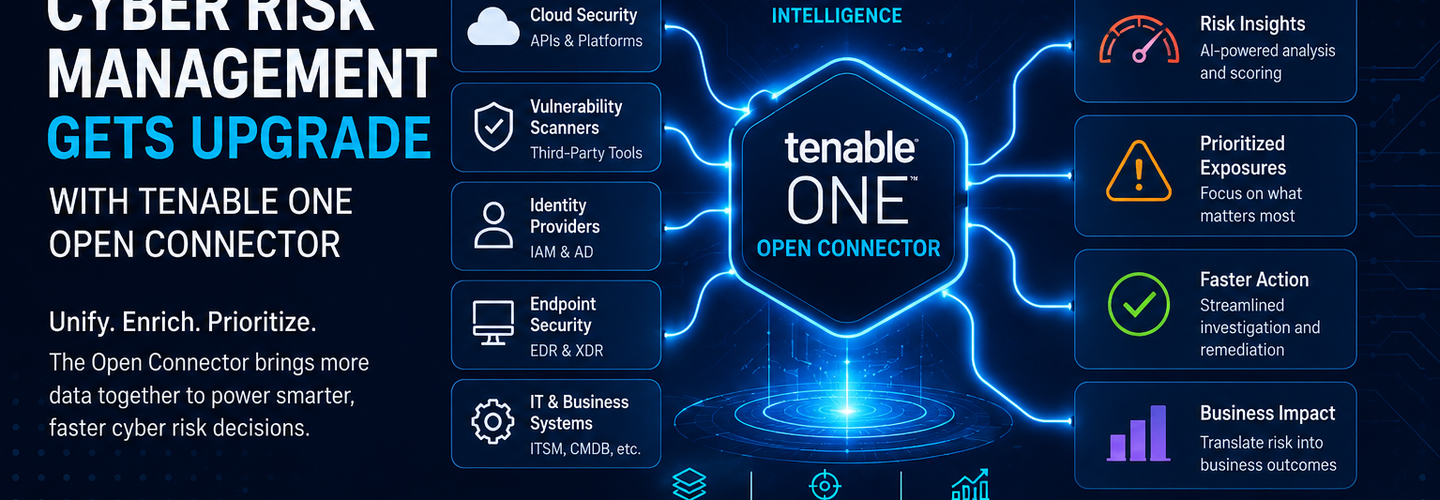
AI-Driven Cyber Risk Management Gets Upgrade with Tenable One Open Connector
As enterprise attack surfaces continue expanding across cloud environments, hybrid infrastructure, and third-party ecosystems, cybersecurity teams are under increasing pressure to prioritize threats faster and make more informed risk decisions. In response to these growing challenges, Tenable has announced a significant enhancement to its cyber exposure platform with the launch of the Tenable One Open Connector framework.
The new capability is designed to help organizations unify security telemetry from a broader range of third-party technologies while enabling more advanced AI-driven cyber risk analysis. Industry analysts say the move reflects a wider trend toward integrated exposure management platforms that combine vulnerability intelligence, cloud visibility, identity data, and operational risk context into a centralized security strategy.
For security teams already overwhelmed by fragmented tools and disconnected alerts, the launch could represent an important shift toward more actionable cyber risk prioritization.
## Expanding Visibility Across Complex Attack Surfaces
Modern enterprises operate across increasingly distributed environments that include cloud workloads, SaaS applications, remote endpoints, operational technology systems, and containerized infrastructure. While organizations deploy numerous security tools to monitor these environments, visibility often remains siloed.
Tenable’s Open Connector initiative aims to address that fragmentation problem by allowing security teams to ingest and correlate data from external security products and business systems directly into the Tenable One platform.
According to the company, the framework enhances exposure management by enabling organizations to connect a wider variety of security technologies, enriching contextual analysis for AI-powered risk scoring and prioritization.
Security experts have repeatedly warned that fragmented visibility remains one of the biggest operational weaknesses facing enterprise cybersecurity programs. Many organizations struggle to identify which vulnerabilities represent genuine business risk because data is scattered across multiple dashboards, vendors, and security teams.
By consolidating that information into a unified risk intelligence model, Tenable hopes to improve decision-making speed while reducing alert fatigue.
## Why AI-Driven Cyber Risk Management Matters
The cybersecurity industry has increasingly shifted from traditional vulnerability management toward exposure management — a broader strategy focused on understanding how weaknesses, identities, cloud assets, and misconfigurations combine to create exploitable attack paths.
Artificial intelligence is playing a growing role in that transition.
Rather than simply listing vulnerabilities based on severity scores, AI-powered exposure management systems attempt to identify which risks are most likely to impact business operations. These platforms can analyze large volumes of telemetry, asset relationships, threat intelligence, and behavioral indicators to help prioritize remediation efforts.
The introduction of Open Connector strengthens Tenable One’s ability to collect diverse security context required for more advanced AI analysis.
Industry analysts note that AI-based prioritization has become increasingly important as enterprises face vulnerability overload. Recent industry research indicates organizations often manage tens of thousands of security findings at any given time, making manual prioritization unrealistic.
Security operations teams also face mounting pressure from ransomware groups and sophisticated threat actors who rapidly exploit exposed systems after vulnerabilities become public.
“Cybersecurity teams are no longer dealing with isolated infrastructure,” one exposure management analyst said in response to the announcement. “Risk exists across interconnected environments, and organizations need platforms capable of understanding those relationships in real time.”
## Addressing Security Tool Sprawl
One of the biggest operational challenges in enterprise cybersecurity today is tool sprawl.
Large organizations frequently rely on dozens — or even hundreds — of security products across vulnerability management, endpoint detection, identity security, cloud monitoring, SIEM platforms, and third-party risk management solutions.
While each platform may provide valuable insights independently, disconnected tools often create visibility gaps and operational inefficiencies.
The Open Connector framework appears aimed at reducing those barriers by improving interoperability between systems.
By enabling broader integration capabilities, Tenable is positioning its platform as a centralized cyber exposure management layer capable of aggregating intelligence from multiple environments simultaneously.
This strategy aligns with broader market demand for platform consolidation, especially as security leaders attempt to streamline operations and improve analyst productivity.
Organizations are increasingly prioritizing technologies that can provide contextual understanding rather than isolated alerts. Security teams want to know not just where vulnerabilities exist, but whether those vulnerabilities are exploitable, connected to critical assets, or tied to privileged identities.
## Technical Advantages of the Open Connector Framework
Although Tenable has not disclosed every integration detail publicly, the Open Connector framework is expected to support broader ingestion of external telemetry and third-party data sources.
This expanded data correlation can potentially improve several critical security functions:
Enhanced Risk Prioritization
AI models become more effective when they can analyze richer environmental context. Integrating cloud posture data, identity intelligence, and asset criticality may improve exposure scoring accuracy.
Faster Incident Response
Unified visibility enables analysts to identify relationships between vulnerabilities, exposed assets, and suspicious activity more efficiently.
Reduced Operational Complexity
Consolidated dashboards and centralized analysis may reduce time spent switching between disconnected security platforms.
Improved Executive Reporting
Organizations often struggle to translate technical vulnerabilities into business-level risk metrics. Exposure management platforms with integrated telemetry can provide more strategic reporting capabilities.
Better Cloud Security Context
As cloud adoption accelerates, enterprises require more sophisticated visibility into ephemeral assets, workload exposure, and misconfigurations across multi-cloud environments.
Security professionals say integrations will likely become even more important as organizations adopt AI-powered workflows and automated remediation pipelines.
## Industry Implications
The launch reflects broader transformation occurring across the cybersecurity industry.
Traditional vulnerability management alone is no longer sufficient for organizations facing modern attack surfaces. Security leaders increasingly seek platforms capable of correlating identities, cloud assets, vulnerabilities, external attack surface exposure, and threat intelligence into a single operational framework.
The rise of AI-enhanced exposure management platforms is also intensifying competition among cybersecurity vendors seeking to position themselves as centralized risk intelligence providers.
At the same time, enterprises are demanding measurable security outcomes rather than overwhelming volumes of alerts and raw findings.
The Tenable announcement additionally highlights growing industry focus on interoperability. Security teams increasingly favor platforms that integrate with existing infrastructure instead of forcing organizations into isolated vendor ecosystems.
Analysts expect exposure management and AI-driven prioritization technologies to remain major investment areas over the next several years as enterprises modernize security operations.
## Why This Matters
The significance of Tenable’s Open Connector launch extends beyond a single product update.
Cybersecurity teams today operate in environments where infrastructure changes constantly, cloud workloads scale dynamically, and vulnerabilities emerge faster than organizations can remediate them manually.
In that landscape, fragmented visibility becomes a serious operational risk.
The ability to centralize telemetry and apply AI-driven analysis may help organizations focus limited resources on the exposures most likely to impact critical systems.
This is particularly important as ransomware operators and advanced threat groups increasingly exploit overlooked weaknesses in cloud environments, third-party integrations, and identity systems.
For enterprise defenders, contextual awareness is rapidly becoming just as important as vulnerability detection itself.
## How Organizations Can Strengthen Exposure Management
Security experts recommend several best practices for organizations seeking to improve cyber risk visibility and prioritization:
Centralize Security Data
Consolidating telemetry from cloud, endpoint, identity, and vulnerability systems can improve contextual analysis and incident response.
Prioritize Based on Business Impact
Organizations should move beyond severity scores alone and evaluate how exposures affect critical operations and sensitive assets.
Continuously Monitor Cloud Environments
Cloud infrastructure changes rapidly, making continuous posture assessment essential for reducing exposure risk.
Reduce Alert Fatigue
Security teams should focus on platforms capable of correlating findings and reducing duplicate or low-priority alerts.
Strengthen Identity Security
Privileged accounts and identity infrastructure remain major attack targets and should be integrated into exposure analysis workflows.
Invest in Automation Carefully
AI and automation can improve operational efficiency, but organizations should maintain human oversight for critical security decisions.
## Official Response
Tenable positioned the Open Connector framework as part of its broader strategy to deliver unified exposure management and AI-driven cyber risk intelligence.
The company emphasized the importance of helping organizations break down data silos and improve contextual security analysis across increasingly complex enterprise environments.
Industry observers expect additional integrations and expanded ecosystem partnerships to follow as vendors continue competing in the exposure management market.
The announcement also reflects ongoing enterprise demand for security platforms capable of combining operational simplicity with advanced risk analytics.
## Sources & References
- ▸Guidance from CISA on exposure management and cyber risk reduction
- ▸Research and best practices from NIST Secure Software and Risk Management frameworks
- ▸Industry reporting on exposure management and AI-driven cybersecurity operations
- ▸Public cybersecurity market analysis related to vulnerability prioritization and attack surface management
## Conclusion
The introduction of the Tenable One Open Connector framework underscores a larger evolution taking place across enterprise cybersecurity.
As attack surfaces become more distributed and security data grows increasingly fragmented, organizations are looking for smarter ways to unify visibility and prioritize risk. AI-driven exposure management platforms are emerging as a key component of that transformation.
For security leaders, the challenge is no longer simply identifying vulnerabilities — it is understanding which exposures matter most, how they connect across environments, and how quickly defenders can respond before attackers exploit them.
Tenable’s latest platform enhancement signals that the future of cyber risk management will depend heavily on integrated telemetry, contextual intelligence, and AI-assisted decision-making.
Read More:
F5 BIG-IP Appliances Targeted by Hackers for SSH Intrusions Into Enterprise Linux Systems
Vellore Man Arrested in Cambodia Cyber Slavery Racket Linked to Online Scam Networks
Cyber Fraud in Bengaluru: Elderly Woman Loses Rs 7.69 Lakh After Clicking Fake WhatsApp Link
10,000+ Zero-Day Vulnerabilities Identified by Anthropic Claude Mythos in Glasswing Project
PyrsistenceSniper Detects 117 Malware Persistence Techniques Across Windows, Linux, and macOS
Greenwood Cyber + AI Lab Opens in Tulsa Through Microsoft and Black Tech Street Collaboration
Open-Source Ecosystem Under Threat as Hackers Breach 34 Software Packages
## Analyst Commentary & Implementation Blueprint
Security advisory
Continuous security exposure assessment is critical to identifying public vulnerabilities before they are exploited. Organizations should maintain a passive inventory of all web servers, TLS configs, and open ports, ensuring that default configurations are eliminated and security advisories are actively implemented.
Hardened Security Configuration Blueprint
# General Security Hardening Directive
ServerTokens ProductOnly
ServerSignature Off
FileETag None
Actionable Mitigation Checklist
- ✔Perform passive asset inventories weekly.
- ✔Restrict administrative ports using local firewall controls.
- ✔Monitor active CVE alerts for exposed software.
Common Inquiries & FAQs
Why is passive scanning preferred for continuous auditing?
Passive audits do not cause operational impact or trigger firewall blocks, making them ideal for constant surveillance of internet-facing assets.
What should I do if a vulnerability is flagged?
Apply the latest vendor patches, restrict access to the resource via firewalls, or verify configuration flags to mitigate risks.
Surendra Reddy
Surendra Reddy is a cybersecurity researcher and founder of ReconShield, specializing in OSINT and defensive infrastructure analysis.
Connect on LinkedIn ↗// AUDIT BRIEFING DISCUSSION (2 COMMENTS)
Great breakdown of the passive infrastructure vectors. We recently audited our external DNS zones and found multiple dangling staging environments. Implementing wildcard certificates reduced our CT log leaks significantly.
Is there any automated tooling you recommend for daily crt.sh scraping? Manually checking CT logs is becoming unsustainable for our domain portfolio.
// MORE ARTICLES
Security Researchers Warn Critical n8n Flaws May Expose Automation Platforms to RCE
Researchers have disclosed critical vulnerabilities in n8n that could expose automation workflows and connected enterprise systems to remote code execution risks, prompting urgent patch recommendations for users and administrators.

How Agentic AI Is Changing Software Engineering and Expanding Mobile Attack Surfaces
Agentic AI is rapidly transforming software engineering workflows through automation and intelligent coding assistance, while cybersecurity experts warn of expanding mobile attack surfaces and emerging application security risks.

SplitVPN Hacked: Data Breach Exposes 865,000 User Records and 58 Million Hidden Connection Logs (July 2026)
SplitVPN hacked: 865,336 user records and 58 million connection logs exposed, directly contradicting the VPN's "no-logs" promise. What was leaked and what to do now.