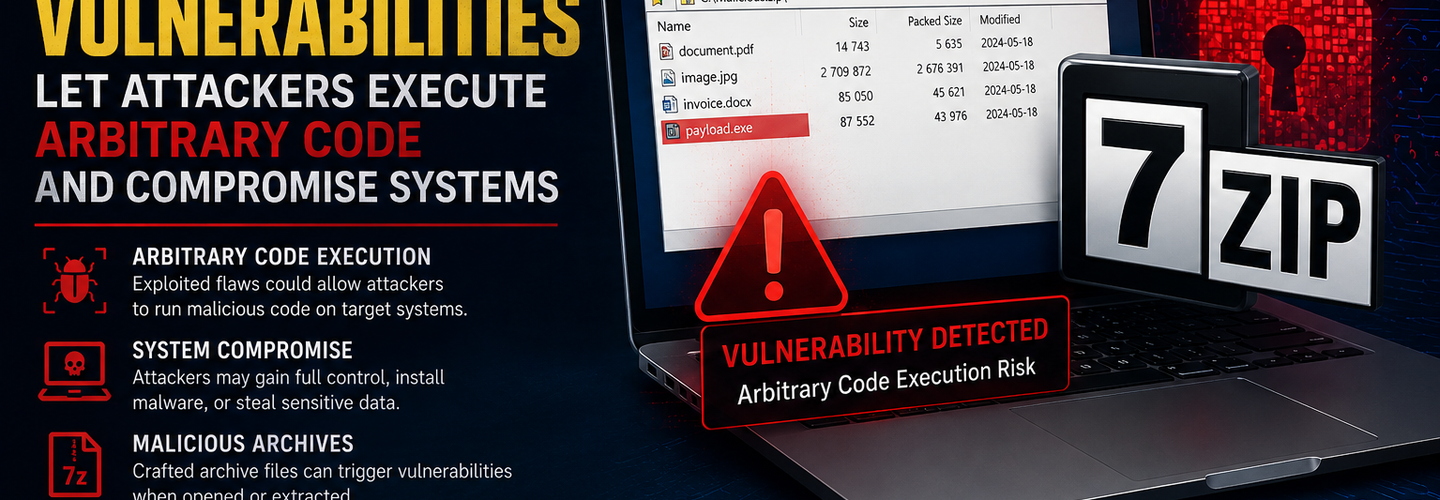
Critical 7-Zip Vulnerabilities Could Allow Arbitrary Code Execution on Windows Systems
File archiving software plays a critical role in modern computing environments. From enterprise systems to personal devices, archive utilities are widely used to compress, extract, transfer, and manage files efficiently. Among these tools, 7-Zip remains one of the most popular open-source archive managers worldwide.
However, cybersecurity researchers have recently identified serious vulnerabilities affecting 7-Zip that could potentially allow attackers to execute arbitrary code and compromise targeted systems. The discovery has raised concerns across the cybersecurity community because archive utilities are frequently trusted by users and integrated deeply into daily workflows.
The newly disclosed vulnerabilities highlight how seemingly routine software components can become high-risk attack vectors when security weaknesses are exploited. Security experts warn that attackers may abuse crafted archive files to trigger malicious behavior, potentially leading to unauthorized access, malware execution, privilege escalation, or broader system compromise.
In this ReconShield analysis, we examine the latest 7-Zip vulnerabilities, how arbitrary code execution attacks work, the potential risks to users and organizations, and the best defensive measures for reducing exposure.
Why 7-Zip Is Widely Used
7-Zip has become one of the most trusted archive management tools because of its:
- ▸Open-source availability
- ▸High compression ratios
- ▸Support for multiple archive formats
- ▸Lightweight performance
- ▸Cross-platform compatibility
- ▸Free accessibility
Millions of users rely on the software to:
- ▸Extract compressed files
- ▸Share documents securely
- ▸Backup data
- ▸Transfer software packages
- ▸Manage archives in enterprise workflows
Because archive utilities interact directly with user files and operating system processes, vulnerabilities within these tools can create significant security risks.
Attackers understand that users often trust compressed files received through:
- ▸Email attachments
- ▸Software downloads
- ▸Shared drives
- ▸Messaging platforms
- ▸Cloud storage services
This makes archive applications attractive targets for cybercriminals.
Understanding Arbitrary Code Execution Vulnerabilities
Arbitrary code execution vulnerabilities are among the most dangerous software security flaws.
These vulnerabilities allow attackers to execute malicious code on a victim’s system, often without requiring extensive user interaction.
In archive software, arbitrary code execution may occur when:
- ▸Malicious archive structures are processed incorrectly
- ▸Memory corruption vulnerabilities are triggered
- ▸Input validation fails
- ▸Parsing mechanisms mishandle crafted files
- ▸Buffer overflows occur during extraction
If exploited successfully, attackers may gain the ability to:
- ▸Install malware
- ▸Deploy ransomware
- ▸Steal sensitive information
- ▸Create backdoors
- ▸Escalate privileges
- ▸Manipulate files
- ▸Disable security tools
The severity depends on:
- ▸User permissions
- ▸System configuration
- ▸Exploit complexity
- ▸Security controls present on the target device
How Attackers Could Exploit 7-Zip Vulnerabilities
Cybercriminals commonly distribute malicious archives through social engineering campaigns.
Potential attack scenarios may include:
## Phishing Emails
Attackers send specially crafted compressed files disguised as:
- ▸Invoices
- ▸Contracts
- ▸Reports
- ▸Software updates
- ▸HR documents
When users open or extract the archive, the vulnerability may trigger malicious execution.
## Fake Software Downloads
Malicious archives may be distributed through:
- ▸Fake update websites
- ▸Pirated software portals
- ▸Malicious advertisements
- ▸Trojanized applications
Users downloading unofficial software packages face elevated risk.
## Supply Chain Attacks
Compromised archives can also appear within:
- ▸Shared development repositories
- ▸Software packages
- ▸CI/CD pipelines
- ▸Enterprise collaboration systems
Supply chain attacks have become increasingly common across the cybersecurity landscape.
## Drive-By Delivery Campaigns
Some advanced attack chains may attempt to combine archive vulnerabilities with browser exploits or malicious downloads.
This increases the likelihood of stealthy compromise.
Why Archive Software Is a Valuable Target
Archive utilities often operate with high levels of user trust.
Unlike suspicious executable files, compressed archives are commonly perceived as harmless.
Attackers exploit this trust advantage because:
- ▸Users regularly open archives
- ▸Security awareness is lower for compressed files
- ▸Many workflows depend on archives daily
- ▸Organizations exchange compressed data frequently
In enterprise environments, archive utilities may also interact with:
- ▸Backup systems
- ▸Automation scripts
- ▸Deployment pipelines
- ▸File synchronization services
A single exploited archive can potentially affect broader infrastructure if defensive controls are weak.
Potential Security Risks for Organizations
The impact of archive software vulnerabilities extends beyond individual devices.
Organizations face multiple potential risks:
## Malware Deployment
Attackers may use crafted archives to deliver:
- ▸Trojans
- ▸Ransomware
- ▸Spyware
- ▸Remote access tools
- ▸Information stealers
## Credential Theft
Compromised systems may expose:
- ▸Browser credentials
- ▸Authentication tokens
- ▸Corporate accounts
- ▸VPN credentials
## Lateral Movement
Once inside a network, attackers may attempt to move laterally across systems and services.
## Data Exfiltration
Sensitive business information may be stolen or leaked.
## Operational Disruption
Critical systems may become unavailable due to ransomware or destructive malware activity.
Common Technical Causes Behind Archive Vulnerabilities
Archive processing is technically complex because compression tools must handle numerous file formats and parsing operations.
Common vulnerability causes include:
## Memory Corruption
Improper memory handling may lead to:
- ▸Buffer overflows
- ▸Heap corruption
- ▸Out-of-bounds access
## Improper Input Validation
Applications must validate:
- ▸File headers
- ▸Metadata
- ▸Compression structures
- ▸File paths
Failure to validate input correctly may allow malicious manipulation.
## Path Traversal Issues
Archive extraction flaws can sometimes overwrite files outside intended directories.
This is commonly known as:
- ▸Zip Slip
- ▸Directory traversal
## Unsafe Parsing Logic
Complex archive parsing increases the attack surface significantly.
Attackers may craft malformed archives specifically designed to trigger unexpected behavior.
Why Timely Patching Matters
One of the most important defenses against software vulnerabilities is prompt patch management.
Organizations should:
- ▸Monitor vulnerability disclosures
- ▸Apply updates quickly
- ▸Replace unsupported software
- ▸Validate patch deployment success
Delayed patching creates opportunities for attackers to weaponize public vulnerabilities.
Cybercriminal groups frequently monitor newly disclosed flaws and rapidly develop exploitation techniques.
Best Security Practices for Archive Software
Reducing risk requires a combination of user awareness, technical controls, and proactive security practices.
## Keep 7-Zip Updated
Always use the latest stable release from official sources.
Security patches often address newly discovered vulnerabilities.
## Avoid Untrusted Archives
Do not open compressed files from unknown or suspicious sources.
Be cautious with:
- ▸Unexpected email attachments
- ▸Pirated software packages
- ▸Unverified downloads
## Use Endpoint Protection
Modern security tools can help detect:
- ▸Malicious payloads
- ▸Suspicious extraction behavior
- ▸Exploit attempts
- ▸Unauthorized process execution
## Enable File Scanning
Organizations should scan archives before extraction whenever possible.
This can reduce exposure to malicious content.
## Limit User Privileges
Least privilege principles help minimize damage if exploitation occurs.
Users should avoid operating daily systems with administrative privileges.
## Segment Critical Systems
Network segmentation helps reduce lateral movement risks during compromise events.
The Growing Trend of Utility Software Attacks
Cybercriminals increasingly target trusted utility applications because they are:
- ▸Widely installed
- ▸Frequently used
- ▸Often overlooked during security reviews
Recent years have seen attacks involving:
- ▸File transfer tools
- ▸PDF readers
- ▸Browser extensions
- ▸Compression utilities
- ▸Developer tools
Attackers understand that compromising trusted software increases the likelihood of successful execution.
This trend reinforces the importance of:
- ▸Software supply chain security
- ▸Continuous monitoring
- ▸Application hardening
- ▸Threat intelligence integration
How Security Teams Should Respond
Security teams should treat archive software vulnerabilities seriously, especially in enterprise environments.
Recommended response actions include:
## Asset Identification
Identify all systems using vulnerable software versions.
## Threat Monitoring
Monitor for:
- ▸Suspicious archive activity
- ▸Unusual process execution
- ▸Exploit indicators
- ▸Malicious downloads
## User Awareness Training
Educate employees about:
- ▸Phishing risks
- ▸Suspicious attachments
- ▸Safe download practices
## Incident Response Readiness
Prepare for potential exploitation scenarios with:
- ▸Backup validation
- ▸Recovery testing
- ▸Detection rules
- ▸Containment procedures
The Importance of Secure Software Development
Software security must remain a continuous process rather than a one-time review.
Developers of archive tools and utility software should prioritize:
- ▸Secure coding practices
- ▸Fuzz testing
- ▸Memory safety improvements
- ▸Regular security audits
- ▸Vulnerability disclosure programs
Modern attackers continuously search for weaknesses in trusted software ecosystems.
Defensive security requires ongoing investment in secure engineering and vulnerability management.
Final Thoughts
The discovery of critical 7-Zip vulnerabilities serves as another reminder that even widely trusted applications can become attack vectors when security flaws emerge.
Archive utilities play an essential role in modern computing, but their deep interaction with files and operating systems makes them attractive targets for cybercriminals seeking arbitrary code execution opportunities.
Organizations and individual users should prioritize:
- ▸Timely software updates
- ▸Safe download practices
- ▸Security monitoring
- ▸Endpoint protection
- ▸User awareness
As attackers increasingly target common utility software, proactive cybersecurity practices become more important than ever.
Maintaining strong defensive controls and keeping software updated remain essential steps for reducing exposure to modern cyber threats.
Suggested Internal Links for ReconShield
- ▸Port Scanner
- ▸DNS Lookup
- ▸WHOIS Lookup
- ▸IP Scanner
- ▸Web Security Research
- ▸Vulnerability Analysis Articles
Read More:
F5 BIG-IP Appliances Targeted by Hackers for SSH Intrusions Into Enterprise Linux Systems
Vellore Man Arrested in Cambodia Cyber Slavery Racket Linked to Online Scam Networks
Cyber Fraud in Bengaluru: Elderly Woman Loses Rs 7.69 Lakh After Clicking Fake WhatsApp Link
10,000+ Zero-Day Vulnerabilities Identified by Anthropic Claude Mythos in Glasswing Project
PyrsistenceSniper Detects 117 Malware Persistence Techniques Across Windows, Linux, and macOS
Greenwood Cyber + AI Lab Opens in Tulsa Through Microsoft and Black Tech Street Collaboration
Open-Source Ecosystem Under Threat as Hackers Breach 34 Software Packages
## Analyst Commentary & Implementation Blueprint
Security advisory
Continuous security exposure assessment is critical to identifying public vulnerabilities before they are exploited. Organizations should maintain a passive inventory of all web servers, TLS configs, and open ports, ensuring that default configurations are eliminated and security advisories are actively implemented.
Hardened Security Configuration Blueprint
# General Security Hardening Directive
ServerTokens ProductOnly
ServerSignature Off
FileETag None
Actionable Mitigation Checklist
- ✔Perform passive asset inventories weekly.
- ✔Restrict administrative ports using local firewall controls.
- ✔Monitor active CVE alerts for exposed software.
Common Inquiries & FAQs
Why is passive scanning preferred for continuous auditing?
Passive audits do not cause operational impact or trigger firewall blocks, making them ideal for constant surveillance of internet-facing assets.
What should I do if a vulnerability is flagged?
Apply the latest vendor patches, restrict access to the resource via firewalls, or verify configuration flags to mitigate risks.
Surendra Reddy
Surendra Reddy is a cybersecurity researcher and founder of ReconShield, specializing in OSINT and defensive infrastructure analysis.
Connect on LinkedIn ↗// AUDIT BRIEFING DISCUSSION (2 COMMENTS)
Great breakdown of the passive infrastructure vectors. We recently audited our external DNS zones and found multiple dangling staging environments. Implementing wildcard certificates reduced our CT log leaks significantly.
Is there any automated tooling you recommend for daily crt.sh scraping? Manually checking CT logs is becoming unsustainable for our domain portfolio.
// MORE ARTICLES
Security Researchers Warn Critical n8n Flaws May Expose Automation Platforms to RCE
Researchers have disclosed critical vulnerabilities in n8n that could expose automation workflows and connected enterprise systems to remote code execution risks, prompting urgent patch recommendations for users and administrators.

How Agentic AI Is Changing Software Engineering and Expanding Mobile Attack Surfaces
Agentic AI is rapidly transforming software engineering workflows through automation and intelligent coding assistance, while cybersecurity experts warn of expanding mobile attack surfaces and emerging application security risks.
SplitVPN Hacked: Data Breach Exposes 865,000 User Records and 58 Million Hidden Connection Logs (July 2026)
SplitVPN hacked: 865,336 user records and 58 million connection logs exposed, directly contradicting the VPN's "no-logs" promise. What was leaked and what to do now.