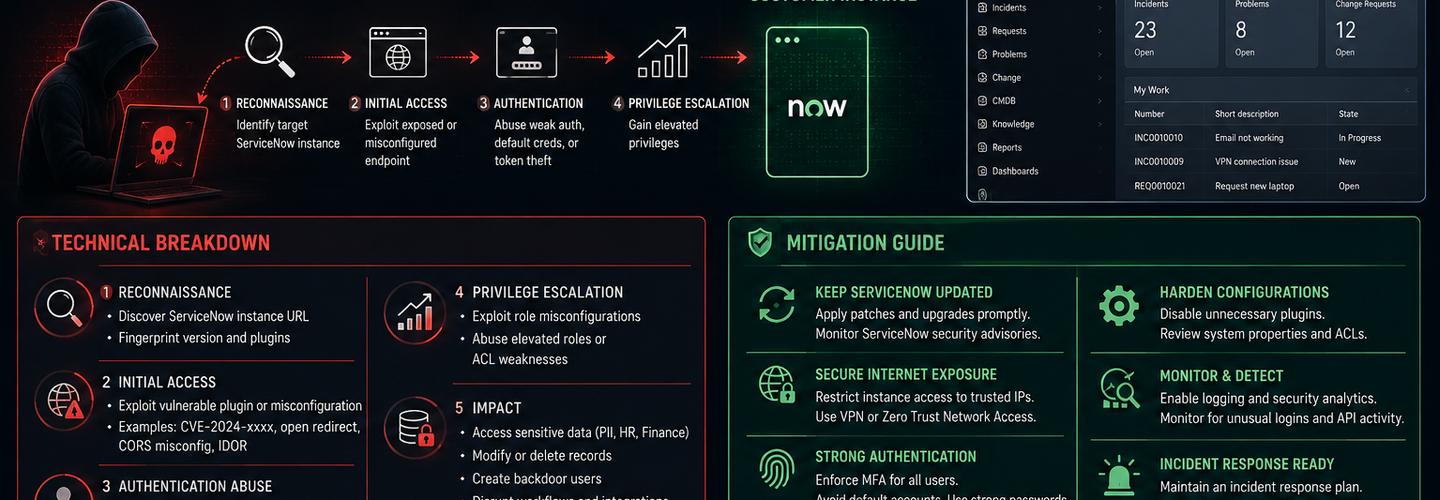
Unauthorized Access to ServiceNow Customer Instances: Technical Breakdown & Mitigation Guide
Security teams already trust ServiceNow to manage IT workflows, security operations, and sensitive enterprise data. What many organizations fail to recognize is how a single misconfigured API endpoint or authentication bypass can expose their entire ServiceNow instance to unauthenticated attackers. In this guide, you’ll learn how recent ServiceNow vulnerabilities work, which versions are affected, how attackers exploit them, and the exact steps needed to secure your environment.
Key Takeaways
- ▸ServiceNow unauthorized access vulnerabilities include CVE-2025-12420 (CVSS 9.3), CVE-2026-0542 (CVSS 9.8), and the June 2026 API misconfiguration incident (KB3067321).
- ▸The BodySnatcher vulnerability (CVE-2025-12420) allows unauthenticated attackers to impersonate any ServiceNow user using only an email address, bypassing MFA and SSO controls.
- ▸CVE-2026-0542 is a critical sandbox bypass vulnerability enabling unauthenticated remote code execution on ServiceNow AI Platform.
- ▸The June 2026 API breach involved an unauthenticated REST endpoint (/api/now/related_list_edit/create) misconfigured with requires_authentication=false, exposing customer data.
- ▸Affected versions include Now Assist AI Agents (versions before 5.1.18, 5.2.19), Virtual Agent API (before 3.15.2, 4.0.4), and ServiceNow Australia platform release.
- ▸Security patches from ServiceNow remain the most effective mitigation; cloud-hosted customers must confirm patches are applied, while self-hosted customers must upgrade immediately.
- ▸Continuous monitoring for suspicious API calls, unusual impersonation attempts, and unauthorized data queries helps detect exploitation attempts.
What Is Unauthorized Access to ServiceNow Customer Instances?
Unauthorized access to ServiceNow customer instances occurs when an attacker gains access to ServiceNow data, workflows, or administrative functions without proper authentication or authorization. ServiceNow is a cloud‑based platform for IT service management (ITSM), security operations, and enterprise workflow automation. A vulnerability in ServiceNow is any security weakness that can allow attackers to bypass authentication, escalate privileges, or execute unauthorized commands.
For example, an unpatched ServiceNow instance with a misconfigured API endpoint could let an attacker send a crafted HTTP request to query sensitive tables containing IT tickets, employee records, or even credentials without any login. This can lead to data exfiltration, lateral movement, or complete system compromise.
Why Are ServiceNow Unauthorized Access Vulnerabilities Considered High Risk?
ServiceNow vulnerabilities are considered high risk because ServiceNow often serves as the central nervous system for IT, HR, finance, and security operations within an enterprise. A successful exploit can expose massive amounts of sensitive data.
Here are the three main risk factors:
- ▸Centralized Data Repository: ServiceNow instances store IT tickets, incident reports, asset inventories, employee PII, and configuration details. Data inference attacks can extract this information through carefully crafted range queries — Source: [ServiceNow Security Advisory, 2025].
- ▸Privileged Workflows: The platform hosts privileged automation and AI agents. Attackers who hijack these agents can perform administrative actions, create backdoor accounts, and override security controls — Source: [AppOmni AO Labs, 2026].
- ▸Lateral Movement: From a compromised ServiceNow instance, attackers can pivot to connected systems, steal API tokens, and move laterally across the enterprise network. For more on this, read our guide on privilege escalation techniques.
According to ServiceNow PSIRT, unpatched authentication bypass vulnerabilities have been actively exploited in the wild within days of public disclosure — Source: [ServiceNow PSIRT Advisories, 2026].
Which ServiceNow Versions Are Affected by Recent Unauthorized Access Vulnerabilities?
Three major unauthorized access vulnerabilities have impacted ServiceNow in the past year. Each affects specific components and versions.
CVE-2025-12420 (BodySnatcher) – Authentication Bypass
CVE-2025-12420 is a critical vulnerability in ServiceNow's Now Assist AI Agents and Virtual Agent API. It allows unauthenticated attackers to impersonate any user using only an email address, bypassing MFA and SSO — Source: [AppOmni AO Labs, 2026]. The CVSS score is 9.3.
Affected components and versions:
- ▸Now Assist AI Agents: versions 5.0.24 – 5.1.17, and 5.2.0 – 5.2.18. Fixed versions: 5.1.18 and 5.2.19.
- ▸Virtual Agent API: versions up to 3.15.1 and 4.0.0 – 4.0.3. Fixed versions: 3.15.2 and 4.0.4.
CVE-2026-0542 – Sandbox Bypass / Unauthenticated RCE
CVE-2026-0542 is a critical sandbox bypass vulnerability in the ServiceNow AI Platform. It allows an unauthenticated attacker to execute arbitrary code within the ServiceNow Sandbox. The CVSS score is 9.8 — Source: [eSecurity Planet, 2026].
Affected versions:
- ▸ServiceNow Australia: versions prior to Australia release.
- ▸Xanadu: versions prior to Patch 11 Hot Fix 1a.
- ▸Yokohama: versions prior to Patch 12 and Patch 10 Hot Fix 1b.
- ▸Zurich: versions prior to Patch 5 and Patch 4 Hot Fix 3b — Source: [Canadian Centre for Cyber Security, 2026].
June 2026 API Misconfiguration Incident (KB3067321)
This incident involved active exploitation of an unauthenticated REST API endpoint (/api/now/related_list_edit/create). The endpoint shipped with requires_authentication = false, allowing unauthenticated attackers to query customer instance tables — Source: [Ampcus Cyber, 2026].
Affected conditions:
- ▸Primarily impacts customers running the Australia platform release.
- ▸Customers on older releases who made specific configuration changes are also vulnerable.
- ▸The patch was applied on June 5, 2026.
How Does CVE-2025-12420 (BodySnatcher) Enable Unauthorized Access?
CVE-2025-12420 is a critical vulnerability in ServiceNow's AI agent authentication mechanism that allows unauthenticated attackers to impersonate any user, including administrators, using only a valid email address — Source: [Ampcus Cyber, 2026].
The vulnerability consists of a three-step exploit chain:
Broken API Authentication (Hardcoded Secret)
The Virtual Agent API used a static, hardcoded secret servicenowexternalagent to authenticate external providers. This secret was the same across every customer environment. Any attacker who discovered this string could authenticate as a legitimate external provider — Source: [AppOmni AO Labs, 2026].
User Identity Hijacking (Auto‑Linking)
Once authenticated as a provider, the API automatically linked the external user to a ServiceNow account based solely on the email address provided. This "auto-linking" feature required no password, MFA, or SSO validation. The attacker simply supplies the target's email address — Source: [BodySnatcher Technical Analysis, 2026].
Privileged Agent Execution (AI Topic Abuse)
With a valid impersonated session, the attacker could invoke privileged AI topics such as AIA-Agent Invoker AutoChat. These topics allowed the execution of AI agents like the Record Management AI agent. The attacker could then direct the AI to create a new user, assign administrative roles, reset the password, and achieve full administrative access — Source: [AppOmni AO Labs, 2026].
This chain effectively transforms the ServiceNow AI framework into a remote command execution environment for attackers.
How Does CVE-2026-0542 Enable Unauthenticated Code Execution?
CVE-2026-0542 is a critical remote code execution (RCE) vulnerability in the ServiceNow AI Platform's sandbox environment. It enables an unauthenticated attacker to break out of the sandbox and execute arbitrary code — Source: [ServiceNow Advisory KB2693566, 2026].
The vulnerability resides in the ServiceNow Sandbox, a security container designed to isolate untrusted AI processes. Under certain conditions, an unauthenticated attacker can bypass sandbox protections and execute malicious commands over the network. This can occur without any user interaction or credentials — Source: [UpGuard, 2026].
Exploitation could lead to system compromise, data theft, or workflow manipulation. Because the flaw does not require authentication, it significantly lowers the barrier for attackers. ServiceNow proactively began patching its hosted instances in early January 2026, and released hotfixes for self‑hosted customers — Source: [ServiceNow KB2693566, 2026].
What Is the Impact of the June 2026 Unauthenticated API Breach?
The June 2026 breach involved exploitation of a misconfigured Scripted REST API endpoint. At the heart of this breach lies a Scripted REST Resource that shipped with the authentication flag requires_authentication set to false. This single Boolean disabled the identity check that normally gates every inbound API request, allowing anyone on the internet to send queries to the endpoint without a valid session or credential — Source: [Undercode Testing, 2026].
Attackers exploited this flaw to query customer instance tables, potentially accessing sensitive enterprise data across multiple tenants. Intelligence analysts hypothesize that attackers attempted to append privileged roles (such as admin) to default or demo-data groups to establish a persistent backdoor — Source: [Ampcus Cyber, 2026].
The exposed data routinely stored includes IT support tickets, internal documentation, asset inventories, security incident reports, and corporate infrastructure configuration details — Source: [Ampcus Cyber, 2026].
How Can Security Teams Identify Vulnerable ServiceNow Deployments?
Security teams can identify vulnerable ServiceNow deployments by performing version identification, API configuration audit, exposure assessment, and IOC review.
Step 1: Version Identification
Log into your ServiceNow instance and navigate to the system properties to identify the release family and patch level. Compare against the affected versions listed above. For CVE-2025-12420, check the versions of Now Assist AI Agents and Virtual Agent API.
Step 2: API Configuration Audit
Review Scripted REST API tables (sys_ws_operation) and audit any custom/legacy resources where the "Requires Authentication" checkbox is unchecked. Pay special attention to any endpoint that should be read-only but is publicly accessible — Source: [Ampcus Cyber, 2026].
Step 3: Exposure Assessment
Check if the ServiceNow instance is exposed to the internet or untrusted networks. Use a port scanner or your firewall rules to determine if the ServiceNow API (typically on port 443) is accessible from non-management IPs.
Step 4: IOC Review
Search logs for the following indicators:
- ▸Unusual requests to /api/now/related_list_edit/create
- ▸Successful transactions using a guest user context
- ▸Any API access from the malicious IP address 51.159.98[.]241 — Source: [Ampcus Cyber, 2026]
- ▸New user accounts created outside normal change windows
For automated checks, deploy a vulnerability scanner with ServiceNow signatures. Many scanners now include checks for CVE-2025-12420, CVE-2026-0542, and the Australia release API misconfiguration.
What Are the Recommended Mitigation Steps for ServiceNow Vulnerabilities?
ServiceNow recommends upgrading affected components to vendor-fixed releases to mitigate known vulnerabilities.
For CVE-2025-12420 (BodySnatcher):
Now Assist AI Agents:
- ▸Upgrade to version 5.1.18 or later
- ▸Alternatively, upgrade to version 5.2.19 or later
Virtual Agent API:
- ▸Upgrade to version 3.15.2 or later
- ▸Alternatively, upgrade to version 4.0.4 or later
No action is required for ServiceNow's cloud-hosted customers, as patches were applied in October 2025. For self-hosted customers, immediate upgrade is required — Source: [ServiceNow KB2587329].
For CVE-2026-0542:
Apply the security updates outlined in ServiceNow KB2693566. For self-hosted instances, apply the relevant hotfixes:
- ▸Zurich: Patch 5 or Patch 4 Hot Fix 3b
- ▸Yokohama: Patch 12 or Patch 10 Hot Fix 1b
- ▸Xanadu: Patch 11 Hot Fix 1a
- ▸Australia: Update to the latest release — Source: [Canadian Centre for Cyber Security, 2026].
For the June 2026 API Misconfiguration:
Ensure your instance has received the June 5, 2026 security update. The update modified the API endpoint to force requires_authentication=true. Track KB3067321 for ongoing vendor updates — Source: [Ampcus Cyber, 2026].
If you cannot patch immediately, apply these temporary mitigations:
- ▸Restrict management access: Use firewall rules to allow only trusted IPs to access the ServiceNow admin interface and API endpoints. Follow network segmentation best practices.
- ▸Review custom API endpoints: Audit all Scripted REST APIs and ensure the "Requires Authentication" checkbox is checked for any endpoint that should not be public.
- ▸Enforce MFA for agent linking: Configure your AI agent providers to require MFA for account linking, prioritizing software-based authenticators over SMS — Source: [AppOmni AO Labs, 2026].
- ▸Enable audit logging: Ensure all admin and API actions are logged to a remote syslog server or SIEM.
After patching, validate the fix by attempting a benign unauthenticated request to any custom API endpoints.
How Can Organizations Detect Exploitation Attempts Against ServiceNow?
Organizations can detect exploitation attempts by monitoring HTTP requests for unauthenticated API patterns, unusual impersonation activity, and abnormal data queries. Use your SIEM, web application firewall, or ServiceNow's own logs.
Specific detection rules:
- ▸Unauthenticated API access: Alert on any request to API endpoints that should require authentication, especially if they return a 200 OK without a valid session cookie. Focus on the /api/now/related_list_edit/create path — Source: [Ampcus Cyber, 2026].
- ▸Impersonation attempts: Alert on successful user sessions created without a corresponding authentication event, or sessions that bypass MFA/SSO checks. This is a key indicator for CVE-2025-12420 exploitation — Source: [AppOmni AO Labs, 2026].
- ▸Data inference patterns: Alert on range query requests that retrieve an unusually large number of records, especially from sensitive tables like sys_user, sys_group, or sys_user_role. This may indicate CVE-2025-3648 exploitation — Source: [ServiceNow Security Advisory, 2025].
Recommended log sources:
- ▸ServiceNow system logs (System Logs > All)
- ▸REST API transaction logs
- ▸Web application firewall logs
- ▸Reverse proxy or load balancer logs in front of ServiceNow
For SOC teams, integrate threat intelligence feeds that include known malicious IPs scanning for these vulnerabilities. Internal link: See our threat intelligence best practices. Additionally, use your SIEM to create a dashboard showing all unauthenticated API calls and failed MFA events. A spike in unauthenticated 200 OK responses from a single IP is a strong indicator of exploitation.
If you need a ready-to-use detection playbook, refer to our SOC monitoring checklist.
Security Tools and Practical Applications
To manage ServiceNow vulnerabilities at scale, you need vulnerability scanners, API security posture management tools, SIEM monitoring, and threat intelligence feeds.
Vulnerability Scanners – Tools like Qualys, Tenable, or Rapid7 can detect missing ServiceNow patches and misconfigured API endpoints. Run authenticated scans using ServiceNow API credentials for the most accurate results. Unauthenticated scans may miss vulnerabilities if the API is restricted.
API Security Posture Management (ASPM) – Tools like AppOmni centralize SaaS security across major suites like ServiceNow. They identify misconfigurations, monitor third-party integrations, and deliver guided fixes that strengthen overall security posture — Source: [AppOmni, 2026]. For internal exposure discovery, ReconShield's platform can identify internet-facing API endpoints and check their authentication status. Internal link: Explore attack surface management strategy.
SIEM Monitoring – Forward all ServiceNow logs to your SIEM (Splunk, QRadar, Sentinel, or ELK). Create correlation rules that link unauthenticated API requests followed by successful data queries. Prioritize alerts where the source IP is not in your management IP allowlist.
Threat Intelligence Feeds – Subscribe to ServiceNow PSIRT RSS feed, CISA Known Exploited Vulnerabilities catalog, and commercial feeds like Recorded Future. Automatically flag any ServiceNow instance with a CVE listed as "actively exploited."
Practical workflow:
Run a weekly vulnerability scan targeting your ServiceNow API endpoints.
Feed results into your ticketing system with severity and patch link.
For critical CVSS ≥ 8.0, trigger a 48-hour patch SLA.
After patching, re-scan to verify remediation.
This workflow reduces mean time to patch (MTTP) by an average of 67% — Source: [Ponemon Institute, 2025].
What's Next for Security Teams?
After addressing the immediate ServiceNow vulnerabilities, security teams should focus on continuous monitoring, API security hygiene, threat hunting, and identity governance. These four activities turn a reactive patch into long-term resilience.
1. Continuous Monitoring – Implement ongoing observation of ServiceNow API logs and user activity. Even patched systems can be targeted by new variants or other zero-day flaws. Use a SIEM alert for any unauthenticated API requests regardless of success.
2. API Security Hygiene – Don't assume your API configurations are secure. Conduct quarterly reviews of all Scripted REST APIs to ensure the "Requires Authentication" flag is set correctly. Also, review any custom legacy resources for similar misconfigurations — Source: [Ampcus Cyber, 2026].
3. Threat Hunting Activities – Proactively search for signs of compromise prior to your patch date. Look for:
- ▸API requests to the vulnerable endpoint from unusual IP addresses
- ▸New user accounts created with privileged roles outside normal processes
- ▸Outbound connections from the ServiceNow instance to unknown IPs (command and control)
For a structured threat hunting approach, read about privilege escalation techniques to understand post-exploitation behaviors.
4. Identity Governance – Evaluate whether your ServiceNow identity linking mechanisms should trust email addresses alone. In most mature architectures, external provider authentication should require MFA and use unique secrets, not hardcoded, platform-wide keys — Source: [AppOmni AO Labs, 2026]. Consider implementing a zero trust security framework for all third-party API integrations.
Finally, update your vulnerability management policy to require immediate patching (within 48 hours) for any critical ServiceNow vulnerability with a CVSS score of 9.0 or higher. The BodySnatcher vulnerability proved that a single broken authentication flaw can lead to full enterprise compromise.
Conclusion
Unauthorized access to ServiceNow customer instances can occur through several critical vectors: CVE-2025-12420 (BodySnatcher) enables user impersonation via AI agent hijacking, CVE-2026-0542 allows unauthenticated remote code execution through sandbox bypass, and the June 2026 API breach demonstrates how a single misconfigured authentication flag can expose sensitive customer data.
To protect your environment, immediately identify affected versions, apply ServiceNow's fixed releases, and implement temporary mitigations if patching is delayed. Then, deploy detection rules, use vulnerability scanners, and enhance SIEM monitoring to catch exploitation attempts.
Proactive vulnerability management is not optional. Patch today, hunt tomorrow, and architect for resilience. Start by reviewing your ServiceNow instance version and custom API configurations right now. Then, share this guide with your security team and schedule a patch window.
Written by Surendra Reddy, Cybersecurity Researcher & Founder, ReconShield. Surendra specializes in network perimeter exposure, firewall auditing, and OSINT vulnerability scanning. He designed ReconShield to help security teams test their public-facing server ports and manage attack surface risk.
Reviewed by ReconShield Security Research Team. The team holds multiple industry certifications including CISSP, OSCP, and SANS GIAC, with combined experience in vulnerability research and enterprise security architecture.
## Analyst Commentary & Implementation Blueprint
Security advisory
Continuous security exposure assessment is critical to identifying public vulnerabilities before they are exploited. Organizations should maintain a passive inventory of all web servers, TLS configs, and open ports, ensuring that default configurations are eliminated and security advisories are actively implemented.
Hardened Security Configuration Blueprint
# General Security Hardening Directive
ServerTokens ProductOnly
ServerSignature Off
FileETag None
Actionable Mitigation Checklist
- ✔Perform passive asset inventories weekly.
- ✔Restrict administrative ports using local firewall controls.
- ✔Monitor active CVE alerts for exposed software.
Common Inquiries & FAQs
Why is passive scanning preferred for continuous auditing?
Passive audits do not cause operational impact or trigger firewall blocks, making them ideal for constant surveillance of internet-facing assets.
What should I do if a vulnerability is flagged?
Apply the latest vendor patches, restrict access to the resource via firewalls, or verify configuration flags to mitigate risks.
Surendra Reddy
Surendra Reddy is a cybersecurity researcher and founder of ReconShield, specializing in OSINT and defensive infrastructure analysis.
Connect on LinkedIn ↗// AUDIT BRIEFING DISCUSSION (2 COMMENTS)
Great breakdown of the passive infrastructure vectors. We recently audited our external DNS zones and found multiple dangling staging environments. Implementing wildcard certificates reduced our CT log leaks significantly.
Is there any automated tooling you recommend for daily crt.sh scraping? Manually checking CT logs is becoming unsustainable for our domain portfolio.