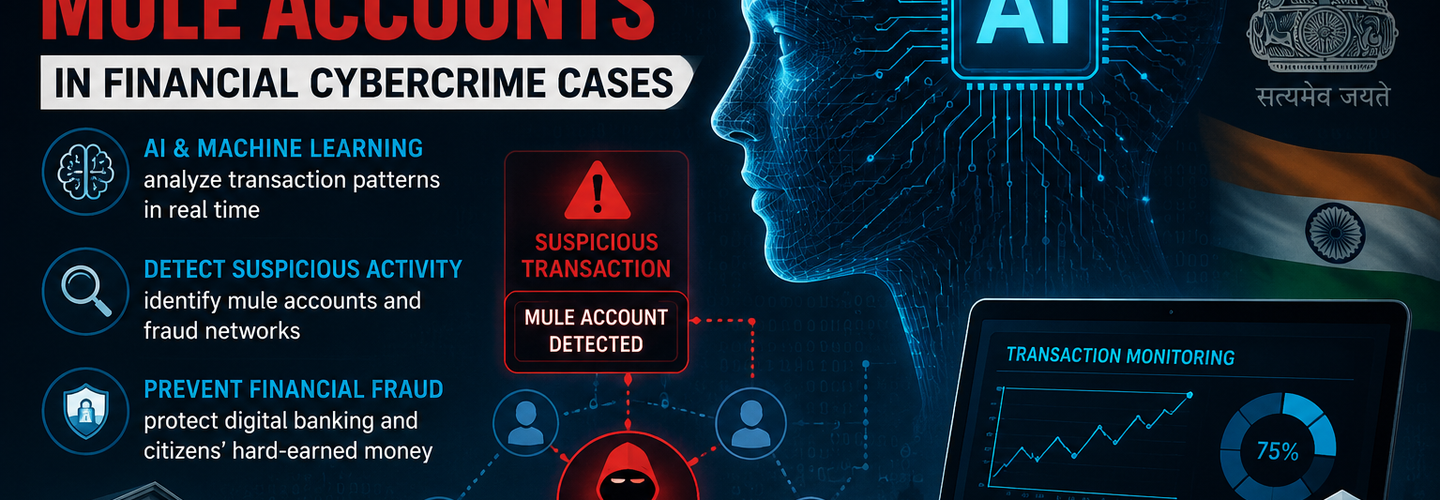
Government Deploys AI Systems to Detect Mule Accounts in Financial Cybercrime Cases
India is strengthening its fight against financial cybercrime by deploying advanced artificial intelligence (AI) systems to identify and track mule accounts involved in illegal financial transactions. The initiative comes amid a sharp rise in online banking fraud, phishing scams, investment scams, and cyber-enabled financial crimes targeting individuals and businesses across the country.
Government agencies and financial institutions are increasingly turning to AI-driven analytics and machine learning tools to detect suspicious transaction patterns and prevent fraud before it causes major financial losses.
What Are Mule Accounts?
Mule accounts are bank accounts used by cybercriminals to move illegally obtained money. Fraudsters often recruit unsuspecting individuals through fake job offers, online advertisements, or social engineering tactics to open or share bank accounts. These accounts are then used to transfer stolen funds, making it difficult for law enforcement agencies to trace the actual criminals behind the fraud.
Cybercriminals use mule accounts in several types of scams, including:
- ▸Phishing attacks
- ▸Investment fraud
- ▸Fake trading applications
- ▸UPI payment fraud
- ▸Cryptocurrency scams
- ▸Business email compromise attacks
The growing use of digital payment systems and online banking platforms has increased the need for advanced fraud detection technologies capable of identifying suspicious activity in real time.
AI Systems to Strengthen Fraud Detection
The newly deployed AI systems analyze large volumes of financial transaction data to identify unusual behavior linked to mule accounts. Using machine learning algorithms, these platforms can detect patterns that may indicate money laundering or cyber fraud operations.
AI-based fraud detection tools can monitor:
- ▸Rapid fund transfers between multiple accounts
- ▸Unusual transaction frequency
- ▸Geographic inconsistencies in account activity
- ▸Suspicious withdrawal patterns
- ▸High-risk transaction networks
Unlike traditional rule-based systems, AI models continuously learn from new cybercrime techniques, improving their ability to detect emerging fraud trends.
Officials believe that integrating AI into financial cybersecurity infrastructure will help reduce response times and improve coordination between banks, law enforcement agencies, and cybersecurity teams.
Rising Threat of Financial Cybercrime
India has witnessed a surge in cyber-enabled financial crimes over the past few years. Fraudsters are increasingly targeting users through fake investment schemes, malicious mobile applications, phishing websites, and social media scams.
According to cybersecurity experts, financial fraud networks often rely on mule accounts to quickly distribute stolen money across multiple banking channels. This makes tracing transactions extremely difficult without automated intelligence systems.
The use of AI can help investigators identify linked accounts, suspicious transaction chains, and organized cybercrime networks more effectively than manual analysis.
Collaboration Between Banks and Government Agencies
To improve cyber fraud prevention, government agencies are working closely with banks, fintech companies, and digital payment providers. Financial institutions are being encouraged to strengthen Know Your Customer (KYC) verification processes and deploy advanced monitoring systems.
AI-powered cybersecurity systems are also expected to support real-time alerts, enabling banks to freeze suspicious transactions before funds are withdrawn or transferred overseas.
Experts say that cooperation between public and private sectors will play a crucial role in reducing financial cybercrime and protecting users from digital fraud.
Importance of Public Awareness
While AI technology can improve fraud detection, cybersecurity professionals stress that public awareness remains equally important. Many victims unknowingly become part of mule account operations after responding to fake employment opportunities or sharing bank credentials online.
Users are advised to:
- ▸Avoid sharing banking information with unknown individuals
- ▸Verify job offers and investment schemes carefully
- ▸Monitor account activity regularly
- ▸Enable multi-factor authentication
- ▸Report suspicious transactions immediately
Cybersecurity awareness campaigns are expected to continue alongside the deployment of AI-driven fraud detection systems.
Future of AI in Cybersecurity
The adoption of AI in financial cybersecurity marks a significant step toward modernizing India’s cyber defense infrastructure. As cybercriminals continue to evolve their techniques, governments and financial institutions worldwide are investing heavily in artificial intelligence to strengthen digital security.
AI-powered systems can provide faster detection, automated threat analysis, and improved fraud prevention capabilities, helping reduce financial losses and protect digital banking ecosystems.
With online financial transactions continuing to grow rapidly, experts believe AI will become a critical component of future cybersecurity operations, enabling authorities to respond more effectively to complex cyber threats and organized fraud networks.
India’s latest AI-driven initiative reflects the increasing importance of advanced technology in safeguarding financial systems and combating the growing threat of cyber-enabled economic crime.
More articles:
Pentagon’s CYBERCOM Requests Massive AI Funding Jump for Cybersecurity
Google Reports North Korean Hackers Using AI to Target Cybersecurity Blind Spots
Suggested Internal Links for ReconShield
## Analyst Commentary & Implementation Blueprint
Security advisory
Continuous security exposure assessment is critical to identifying public vulnerabilities before they are exploited. Organizations should maintain a passive inventory of all web servers, TLS configs, and open ports, ensuring that default configurations are eliminated and security advisories are actively implemented.
Hardened Security Configuration Blueprint
# General Security Hardening Directive
ServerTokens ProductOnly
ServerSignature Off
FileETag None
Actionable Mitigation Checklist
- ✔Perform passive asset inventories weekly.
- ✔Restrict administrative ports using local firewall controls.
- ✔Monitor active CVE alerts for exposed software.
Common Inquiries & FAQs
Why is passive scanning preferred for continuous auditing?
Passive audits do not cause operational impact or trigger firewall blocks, making them ideal for constant surveillance of internet-facing assets.
What should I do if a vulnerability is flagged?
Apply the latest vendor patches, restrict access to the resource via firewalls, or verify configuration flags to mitigate risks.
Surendra Reddy
Surendra Reddy is a cybersecurity researcher and founder of ReconShield, specializing in OSINT and defensive infrastructure analysis.
Connect on LinkedIn ↗// AUDIT BRIEFING DISCUSSION (2 COMMENTS)
Great breakdown of the passive infrastructure vectors. We recently audited our external DNS zones and found multiple dangling staging environments. Implementing wildcard certificates reduced our CT log leaks significantly.
Is there any automated tooling you recommend for daily crt.sh scraping? Manually checking CT logs is becoming unsustainable for our domain portfolio.
// MORE ARTICLES

Security Researchers Warn Critical n8n Flaws May Expose Automation Platforms to RCE
Researchers have disclosed critical vulnerabilities in n8n that could expose automation workflows and connected enterprise systems to remote code execution risks, prompting urgent patch recommendations for users and administrators.

How Agentic AI Is Changing Software Engineering and Expanding Mobile Attack Surfaces
Agentic AI is rapidly transforming software engineering workflows through automation and intelligent coding assistance, while cybersecurity experts warn of expanding mobile attack surfaces and emerging application security risks.

Critical Tenda Router Backdoor (CVE-2026-11405): Check If Your Device Is Vulnerable Now
CVE-2026-11405 is an unpatched Tenda router backdoor granting full admin access without a password. Check if your model is affected now.