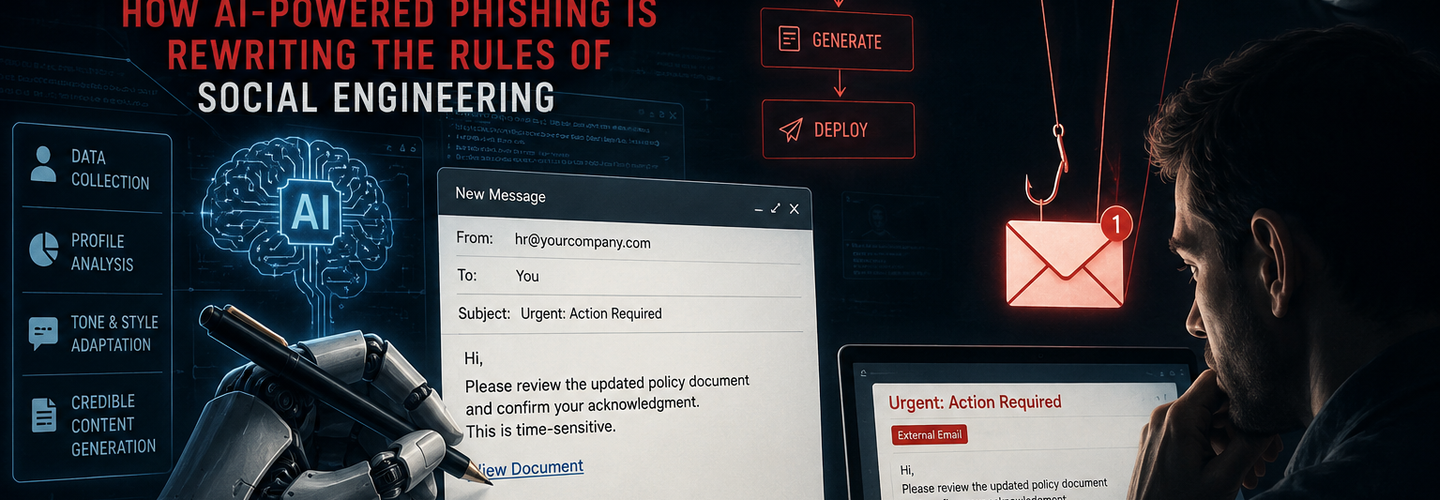
When the Bait Writes Itself: How AI-Powered Phishing Is Rewriting the Rules of Social Engineering
There's a particular kind of dread that grips a security team when they realize the phishing email that compromised an executive's account wasn't just convincing it was perfect. No grammatical slips, no suspicious domain mismatches, no generic "Dear Customer" salutation. It knew the executive's name, referenced an upcoming board meeting, and mimicked the tone of a trusted colleague almost flawlessly. The team spent an hour assuming the account had been accessed by someone inside the organization.
It hadn't. It was AI, and it took less than 30 seconds to build the lure.
This is the defining cybersecurity challenge of 2026: not just that phishing attacks are more frequent, but that the craft behind them has fundamentally changed.
## The Industrialization of Deception
For years, security awareness trainers taught employees to spot phishing through surface-level tells awkward phrasing, mismatched sender addresses, urgency-laced subject lines. That playbook hasn't disappeared; it's just becoming less reliable by the month.
AI is both lowering the entry bar to phishing and making attacks more sophisticated and harder to spot. Phishing emails are no longer crafted by hand they're generated through large language models in minutes. The operational math has shifted entirely. IBM X-Force research demonstrated that AI can generate highly convincing phishing emails in five minutes, compared to the sixteen hours typically required by experienced human operators a 192× improvement in efficiency. More recently, Okta's threat intelligence team documented attackers using generative AI to build complete phishing sites in under 30 seconds.
That velocity matters because defenders don't move at the same speed. Domain takedowns, email filter updates, and threat intelligence sharing all operate on timescales measured in hours or days. Attackers are now operating in minutes.
Phishing is projected to account for more than 42% of all global breaches in 2026, and phishing-driven financial losses are expected to surpass $25 billion per year. Meanwhile, nearly 1.2% of all emails sent are malicious, accounting for approximately 3.4 billion phishing emails delivered daily. Those are not statistics that belong in a slide deck at a quarterly review — they describe the ambient threat environment your employees navigate every single workday.
## What "AI-Powered Phishing" Actually Means in Practice
The phrase gets thrown around enough that it risks losing meaning. It's worth being precise about what has actually changed at the technical and operational level not to give attackers a roadmap, but because defenders need to understand what they're up against.
Traditional phishing campaigns were essentially broadcast operations: craft one email, blast it to thousands of addresses, accept a low hit rate. AI-assisted campaigns are fundamentally different in character. Today's threat actors primarily use AI to automate reconnaissance, personalize phishing messages, rapidly generate malware variants, and produce deepfake content that increases the success rate of social engineering attacks.
The result is spear phishing at spam scale. Attackers can now cross-reference LinkedIn profiles, corporate org charts, recent press releases, and even public Slack integrations to construct individualized pretexts for hundreds of targets simultaneously. The "spray and pray" era isn't over it's just been supplemented by precision strikes that are orders of magnitude cheaper than they used to be.
Voice phishing (vishing) with AI-driven voice cloning is emerging as a particularly concerning vector, enabling hyperrealistic impersonations at scale. Several documented cases in 2025 involved employees receiving calls from apparent C-suite executives voices that had been cloned from public earnings calls or YouTube interviews authorizing wire transfers or credential resets.
The attack surface has also expanded beyond email. Trends for 2026 include higher rates of multi-channel attacks spanning SMS, QR codes, and voice, with phishing involved in 57% of social engineering incidents. QR-code phishing ("quishing") in particular has surged as a bypass technique, since many email security gateways inspect URLs but don't decode QR images for analysis.
## Technical Impact Analysis
MFA Is Not the Silver Bullet It Once Was
Multi-factor authentication remains a critical control but attackers have adapted. MFA fatigue attacks, also known as "push bombing," flood a user with authentication requests until they approve one out of frustration or confusion. More sophisticated variants deploy adversary-in-the-middle (AiTM) proxies that relay captured session tokens in real time, defeating time-based OTP codes entirely.
Phishing-as-a-Service (PhaaS) and associated toolkits now power over 60–90% of credential thefts, with spear phishing dominating high-value targets. Many of these PhaaS platforms come pre-configured with AiTM capabilities, putting previously advanced techniques within reach of low-skill operators.
Business Email Compromise Losses Are Accelerating
In 2024 alone, Business Email Compromise attacks caused around $2.7–$2.9 billion in reported losses across more than 21,000 incidents, making BEC one of the most financially damaging cybercrime categories reported to the FBI's IC3. These figures represent only reported losses the true figure is likely significantly higher, given underreporting by enterprises concerned about reputational damage.
The Human Firewall Is Under Extraordinary Pressure
CISA's assessment data, which has become a frequently cited benchmark for measuring employee susceptibility, paints a sobering picture. According to CISA's assessment-based findings, 8 out of 10 organizations had at least one person fall victim to a phishing attempt, 84% of employees took the bait within the first ten minutes of receiving a malicious email, and only 13% of targeted employees actually reported the phishing attempts.
That last figure 13% reporting is arguably the most operationally important. Incident response depends heavily on early warning. When the vast majority of employees who encounter a phishing attempt quietly move on without flagging it, security teams lose visibility into campaigns that may already be active inside the network.
## Industry Implications
Healthcare Carries the Highest Stake
In the healthcare sector, the cost of the average breach reached USD 9.77 million between 2022 and 2024, showing how resource-intensive recovery can be. Healthcare organizations face a compound problem: they hold extraordinarily sensitive data, they operate legacy systems that resist rapid patching, and their staff nurses, technicians, administrators are not primarily trained as security practitioners. Phishing remains the dominant initial access vector in healthcare breaches, and AI-generated campaigns that impersonate internal IT teams or insurance providers are particularly effective in that environment.
Supply Chain Exposure Multiplies Risk
Over the past five years, major supply chain and third-party breaches increased sharply, with incidents quadrupling, according to IBM's X-Force Threat Intelligence Index 2026. IBM X-Force also observed a 44% year-over-year increase in the exploitation of public-facing applications. Phishing is frequently the entry point through which supply chain compromises begin a contractor, a vendor contact, a managed service provider employee.
Recent incidents involving platforms such as Salesloft and Drift illustrate how the compromise of a trusted third party can enable indirect access to customer environments in ways that organizations had not fully prepared for. When the trusted third party's employee is the phishing victim, the blast radius extends to every organization they serve.
The Talent Gap Compounds Everything
The ongoing cybersecurity skills shortage is pushing many organizations to rely more heavily on managed and third-party security services. That's not inherently problematic, but it does mean that the humans reviewing phishing alerts are often stretched thin, managing more alerts than they can meaningfully investigate. Dwell time the gap between initial compromise and detection remains unacceptably long at most organizations, partly for this reason.
## Why This Matters
The escalation of AI-powered phishing isn't a technical trend that only matters to security engineers. It's a business continuity issue, a financial exposure issue, and increasingly a regulatory compliance issue.
The global average data breach cost reached $4.88 million, and reported cybercrime losses exceeded $16.6 billion a 33% increase from 2023. Regulators in the EU under DORA and NIS2, and US agencies including CISA and the SEC, are increasingly treating inadequate phishing defenses as a governance failure, not just an operational one. Boards are being asked questions their security teams may not be prepared to answer.
Over 7.5 million cyber incidents were recorded in 2025, up significantly from the prior year, and ransomware-related attacks drove over half of all global cyberattacks frequently initiated via phishing as the delivery mechanism.
The threat isn't abstract. It arrives in inboxes every morning.
## How Users and Organizations Can Stay Safe
No single control eliminates phishing risk entirely, but layered defenses significantly raise the cost and complexity of successful attacks.
For Organizations:
- ▸Adopt phishing-resistant MFA. FIDO2/passkey-based authentication eliminates the session-token relay problem that defeats traditional TOTP codes. CISA formally recommends migrating away from SMS-based MFA for any high-value accounts.
- ▸Deploy AI-aware email security. Traditional rule-based filters are increasingly blind to LLM-generated phishing content that lacks the grammatical markers legacy tools were trained to detect. Look for solutions that assess behavioral context and intent, not just known-bad indicators.
- ▸Run regular simulated phishing with realistic AI-generated content. Training programs using generic templates are becoming less useful as real attacks grow more sophisticated. Simulations should reflect current attacker tradecraft, including voice and QR-code variants.
- ▸Establish and enforce a reporting culture. The 13% reporting rate from CISA's data is a security program failure, not a user failure. Make reporting frictionless, eliminate blame for clicking, and close the feedback loop so employees know their reports matter.
- ▸Implement Zero Trust network segmentation. Phishing will succeed at some rate regardless of controls. Zero Trust architecture limits the blast radius by ensuring that compromised credentials don't automatically grant broad lateral movement.
- ▸Verify high-risk requests out-of-band. Wire transfers, credential changes, and sensitive data sharing authorized via email alone should require verbal confirmation through an independently verified channel.
For Individual Users:
- ▸Treat unexpected urgency even from known senders as a red flag. AI-generated phishing is specifically engineered to create time pressure that bypasses careful thinking.
- ▸Verify any QR code destination before entering credentials. Mobile browsers should show the full URL; scrutinize it carefully.
- ▸Report suspicious emails even if you didn't click. Early warning is only possible if users flag attempts.
- ▸Use a password manager. It won't autofill credentials on lookalike domains, providing a subtle but effective check against credential harvesting pages.
## Official Responses and Industry Action
CISA has expanded its phishing guidance under the "Secure by Design" initiative, placing increasing pressure on software vendors to ship phishing-resistant authentication by default rather than as an optional add-on. The agency's Known Exploited Vulnerabilities catalog continues to grow, with several entries tied to vulnerabilities exploited following phishing-based initial access.
The Google Cloud Cybersecurity Forecast 2026 states that "threat actor use of AI is expected to transition decisively to the norm," signaling that major vendors are building AI-threat response into core product roadmaps. Microsoft, Google, and Proofpoint have all announced enhanced AI-detection capabilities for their email security platforms in recent cycles, though the cat-and-mouse dynamic means attackers adapt quickly.
The World Economic Forum's Global Cybersecurity Outlook 2026 warns of a widening "cyber equity" gap meaning smaller organizations and those in under-resourced sectors face exponentially greater risk because they lack access to the same defensive tooling as large enterprises. That gap is where AI-powered phishing campaigns concentrate their most opportunistic activity.
## Conclusion
Security awareness as a discipline was built on the premise that educated users could reliably spot bad actors. That premise is being stress-tested in ways that were difficult to predict even three years ago. The "Nigerian prince" email became a symbol of unsophisticated attacks precisely because it was so easy to dismiss. Today's AI-generated campaigns are neither easy to dismiss nor easy to detect.
The organizations coming out ahead aren't those that have simply increased security awareness training frequency. They're the ones that have built defensive architectures that assume phishing will succeed and have designed their networks, access controls, and incident response processes accordingly.
The threat isn't slowing. Neither should the response.
## Sources & References
CISA Phishing Assessment Data — cisa.gov/phishing
IBM X-Force Threat Intelligence Index 2026 — ibm.com/reports/threat-intelligence
Verizon 2025 Data Breach Investigations Report — verizon.com/dbir
Google Cloud Cybersecurity Forecast 2026 — cloud.google.com/security/resources
World Economic Forum Global Cybersecurity Outlook 2026 — weforum.org/cybersecurity-outlook
FBI IC3 2024 Internet Crime Report — ic3.gov/annualreport
TierPoint 2026 Cybersecurity Trends Survey — tierpoint.com
Okta Threat Intelligence Report — okta.com/security-blog
Whalebone: AI Impact on Phishing 2025–2026 — whalebone.io
Practical DevSecOps AI Security Statistics 2026 — practical-devsecops.com
Published by ReconShield | Threat Intelligence & Defensive Security All statistics cited from public research; verify with linked primary sources before use in formal reporting.
## Analyst Commentary & Implementation Blueprint
Security advisory
Continuous security exposure assessment is critical to identifying public vulnerabilities before they are exploited. Organizations should maintain a passive inventory of all web servers, TLS configs, and open ports, ensuring that default configurations are eliminated and security advisories are actively implemented.
Hardened Security Configuration Blueprint
# General Security Hardening Directive
ServerTokens ProductOnly
ServerSignature Off
FileETag None
Actionable Mitigation Checklist
- ✔Perform passive asset inventories weekly.
- ✔Restrict administrative ports using local firewall controls.
- ✔Monitor active CVE alerts for exposed software.
Common Inquiries & FAQs
Why is passive scanning preferred for continuous auditing?
Passive audits do not cause operational impact or trigger firewall blocks, making them ideal for constant surveillance of internet-facing assets.
What should I do if a vulnerability is flagged?
Apply the latest vendor patches, restrict access to the resource via firewalls, or verify configuration flags to mitigate risks.
Surendra Reddy
Surendra Reddy is a cybersecurity researcher and founder of ReconShield, specializing in OSINT and defensive infrastructure analysis.
Connect on LinkedIn ↗// AUDIT BRIEFING DISCUSSION (2 COMMENTS)
Great breakdown of the passive infrastructure vectors. We recently audited our external DNS zones and found multiple dangling staging environments. Implementing wildcard certificates reduced our CT log leaks significantly.
Is there any automated tooling you recommend for daily crt.sh scraping? Manually checking CT logs is becoming unsustainable for our domain portfolio.
// MORE ARTICLES
Security Researchers Warn Critical n8n Flaws May Expose Automation Platforms to RCE
Researchers have disclosed critical vulnerabilities in n8n that could expose automation workflows and connected enterprise systems to remote code execution risks, prompting urgent patch recommendations for users and administrators.
How Agentic AI Is Changing Software Engineering and Expanding Mobile Attack Surfaces
Agentic AI is rapidly transforming software engineering workflows through automation and intelligent coding assistance, while cybersecurity experts warn of expanding mobile attack surfaces and emerging application security risks.
SplitVPN Hacked: Data Breach Exposes 865,000 User Records and 58 Million Hidden Connection Logs (July 2026)
SplitVPN hacked: 865,336 user records and 58 million connection logs exposed, directly contradicting the VPN's "no-logs" promise. What was leaked and what to do now.