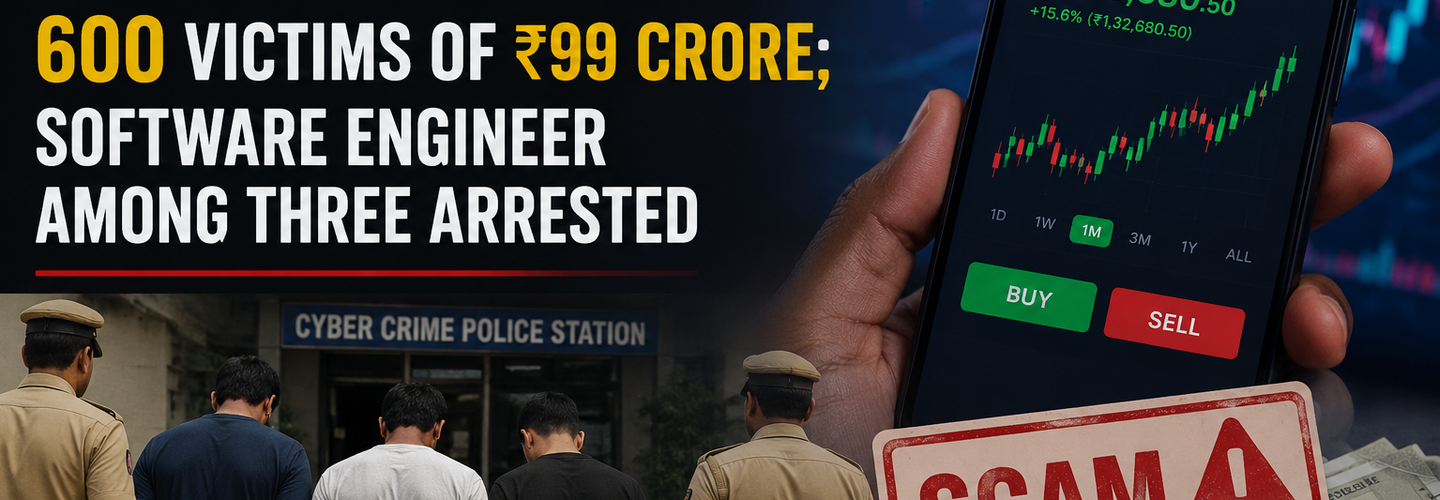
Fake Trading App Scam Swindles 600 Victims of ₹99 Crore; Software Engineer Among Three Arrested
## Fake Trading App Scam Exposed: 600 Victims Lose ₹99 Crore in Elaborate Investment Fraud
In one of the most audacious cybercrime cases to emerge in recent times, a sophisticated fake trading application scam has defrauded more than 600 victims of a staggering ₹99 crore across India. Authorities have arrested three individuals in connection with the fraud, including a software engineer whose technical expertise is believed to have been instrumental in building and operating the deceptive platform.
The case has sent shockwaves through investor communities and once again exposed the alarming rise of online trading fraud in India, where increasingly tech-savvy criminals are using polished apps, fabricated profit dashboards, and psychological manipulation to loot unsuspecting citizens.
## How the Fake Trading App Scam Worked
The scam was meticulously orchestrated and followed a blueprint that has become disturbingly common in cyber fraud cases across India.
Step 1: The Initial Hook
Victims were first approached through social media platforms — primarily WhatsApp, Telegram, Facebook, and Instagram — where fraudsters posed as financial advisors, stock market experts, or representatives of reputed brokerage firms. Many contacts were initiated through fake profiles of well-known investment gurus or celebrities to build instant credibility.
Step 2: Grooming Through Fake Profits
Once victims expressed interest, they were added to exclusive-sounding investment groups. In the beginning, the fraudsters provided seemingly accurate market tips and encouraged small investments. The fake trading app — professionally designed to mimic legitimate platforms — would display fabricated profits and unrealistic returns, sometimes showing gains of 30–50% within days.
This phase was critical. Victims, elated by what they saw as massive returns on their money, were encouraged to invest larger sums. Many victims reinvested their apparent "profits," unaware that the entire dashboard was a sham — the numbers were hardcoded illusions with no actual trading taking place.
Step 3: The Trap Tightens
As victims poured in more money — often convincing their family members and friends to join — the app continued to show astronomical returns. When victims attempted to withdraw their funds, they were told to pay additional charges such as "GST clearance fees," "government taxes," "platform upgrade charges," or "compliance fees." These additional payments were simply further extractions from the same victims.
Eventually, the app went dark. Operators vanished. Customer support numbers stopped responding. The social media accounts were deleted. Victims were left staring at frozen screens and empty bank accounts.
## The Arrests: Software Engineer Was the Architect
Following months of investigation by the Cyber Crime Branch, authorities tracked down and arrested three key operatives behind the fraud. Among them was a software engineer in his late 20s, believed to be the technical brain responsible for designing and maintaining the fake trading application.
The other two arrested individuals allegedly handled the network of agents who recruited victims, managed the fake social media profiles, and processed the fraudulent transactions. Investigators revealed that the gang used shell accounts, crypto wallets, and multiple layers of money mules to launder the proceeds, making it difficult to trace funds.
During raids, police seized mobile phones, laptops, SIM cards, and financial documents that are now being analyzed as part of the ongoing investigation. Officials confirmed that the arrested individuals are being questioned to unravel a potentially wider network operating across multiple states.
## Scale of the Damage: 600+ Victims, ₹99 Crore Lost
The sheer scale of the fraud is staggering. Over 600 victims from various states filed complaints, many of whom invested between ₹5 lakh and ₹50 lakh each. Several victims — including salaried professionals, homemakers, retirees, and small business owners — reported losing their life savings, provident funds, and borrowed money.
Investigations suggest the actual number of victims could be significantly higher, as many defrauded individuals, especially the elderly, often do not report such crimes out of embarrassment or lack of awareness about cybercrime reporting channels.
## Why Are Fake Trading App Scams on the Rise?
India's rapidly growing retail investor base — fueled by post-pandemic interest in stock markets and digital finance — has made it a prime target for such fraud. The Securities and Exchange Board of India (SEBI) has repeatedly warned investors about unregistered investment platforms and fake advisory services, yet the lure of quick returns continues to make people vulnerable.
Cyber fraud experts point to several contributing factors:
- ▸Digital literacy gaps — Many first-time investors cannot distinguish between legitimate SEBI-registered platforms and fake clones.
- ▸Sophisticated app design — Fraudsters now invest in professional UI/UX to create apps that look indistinguishable from real platforms.
- ▸Social proof manipulation — Fake testimonials, WhatsApp group chats with planted "winners," and celebrity endorsements lower victims' defenses.
- ▸Delayed red flags — Initial small profits keep victims engaged long enough to invest larger amounts before the fraud is discovered.
## How to Protect Yourself from Fake Trading App Scams
Authorities and cybersecurity experts urge the public to follow these essential precautions:
Verify SEBI Registration — Always check whether an investment platform or advisor is registered with SEBI at sebi.gov.in before investing.
Avoid unsolicited investment tips — Legitimate brokers do not solicit clients through WhatsApp groups or Telegram channels.
Test withdrawals early — Before investing large sums, try withdrawing a small amount. Scam platforms often block or delay withdrawals.
Be skeptical of guaranteed returns — No legitimate investment guarantees fixed, high returns. If it sounds too good to be true, it is.
Report fraud immediately — File a complaint at the National Cyber Crime Reporting Portal (cybercrime.gov.in) or call Cyber Crime Helpline 1930.
## Authorities Urge Victims to Come Forward
The Cyber Crime Branch has urged anyone who may have been defrauded by similar fake trading apps to come forward and file a complaint. Officials have assured victims that their privacy will be protected and that law enforcement is actively working to recover funds and dismantle such networks.
The investigation remains active, and authorities believe the arrested trio are part of a larger syndicate with possible international connections. Further arrests are anticipated as digital forensics teams continue to analyze the seized devices.
## Conclusion
The ₹99 crore fake trading app scam is a grim reminder of the evolving sophistication of cybercrime in India. As digital investment becomes mainstream, so does the ingenuity of those seeking to exploit it. Awareness, vigilance, and prompt reporting remain the most powerful weapons against such fraud. If you or someone you know has been targeted by a suspicious trading application, report it immediately — and remember, no legitimate investment opportunity promises guaranteed overnight wealth.
More Articles:
Fake Trading App Scam Swindles 600 Victims of ₹99 Crore; Software Engineer Among Three Arrested
Controversy Grows After Cyber Crime Wing Targets Social Media Posts
Suggested Internal Links for ReconShield
## Analyst Commentary & Implementation Blueprint
Security advisory
Continuous security exposure assessment is critical to identifying public vulnerabilities before they are exploited. Organizations should maintain a passive inventory of all web servers, TLS configs, and open ports, ensuring that default configurations are eliminated and security advisories are actively implemented.
Hardened Security Configuration Blueprint
# General Security Hardening Directive
ServerTokens ProductOnly
ServerSignature Off
FileETag None
Actionable Mitigation Checklist
- ✔Perform passive asset inventories weekly.
- ✔Restrict administrative ports using local firewall controls.
- ✔Monitor active CVE alerts for exposed software.
Common Inquiries & FAQs
Why is passive scanning preferred for continuous auditing?
Passive audits do not cause operational impact or trigger firewall blocks, making them ideal for constant surveillance of internet-facing assets.
What should I do if a vulnerability is flagged?
Apply the latest vendor patches, restrict access to the resource via firewalls, or verify configuration flags to mitigate risks.
Surendra Reddy
Surendra Reddy is a cybersecurity researcher and founder of ReconShield, specializing in OSINT and defensive infrastructure analysis.
Connect on LinkedIn ↗// AUDIT BRIEFING DISCUSSION (2 COMMENTS)
Great breakdown of the passive infrastructure vectors. We recently audited our external DNS zones and found multiple dangling staging environments. Implementing wildcard certificates reduced our CT log leaks significantly.
Is there any automated tooling you recommend for daily crt.sh scraping? Manually checking CT logs is becoming unsustainable for our domain portfolio.
// MORE ARTICLES
₹250 Crore Cyber Scam Busted: Gujarat Police Arrest 19, Including MBA Student
Gujarat Police bust a ₹250 crore cyber fraud network, arresting 19 including an MBA student. Here's how the mule account scam worked.

Delhi Police Arrest 916 Suspects in Major Cyber Fraud Crackdown: A Comprehensive Breakdown of Operation CyHawk 5.0
Delhi Police arrest 916 suspects in a major cyber fraud crackdown. See how Operation CyHawk 5.0 worked, the scams uncovered, and how to protect yourself.
Cyber Fraud in Bengaluru: Elderly Woman Loses Rs 7.69 Lakh After Clicking Fake WhatsApp Link
An 86-year-old woman in Bengaluru lost Rs 7.69 lakh to cyber fraudsters after clicking a malicious WhatsApp link in a sophisticated online scam targeting senior citizens.