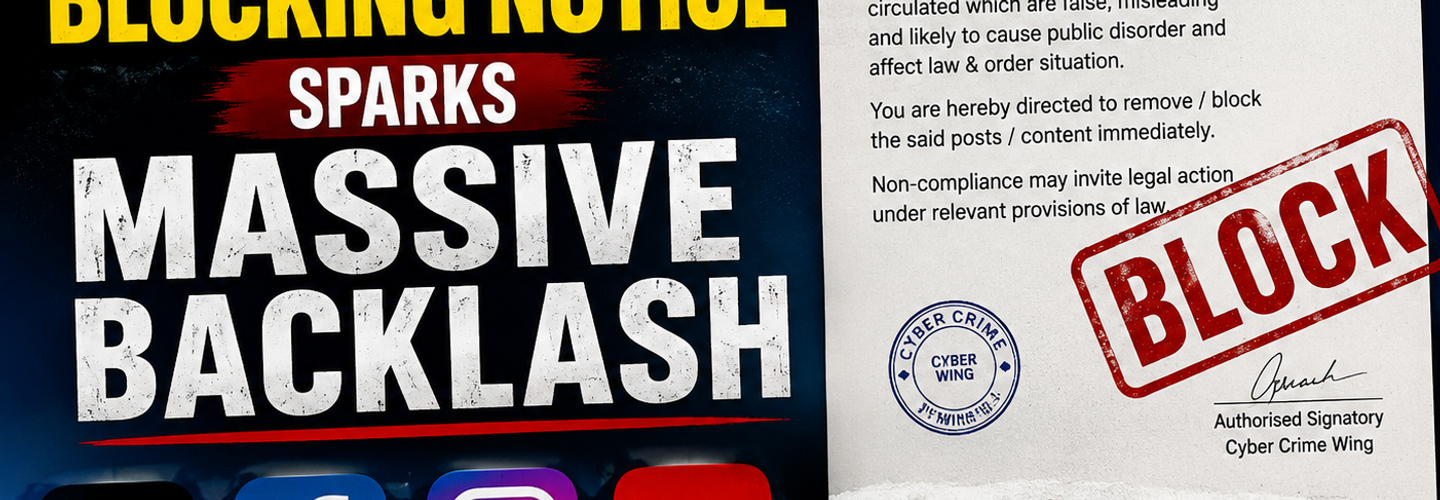
Controversy Grows After Cyber Crime Wing Targets Social Media Posts
## Introduction
A fresh controversy has erupted across India's digital landscape after the Cyber Crime Wing of the police issued formal notices directing the removal and blocking of specific social media posts. The move, which authorities claim is aimed at preventing the spread of misinformation, communal tension, and anti-national content, has been met with sharp pushback from civil society groups, opposition politicians, digital rights activists, and ordinary netizens. Critics argue that the notices represent a dangerous overreach by law enforcement, threatening constitutionally guaranteed freedoms of speech and expression.
## What the Cyber Crime Wing Notice Says
The notices, reportedly issued under the provisions of the Information Technology Act, 2000 — particularly Section 69A — instruct social media platforms including Facebook, Instagram, X (formerly Twitter), and YouTube to take down specific posts flagged by the authorities. The Cyber Crime Wing has stated that the flagged content includes posts allegedly spreading fake news, inciting communal violence, or undermining national security.
According to officials, the action was taken following a surge in complaints received through the National Cyber Crime Reporting Portal (cybercrime.gov.in). Authorities claim they followed due process before issuing the blocking directives, and that the notices are consistent with the legal framework governing digital content in India.
## Why the Notice Has Sparked Backlash
1. Free Speech Concerns
The most immediate and loudest criticism has come from free speech advocates. Digital rights organizations argue that the broad and vague language in the notices gives law enforcement disproportionate power to silence dissent under the guise of preventing cybercrime.
"Blocking social media posts without judicial oversight sets a dangerous precedent," said a statement from the Internet Freedom Foundation (IFF), one of India's leading digital rights organizations. Activists point out that many of the posts targeted appear to be political commentary or citizen journalism — content that should be protected under Article 19(1)(a) of the Indian Constitution.
2. Lack of Transparency
A major grievance is the absence of transparency in the process. Critics note that neither the individuals whose posts were flagged nor the general public are informed about the specific reasons for blocking. This opaque approach, they argue, makes it impossible to challenge the notices through legal channels, effectively denying due process to content creators.
Read: Software-Defined Vehicles Introduce Growing Cybersecurity Challenges for the Auto Industry
3. Misuse of Cybercrime Laws
Opposition parties and legal experts have raised concerns that cybercrime laws are increasingly being misused as tools of political suppression. Several of the flagged posts, according to sources, included coverage of government policy failures and social protests. The weaponization of IT laws against journalists and activists has been a growing concern in India, with multiple cases already under scrutiny in various High Courts.
4. Chilling Effect on Online Expression
Digital freedom watchdogs warn of a wider chilling effect on online expression. When users see posts being taken down without explanation, self-censorship becomes inevitable. Social media users, bloggers, and independent journalists may begin to avoid covering sensitive topics out of fear of legal action — a trend that fundamentally undermines a democratic society's need for open discourse.
## Government's Defence of the Action
Despite the backlash, government officials and police spokespeople have defended the Cyber Crime Wing's decision. They argue that social media has become a breeding ground for misinformation, deepfakes, and coordinated hate campaigns, all of which can have serious real-world consequences, including communal riots, financial fraud, and mob violence.
Officials point to incidents in recent years where viral social media posts led to violence on the ground, stressing that the state has a legal and moral obligation to intervene before harm is done. They also maintain that the actions are targeted and not intended to curb legitimate criticism or political speech.
The Ministry of Electronics and Information Technology (MeitY) has reiterated that blocking orders under Section 69A go through a government committee review before being issued, and are therefore not arbitrary.
## Legal Framework: Section 69A and Its Critics
Section 69A of the IT Act empowers the Central Government to issue directions to block public access to any information online in the interest of national sovereignty, security, friendly relations with foreign states, public order, or prevention of incitement of cognizable offences.
While the Supreme Court upheld the constitutionality of Section 69A in the landmark Shreya Singhal v. Union of India (2015) verdict, it also struck down the vague Section 66A, emphasizing that restrictions on speech must be narrowly tailored and proportionate. Critics argue that the current Cyber Crime Wing notices fail this proportionality test.
Legal experts urge that any blocking notice must be accompanied by the right of appeal and public disclosure of the basis for the takedown — safeguards that remain poorly implemented in practice.
## Social Media Platforms Caught in the Middle
Social media companies are in a difficult position. Under India's Information Technology (Intermediary Guidelines and Digital Media Ethics Code) Rules, 2021, platforms are legally required to comply with government takedown orders within 36 hours for emergency cases. Non-compliance risks heavy penalties or even a ban — a fate that platforms with millions of Indian users can ill afford.
At the same time, global transparency standards and pressure from international users and investors push these companies to resist government overreach. Several platforms have historically published transparency reports disclosing the number of government requests received, providing at least a partial picture of the volume of content regulation occurring.
## Growing Pattern of Online Censorship
This is not an isolated incident. India has seen a steady increase in government-directed content removals over the past several years. According to Google's Transparency Report and Twitter's (now X) government request data, India consistently ranks among the top countries globally requesting content takedowns. The Cyber Crime Wing notice is the latest flashpoint in an ongoing debate about where to draw the line between national security and digital freedom.
## Calls for Reform
Civil society groups and digital rights advocates are now calling for comprehensive reform of the existing legal framework governing online content regulation in India. Key demands include:
- ▸Judicial oversight before any post or account is blocked.
- ▸Mandatory notification to the content creator about takedown orders.
- ▸Clear and specific grounds for blocking rather than broad interpretations of "national security."
- ▸An independent digital ombudsman to handle grievances related to online censorship.
- ▸Regular public disclosure of all blocking orders issued by cybercrime authorities.
## Conclusion
The Cyber Crime Wing's notice to block social media posts has reignited one of the most important debates of the digital age: how to balance the state's legitimate interest in maintaining public order with citizens' fundamental right to free expression. As India's internet user base continues to grow — crossing 900 million users — the stakes of getting this balance right have never been higher.
The controversy underscores an urgent need for transparent, accountable, and rights-respecting mechanisms for content regulation online. Until such frameworks are firmly in place, notices like this will continue to draw criticism — and rightfully so.
Read More:
- ▸APK Malware Hidden in Fake Wedding Invite Drains Bengaluru Man’s Bank Account
- ▸SEBI Expands Cybersecurity Efforts to Counter Emerging AI-Based Financial Threats
Suggested Internal Links for ReconShield
## Analyst Commentary & Implementation Blueprint
Security advisory
Continuous security exposure assessment is critical to identifying public vulnerabilities before they are exploited. Organizations should maintain a passive inventory of all web servers, TLS configs, and open ports, ensuring that default configurations are eliminated and security advisories are actively implemented.
Hardened Security Configuration Blueprint
# General Security Hardening Directive
ServerTokens ProductOnly
ServerSignature Off
FileETag None
Actionable Mitigation Checklist
- ✔Perform passive asset inventories weekly.
- ✔Restrict administrative ports using local firewall controls.
- ✔Monitor active CVE alerts for exposed software.
Common Inquiries & FAQs
Why is passive scanning preferred for continuous auditing?
Passive audits do not cause operational impact or trigger firewall blocks, making them ideal for constant surveillance of internet-facing assets.
What should I do if a vulnerability is flagged?
Apply the latest vendor patches, restrict access to the resource via firewalls, or verify configuration flags to mitigate risks.
Surendra Reddy
Surendra Reddy is a cybersecurity researcher and founder of ReconShield, specializing in OSINT and defensive infrastructure analysis.
Connect on LinkedIn ↗// AUDIT BRIEFING DISCUSSION (2 COMMENTS)
Great breakdown of the passive infrastructure vectors. We recently audited our external DNS zones and found multiple dangling staging environments. Implementing wildcard certificates reduced our CT log leaks significantly.
Is there any automated tooling you recommend for daily crt.sh scraping? Manually checking CT logs is becoming unsustainable for our domain portfolio.
// MORE ARTICLES
Security Researchers Warn Critical n8n Flaws May Expose Automation Platforms to RCE
Researchers have disclosed critical vulnerabilities in n8n that could expose automation workflows and connected enterprise systems to remote code execution risks, prompting urgent patch recommendations for users and administrators.

How Agentic AI Is Changing Software Engineering and Expanding Mobile Attack Surfaces
Agentic AI is rapidly transforming software engineering workflows through automation and intelligent coding assistance, while cybersecurity experts warn of expanding mobile attack surfaces and emerging application security risks.

Critical Tenda Router Backdoor (CVE-2026-11405): Check If Your Device Is Vulnerable Now
CVE-2026-11405 is an unpatched Tenda router backdoor granting full admin access without a password. Check if your model is affected now.